
Book Appointment Now

GC INDUS / MANUFACTURING KNOWLEDGE
5 Lean Manufacturing Principles Every Machine Shop Needs

Machine shops cut waste and boost output by adopting five lean manufacturing principles: mapping value from the customer’s perspective, tracking the value stream to expose non-value-add steps, creating continuous flow between machining and inspection stages, using pull systems tied to actual demand, and pursuing ongoing improvement through operator-led kaizen. Applied to precision machining, these principles target changeover time, scrap rates, and inventory of raw stock or fixtures, without loosening tolerance or inspection standards.

1. Identify Value From the Customer’s Perspective
Value is whatever the customer pays for, a conforming, inspected part delivered on time, not the machine hours or labor spent making it.
This is the starting point among lean manufacturing principles because it forces a shop to separate activity from outcome. A part that runs perfectly on a CNC mill but misses a drawing callout or ships late has produced zero value, regardless of how efficient the machining cycle looked on paper.
This principle matters most for shops juggling multiple part numbers, revision levels, or customer-specific inspection requirements, where priorities blur and the loudest job on the floor wins attention instead of the one the customer actually needs. Defining value up front realigns quoting and scheduling around what the buyer cares about rather than shop convenience.
Where most generic lean guides stop at “value equals what the customer wants,” precision shops need to go further: value has to be tied to the specific inspection and documentation requirements attached to the part, first article inspection reports, material certs, CMM data, not a generic notion of a finished good. A part without its paperwork isn’t done, even if it’s dimensionally perfect.
2. Map the Value Stream to Expose Hidden Waste
Value stream mapping traces a part’s entire path from raw stock to shipment, revealing exactly where time and material get lost along the way.
For a machine shop, that path typically runs: material receipt, programming, setup, machining, deburring, inspection, and packaging. Walking this sequence with real time stamps, not estimates, shows where a part actually sits versus where it’s actually being worked.
How Do You Identify and Eliminate the Seven Wastes in a Machine Shop?
The seven wastes, a core concept in lean manufacturing principles, take on specific forms on a shop floor. Overproduction looks like running parts ahead of the schedule just to keep a machine busy. Waiting shows up as parts sitting in queue for inspection. Excess inventory means work-in-process piling up between operations. Unnecessary transport is tool or fixture movement across the shop. Over-processing is holding a surface finish tighter than the print requires. Defects mean scrap and rework. Motion waste comes from an operator walking across the floor for a tool that should be at the workstation.
Mapping the full process, not just the machining step, is what surfaces these wastes. Most overviews of lean manufacturing principles focus on the cutting operation itself, but in practice the biggest bottleneck is often queue time at CMM inspection, not the machining cycle. A part can run in four minutes and then wait four hours for a CMM slot, and that wait never shows up if a shop only measures machine utilization.
This exercise is most valuable for shops with multiple work centers, CNC, EDM, grinding, inspection, and long routing paths between them, where handoffs are where time actually disappears.
3. Create Continuous Flow Between Operations
Continuous flow means redesigning the physical path between machining, deburring, and inspection so parts move with minimal stops, travel, or handling.
A cell-based layout groups the machines and processes a part family needs into one physical area, versus a department-based layout where all mills sit in one zone, all inspection in another, and parts travel between them on carts. Proximity cuts part travel distance and reduces the handling damage risk that comes with moving precision components across a shop floor repeatedly.
The benefit is a shorter cycle time from first cut to shipment, achieved without buying another machine, just by rearranging how work moves. This suits shops running repeat or family-of-parts production, where the same routing happens often enough to justify a dedicated cell; pure one-off prototype work rarely has enough volume to make cell redesign worthwhile.
What most discussions of flow skip: the real flow-killer usually isn’t machine speed, it’s changeover time, swapping fixtures, tooling, and programs between jobs. Applying SMED-style changeover reduction (single-minute exchange of die) to fixture setups often cuts more cycle time than any spindle upgrade would.
4. Apply 5S to the Shop Floor
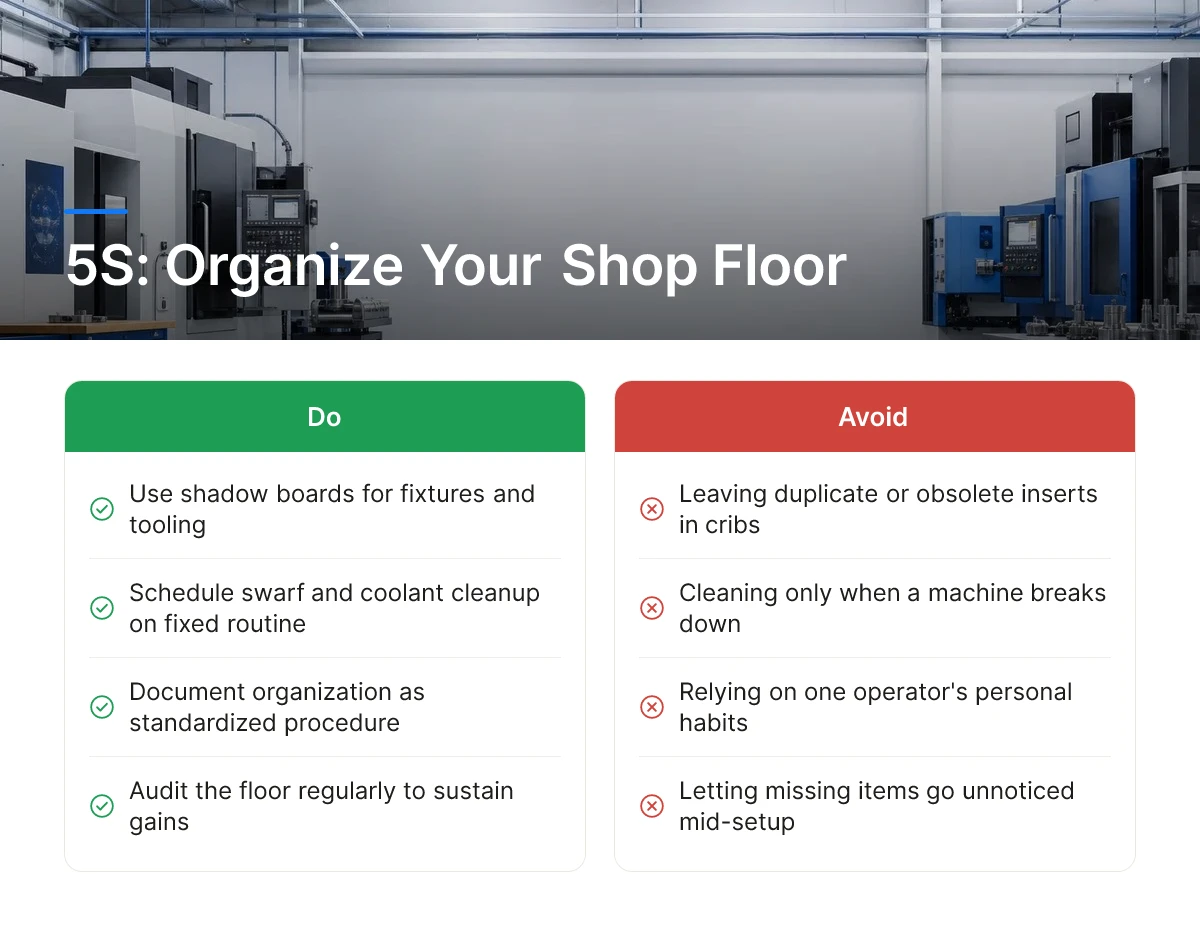
5S, Sort, Set in order, Shine, Standardize, Sustain, organizes tools, fixtures, and work areas so every item has a place and every deviation is visible.
What Are the 5S and 7 Wastes, and Why Do They Matter for Cycle Time?
Sort means clearing tool cribs of duplicate or obsolete inserts and fixtures. Set in order means shadow boards for fixtures and tooling, so a missing item is obvious at a glance instead of discovered mid-setup. Shine means swarf and coolant cleanup on a fixed schedule, not only when a machine breaks down. Standardize turns that cleanup and organization into a documented routine rather than one operator’s habit. Sustain means auditing the floor regularly so the first four don’t decay over a few busy weeks.
5S connects directly to the seven wastes covered above, a disorganized tool crib creates motion waste, and a dirty fixture creates defects. In precision work, 5S isn’t about tidiness for its own sake: swarf or coolant residue on a fixture or gauge surface during setup or inspection can throw off a measurement or contaminate a bore, producing an out-of-tolerance part that looked fine on the machine.
5S is the lowest-cost, fastest-to-implement of the lean manufacturing principles, which makes it the right starting point for shops adopting lean for the first time, it requires discipline more than capital. One link generic lean guides rarely make: 5S sustainment checklists map almost directly onto ISO 9001 internal audit requirements, so a shop building 5S routines is also building documentation it needs for recertification.
5. Use Pull Systems and Kanban for Material and Work Scheduling
Pull systems trigger replenishment of raw stock, tooling, or the next job based on actual downstream consumption, not a forecast or a production push.
In a machine shop, kanban applies well to bar stock and cutting tool inserts: a bin of material or tooling gets reordered when it hits a set level, instead of the shop pushing large batches through based on projected demand that may shift. Lean manufacturing principles treat this as a direct lever against overproduction, the shop only makes or orders what the next step actually needs.
The benefit shows up on the balance sheet: less capital tied up in bar stock, inserts, and work-in-process sitting on shelves between operations. This model fits shops with recurring production runs or blanket purchase orders, where consumption patterns are predictable enough to set reorder points; pure prototype shops, by contrast, rarely have the repeat volume to make kanban worth the setup.
A wrinkle most lean overviews miss: pull systems have to flex around low or flexible minimum order quantities, since machine shops, unlike discrete assembly lines, can’t always batch production to smooth out demand. GC INDUS, for instance, accepts orders starting from 1 piece, which means pull-based scheduling has to work alongside single-piece and small-batch jobs rather than assuming steady, batchable volume throughout.
6. Build Continuous Improvement Into Daily Operations (Kaizen)
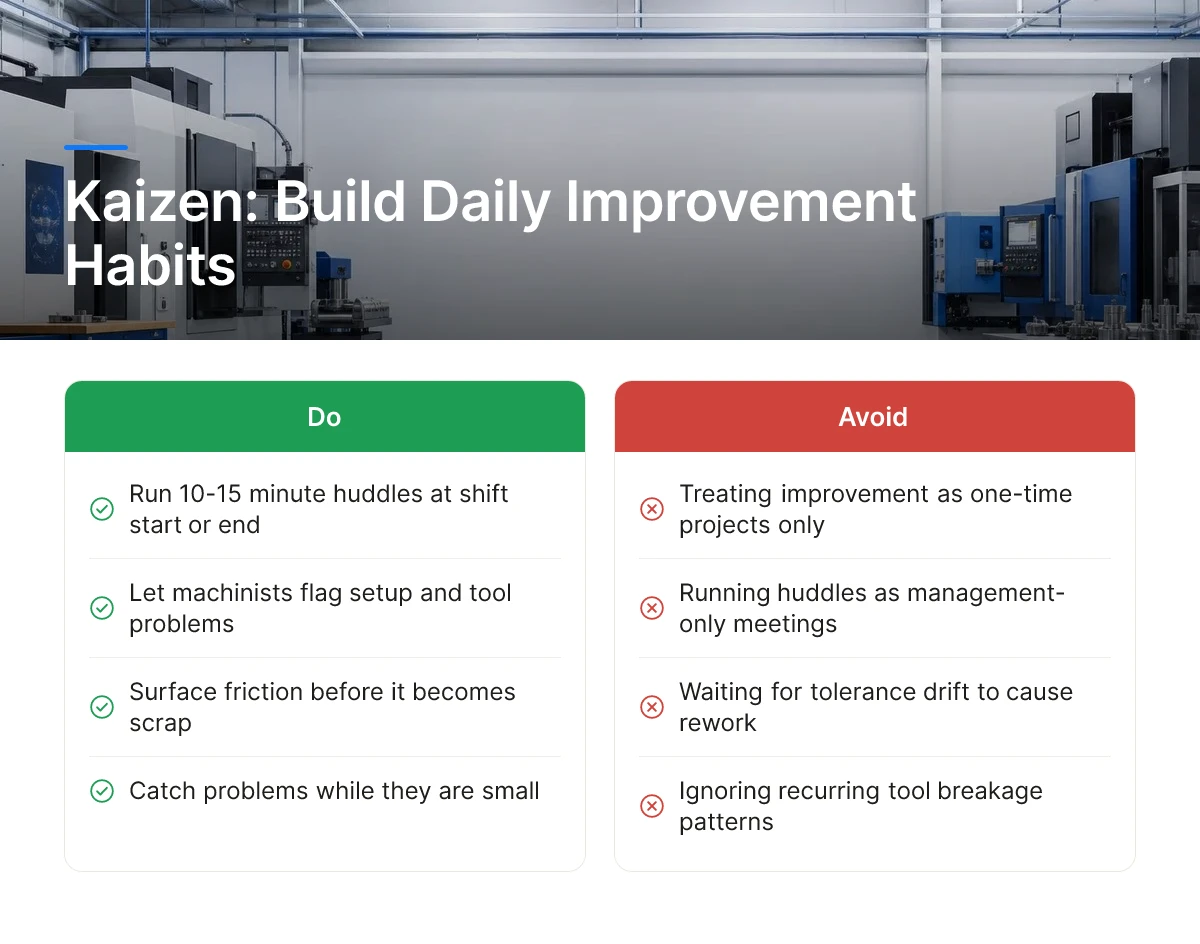
Kaizen turns lean manufacturing principles into a daily habit rather than a one-time project, using short operator-led huddles to catch problems while they are small.
A typical kaizen routine is a 10-15 minute huddle at shift start or end, where machinists flag recurring setup problems, tolerance drift on a specific fixture, or a tool that keeps breaking early. These are not management meetings, they are run by the people standing at the machine. The goal is to surface friction before it becomes scrap or a missed delivery date.
The benefit compounds. A single value stream mapping project might cut cycle time once, but kaizen generates a steady stream of smaller fixes, a regripped vise, a relabeled bin, a revised work instruction, that stack on top of each other month after month. Shops that already completed an initial 5S and flow pass get the most from kaizen because the groundwork for standardized work is in place; without that baseline, huddles tend to surface the same organizational complaints every week instead of process-specific ones.
The differentiator is a visible tracking board, physical or digital, where every kaizen suggestion gets logged, assigned, and marked done. Operators who see their own suggestion move from “proposed” to “fixed” keep contributing. Top-down lean mandates without this feedback loop tend to lose participation within a few months.
How Do You Handle Employee Resistance and Cultural Change During a Lean Transformation?
Resistance usually drops when operators see their suggestions acted on quickly rather than filed away, the tracking board does double duty as both a work queue and proof that management is listening. Pairing kaizen with respect for the people doing the work, not just the tools, is one of the two pillars lean practitioners point to when transformations stick.
7. Roadmap: How to Roll Out Lean Manufacturing Principles Step by Step
Start with one pilot cell, measure before and after with real numbers, and expand only once the gains hold for 60 to 90 days.
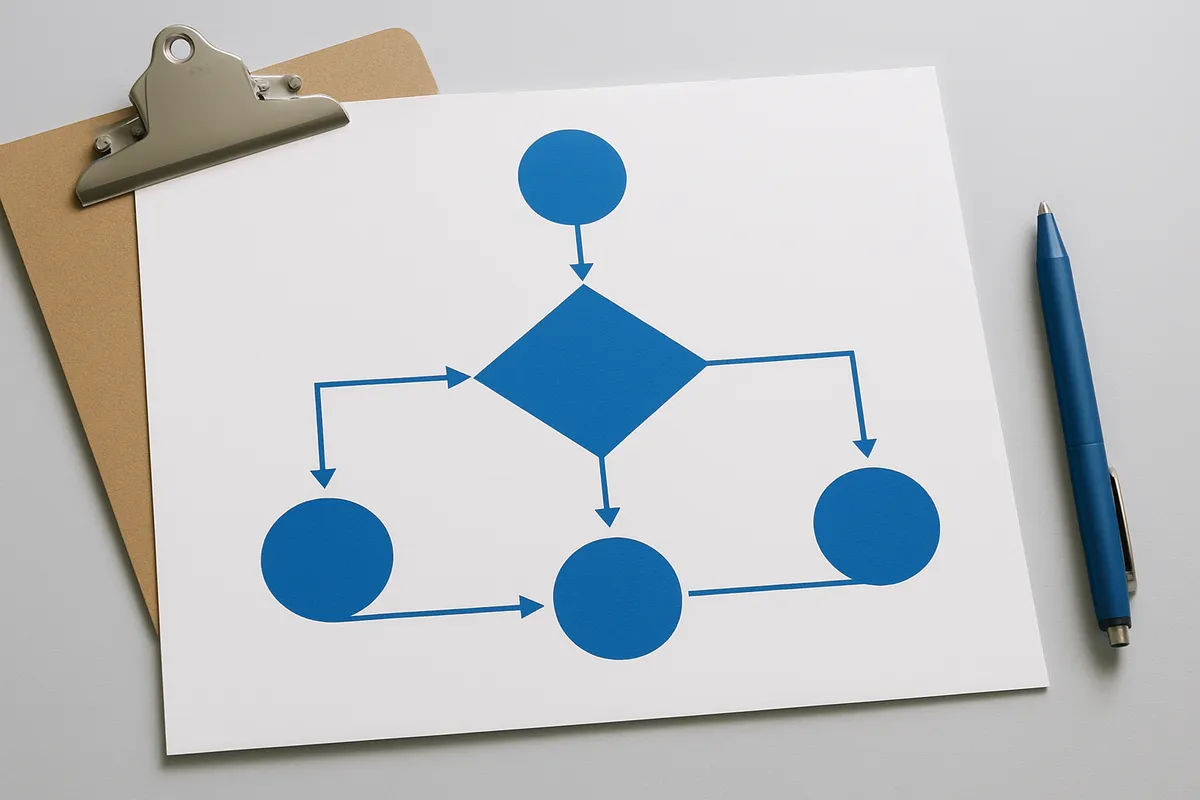
Phase 1 picks a single work cell or part family, not the whole shop floor, and runs 5S plus a basic value stream map before any capital is spent on new equipment or software. This keeps the pilot cheap and reversible if the first attempt misses the mark. Mapping the value stream means tracing every step material and information take from raw stock to shipped part, flagging anything that does not add value the customer is paying for.
Phase 2 measures baseline cycle time and scrap rate before touching the process, then re-measures after 60-90 days. Without a baseline, it is impossible to say whether changes actually worked or whether output shifted for unrelated reasons.
What Does a Practical Lean Deployment Timeline Look Like for a Shop New to These Principles?
Tool crib organization and changeover time reduction typically show results fastest, often within the first month, because they require no new equipment, just discipline in how tools are stored and how setups are sequenced. These quick wins build the internal case for expanding lean manufacturing principles to the next cell.
When Should a Machine Shop Choose Lean Over Six Sigma or Theory of Constraints?
Lean targets flow and waste, motion, waiting, overproduction, while Six Sigma targets variation reduction in a process that already flows reasonably well. Shops with tolerance-driven defects, where parts drift out of spec intermittently rather than suffering from long queues or excess handling, often get more value combining the two than picking one. Theory of Constraints adds a lens for identifying which single bottleneck machine or step limits total throughput, useful once flow improvements plateau.

8. Track the Right Metrics to Prove Lean Is Working
Five KPIs, first-pass yield, scrap/rework rate, changeover time, on-time delivery rate, and raw stock inventory turns, show whether lean changes are paying off.
First-pass yield and scrap/rework rate reveal whether quality improved or just moved downstream. Changeover time tracks whether setup reduction work actually stuck. On-time delivery rate and inventory turns on raw stock show whether flow improvements reduced the cash and time tied up in work sitting idle.
Calculate the payoff qualitatively rather than quoting a invented percentage: compare the labor and material cost tied up in rework and idle machine time before changes against the same cost after changes, over a comparable production volume. If rework hours drop and machines run more of their scheduled time cutting parts instead of waiting on tooling or inspection, the initiative is working, the dollar figure follows from your own labor rates and overhead, not a generic benchmark.
This approach suits shops reporting results to ownership or to customers asking for evidence that lean manufacturing principles are more than a slogan on the wall. The differentiator: these metrics already exist inside most quality systems. Inspection reports and nonconformance logs required under ISO 9001 already capture first-pass yield and scrap data, so tracking lean progress adds minimal new paperwork, it reuses records a certified shop keeps anyway. GC INDUS runs ISO 9001 and ISO 13485 quality systems across its CNC, casting, and molding lines, which is the same reason inspection data doubles as lean performance data rather than a separate reporting burden.
How to Choose Which Lean Manufacturing Principles to Start With
Match the starting principle to the specific symptom: search time points to 5S, queue delays point to value stream mapping and flow.
If machinists spend visible chunks of each shift hunting for tools, fixtures, or gauges, start with 5S, sort, set in order, shine, standardize, sustain. If the bigger problem is parts piling up ahead of inspection or sitting between operations, start with value stream mapping to find where flow breaks down before tackling anything else.
Can Lean Manufacturing Coexist With Tight Tolerance Requirements Without Compromising Quality?
Yes, lean targets non-value-add steps like waiting, motion, and overproduction, not inspection rigor itself. A ±0.001mm tolerance requirement and lean manufacturing principles coexist as long as quality checks stay built into the process rather than getting cut to save time. GC INDUS holds tolerances to ±0.001mm across CNC milling, turning, and 5-axis work while keeping full inspection protocols in place, which is the practical version of this balance: cut the waiting and rework, not the checking.
How Do Digital Tools and Data Analytics Enhance Lean Manufacturing Practices?
Shop floor data collection and machine monitoring software make cycle time, scrap, and downtime visible in real time instead of relying on end-of-shift paper logs. That visibility feeds kaizen huddles with current data rather than memory, which speeds up decisions on what to fix next.
Part mix matters too. A shop running high-repeat production benefits most from pull systems and kanban, since steady demand makes replenishment signals reliable. A one-off prototype shop, closer to GC INDUS’s own model of accepting orders from a single piece, should weight flow and 5S higher and pull/kanban lower, since each job may differ too much for a standard replenishment signal to apply.
Frequently Asked Questions
What is the history and origin of lean manufacturing principles?
Lean manufacturing grew out of the Toyota Production System, developed in Japan after World War II. The five core principles, value, value stream, flow, pull, and perfection, were later codified by Womack and Jones in their book “The Machine That Changed the World”. Toyota built the system to compete with Western mass production using far fewer resources, which forced a focus on eliminating anything that didn’t serve the customer.
What are the key elements of the Toyota Production System that translate to precision manufacturing?
Toyota’s system rests on three operating rules that apply directly to machine shops: produce only what’s needed, correct abnormalities immediately, and let operators improve their own processes. For a CNC shop, that means machining to actual order demand rather than batch forecasts, stopping a line the moment a part drifts out of tolerance, and having machinists, not just engineers, flag process fixes. Lean also pushes beyond just-in-time inventory control by cutting cycle time and flow time across the whole shop, not just the stockroom.
What are the 5 principles of lean manufacturing versus the 7 wastes, which framework fits machine shops best?
The 5 principles (value, value stream, flow, pull, perfection) give you a sequence to follow; the 7 wastes give you a diagnostic checklist. Machine shops benefit from using both, the 5 principles to structure a lean rollout and the 7 wastes (overproduction, waiting, transport, over-processing, inventory, motion, defects) to audit a specific cell or machine for inefficiency. Start with the 5 principles if you’re building a program; use the 7 wastes when you’re troubleshooting a bottleneck.
What are the first quick wins and early milestones in a lean implementation?
Early wins come from mapping one value stream and fixing its worst bottleneck, usually changeover time or work-in-progress buildup. A first milestone is reducing one machine’s setup time or clearing excess inventory from a single cell. Pick a single part family, measure before and after, then expand what works to the rest of the floor.
What real-world examples exist of machine shops successfully implementing lean principles?
Machinists apply lean by defining customer value upfront, tolerance, timeline, and price point, before committing a job to the shop floor. From there, shops map the value stream from raw stock to finished part, then restructure machine layout and scheduling to create continuous flow instead of batch-and-queue production. GC INDUS applies this same logic across CNC, die casting, and assembly lines, using full inspection protocols at each stage to catch defects before they move downstream rather than at final QC.
Conclusion
Lean manufacturing succeeds in a machine shop when it’s treated as a sequence, not a toolkit: define what the customer actually values, map how a part moves through your shop today, then attack whichever of the 7 wastes is slowing that flow. Start small, one value stream, one bottleneck, measured before and after, rather than rolling out 5S and Kanban shop-wide on day one. Shops that combine this discipline with tight inspection protocols at every stage, the way GC INDUS does across CNC, casting, and assembly, cut rework without sacrificing the tolerances precision parts demand. Your next step: pick one part family, map its current value stream on paper, and time every step that doesn’t involve a tool touching metal.
Recommended Articles
Explore more from our content library:


