
Book Appointment Now

GC INDUS / MANUFACTURING KNOWLEDGE
5 Signs You Need Custom Precision Machining Services

Your manufacturing operation needs custom precision machining services when internal signals—not vendor marketing—tell you in-house capacity can’t keep up. Five signs stand out: recurring tolerance failures or rework, order volumes that outpace machine or staff capacity, requests for materials or geometries your shop can’t handle, lead times slipping past customer deadlines, and quality audits flagging inconsistent inspection records. When two or more of these appear together, the cost of staying in-house usually exceeds the cost of outsourcing.

1. Recurring Tolerance Failures or Rework on Finished Parts
Rising scrap and rework on the same part families means your equipment or process has hit a capability ceiling, not that an operator made a one-time mistake. This is particularly relevant for custom precision machining services.
When the same feature, a bore diameter, a flatness callout, a thread pitch, fails inspection across multiple production runs, the pattern points to a systemic gap. A single bad part is an error. Three bad batches of the same part is a capability limit.
What Does ±0.001mm Tolerance Mean in Practice, and Why Does It Matter?
Holding tolerances to ±0.001mm requires machine rigidity, temperature-stable shop environments, calibrated tooling, and metrology equipment capable of measuring at that resolution. General-purpose 3-axis mills and shops without climate control or coordinate measuring machines will drift out of spec even when the program is correct, because thermal expansion and tool wear introduce variation the equipment can’t detect or compensate for.
This is the clearest trigger for custom precision machining services: operations making medical, aerospace, or other tightly-toleranced components can’t absorb a quality escalation from a customer who receives an out-of-spec batch.
Most comparisons stop at machine age, but a shop can own a brand-new five-axis CNC and still fail tolerance checks if it lacks documented in-process inspection. GC INDUS holds tolerances as tight as ±0.001mm because every job runs through first-article and in-process checks, not just a capable machine, the inspection protocol is what prevents drift from reaching the customer.
2. Order Volume Is Outpacing Machine and Workforce Capacity
When backlog grows faster than you can add shifts or machines, the bottleneck is capacity math, not a planning failure.
Every CNC machine has a finite number of productive hours per day, and changeover time between jobs eats into that further. Once your order book exceeds available machine-hours, orders queue regardless of how well you schedule them.
What Production Volume Thresholds Make Outsourcing More Cost-Effective?
There’s no fixed number, it depends on part mix and changeover frequency, but the signal is consistent: once overflow work would require a new machine purchase, a new hire, and months of training lag just to catch up, outsourcing the excess becomes the faster path. A capital equipment purchase can take months to spec, install, and staff before it produces a single conforming part.
This situation fits operations seeing seasonal demand spikes or a new contract win that pushes volume past current shift capacity. Rather than overbuild for a peak that may not repeat, routing overflow to a partner with spare capacity keeps core production in-house while absorbing the spike. When considering custom precision machining services, this point stands out.
Flexible minimum order quantity matters here. A partner that only accepts large production runs forces you to either turn away the overflow or commit to inventory you don’t need. GC INDUS accepts orders starting from a single piece, which lets a manufacturer offload a short-run spike without restructuring its own production plan around it.
3. Your Shop Can’t Handle the Materials or Geometries Customers Request
If incoming RFQs call for materials or shapes your current tooling can’t produce, that gap, not your labor rate, is costing you the bid.
Specific capability gaps show up repeatedly: titanium or Inconel machining that demands different cutting speeds and tooling than aluminum or mild steel, thin-wall parts prone to deflection under standard clamping, and multi-axis contours that a 3-axis mill simply cannot reach in a single setup. Each of these requires equipment and process knowledge that general-purpose shops often don’t carry.
How Do You Identify Capability Gaps That Signal It’s Time to Partner With a Precision Service Provider?
Surface finish requirements compound the problem. Anodizing, passivation, and specific Ra values frequently require outside processing even when the cutting itself happens in-house, which means a part can be dimensionally correct and still fail a spec sheet.
This situation is most common for operations expanding into new industries, medical or aerospace, where part specs exceed the tooling and finishing processes built for commodity work.
The most reliable diagnostic isn’t a capability list, it’s your own quote history. Pull your last ten lost or redesigned quotes and check how many failed because of material or geometry limits rather than price. That pattern tells you exactly where a custom precision machining services partner would close the gap, and GC INDUS covers CNC milling, turning, 5-axis, Swiss lathe, EDM, and wire cutting across aluminum, magnesium, steel, and stainless steel specifically to close gaps like these.
4. Lead Times Are Slipping Past Customer Deadlines
Slipping deadlines usually trace back to queue depth and shift limits compounding on urgent orders, not a drop in machine capability.
A single-shift operation with a full queue has no slack to absorb a rush order without delaying everything already scheduled. The delay compounds because every urgent job pushes the rest of the queue back, and the gap between quoted lead time and actual delivery widens with each new rush request. For those exploring custom precision machining services, this matters.
How Do You Assess Whether a Provider Can Consistently Meet On-Time Delivery Requirements?
Benchmark a potential partner by comparing their stated rush and standard lead times against your own current average turnaround, not just against their marketing copy. If their standard lead time beats your rush lead time, that’s a real capacity gap worth acting on.
This is most relevant for operations whose customers have started requiring expedited or just-in-time delivery commitments, a shift in customer expectations that a single-shift shop often can’t match without outside help.
Verify delivery claims the same way you’d verify a reference check: ask for sample order tracking data or speak with existing clients about actual turnaround, not quoted turnaround. A quoted lead time is a promise; a tracked order history is proof. GC INDUS backs on-time delivery commitments with full inspection protocols and a base of 300+ client companies that can be checked against for delivery reliability.

5. Quality Audits or Certifications Expose Gaps in Your Process
A failed or marginal audit means your documentation trail, not just your parts, is now a liability with regulated customers.
Customers in medical, aerospace, and automotive supply chains increasingly require ISO 9001 or AS9100 compliance upstream before they’ll place an order at all. When your shop can’t produce the paperwork, calibration records, inspection reports, traceability documents, the audit fails even if the physical parts are within spec.
How Do AS9100 and ISO 9001 Certifications Affect the Quality Guarantees You Should Demand?
A credible manufacturing partner should already run first-article inspection, in-process dimensional checks, and final inspection reports as standard practice, not as a special request. These records are what let a regulated customer trace a part back through its full production history if a field failure ever occurs.
This gap hits hardest for operations supplying regulated industries facing stricter supplier audits, a single missing calibration certificate can disqualify an otherwise qualified shop. This directly impacts custom precision machining services outcomes.
What most competitor content misses: certification gaps cost you before quality problems ever reach production. Procurement teams screen out non-certified suppliers at the RFQ stage, so the lost business never shows up as a quality complaint, it shows up as a bid you never won. GC INDUS holds ISO 9001 and ISO 13485 certifications specifically so medical device and regulated-industry customers can verify compliance before committing to an order, closing that gap at the quoting stage rather than after a failed audit.
6. Preparing Designs and Specifications for a Custom Precision Machining Service
A clean handoff package, correct file formats, clear tolerances, and finish callouts, is what separates a same-day quote from a week of email back-and-forth.
Send native CAD files alongside a neutral format like STEP, plus a 2D drawing that specifies material grade, critical tolerance callouts, surface finish, and any required certifications. Missing any one of these forces the shop to guess or stop and ask, which adds days to the quote cycle before machining even starts.
How Can You Optimize CAD Files to Reduce Costs Without Compromising Precision?
Mark only the features that truly require tight tolerances. Tolerancing every dimension to ±0.001mm when only two surfaces are functionally critical forces extra setups, slower cycle times, and more inspection, all billed into the part price. Relaxing non-critical dimensions to standard shop tolerances, and consolidating features that can be machined in one setup, lowers outsourced cost without touching the part’s function.
Clear GD&T callouts matter as much as the tolerance values themselves. Ambiguous or missing datums are one of the most common reasons quotes stall, since the machinist has to interpret intent rather than execute a spec. This step is best suited for engineering teams preparing their first handoff to an external partner: a well-documented package signals to any custom precision machining services provider that the project is quote-ready, not a design still in flux.
7. Choosing Between an Online Machining Platform and a Regional Partner
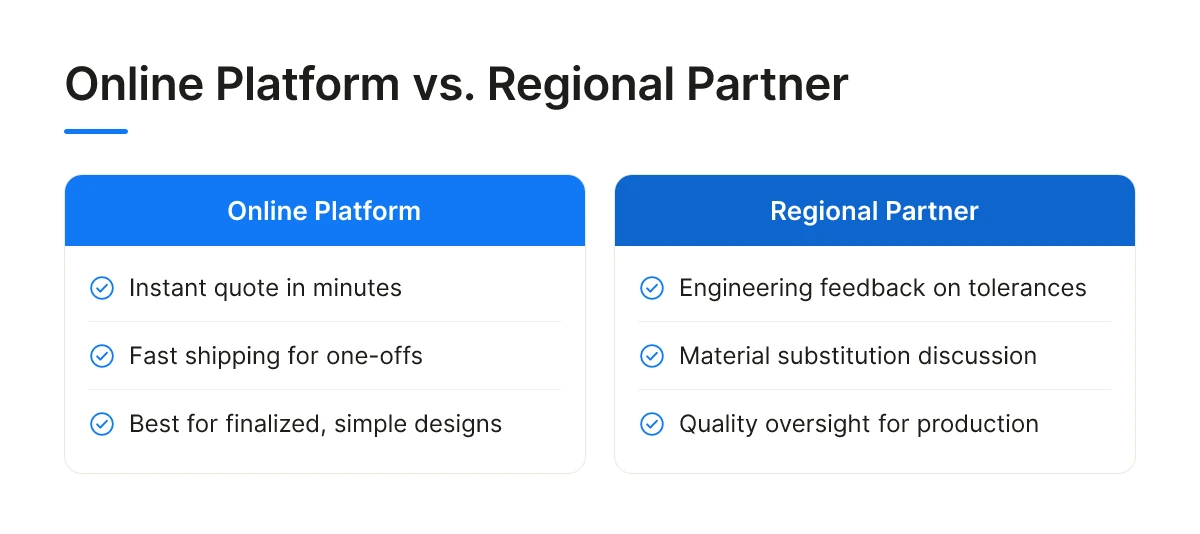
Online platforms win on speed for simple one-off parts; regional partners win on collaboration and quality oversight for ongoing production.
Instant-quote platforms upload a file, return a price in minutes, and ship fast, useful when a design is finalized and complexity is low. What they typically don’t offer is engineering feedback on a borderline tolerance, a phone call to discuss a material substitution, or a walk-through of the shop floor before a quality audit.
How Do Geography, Communication, and Relationship Depth Affect Your Choice of Service Model?
A regional or dedicated partner changes the equation once a part moves from prototype to production. Being able to visit the shop floor, review first-article inspection results in person, and build a working relationship with the same engineering contact reduces the risk of repeat quality escapes. Geography also affects shipping cost and communication lag, a partner in a distant time zone can turn a same-day question into a two-day delay. This is particularly relevant for custom precision machining services.
This decision is best suited for teams weighing a quick prototype order against a longer production commitment. For a single bracket needed next week, an online platform is fine. For a part that will run for years and needs design-for-manufacturability input, a dedicated relationship, the kind GC INDUS builds with its 300+ client base across CNC, casting, and molding, tends to hold up better over time.
8. In-House Capacity Upgrade vs. Outsourcing: Calculating the True Cost
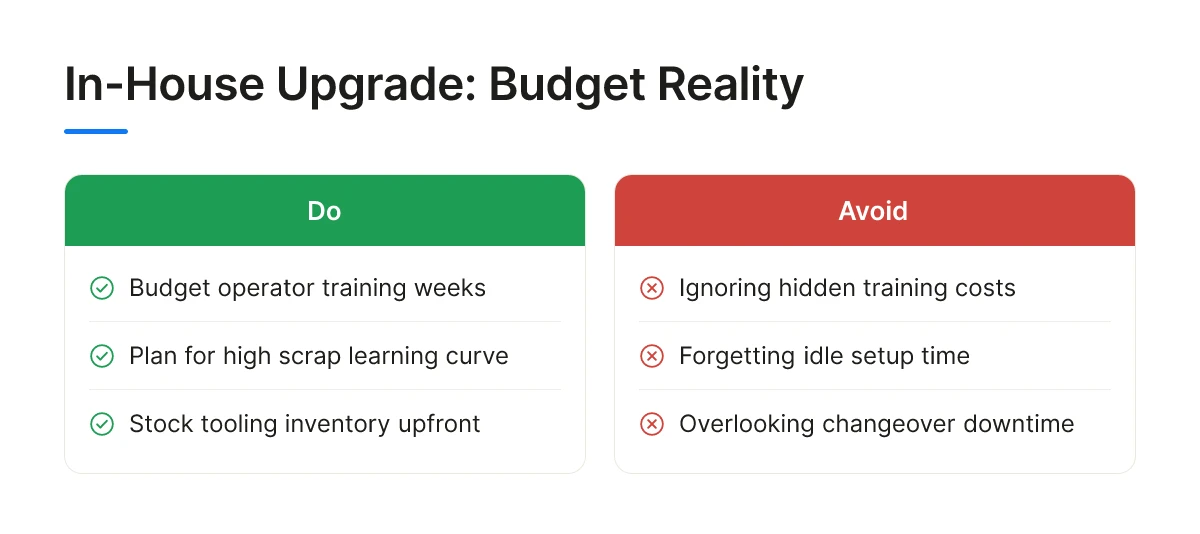
Comparing a new machine’s price tag to a vendor’s quote ignores the hidden costs that usually decide which option is actually cheaper.
Buying new CNC equipment means budgeting for more than the machine itself. Operator training takes weeks before output is reliable, scrap rates run high during the learning curve, tooling inventory has to be stocked, and the machine sits idle during setup and changeover, all real costs that rarely appear in the initial capital request.
How Do Volume Commitments and Long-Term Partnerships Typically Affect Pricing?
Outsourcing shifts that fixed capital cost into variable, per-part or per-project pricing. Simple geometries in standard materials land in a budget-friendly tier, while tightly toleranced parts in difficult alloys or regulated industries sit closer to premium pricing, reflecting the inspection and setup time involved, not arbitrary markup.
Volume commitments or multi-year partnerships typically move pricing toward more favorable per-part rates, since the supplier can plan tooling and scheduling around predictable demand. This comparison is best suited for operations facing an equipment replacement decision this budget cycle: if the part mix is low-volume or specialized, the true cost of in-house capacity, downtime, training, scrap, often outweighs outsourcing to a partner already running the equipment at scale.
How to Choose the Right Custom Precision Machining Service Partner
Score candidates against a fixed checklist, certifications, inspection protocols, materials supported, MOQ flexibility, and lead time history, before signing anything.
Confirm which quality certifications a provider holds and ask for documented inspection protocols, not just a verbal assurance. ISO 9001 covers general quality management; ISO 13485 is required if the part feeds a medical device program. Check that the shop’s process list, CNC milling, turning, 5-axis work, die casting, injection molding, actually matches the part’s geometry and material, and confirm minimum order quantity flexibility if the project will start small. When considering custom precision machining services, this point stands out.
Weight these factors differently depending on the trigger. Overflow capacity needs favor lead time track record above all else. A new capability gap favors process breadth and engineering collaboration. Quality system support, audits, documentation, traceability, favors certifications and inspection rigor over speed.
Before committing to a volume agreement, request a sample part or small trial order. It’s the fastest way to verify that quoted tolerances hold up in practice. Expect pricing to track qualitatively with complexity: budget-friendly for simple prototypes, premium for tightly toleranced parts in regulated industries. A provider like GC INDUS, holding both ISO 9001 and ISO 13485 with tolerances to ±0.001mm and MOQs from 1 piece, illustrates the kind of profile this checklist is built to identify among custom precision machining services.

Frequently Asked Questions
What’s a realistic cost breakdown for custom precision machining, and where do most expenses concentrate?
Machine time, tooling, and setup typically drive the bulk of per-part cost, followed by material and finishing. Complex geometries, tight tolerances, and low-volume runs push setup and programming costs higher per unit because they can’t be spread across a large batch. Material grade and secondary processes like heat treatment or surface finishing add a smaller but predictable share. Ask for a cost breakdown by operation, not just a lump-sum quote, so you can see which decisions actually move the price.
Which metals and plastics should you specify based on your application and cost constraints?
Match material to load, environment, and budget: aluminum for lightweight structural parts, stainless steel for corrosion resistance, and engineering plastics for low-cost, non-structural components. Medical and automotive applications often require certified alloys or biocompatible plastics regardless of cost. GC INDUS machines and casts aluminum, magnesium, iron, steel, and stainless steel, so material choice doesn’t have to limit process selection. When budget is tight, ask whether a lower-cost alloy meets the same functional spec before defaulting to premium material.
What measurable improvements in quality, lead time, or cost have manufacturers achieved after switching to a specialized machining partner?
Buyers typically report fewer out-of-tolerance rejects, shorter lead times, and lower total cost once rework and expediting fees drop out of the equation. Specialized partners with in-process inspection catch deviations before parts leave the shop, which is the main lever behind those gains. We don’t have independently verified before-and-after figures to cite here, so treat any specific percentage a vendor quotes with some skepticism and ask for references from comparable projects instead.
How do you set realistic expectations for the first project with a new machining partner?
Start with a smaller, well-documented part and treat it as a test of communication, not just output quality. Confirm quoting speed, how they handle design questions, and whether first-article inspection reports match your drawings. GC INDUS accepts orders from a single piece, which makes this kind of low-risk trial run practical before committing to production volume.
Conclusion
Watch three indicators: rising reject rates on tight-tolerance features, lead times that keep slipping past quoted dates, and engineering time lost chasing suppliers instead of designing. Any one of these justifies a serious look at a specialized partner; all three together mean the current setup is already costing more than switching would.
Start small. Send one tight-tolerance part, the one that’s caused the most rework this year, to a precision partner like GC INDUS as a trial order, and compare the first-article inspection report against your current supplier’s last three shipments.
Recommended Articles
Explore more from our content library:


