
Book Appointment Now

GC INDUS / MANUFACTURING KNOWLEDGE
The 5 Stages Every Prototype Development Service Follows
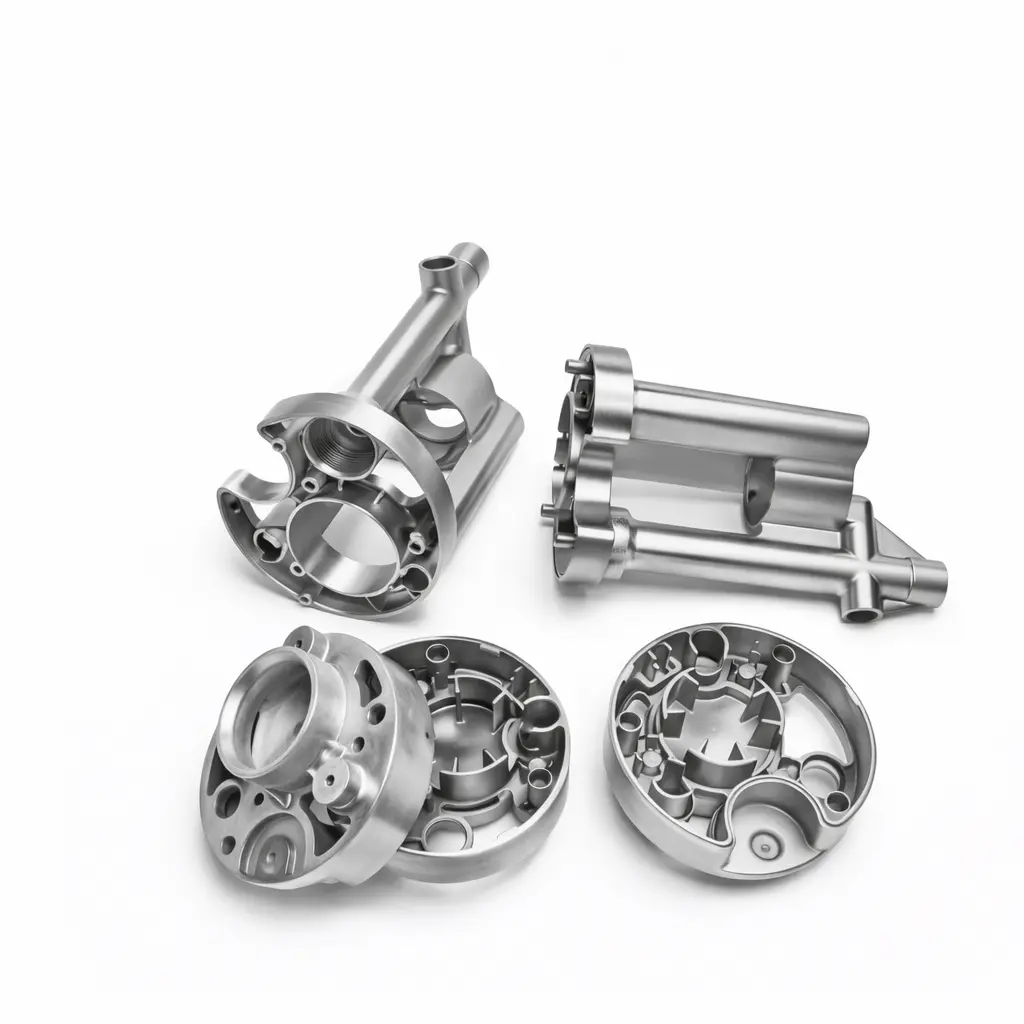
Prototype development services typically move through five stages: design review and feasibility, method selection, first-article fabrication, testing and validation, and design refinement for production handoff. Each stage exists to catch a specific risk, geometry that can’t be machined, tolerances that won’t hold, materials that won’t perform, before it becomes a costly change on a production line. Providers that follow this sequence consistently shorten the path from concept to a manufacturable, repeatable part.
1. Design Review and Feasibility Assessment
A manufacturability review checks every dimension, wall, and tolerance against what a given process can actually hold before any material gets cut.
Reviewers compare wall thickness, tolerance callouts, and material choice against the real limits of CNC machining, die casting, or molding. A 0.3mm wall that looks fine on screen may warp during injection molding or chatter under a cutting tool. Flagging that now costs a markup on a drawing; flagging it after tooling or fixturing is built costs a re-cut mold or a scrapped batch.
Why Prototyping Is a Critical Step Before Scaling Manufacturing
This stage is suited to teams who already have a near-final CAD file and need a manufacturability gut-check before committing budget to prototype development services. Skipping it means the first real feedback on a design arrives after parts are already in production, which is the most expensive place to find a problem.
Most shops give verbal feedback, a quick call, a thumbs-up or thumbs-down. A structured process instead returns annotated DFM comments tied to specific features on the drawing, so engineers can trace every change back to a reason. That written record also becomes useful later, when the same part moves into production planning and someone needs to know why a radius changed.
2. Prototyping Method Selection
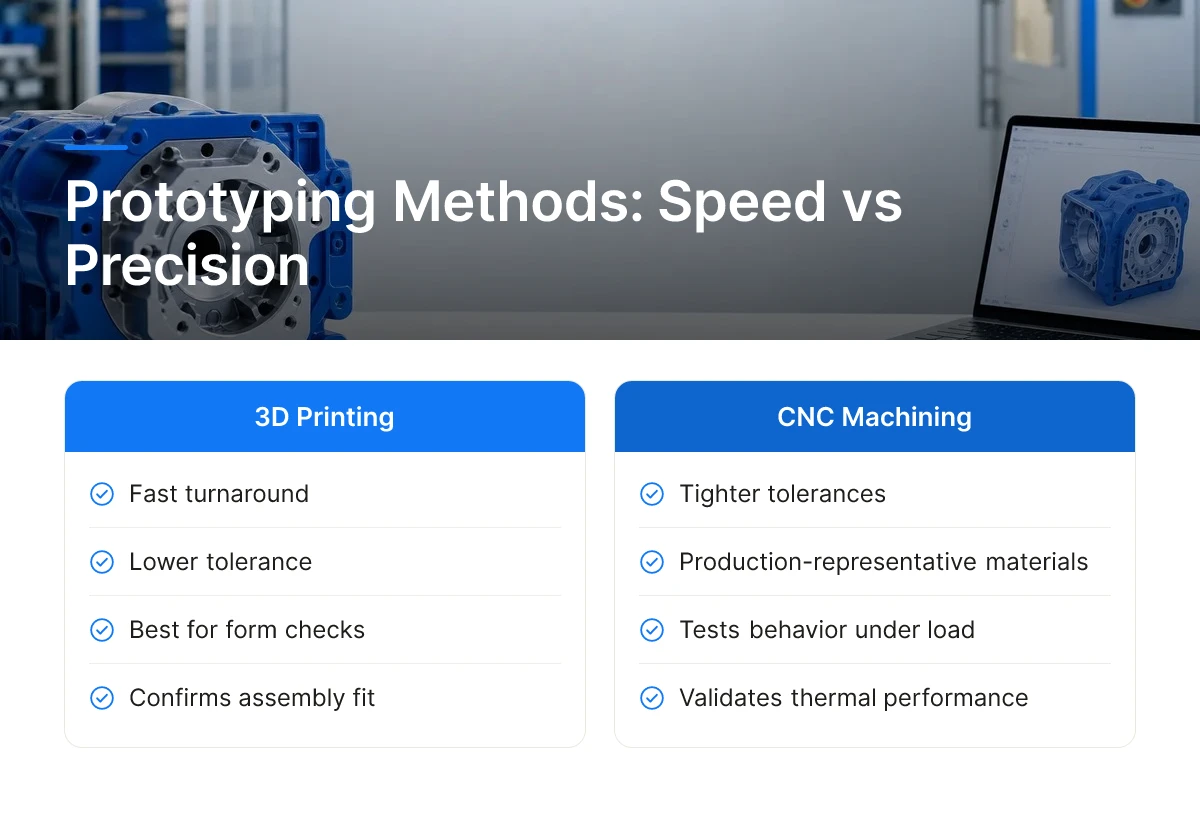
The right prototyping method depends on what the part has to prove, form, fit, or function, not just on timeline or budget.
3D printing works well for checking form: it is fast, lower in tolerance, and best for confirming a shape fits in an assembly before committing to harder tooling. CNC machining holds tighter tolerances and can run production-representative materials, which matters when a prototype needs to behave like the final part under load or heat. Urethane casting fits in between, good for small batches of look-alike parts for user testing or trade shows, without the cost of metal tooling.
When to Use 3D Printing vs CNC Machining vs Urethane Casting
The underlying trade-off is mechanical: additive processes trade tolerance for speed, while subtractive processes trade setup time for repeatability. A printed bracket might take hours but drift several tenths of a millimeter off spec; a machined one takes longer to program but can hold tolerances as tight as ±0.001mm on a provider like GC INDUS, where 5-axis and Swiss lathe equipment produce production-grade accuracy even at single-piece quantities.
This step suits engineers who already know whether they need a visual mock-up, a functional test part, or a near-production sample. The differentiator worth asking about: does the provider match the method to the specific downstream test the prototype must pass, a drop test, a fit check, a load test, rather than defaulting to whatever process is cheapest that week.
Common factors that determine which prototyping method fits a given part include:
- How closely the prototype must match final production material behavior
- Whether the part is being tested for form, fit, or full function
- Required tolerance band and surface finish
- Expected quantity of prototype iterations
- Timeline pressure versus need for production-representative data
3. First-Article Fabrication
First-article fabrication produces the first physical part under documented conditions, not as a one-off but as a traceable step toward production.
A controlled first article comes with a traveler, revision control on the drawing, and material certifications tied to the batch used. An informal mock-up has none of that, if the part works, nobody can say exactly why, and if it fails, nobody can trace which variable caused it.
Providers that think ahead set up fixturing and CNC programs anticipating later production volumes, not just the single part in front of them. That upfront planning saves rework when the project scales from one prototype to a few hundred units.
This stage fits projects where the prototype must double as a functional test unit rather than a visual sample. The differentiator: logging process parameters, speeds, feeds, tool paths, heat treatment cycles, during fabrication so that data carries directly into production planning instead of getting reconstructed later from memory.
4. Testing and Validation
Testing exposes fit problems, tolerance stack-up, and material weaknesses while a design is still cheap to change.
Dimensional inspection catches where a part drifted from its drawing; functional testing shows how it behaves under the loads, temperatures, or cycles it will actually see. Both surface design flaws, a bearing bore slightly undersized, a wall that flexes more than expected, before anyone cuts hard tooling around a flawed assumption.
What Prototype Testing Reveals Before Full-Scale Manufacturing
A failed prototype test is inconvenient. A failed production run after tooling is built is a different order of cost, reworking a mold or scrapping thousands of out-of-spec parts dwarfs the price of a second prototype iteration.
How Tolerance Requirements for Prototypes Compare to Production Parts
For regulated or high-consequence parts, medical devices, automotive components, aerospace hardware, the prototype’s tolerance band should mirror the final part’s, not a looser prototype-only standard. This is where documentation matters as much as the physical result: a provider holding ISO 13485 compliance, like GC INDUS, ties inspection criteria to the same quality standard the final part must meet, rather than running prototypes against a generic checklist that doesn’t hold up under an audit.
This stage is built for companies that need prototype development services with full inspection protocols and a paper trail, not just a part that looks right. For more information, see Business Development Manager.
5. Design Refinement and Production Handoff
Handoff closes the loop: test results shape final design changes, and documentation carries that knowledge into production without gaps.
The iteration loop runs test result, design change, re-verification. A minor dimensional miss might get corrected and verified on paper; a functional failure, a part that cracks under load or doesn’t seat correctly, usually means building a second prototype round before anyone commits to tooling. Deciding which path applies is a judgment call providers make based on how far the result deviated from the requirement, not a fixed rule.
What Happens After Prototype Validation Is Complete?
Handoff documentation should include finalized drawings, material specs, inspection results, and process notes from fabrication, everything a production line needs without re-asking questions already answered during prototyping. Missing any of these pieces forces the production team to re-derive settings that were already proven out.
This stage suits companies moving from a validated prototype into tooling or volume production and needing continuity between the two. The differentiator is structural: a single point of contact or process record that carries from prototype through production avoids the information loss that happens when a part changes hands between separate vendors, one reason GC INDUS keeps CNC, casting, molding, and assembly under one roof rather than splitting the work across suppliers.
6. In-House vs Outsourced Prototype Development Services
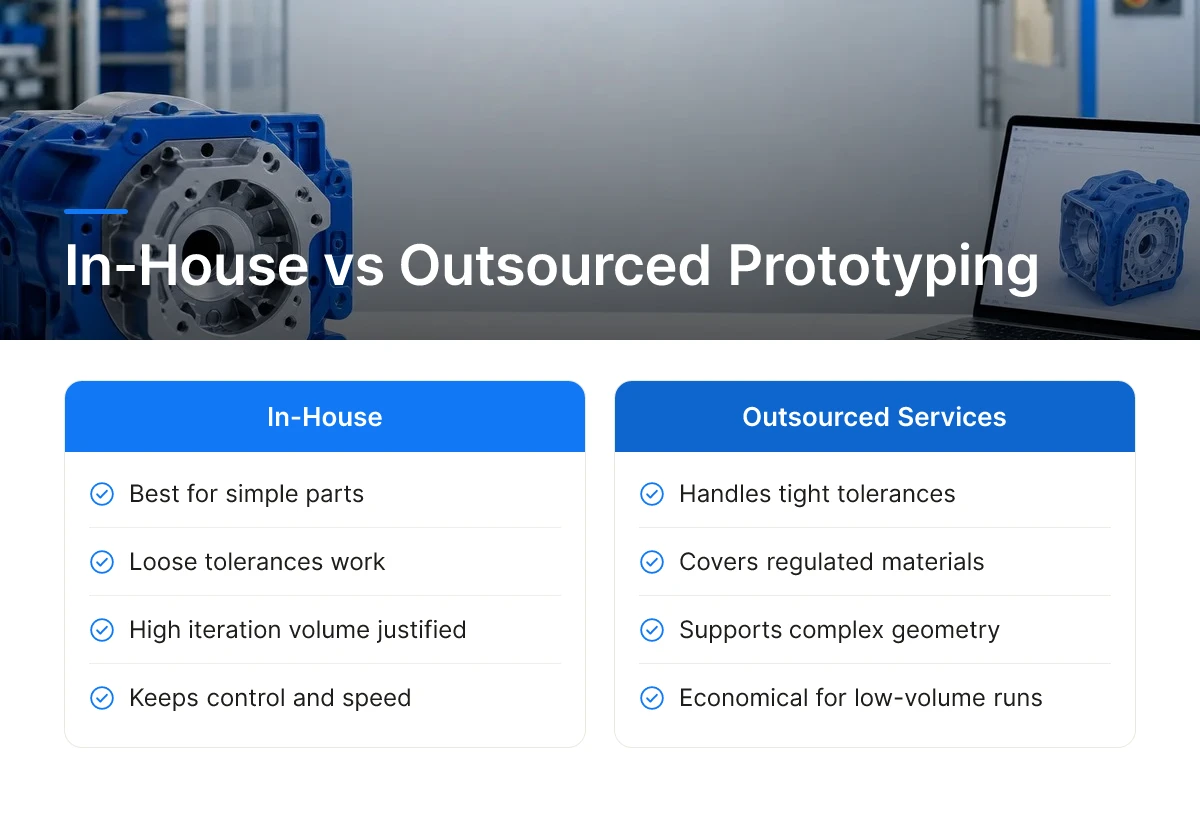
In-house prototyping keeps control and speed for simple parts, but outsourced prototype development services cover tolerances, materials, and processes no internal shop can match economically.
Building an internal shop makes sense when parts are simple, tolerances are loose, and iteration volume is high enough to justify the equipment. The moment a design needs tight tolerances, regulated materials like medical-grade titanium, or a complex geometry requiring 5-axis milling or EDM, in-house capability usually hits a wall. Low-volume runs compound the problem, a single CNC mill or 3D printer can’t justify its own tooling and labor cost for a handful of units.
What Capabilities Should You Look for in an Outsourced Partner?
Look for multi-process capability under one roof, CNC milling, turning, die casting, and injection molding, so the same partner can carry a part through design changes without re-quoting elsewhere. Check for a documented quality system (ISO 9001 at minimum, ISO 13485 for medical work) and confirm the minimum order quantity doesn’t force a batch commitment before the design is finalized. GC INDUS, for example, accepts orders from a single piece and holds tolerances to ±0.001mm across CNC, casting, and molding, which removes the MOQ barrier that stalls early-stage iteration. Firms researching the broader landscape of providers can also review comparative overviews such as this roundup of product design and prototype development services firms before narrowing a shortlist.
This approach suits companies scaling product lines faster than their internal shop can keep pace with. Cost framing stays qualitative here: in-house is budget-friendly for simple, high-repeat parts, while outsourcing to a premium-capability partner pays off once tolerance or material complexity rises.
When comparing in-house capability against outsourced prototype development services, weigh these factors:
- Tolerance and material requirements versus existing in-house equipment
- Regulatory or quality certification needs (ISO 9001, ISO 13485)
- Minimum order quantity flexibility for early-stage iteration
- Access to multiple processes (CNC, casting, molding) under one roof
- Total cost of ownership for equipment versus per-project outsourcing
7. Industry-Specific Prototyping Requirements
Medical, automotive, and electronics prototypes each demand different methods because regulation, repeatability, and iteration speed pull in different directions.
Medical device prototypes carry traceability and biocompatibility requirements from the first build, the material a prototype is cut from often has to match a pre-approved list, because switching materials later can trigger a new validation cycle. This shapes method choice early: a shop without ISO 13485 experience may build a functional prototype that still can’t feed into a regulatory submission.
Automotive prototypes prioritize repeatability testing, especially for parts headed into high-volume die casting or stamping. A single prototype that looks right means little if the production tooling can’t reproduce it across thousands of cycles, so automotive teams often run multiple prototype iterations specifically to test process repeatability, not just part geometry.
Electronics enclosures favor fast iteration and tight-fit tolerances over matching the final production material, a 3D-printed or machined stand-in is often good enough if it proves the fit and clearance, deferring exact resin or alloy selection to a later stage.
How Do Industry Standards Affect Prototype Development Strategy?
Regulation changes which documentation must exist at the prototype stage, not just at production. Medical and aerospace programs often require first-article inspection records and material certificates attached to prototype batches, while consumer electronics projects can defer that paperwork until the design locks. Specialized firms such as precision prototype development and fabrication providers often structure their process specifically around these regulatory distinctions.
8. Turnaround Time and Complexity Factors
Turnaround depends less on part size and more on feature count, tolerance tightness, and how many secondary operations the design requires.
A part with more features, tighter tolerances, or multiple materials in one assembly takes longer to program and set up, regardless of whether the method is CNC machining, casting, or molding. Programming a 5-axis toolpath for a part with interdependent tolerances takes meaningfully longer than a simple two-axis turned part, even before any material is cut.
How Does Prototype Complexity Affect Turnaround Time?
Material availability and surface finish requirements add steps beyond base fabrication. A part needing a specific alloy on back order, or a finish like anodizing or passivation, adds lead time that has nothing to do with the machining itself.
Simple single-process parts, a bracket machined and shipped as-is, move faster than multi-stage parts needing finishing, plating, heat treatment, or assembly. Each added step is a handoff, and handoffs are where schedules slip if a provider doesn’t manage them under one roof.
This matters most for teams planning a product launch timeline who need to sequence prototype rounds realistically. Building in buffer for secondary operations, rather than assuming machining time equals total turnaround, keeps a launch schedule from slipping after the first prototype round.
Factors that most commonly extend turnaround on prototype development services include:
- High feature count or tightly interdependent tolerances
- Multiple materials within a single assembly
- Back-ordered or specialty alloys
- Secondary finishing operations such as anodizing or passivation
- Multi-vendor handoffs between fabrication, finishing, and assembly
How to Choose the Right Prototype Development Partner
Match a partner’s process range, quality certifications, and inspection protocols against your part’s actual requirements before comparing cost or turnaround.
What Capabilities and Experience Should a Provider Have?
Start with a checklist: process range (CNC machining, casting, molding, sheet metal) under one roof, quality certifications relevant to your industry (ISO 9001 generally, ISO 13485 for medical work), and documented first-article inspection protocols. A provider offering prototype development services without a written inspection process is asking you to trust results you can’t verify. Reviewing how established providers describe their own process, such as this overview of rapid prototyping services or this engineering-focused prototype development services page, can help calibrate what a thorough process should look like.
How Do You Evaluate a Partner’s Tolerance and Material Fit?
Verify tolerance and material capability against your actual part specs, not marketing claims. Ask for a sample inspection report on a comparable part, and confirm the tolerance quoted, ±0.001mm, for instance, applies to the feature type your design depends on, not just an easy reference dimension.
Responsiveness during the quoting stage signals how design reviews will go later. A partner that flags a tolerance conflict or material substitution risk in the quote is more likely to catch problems during production than one that just returns a price. Some regional product development firms, like this Atlanta-based product development company, pair prototyping directly with broader product development support, which can be useful for teams that need more than fabrication alone.
Favor a provider that can carry the same part from prototype into low-volume and full production without re-sourcing, GC INDUS, for example, serves clients from single-piece prototypes through production runs using the same CNC, casting, and molding processes, which avoids re-validating a part with a new vendor. Frame cost comparisons qualitatively: budget-friendly shops suit simple, loose-tolerance work, while mid-range and premium providers justify their cost through certified quality systems and broader process depth.
A short checklist to apply before signing with any provider of prototype development services:
- Confirmed process range under one roof (CNC, casting, molding, sheet metal)
- Relevant quality certifications (ISO 9001, ISO 13485 where applicable)
- Documented first-article inspection protocol
- No forced minimum order quantity for early iterations
- Clear path from single-piece prototype to volume production with the same vendor
Frequently Asked Questions
What does prototype development mean in precision manufacturing?
It is the structured sequence of building, testing, and refining physical parts before committing to full production tooling and runs. In precision manufacturing, this moves through concept models, functional prototypes, and pre-production samples, each stage checked against tolerances, materials, and assembly fit. The goal is catching design and manufacturability problems while changes are still inexpensive to make.
How much should you budget for prototype development?
Budget depends on process, material, and tolerance requirements rather than a fixed figure, simple CNC prototypes cost far less than cast or molded samples requiring tooling. Treat prototyping as a mid-range line item relative to total product development, since it is still cheaper than reworking production tooling. GC INDUS accepts orders from 1 piece, so you can prototype in the exact material and process your final part will use without committing to volume pricing upfront.
What inspection and documentation standards should prototypes meet?
Prototypes intended to validate manufacturability should pass the same inspection protocols as production parts, not a relaxed version. For regulated industries, that means dimensional reports, material certifications, and compliance with standards like ISO 9001 or ISO 13485 for medical devices. Skipping documentation at the prototype stage usually means repeating validation work later.
What ROI can you expect from catching manufacturing issues during prototyping?
Catching a design flaw during prototyping avoids the far higher cost of correcting it after production tooling is cut. A functional prototype lets engineers test fit, tolerance stack-up, and material behavior before committing to hard tooling or large production runs. The return shows up as fewer tooling revisions, fewer field failures, and faster time to a manufacturable design, outcomes that are hard to quantify universally but consistently cited as the core reason to prototype before scaling.
How do prototype costs compare to the cost of fixing problems in full production?
Prototype costs are consistently smaller than the cost of correcting the same problem after production tooling exists. Reworking injection molds, die casting tools, or fixtures after a flaw surfaces in volume production means scrapped tooling, line downtime, and missed delivery dates, expenses a single-piece prototype run is built to prevent.
Conclusion
Prototype development works best as a staged process, concept models, functional prototypes, pre-production samples, each checked against the same tolerances and documentation a production part will need, not a relaxed version. Skipping that rigor is where most costly rework starts. Three actions matter most: validate materials and process early, insist on full inspection data even at prototype stage, and choose a manufacturing partner who can carry the same part from one piece to volume production without a vendor handoff. GC INDUS runs CNC machining, die casting, and molding under one roof with ISO 9001 and ISO 13485 compliance, so your prototype and production part come from the same process. Start by requesting a quote on your next prototype in its intended production material.
Recommended Articles
Explore more from our content library:


