
Book Appointment Now

GC INDUS / MANUFACTURING KNOWLEDGE
6 Aluminum Alloys Worth Considering for Machined Parts

Understanding aluminum machined parts is essential. The best aluminum alloys for machined parts are 6061, 7075, 2024, 6063, 5052, and MIC-6, each suited to different priorities. 6061 balances machinability, strength, and cost for general precision parts; 7075 delivers the highest strength-to-weight ratio for aerospace and structural components; 2024 excels in fatigue resistance for aircraft parts; 6063 suits cosmetic and architectural work; 5052 handles sheet-formed and corrosion-prone parts; and MIC-6 gives dimensional stability for tooling and fixtures. Choosing among them depends on how much you weigh machining speed, mechanical strength, corrosion resistance, and material cost against each other.
1. 6061 Aluminum: The Default Choice for Aluminum Machined Parts
6061 dominates quoting volume because it balances machinability, moderate strength, and weldability better than any other alloy in general production.
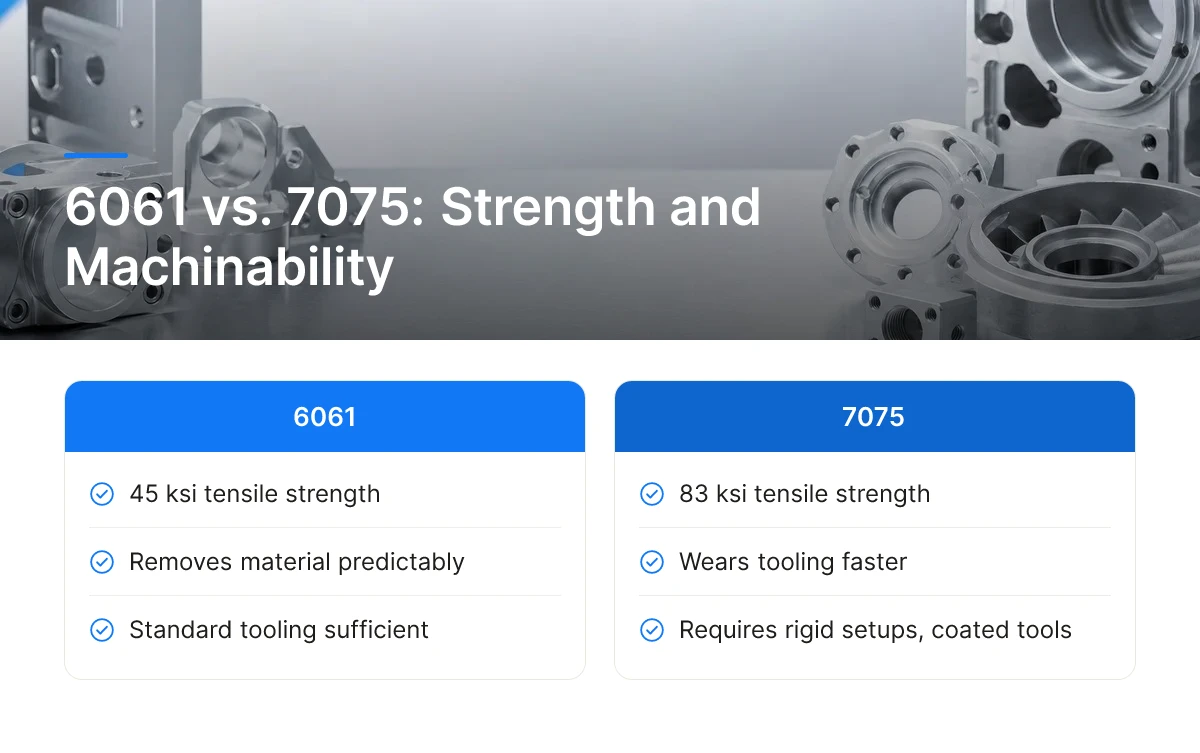
Shops default to 6061 because it removes material predictably, holds dimensions through multiple operations, and accepts most standard fixturing without special tooling. Its moderate strength (45 ksi tensile typical) is enough for brackets and housings without fighting the tool the way harder alloys do.
Is 6061 Aluminum Suitable for High-Precision Machining?
Yes. 6061 routinely holds tolerances in the ±0.01mm to ±0.05mm range on standard 3-axis and 5-axis equipment, and tighter bands are achievable with rigid setups and finish passes, without resorting to exotic secondary operations. This is one reason 6061 shows up so often in aluminum machined parts destined for enclosures, fixtures, and prototype runs where dimensional consistency matters but extreme strength doesn’t.
Best-fit users include prototype shops, general industrial component makers, and anyone producing brackets or fixtures at volume. One thing competitor pages rarely mention: 6061’s chip formation is unusually consistent, which reduces tool-change frequency and helps a shop hold tolerance across a long production run rather than drifting as tooling wears. It also anodizes cleanly, giving a durable, corrosion-resistant finish for parts that need both function and appearance.

2. 7075 Aluminum: For High-Strength, Lightweight Parts
7075 is the alloy to specify when strength-to-weight ratio matters more than ease of machining or cost.
Its higher strength, roughly 83 ksi tensile typical versus 45 ksi for 6061, comes at a cost on the shop floor. 7075 wears tooling faster, generates more heat during cutting, and demands rigid setups with sharper, often coated tooling to avoid chatter and premature tool failure. Programs written for 6061 don’t transfer directly; feeds and speeds need adjustment to manage the harder, more abrasive cut.
Best-fit users are aerospace and defense programs, high-load fixtures, sporting goods manufacturers, and any application where shaving grams matters as much as holding load. Compared to 6061, 7075 delivers noticeably higher strength-to-weight; compared to 2024, it trades some fatigue performance for outright strength and hardness. The differentiator engineers often miss: 7075’s copper content limits weldability and reduces corrosion resistance relative to 6061, which pushes design toward mechanical fastening and often requires additional coating or plating to meet corrosion specs.
3. 2024 Aluminum: Built for Fatigue Resistance
2024 aluminum is specified when parts face repeated stress cycles, because its microstructure resists crack initiation and propagation better than most alloys.
That fatigue resistance comes from its copper content and the way the alloy responds to cyclic loading, small stresses that would eventually crack 6061 or 7075 take longer to propagate in 2024. That makes it the standard choice for aircraft fuselage skins and structural components that flex thousands of times over a service life.
What Are the Differences Between 6061, 7075, 2024, and Other Common Machining Alloys?
Best-fit users are aerospace manufacturers building fuselage panels, wing components, and other structural parts under repeated stress. Against 7075, 2024 machines differently: it tends to produce longer, stringier chips and a different surface finish, which affects chip evacuation and can extend cycle time compared to 7075’s cleaner break. 2024 is also more corrosion-sensitive than 6061 or 7075, which is why aircraft-grade stock is frequently clad with a thin layer of pure aluminum or specified with a protective coating before final assembly.
4. 6063 Aluminum: Best for Cosmetic and Architectural Parts
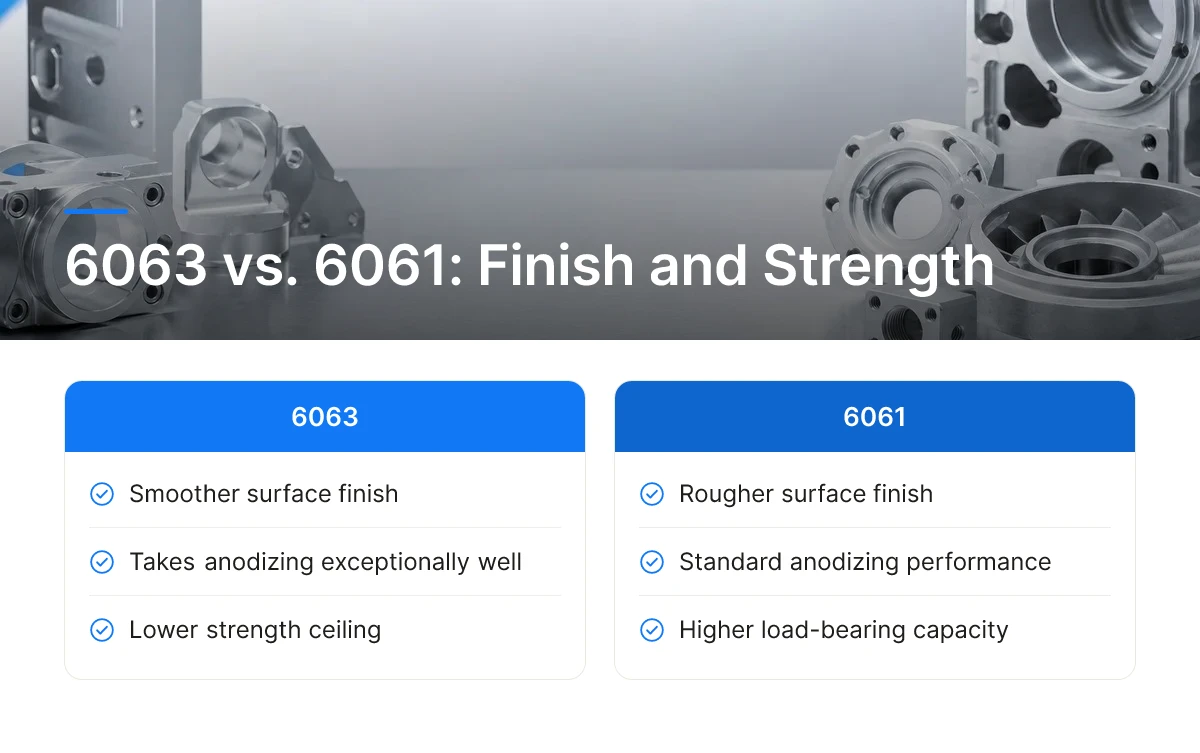
6063 is the alloy to choose when surface finish and anodized appearance matter more than raw strength.
It machines cleanly with a smoother finish than 6061 and takes anodizing exceptionally well, which is why it shows up in architectural trim, storefront framing, and consumer product housings where the part is seen, not just used. Buyers producing aluminum machined parts for retail or display applications often choose 6063 specifically for this cosmetic edge.
The tradeoff is strength: 6063’s ceiling sits well below 6061, making it a poor fit for load-bearing brackets or structural fixtures despite its finish advantages. It’s also worth noting for sourcing, 6063 originates almost exclusively as extruded stock, so lead times and available cross-sections depend on extrusion supply rather than plate or bar inventory, which can shift scheduling versus alloys stocked in multiple forms.
5. 5052 Aluminum: For Corrosion Resistance and Sheet-Formed Parts
5052 earns its place when corrosion resistance and formability matter more than pure machinability, especially in marine and outdoor use.
Its magnesium content gives it strong resistance to saltwater and chemical exposure, which is why it’s a common choice for marine hardware, fuel handling components, and chemical enclosures. It’s also easy to form, so it typically arrives as sheet stock that’s bent or stamped first and machined only where features demand it.
Best-fit users are sheet metal fabricators and marine or industrial equipment makers who need a housing or bracket that starts as formed sheet and gets drilled, tapped, or trimmed afterward. 5052 is rarely anyone’s first pick for a pure machining job cut from billet, its differentiator is excelling at the hybrid sheet-plus-machining workflow rather than head-to-head with 6061 or 7075 in a mill. One cosmetic caveat: 5052 doesn’t anodize as brightly or evenly as 6063, so specs calling for a polished anodized look usually look elsewhere.
6. MIC-6 Cast Aluminum Plate: For Dimensional Stability in Tooling
MIC-6 stays flat because it is cast and stress-relieved before machining, so it does not warp when heavy pockets or cavities are cut into it.
Wrought alloys like 6061 and 7075 carry internal stresses from rolling and extrusion. Machine away material unevenly and those stresses release, pulling the plate out of flat. MIC-6 is cast to near-final thickness and stress-relieved as a slab, so its internal grain structure has nowhere to shift once a mill starts removing material. That is the mechanism other aluminum comparisons skip: they rank alloys by strength or machinability, not by what happens dimensionally after aggressive stock removal.
MIC-6 fits tooling plates, fixture bases, mold components, and optical or inspection tables, anywhere flatness across a large surface matters more than tensile strength. It is not a structural alloy. Do not spec it for load-bearing brackets, fasteners, or parts that see repeated stress cycles; 6061 or 7075 handle that job better. Think of MIC-6 as a specialist for one requirement: a plate that measures the same after machining as it did before.
Why Aluminum Machined Parts Cost Less Without Sacrificing Performance
Aluminum machined parts cost less mainly because aluminum cuts faster and wears tools slower than steel or titanium, without giving up strength most designs need.
How Does Aluminum Pricing Compare to Other Metals for Custom Machining?
Aluminum’s lower hardness means a mill can run higher spindle speeds and deeper cuts per pass than it can on steel or titanium, cutting cycle time. Shorter cycles mean less machine time billed per part, and softer chip formation means end mills and inserts last longer before they need replacing. Titanium in particular work-hardens and holds heat at the cutting edge, forcing slower feeds and frequent tool changes, costs that show up directly in the finished part price. Aluminum’s high thermal conductivity carries heat away from the tool during the cut, which is part of why shops can run it aggressively without burning up cutters.
What Cost Savings Can You Achieve by Choosing the Right Aluminum Alloy?
Alloy choice sets the cost tier before the first cut. 6061 is the budget-friendly baseline for general-purpose brackets and housings. 7075 and 2024 sit mid-to-premium, the material costs more and wears tooling faster because of higher alloying content, but you get strength or fatigue resistance 6061 cannot match. MIC-6 cast plate is a premium choice reserved for tooling-grade flatness, not general parts. Design simplicity compounds the savings: fewer setups, standard tool diameters, and reasonable tolerance bands all reduce machine time. Specifying the correct alloy up front, rather than discovering mid-run that a part cannot hold spec, avoids scrapped stock and secondary finishing that erase any savings from a cheaper material choice.
Overcoming Common Challenges When Machining Aluminum
Aluminum machines fast but gums up on dull tooling, so shops need the right geometry, coating, and coolant strategy to avoid defects.
Why Is Aluminum Harder to Machine Than Some Assume?
Aluminum’s softness and low melting point work against it under sustained cutting. The material can smear onto the cutting edge instead of shearing cleanly, forming built-up edge that drags across the surface and leaves galling or burrs. Shops without aluminum-specific experience often apply steel cutting parameters, running speeds too slow and generating heat that softens the material further instead of cutting through it.
What Surface Finishes Are Achievable on Aluminum Machined Parts Without Secondary Operations?
Sharp-edged tools with high positive rake angles, polished flute surfaces, and coatings like ZrN or uncoated polished carbide reduce material adhesion during the cut. Flood coolant or mist systems pull heat away from the tool-workpiece interface and flush chips before they re-cut and scar the surface. With the right tool geometry and feed rate, a single milling pass can hold a smooth, consistent finish suitable for many applications without grinding or polishing afterward.
Tight tolerance work, down to the fine bands aerospace and medical drawings call out, needs rigid fixturing to eliminate part deflection and thermal control to stop dimensions drifting as the material heats up mid-cut. GC INDUS holds tolerances as tight as ±0.001mm on CNC-machined aluminum parts, using 5-axis and Swiss lathe equipment paired with full inspection protocols under ISO 9001 certification. Certifications like ISO 9001 and AS9100 matter here because they force documented inspection steps, coordinate measuring machine checks, surface roughness testing, that catch gumming marks, burrs, or out-of-tolerance features before parts ship, not after a customer rejects them.
How to Choose the Right Aluminum Alloy for Your Machined Parts
Start with load and environment, match to an alloy family, then confirm tolerance and finish needs before locking in a design.
How Do You Select an Alloy When Machinability Conflicts With Performance Requirements?
Define what the part has to survive first: static load, cyclic fatigue, corrosive exposure, or just enclosure duty with no real stress. That answer points to a family, 6061 for general use, 7075 for maximum strength, 2024 for parts under repeated loading. Only after that should machinability and cost tip the final choice, since a part that fails in service costs far more than one that took an extra minute on the mill.
Design details interact with that alloy choice more than most drawings account for. Thin walls, sharp internal corners, and deep narrow holes all increase deflection and chatter risk, and some of that risk is alloy-dependent, 7075 tolerates aggressive cuts differently than 6061 does. Certification requirements narrow the field further: aerospace work usually demands AMS-traceable material and AS9100 process control, medical devices need ISO 13485 compliance and biocompatible finishing, automotive parts lean on IATF-aligned quality systems. GC INDUS carries both ISO 9001 and ISO 13485 certification, which covers general industrial and medical-grade aluminum machined parts under one roof rather than splitting the order across vendors.
Bring a machining partner in during design, not after drawings are frozen, catching a feature that forces a fourth setup or a non-standard tool before quoting is far cheaper than redesigning post-quote. Finishing is the last filter: anodizing for wear and corrosion resistance, plating for conductivity, passivation for cleanliness in medical applications. Each one can shift alloy selection since not every aluminum grade anodizes or plates the same way.
Frequently Asked Questions
Can aluminum be machined to tight tolerances like ±0.001mm?
Yes—aluminum’s dimensional stability and easy machinability make it well suited to holding ±0.001mm tolerances. GC INDUS achieves this level of precision using 5-axis milling, Swiss lathe turning, and grinding, backed by full inspection protocols to confirm every part meets spec before shipment.
Why do some aluminum alloys machine faster than others?
Alloy composition changes chip formation, tool wear, and cutting speed, so some grades machine faster than others. 6061 machines quickly and predictably for general-purpose parts, while 7075 and 2024 demand slower feeds because of higher strength. Softer, more stable alloys generally cut cycle time.
What certifications should an aluminum machining provider hold for aerospace and medical parts?
Look for ISO 9001 as a baseline and ISO 13485 if the part is destined for a medical device. ISO 9001 confirms a consistent quality management system, while ISO 13485 addresses medical-specific traceability and risk controls. GC INDUS holds both, which matters since many competing shops lack medical device compliance, creating gaps for regulated buyers.
What anodizing, plating, and coating options work best for aluminum machined components?
Type II and Type III hard anodizing are the most common choices, adding corrosion resistance and wear protection without significant dimensional change. Type II suits cosmetic and general corrosion protection; Type III (hard anodize) suits parts under abrasion or friction. Plating options like chromate conversion add conductivity or paint adhesion for electronics housings and structural brackets.
What turnaround times can you expect for custom aluminum machined parts?
Turnaround depends on part complexity, quantity, and finishing steps, so timelines vary by order rather than following one fixed number. Simple single-piece prototypes move faster than multi-process runs involving heat treatment or anodizing. GC INDUS quotes lead time per project after reviewing the CAD file and specs.
Conclusion
Alloy choice drives everything downstream: 6061 covers most general-purpose parts economically, 7075 answers strength-critical designs, and 2024 handles cyclic loading where fatigue resistance matters. Tolerance requirements, finishing needs, and certification demands should shape that alloy decision before cutting starts, not after.
If your current supplier can’t hold ±0.001mm consistently or lacks ISO 13485 for a medical application, that’s a signal to requalify your source. Start by sending GC INDUS your CAD file and spec sheet for a fast quote—MOQs start at 1 piece, so you can validate a new alloy or tolerance before committing to a production run.
Recommended Articles
Explore more from our content library:


