
Book Appointment Now

GC INDUS / MANUFACTURING KNOWLEDGE
6 Industrial Parts Fabrication Methods and When to Use Each

Understanding industrial parts fabrication is essential. The right fabrication method depends on your material thickness, tolerance requirements, and production volume, laser cutting suits thin-to-mid gauge metals needing tight tolerances, plasma cutting favors thick carbon steel where speed matters more than edge precision, and waterjet handles heat-sensitive or reflective materials that can’t tolerate thermal distortion. CNC machining, stamping, and bending round out the toolkit for parts with 3D features or high-volume runs. Matching the method to the part spec, not defaulting to one process, is what controls both cost and quality.
Choosing among these options is rarely about picking the “best” method in the abstract. Every approach to industrial parts fabrication carries tradeoffs in speed, edge quality, tolerance, and cost that only make sense once you know the part’s full spec. The sections below break down each method, what it’s good at, where it falls short, and how to weigh them against each other. For a broader look at how fabrication shops frame these same tradeoffs, see this overview of industrial fabrication solutions.
1. Laser Cutting for Industrial Parts Fabrication
Laser cutting uses a focused beam of light to melt or vaporize metal along a narrow path, producing tight kerf widths and clean edges on thin-to-mid gauge material.
The process works by directing high-energy light through a lens, concentrating enough heat on a small spot to cut through metal while a gas jet clears the melted material from the path. This makes laser cutting a strong fit within industrial parts fabrication when a design calls for intricate geometries, small-to-mid batch runs, or parts that need minimal secondary finishing before moving to the next production step. Typical materials include stainless steel, aluminum, and mild steel sheet, all metals that respond well to a clean, narrow cut.
What Are the Key Advantages and Limitations of Laser Cutting Versus Plasma Cutting?
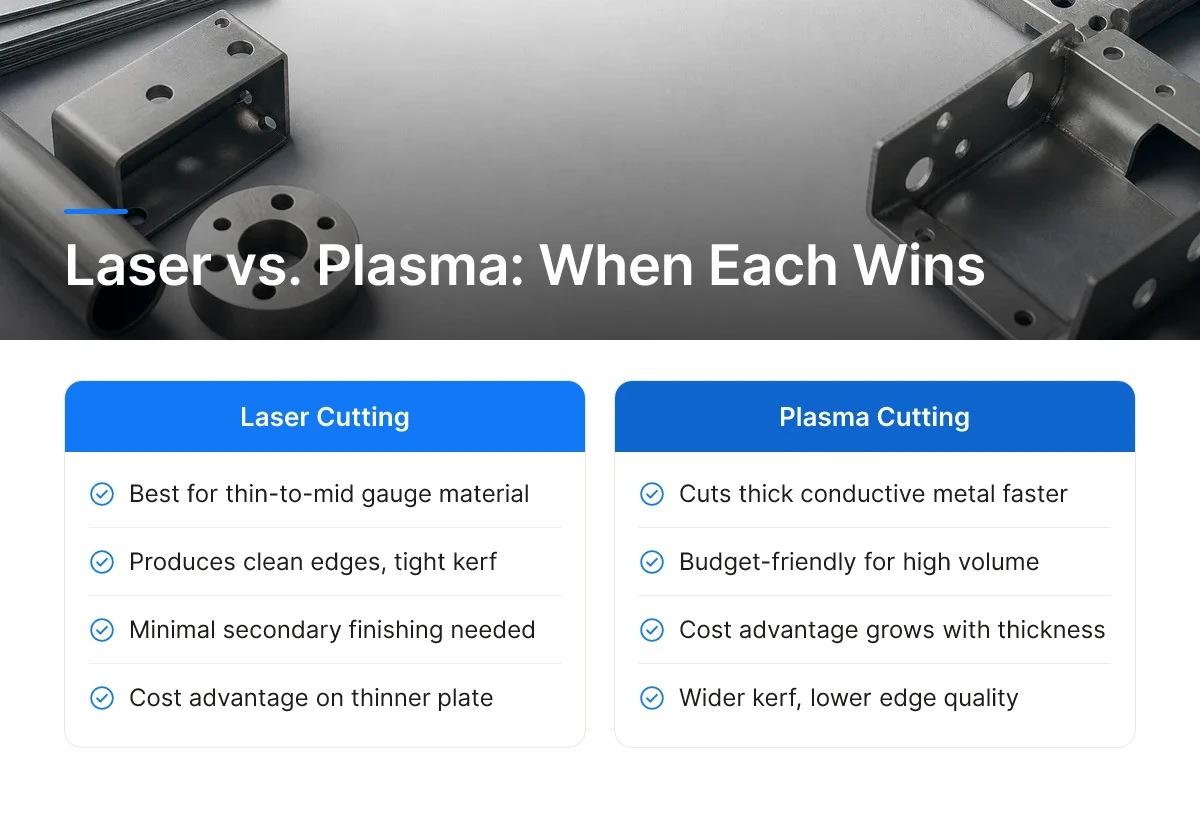
Laser cutting holds its edge-quality advantage mainly on thinner stock, and that advantage narrows as plate thickness increases. The heat-affected zone on laser cuts actually shrinks as material gets thinner, which is exactly why the process loses its edge-quality lead over plasma once you move into thick plate, plasma starts to compete on both speed and cost at that point. For shops choosing between the two, material thickness is the deciding variable more than edge finish alone.
- Best for: thin-to-mid gauge stainless steel, aluminum, and mild steel sheet
- Strengths: tight kerf width, clean edges, minimal secondary finishing
- Limitations: loses its edge-quality advantage on thick plate, where plasma becomes more competitive
- Typical use cases: intricate geometries, small-to-mid batch runs, tight-tolerance sheet parts
2. Plasma Cutting
Plasma cutting uses a jet of ionized gas to cut through thick conductive metal faster than a laser can manage at the same thickness.
The torch sends an electrical arc through a gas stream, turning it into plasma hot enough to melt metal on contact, and compressed air blows the molten material out of the cut. This makes it the practical choice for structural steel, heavy plate, and budget-friendly high-volume cutting of thick carbon steel. Plasma’s cost advantage actually grows as material gets thicker, which inverts the comparison with laser cutting, the thicker the plate, the more plasma makes economic sense.
The tradeoff is edge quality. Plasma cuts leave a wider kerf and a rougher edge than laser, so parts with tight edge-finish requirements often need secondary deburring or grinding before they’re ready for assembly.

3. Waterjet Cutting
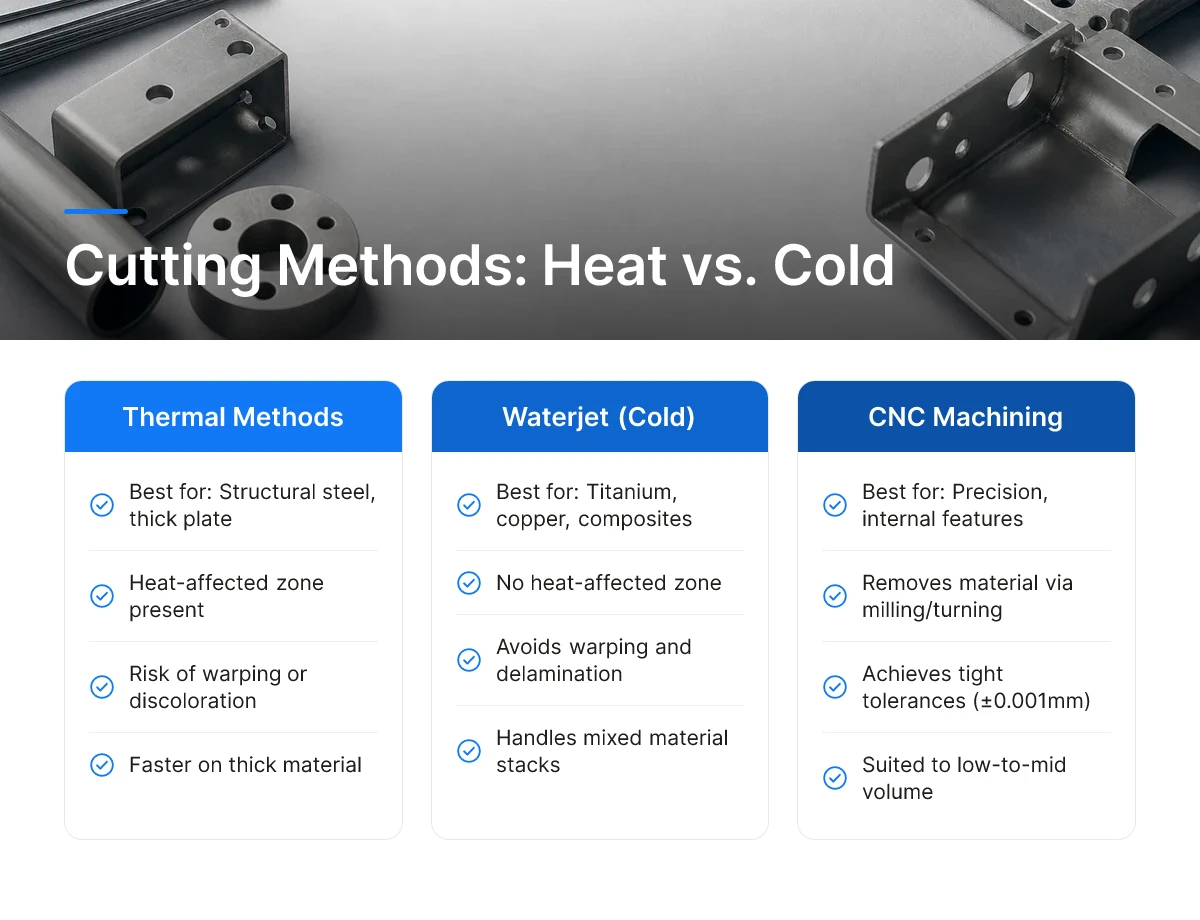
Waterjet cutting uses a high-pressure, abrasive-laden water stream to cut material cold, leaving no heat-affected zone at all.
Because the process relies on mechanical erosion rather than heat, it avoids the warping, discoloration, or metallurgical changes that thermal cutting methods can introduce. That makes waterjet the right call for materials prone to distortion under heat, titanium, reflective metals like copper and brass, and layered composites that would delaminate under a laser or plasma torch.
When Should You Use Waterjet Cutting Instead of Traditional Metal Fabrication Methods?
Reach for waterjet when the job involves mixed materials or a composite stack that other methods can’t touch without retooling. It’s the only method in this list that cuts metals and non-metals interchangeably, stone, rubber, glass, composites, without swapping heads or tooling between runs. The tradeoff is cycle time: waterjet runs slower than laser or plasma on comparable thicknesses, so throughput-sensitive jobs may need to weigh that against the material versatility it offers. For comparison, some shops specializing in metal fabrication and part design outline similar tradeoffs across cutting methods.
4. CNC Machining
CNC machining removes material through milling or turning to produce 3D features and tight tolerances that flat-cutting methods can’t achieve.
Rather than following a single flat profile, a CNC machine moves a cutting tool through multiple axes to carve pockets, bores, threads, and contoured surfaces directly into a block or bar of material. That makes it the method of choice for low-to-mid volume precision components, prototypes, and parts with internal features that cutting-only processes simply can’t produce. GC INDUS runs 5-axis milling, turning, and Swiss lathe operations to hold tolerances as tight as ±0.001mm on parts destined for medical and electronics assemblies.
CNC is the only method in this list that delivers finished 3D geometry in a single setup, rather than a flat profile that still needs bending or forming downstream. On tolerance alone, it also outperforms laser and waterjet on the same material, those methods are built for 2D profiles, while CNC holds precision across complex, multi-surface parts.
5. Press Brake Forming and Bending
Press brake forming applies controlled mechanical force to bend flat, pre-cut blanks into finished 3D shapes like brackets and enclosures.
A punch presses the blank into a die at a set angle and depth, and the tooling repeats that bend consistently across a production run. This makes press brake work well suited to enclosures, brackets, and parts requiring multiple consistent bends at mid-to-high volume, where repeatability matters more than one-off customization.
What most guides skip is the design link upstream: bend sequence and tooling clearance often dictate which cutting method is practical in the first place. A part with tight internal bends may need a different cutting approach than one with simple straight-line folds, so cutting and forming decisions should be made together, not in isolation, a point that matters for anyone sequencing industrial parts fabrication across multiple processes.
Springback is the other variable to plan for. Metal flexes back slightly after the punch releases, and the degree depends on material type and thickness, so achievable bend tolerance varies by material, a factor that should inform material selection as much as strength or cost does.
6. Metal Stamping
Stamping trades a large upfront tooling cost for a per-part price that keeps falling as volume climbs, making it the economics-first choice for repeat production.
A stamping die can cost significantly more to build than a cutting program, and lead time to first part is longer because the die has to be designed, machined, and proofed before production starts. Once that die is running, though, each stroke of the press produces a part in seconds, and the tooling cost amortizes across thousands or millions of units. This is the one point in industrial parts fabrication where the cost curve inverts: cutting methods like laser or waterjet hold a fairly flat cost per part regardless of quantity, while stamping starts expensive and drops sharply as volume rises.
That makes stamping the right call for brackets, enclosures, clips, and terminals ordered by the thousands, automotive and appliance manufacturers lean on it for exactly this reason. It’s a poor fit for prototyping or orders under a few hundred units, since the die cost dominates the total and there’s no opportunity to recover it. Shops offering metal fabrication parts services often run stamping alongside cutting and forming lines to cover this full range of volume.
How Does Batch Size Impact Your Choice Between Manual and Automated Fabrication?
Small batches favor manual or semi-automated cutting where setup time is minimal and changeovers are cheap. Large, repeat batches favor automated stamping or progressive dies, where the labor and setup cost per part shrinks as the run length grows, the crossover point depends on part complexity, but it’s rarely worth tooling a die for anything under a few thousand pieces.
How to Choose the Right Industrial Parts Fabrication Method
Pick a method by filtering material and thickness first, then tolerance, then volume, then lead time, in that order, not by cost alone.
Start with what the part is made of and how thick it is. Thin sheet in steel or aluminum opens up laser and turret punching; thick plate often forces plasma or waterjet; exotic alloys and reflective metals narrow the field further, since some lasers struggle with copper and brass. Next, apply the tolerance requirement, tight-tolerance parts going into assemblies or medical devices rule out plasma cutting immediately and point toward laser, waterjet, or CNC machining, while standard-tolerance brackets keep every method on the table. Only after material and tolerance narrow the list should volume and lead time decide between cutting methods and stamping.
A simple way to frame the decision sequence for industrial parts fabrication:
- Material and thickness: narrows the field to a handful of viable cutting or forming methods
- Tolerance requirement: rules out processes that can’t hold the needed precision
- Volume and lead time: decides between one-off cutting methods and tooling-heavy processes like stamping
- Certifications: filters out shops that can’t document quality to the standard your industry requires
Quality certifications filter the list again. Regulated industries, medical devices, aerospace, automotive, require partners holding ISO 9001 or sector-specific standards, and some processes simply aren’t documented well enough to pass an audit trail. GC INDUS holds ISO 9001 and ISO 13485 certification, which covers both general quality management and medical device manufacturing requirements for clients who can’t gamble on an uncertified shop. Shops offering custom metal parts and component fabrication or custom metal part manufacturing services typically list their certifications upfront for exactly this reason.
Design choices also decide how locked-in a part becomes. Generous bend relief, standard hole sizes, and consistent wall thickness keep a part compatible with multiple fabrication methods; tight corner radii or variable wall sections often lock it into one process from the start.
What Questions Should You Ask a Fabrication Shop About Equipment and Track Record?
Ask what machines they run, 5-axis CNC, Swiss lathe, EDM, wire cutting, and request inspection reports from a past job matching your tolerance class. Confirm certifications in writing rather than taking a sales claim at face value, and ask how they handle out-of-tolerance parts when inspection catches them.
How Should You Design Parts to Be Fabrication-Method Agnostic or Method-Optimized?
Keep hole diameters standard, avoid sharp internal corners unless the application demands them, and specify tolerance only as tight as the function requires. Over-specifying tolerance is the most common way engineers accidentally eliminate cheaper, faster methods before quoting even starts.

Frequently Asked Questions
Can laser cutting achieve tighter tolerances than plasma cutting for the same material?
Yes, laser cutting typically holds tighter tolerances than plasma cutting on the same material, especially on thinner gauges. Plasma relies on a hotter, less focused arc that widens the kerf and increases heat distortion, while laser’s narrow beam gives cleaner edges and better repeatability. Plasma remains competitive on thick plate where laser power drops off.
How do setup costs, material waste, and labor differ across fabrication methods?
Setup costs, waste, and labor scale differently depending on whether you choose cutting, machining, or casting. Laser and waterjet cutting need minimal tooling but generate more scrap on complex nests; CNC machining has higher programming and fixturing time but tighter control over waste; die casting carries high upfront tooling costs that only pay off at volume. Low-volume jobs usually favor cutting or CNC over casting or molding.
Which fabrication methods offer the fastest turnaround for urgent orders?
Laser cutting and CNC machining generally deliver the fastest turnaround since they skip tooling lead time entirely. Waterjet cutting is similarly quick for one-off or low-volume parts. Casting and injection molding are slower because mold or die fabrication alone can take weeks before production starts.
How do carbon steel, stainless steel, and specialty alloys require different fabrication approaches?
Each material demands different cutting speeds, tooling, and heat management to avoid warping or work hardening. Carbon steel cuts and welds easily with standard plasma or laser setups; stainless steel needs nitrogen-assisted laser cutting to prevent oxidation at the edge; specialty alloys like titanium or magnesium often require slower CNC feed rates, specialized tooling, and controlled atmospheres to avoid cracking or discoloration during machining.
Which industries require ISO or AS9100-type certifications for fabricated parts?
Medical device, aerospace, and automotive industries typically require certified fabrication partners. Medical device makers need ISO 13485 compliance for traceability and quality control, aerospace suppliers often require AS9100, and automotive Tier-1 and Tier-2 suppliers commonly expect ISO 9001 as a baseline for any supplier relationship.
Conclusion
Matching fabrication method to tolerance, material, and volume prevents the two most common costs in custom parts sourcing: rework and overpaying for precision you don’t need. Laser cutting suits thin, tight-tolerance sheet work; CNC machining handles complex geometries and tough alloys; casting and molding make sense once volume justifies tooling spend. GC INDUS runs CNC milling, turning, 5-axis, die casting, and injection molding under one roof, holding tolerances to ±0.001mm with ISO 9001 and ISO 13485 quality systems in place. Before your next RFQ, map your part’s tolerance, material, and volume against these methods, then request a quote comparing at least two fabrication approaches side by side.
Recommended Articles
Explore more from our content library:


