
Book Appointment Now

GC INDUS / MANUFACTURING KNOWLEDGE
6 Questions to Ask Before Hiring Custom Machining Services

Before hiring custom machining services, evaluate a vendor on six fronts: tolerance and material capability, quality certifications and inspection process, lead-time reliability, minimum order flexibility, equipment and finishing range, and transparent cost structure. Checking these together, rather than price alone, tells you whether a vendor can actually hold your specifications on time, every run. Vendors that document their process controls and show real production history are far less likely to cause costly rework or missed deadlines.
1. Tolerance Capability and Material Expertise
A vendor’s realistic tolerance and material track record matter more upfront than its price sheet, because out-of-spec parts cost more than any quote saved. This is particularly relevant for custom machining services.
What tolerance ranges can different vendors reliably achieve?
A machine’s quoted tolerance and a shop’s process-held tolerance are not the same number. Any CNC machine can hit a tight spec on a single test cut; the real question is whether that tolerance holds across a 500-piece run once tools wear, fixtures shift, and operators change. Precision CNC machining is a subtractive process guided by computer tooling, and accuracy depends as much on repeatability controls as on the machine itself. When evaluating custom machining services, ask for process capability data (Cpk values) from a comparable production run, not just a spec sheet.
Which materials should a vendor have certified experience with?
Generic “we machine metal” claims hide a lot of risk. A shop that has cut mild steel for years may have no documented machinability data for titanium or a glass-filled polymer, and that gap shows up as tool chatter, warping, or surface defects. Complexity narrows the field fast, thin walls, deep pockets, and tight concentricity require machinists who have solved those exact problems before. Ask for a sample part or inspection report from a past job in your specific material family; a capability chart only tells you what a vendor hopes it can do.
2. Quality Certifications and Process Controls
Certifications and documented process controls prove a vendor’s quality claims instead of just stating them, which is what separates reliable custom machining services from risky ones.
What certifications should you require from a machining vendor?
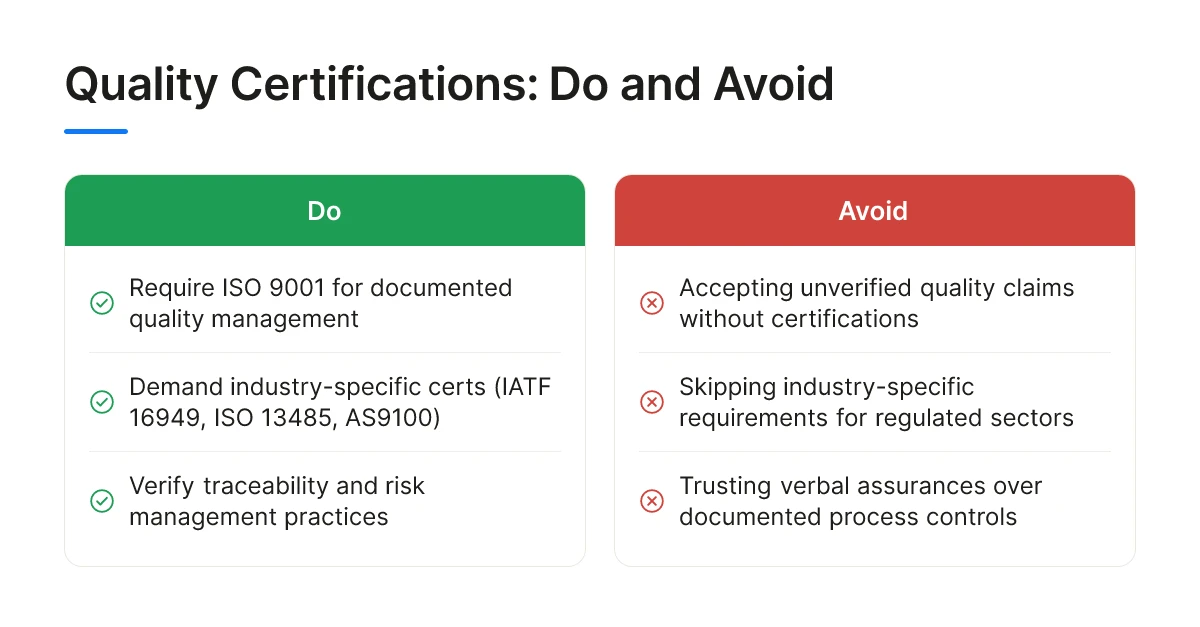
ISO 9001 verifies that a shop has a documented, repeatable quality management system, not that every part is perfect, but that errors get caught and corrected systematically. Industry-specific certifications (IATF 16949 for automotive, ISO 13485 for medical devices, AS9100 for aerospace) go further, requiring traceability, risk management, and design-control practices tied to in a regulated industry. Choosing the right certifications depends on where your parts end up, since aerospace-grade components demand different compliance than consumer hardware.
How do you verify a vendor’s inspection capabilities?
Ask for specifics: first-article inspection reports, statistical process control charts from repeat runs, and calibration records for gauges used on your parts. A logo on a website proves nothing on its own. Request a redacted quality report or audit certificate from an actual job, and look for vendors who can tie their certifications to specific part types they’ve shipped, a blanket certification list without shipped examples is a weaker signal than one documented success in your part category.
3. Lead Time and Delivery Reliability
A quoted lead time only matters if it matches the vendor’s actual on-time shipment history, so verify delivery data before committing.
What turnaround guarantees should you negotiate?
A number on a quote is a promise, not a guarantee. Get the lead time committed in writing, along with a clear communication protocol for what happens if a run slips, who notifies whom, and by when. Vendors serious about on-time performance will put this in the contract rather than leave it as a verbal assurance. When considering custom machining services, this point stands out.
How do you assess a vendor’s on-time delivery track record?
Ask for historical on-time delivery rates, not just current quoted turnaround, since the two diverge once queue depth, tooling changeovers, and outsourced finishing steps enter the picture. A shop juggling multiple jobs on the same equipment can quote four weeks and still slip to six. One useful differentiator: ask how the vendor handles expedited reruns when a part fails inspection. A vendor with real capacity buffer can requeue and rerun quickly; one running at full capacity cannot, and that gap only shows up when something goes wrong.
4. Minimum Order Quantities and Batch Flexibility
MOQ policy determines whether you can prototype, bridge, and scale production with one vendor or get forced into splitting sourcing across suppliers.
How do minimum order quantities affect your sourcing decisions?
A vendor locked into high MOQs pushes you toward overstock you don’t need or forces a second supplier relationship just to cover prototype and low-volume orders. That means two qualification processes, two quality systems to audit, and two sets of lead times to track. GC INDUS accepts orders starting from a single piece, which removes that forced split and lets one qualified partner cover prototyping through full production.
What flexibility should you expect on small runs versus production volumes?
Low-volume flexibility supports design iteration without re-qualifying a new vendor every time a revision is needed, a real cost in regulated industries where vendor approval itself takes weeks. Batch-size flexibility also signals something about the shop floor: quick-change fixturing and flexible scheduling let a vendor run a 5-piece order Tuesday and a 5,000-piece order Thursday without disruption. Ask whether pricing scales smoothly from prototype to production volume or jumps sharply at set tiers, a smooth curve suggests efficient setup; a cliff suggests the vendor is better suited to one volume range than the other.

5. CNC Equipment Range and Surface Finish Options
Equipment breadth and an in-house finishing menu show whether a vendor can take a part from raw stock to finished assembly without blind subcontracting. For those exploring custom machining services, this matters.
What CNC machine types indicate a vendor can meet your precision needs?
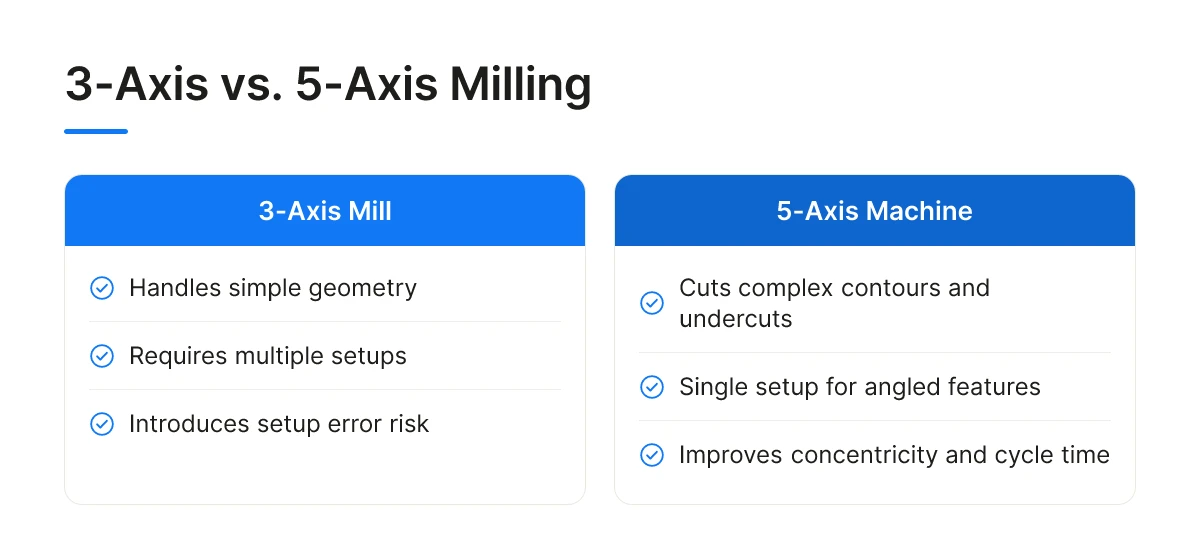
A 3-axis mill handles simple geometry but often needs multiple setups for complex parts, and every extra setup is another chance to introduce error. A 5-axis machine can cut complex contours, undercuts, and angled features in a single setup, improving concentricity and cutting cycle time. Shops offering Swiss lathe turning, wire EDM, and grinding alongside milling can handle a broader range of part geometries without handing work to a second vendor, equipment range is one of the clearest signals of whether custom machining services can cover a project end to end.
What surface finishes and secondary operations should a vendor offer?
Finish requirements fall into three categories: cosmetic (bead blasting, polishing), functional (tight-tolerance grinding, passivation for fit and wear), and corrosion resistance (anodizing, plating). A vendor offering these in-house, alongside heat treatment and assembly, reduces the handoff risk that comes with shipping parts to a third-party finisher. Ask directly whether finishing is done in-house or outsourced; outsourced finishing adds a lead-time and quality variable the vendor doesn’t fully control, since they’re now dependent on someone else’s schedule and inspection standards to meet your deadline.
6. Quality Assurance Documentation and Inspection Reporting
Documentation separates vendors who catch defects on the shop floor from vendors who let you discover them on the assembly line.
How does a vendor document compliance with your specifications?
A first-article inspection (FAI) report is the first proof point. It confirms the vendor read your drawing correctly and validated a single sample part against every called-out dimension before committing to a full run . Skipping this step is how a 500-piece order ends up 500 pieces wrong instead of one.
What inspection reporting should you expect before parts ship?
Expect coordinate measuring machine (CMM) reports, dimensional reports mapped directly to the print’s datum structure, and material certifications tracing the raw stock to its mill source . These documents should reference the same revision of the drawing you submitted, not a generic template.
Ask how the vendor handles non-conformance. A documented process, containment, root cause, corrective action, signals accountability; a verbal “we’ll fix it” doesn’t. The sharpest differentiator: does the vendor share inspection data per batch automatically, or only hand it over after you’ve asked because something already went wrong? This directly impacts custom machining services outcomes.
7. Cost Structure and Value Beyond the Quote
The lowest unit price on a quote sheet rarely reflects the lowest total cost once rework, delays, and expedite fees enter the picture.
How should you balance price against precision and delivery commitments?
Vendors generally fall into budget-friendly, mid-range, and premium tiers, and the tier usually reflects tooling investment, certification overhead (ISO 9001, ISO 13485), and in-house finishing capability rather than arbitrary markup . A premium-tier shop quoting higher per piece may still cost less across a program if it eliminates rework and missed ship dates.
What cost factors should you compare across vendor quotes?
Ask vendors to itemize rework risk from tight tolerances, expedite surcharges, shipping costs from splitting work across multiple suppliers, and the requalification expense of switching vendors mid-program . These are the line items that don’t show up on page one of a quote but show up on the invoice six months later.
A single scrapped batch or a missed delivery window on a line-down part can outweigh months of per-piece savings. When comparing custom machining services, request a cost breakdown, not just a bottom-line number, so tooling, inspection, and finishing costs are visible individually .
8. Industries and Applications That Depend on Precision Machining
Aerospace, medical device, and automotive programs impose the strictest documentation and certification demands because part failure there carries safety and regulatory consequences.
Which sectors rely most heavily on precision custom machining?
Aerospace buyers typically require AS9100 alongside full material traceability; medical device manufacturers need ISO 13485 compliance covering biocompatible materials and sterile assembly . Automotive Tier 1 and Tier 2 suppliers sit close behind, driven by high-volume consistency and PPAP-style documentation.
Not every part warrants that level of rigor. A load-bearing structural bracket or a surgical instrument component demands tight tolerance control and full inspection records; a cosmetic housing with no functional tolerance can tolerate a lighter vetting process. Fluid-power fittings sit in between, dimensional accuracy affects sealing and performance even though the application isn’t life-critical. This is particularly relevant for custom machining services.
A vendor’s existing industry mix tells you whether they’re already set up for your sector’s compliance burden, or whether you’d be asking them to build that infrastructure on your dime.
How to Choose the Right Custom Machining Services Partner
Shortlist by capability match, verify with sample inspection data, then confirm with a trial part before committing to production volume.
What steps should guide your vendor selection process?
Start by narrowing candidates to those with the equipment and certifications your part actually requires, not every shop needs 5-axis milling or Swiss lathe turning, but your part might . Request a sample CMM report and first-article inspection documentation before placing an order, then run one trial part or a small batch to confirm the vendor’s process matches their paperwork.
How do you use past projects to evaluate vendor capability?
Ask for references tied to parts similar in complexity and tolerance to yours, not just a general client list. A vendor serving 300-plus companies across medical, automotive, and electronics sectors, for instance, should be able to point to comparable completed work rather than promises .
Weight the criteria by project type: a one-off prototype favors speed and low minimum order quantities, while a long-term program favors certification depth and documented process control. No single factor, price, speed, or a certification logo alone, substitutes for checking all eight criteria together. Providers like GC INDUS, which combine ISO 9001 and ISO 13485 certification with MOQs starting at one piece, illustrate what a program-ready custom machining services partner should offer end to end.

Frequently Asked Questions
What technical specifications should you verify before hiring a custom machining vendor?
Verify achievable tolerance range, surface finish capability, material certifications, and available processes before signing a contract. Ask for documented tolerance capability by process, a shop quoting ±0.001mm on a Swiss lathe job should show inspection reports proving it, not just a spec sheet claim. Confirm material traceability and finishing options match your part’s application. When considering custom machining services, this point stands out.
How do you assess whether a vendor can handle your part’s complexity?
Match the vendor’s equipment list and process mix against your part’s geometry, tolerances, and material before quoting. A shop running only basic 3-axis mills can’t hold position tolerances that require 5-axis or Swiss lathe work. Request sample parts or case examples from jobs with similar complexity rather than relying on a general capabilities list.
What should a vendor’s quote itemize besides unit price?
A complete quote breaks out tooling costs, material costs, finishing steps, inspection protocols, and lead time separately from unit price. This lets you compare vendors on actual scope rather than a single number that might hide missing finishing or incomplete inspection. Ask what quality documentation is included, first-article inspection, material certs, or dimensional reports.
How many vendors should you shortlist before awarding a machining project?
Shortlist three to five vendors to compare capability, pricing structure, and responsiveness without overextending your evaluation time. Fewer than three limits use and comparison data; more than five slows decision-making without adding meaningful insight. Narrow the list using certifications and equipment fit before requesting detailed quotes.
What is the risk of choosing a machining vendor on price alone?
Price-only selection raises the risk of rework, missed deadlines, and quality escapes that cost more than the initial savings. A low bid often excludes inspection steps, finishing, or capacity buffers that a thorough quote would include. Low price with weak quality systems is a common source of field failures in regulated industries like medical and automotive.
Conclusion
Vendor selection comes down to three checks: documented tolerance capability, quality certifications relevant to your industry, and quotes itemized enough to compare on more than price. Shops that combine ISO 9001 and ISO 13485 certification, multi-process capability, and flexible order quantities reduce the coordination burden of managing separate CNC, casting, and molding suppliers. GC INDUS applies this model directly, ±0.001mm tolerances, in-house finishing and assembly, and MOQs from 1 piece let OEM and medical device buyers consolidate sourcing without compromising on inspection protocols. Before your next RFQ, pull your last three vendor quotes and check whether each one itemizes tooling, inspection, and finishing separately, if not, request a revised quote before comparing bids.
Recommended Articles
Explore more from our content library:


