
Book Appointment Now

GC INDUS / MANUFACTURING KNOWLEDGE
7 Questions to Ask Any Industrial Parts Manufacturer

Choosing the right industrial parts manufacturer comes down to matching their certifications, process capabilities, and tolerance range to your part’s actual requirements, not just comparing quoted prices. The strongest evaluations weigh quality systems (ISO 9001 and industry-specific standards), proven on-time delivery, transparent cost drivers, and the ability to scale volume without losing precision. Ask about inspection protocols, lead time flexibility, and tolerance capability before committing, and validate claims with a trial order or audit rather than taking a sales pitch at face value.
1. Quality Certifications That Signal a Trustworthy Industrial Parts Manufacturer
ISO 9001 confirms a documented, repeatable quality management system is in place, it doesn’t certify that a shop can hold ±0.005mm on a titanium part. Buyers who stop at “ISO 9001 certified” on a website are checking a box, not verifying capability.
What’s the Difference Between AS9100 for Aerospace and IATF for Automotive Requirements?
AS9100 and IATF 16949 are industry-specific overlays built on top of ISO 9001’s base framework, adding traceability and risk-management requirements specific to aerospace and automotive supply chains, respectively. A medical device buyer needs neither, the relevant standard is ISO 13485, which governs design controls, risk management, and traceability for devices where a part failure has patient-safety consequences. GC INDUS holds both ISO 9001 and ISO 13485, covering general industrial quality management and medical-grade compliance under one roof.
How Do Industry-Specific Certifications Affect Pricing and Lead Times?
Industry-specific certifications add documentation and traceability steps, material certs, batch records, process validation reports, that lengthen the paperwork trail around a production run without necessarily changing the machining itself. Best for regulated industries, aerospace, medical, automotive, where a failure in the field costs far more than the added administrative time. The differentiator competitors miss: ask any industrial parts manufacturer for a redacted audit report or the certificate’s scope of registration, not just a logo in the website footer. A logo tells you nothing about which processes or sites the certification actually covers.
2. Manufacturing Process Capability Match
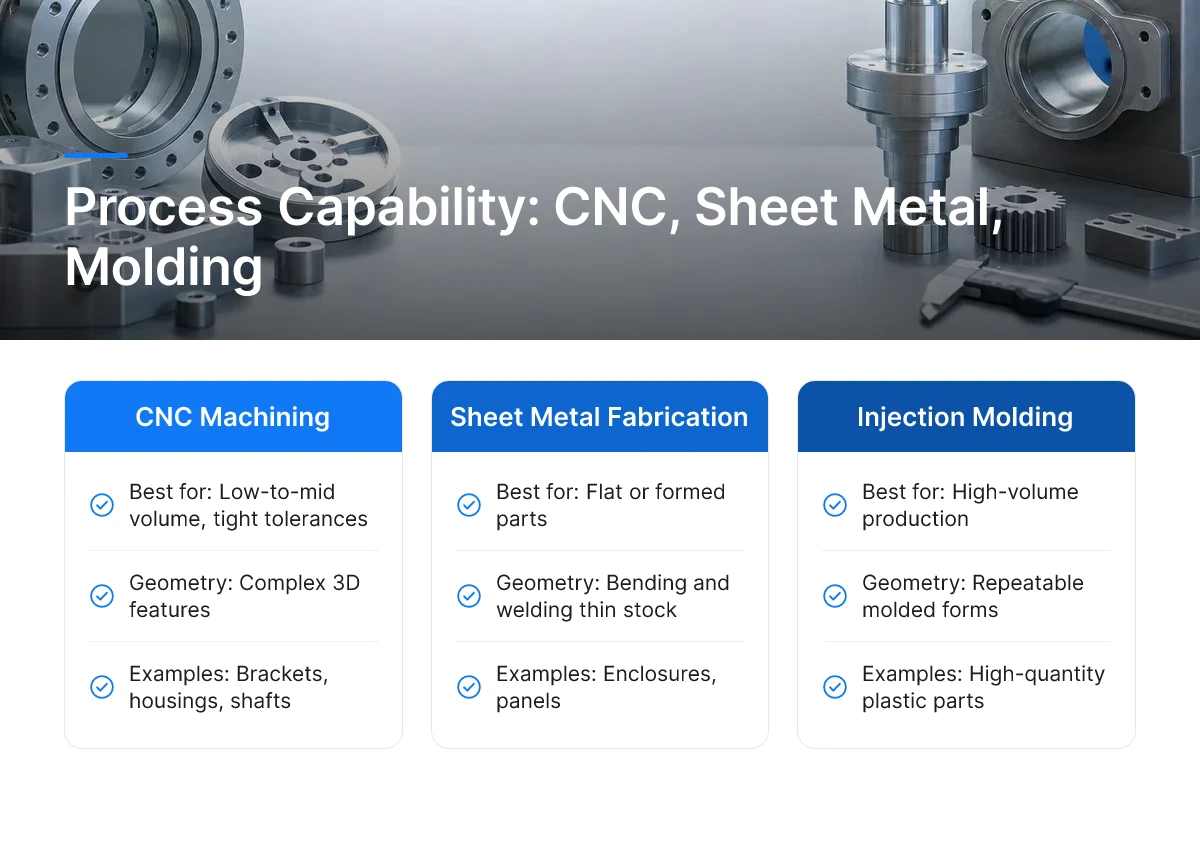
The right process depends on part geometry, material, and volume, CNC machining, sheet metal, and injection molding each win in different zones of that matrix.
What’s the Difference Between CNC Machining, Sheet Metal Fabrication, and Injection Molding for My Needs?
CNC machining wins for low-to-mid volume runs with tight tolerances and complex 3D geometry, brackets, housings, shafts with features that can’t be stamped or molded economically. Sheet metal fabrication fits flat or formed parts like enclosures and panels, where bending and welding thin stock is faster than removing material from a block. Injection molding makes sense once volumes climb high enough to amortize the tooling cost over thousands of plastic parts; below that threshold, machining a handful of plastic prototypes is usually cheaper than cutting a mold.
Which Manufacturing Process Offers the Best Cost-to-Precision Ratio for Custom Parts?
There’s no single winner, the tradeoff is tooling investment versus unit cost. Molding requires upfront tooling spend that only pays off at volume; machining has near-zero tooling cost but higher per-part machine time, so unit cost drops slower as volume rises. This is best for buyers staring at a CAD file or sketch with no manufacturing background, unsure which route fits their part. The differentiator: an industrial parts manufacturer offering CNC, die casting, and injection molding in-house, as GC INDUS does, removes the quality handoff risk of splitting a project across separate vendors for machining and molding.
3. Precision Tolerance Capability
Holding a tight tolerance on a single sample part proves little, holding it across a 5,000-piece run as tooling wears and machines drift is the real test.
How Do Tight Tolerances Like ±0.001mm Affect Manufacturing Cost and Feasibility?
Tolerance requirements interact directly with material choice, some metals and plastics move more during cutting or cooling, so a tolerance that’s routine in steel can be difficult to hold in a part prone to warping. Tighter tolerances also raise cost through a clear mechanism: slower cycle times to avoid tool deflection, more frequent in-process inspection, and higher scrap rates when a cut runs out of spec. GC INDUS holds tolerances as tight as ±0.001mm using 5-axis CNC and Swiss lathe equipment, but even at that level the cost driver is the same, cycle time and inspection frequency, not a flat “precision surcharge.”
What Tolerance Capabilities Should I Verify Before Placing an Order?
This matters most for buyers with mating parts, assemblies, or regulated specs, where a fit failure downstream costs far more than the part itself. Best practice: ask the manufacturer for an actual CMM or coordinate measuring report format before ordering, not just a tolerance figure printed in a capabilities brochure. A sample inspection report shows how they document variation across a batch, a tolerance claim alone shows nothing.
4. Lead Time and Turnaround Reliability
A quoted lead time reflects best-case capacity, not what a manufacturer has actually delivered on comparable orders over the past year.
What Rush Order Capabilities Should I Expect from a Reliable Partner?
Real rush capability means a dedicated capacity buffer set aside for urgent orders, not simply pushing another customer’s job back in the queue to fit yours in. Ask directly how rush orders are scheduled; a vague answer usually means the second scenario. This is best for buyers running just-in-time production schedules or facing seasonal demand spikes, where a missed date stalls a downstream line.
How Do I Factor Lead Time into My Supply Chain Planning?
Ask for recent order data, actual ship dates against original quotes on the last quarter’s orders, rather than accepting a standard brochure figure. What breaks supply chain planning usually isn’t a long average lead time; it’s variability. A manufacturer that’s reliably three weeks out is easier to plan around than one that swings between one week and five depending on workload. GC INDUS serves 300+ companies globally and structures production around full inspection protocols precisely to keep that variability narrow.
5. Cost Structure and Pricing Transparency
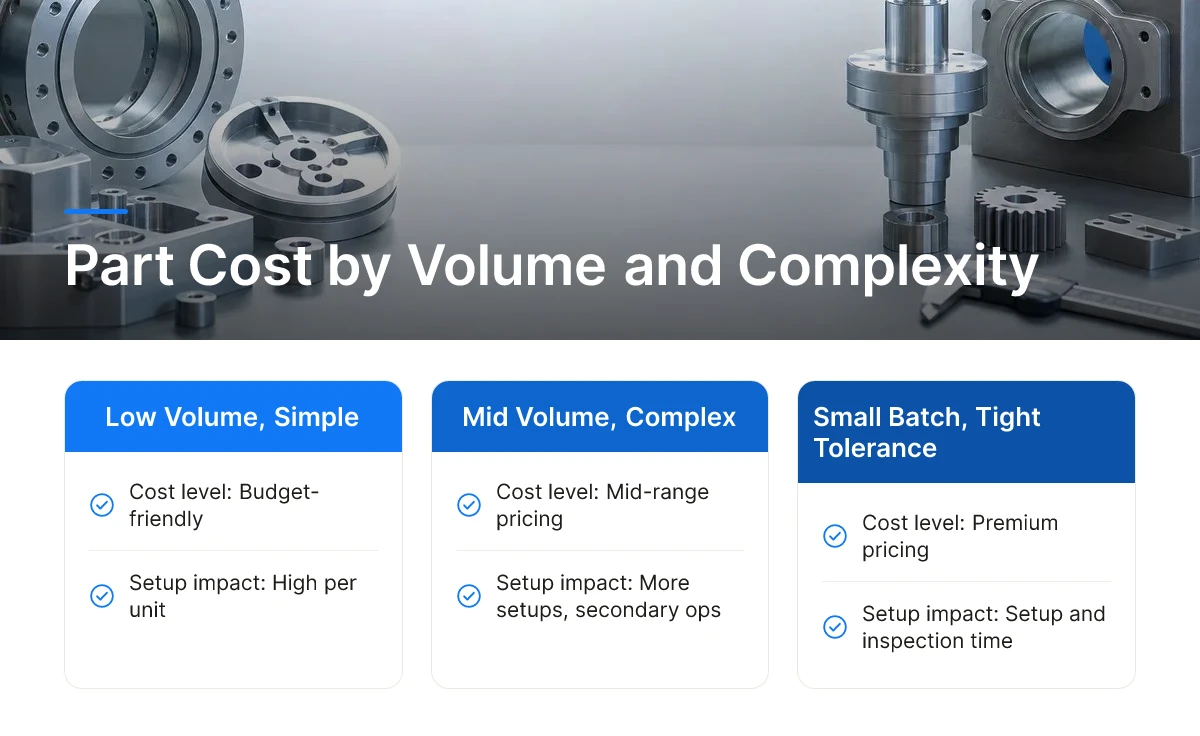
Part cost comes from the number of setups, tool changes, and secondary operations a part requires, not from a single opaque “complexity fee” on the quote.
How Do I Estimate Manufacturing Costs for Different Order Volumes?
Volume changes per-part cost by spreading tooling and setup time across more units. A simple part in low volume is usually budget-friendly; mid-range pricing shows up as geometry gets more complex, more setups, more secondary operations like deburring or anodizing; premium pricing applies to tight-tolerance parts made in small batches, where setup and inspection time can’t be spread across many units. Buyers comparing multiple quotes for the same part should expect this pattern to explain most of the price gap between them.
What Pricing Transparency Should I Expect from a Manufacturer?
A transparent quote itemizes material cost, machine time, tooling, inspection, and finishing separately, so you can see exactly what drives the total. An opaque lump-sum quote hides which line item is actually expensive, often finishing or inspection, not the machining itself. This is best for buyers juggling several quotes who need to know why one industrial parts manufacturer came in lower than another, rather than just picking the cheapest number on the page.
6. On-Time Delivery Track Record
Verify delivery performance with client references, sample project documentation, and a direct question about how the manufacturer calculates its on-time rate.
What Metrics Should I Use to Measure a Manufacturer’s Performance Over Time?
Ask for references from current clients in your industry, a medical device company wants to hear from other medical device clients, not just automotive accounts. Request sample past-project documentation showing planned versus actual ship dates, not just a summary percentage.
Ask directly how the on-time delivery rate is calculated: does it count a part shipped one day late as a miss, or does the shop round up? A manufacturer willing to walk through its methodology is giving you something you can verify. One that deflects with “we’re basically always on time” is not.
How a shop discusses past misses tells you more than a flawless record claim. A manufacturer that can describe a specific delay, what caused it, and what corrective action followed, a new incoming-material check, a revised scheduling buffer, is more credible than one that insists it has never missed a date.
How Do Case Studies and Past Projects Demonstrate Manufacturing Capability?
Read case studies for substance, not adjectives. A useful case study names the part type, the specific problem, tolerance drift on a titanium housing, a finish failing salt-spray testing, and the process change that fixed it, not phrases like “exceeded expectations.”
This approach suits buyers who have already been burned by a vendor’s missed commitment and want proof before signing, not promises.
7. Supply Chain and Logistics Capability
A manufacturer’s logistics setup and supplier network determine your real-world reliability as much as what happens on their shop floor.
How Do I Assess a Manufacturer’s Supply Chain and Logistics Capabilities?
Raw material sourcing reliability matters as much as machining capability. A shop with excellent CNC equipment but an unreliable aluminum or stainless supplier will still hand you late parts, the bottleneck just moves upstream.
Ask about packaging standards for sensitive components, freight partnerships for cross-border shipments, and how the manufacturer handles customs documentation if you’re importing. A manufacturer with established freight lanes and export experience avoids the customs delays that catch first-time importers off guard.
Fragmented supply chains add risk. When plating, heat treatment, and specialty finishing each sit with separate sub-suppliers, every handoff is a point where a part can sit in queue or get lost in transit, and lead time variability compounds with each added vendor.
What Guarantees Should I Negotiate Regarding Quality and Delivery?
Negotiate clear terms on inspection criteria, replacement timelines for out-of-spec parts, and communication protocols for delays before they happen, not after. This matters most for buyers importing parts or running lean inventory with little buffer stock, where a single late shipment can stop a production line.
8. Scalability for Future Growth
Confirm spare machine capacity, shift flexibility, and whether prototype runs use the same process as production before committing long-term.
What Production Capacity and Flexibility Should I Verify Upfront?
Ask whether the shop has spare machine capacity or second-shift availability to absorb volume growth, rather than running at full capacity with no room to flex. Ask specifically whether your low-MOQ prototype run uses the same tooling, fixturing, and inspection process as the eventual production run, if not, a part that passed first-article inspection at quantity one can behave differently at quantity ten thousand.
How Do I Ensure a Manufacturer Can Handle Increased Volumes Without Compromising Quality?
A shop that handles prototypes well but lacks a documented quality system often struggles to hold consistency once volume increases, tribal knowledge that worked for five pieces does not scale to five thousand. Look for ISO 9001 or equivalent certification as evidence the process is repeatable, not just skilled.
Flexible minimum order quantities let you test a partner at low risk before scaling commitment. GC INDUS accepts orders starting from 1 piece, which means a buyer can validate quality and communication on a small run before placing a production-volume order with the same vendor. This setup suits startups and growing manufacturers planning to move from prototype to volume production without re-qualifying a new supplier at each stage.
9. A Smooth Transition to a New Manufacturing Partner
Switch vendors safely with a staged process: first article inspection, a pilot batch, then parallel running before fully cutting over.
What Should a Manufacturer Do to Ensure a Smooth Onboarding Process?
A responsible manufacturer starts with first article inspection on your exact specifications, moves to a pilot batch at modest volume, and only then recommends running the new supplier in parallel with the old one before you cut over completely. This staged approach catches tolerance or finish issues while you still have a fallback supplier in place.
Documentation handoff reduces risk at every stage. Complete drawings, material specs, and inspection criteria transferred clearly to the new manufacturer prevent the kind of misreads that cause early-batch rejects.
How Can I Validate a New Partner’s Quality Before Full-Scale Production?
Validate quality with a trial order before committing to full volume. Reviewing a small batch against your inspection criteria protects against surprises that only show up at scale, like a plating adhesion issue that a five-piece sample wouldn’t reveal.
This process fits buyers replacing an underperforming vendor who can’t tolerate a gap in production, proof of consistency has to come before the old supplier relationship ends, not after.
How to Choose the Right Industrial Parts Manufacturer for Your Project
Weight certifications and tolerance capability first for regulated or precision-critical parts, then compare cost and lead time across a qualified shortlist.
Start by filtering out any industrial parts manufacturer that lacks the certification your part requires, ISO 13485 for medical devices, for example, regardless of price or lead time. Once you have a shortlist that meets the quality bar, cost and turnaround become the deciding factors, not before.
Request a small trial order or sample part as the final filter before signing a long-term contract. A trial run surfaces communication gaps, documentation issues, and quality variance that a sales conversation never will.
Document the chosen process and specifications clearly once you commit, so tolerances, materials, and inspection criteria are traceable from day one rather than left to informal email threads, our guide to documenting manufacturing processes covers how to set this up. If you’re replacing a vendor and working from an existing part with no current drawings, reverse engineering that part becomes a necessary first step, which we cover separately in our guide to reverse engineering parts.
Choosing an industrial parts manufacturer this way, certification first, trial order last, turns a marketing pitch into a verified decision backed by your own evidence.

Frequently Asked Questions
How do I verify a manufacturer’s quality assurance processes before signing a contract?
Ask for the inspection protocol documentation, not just a certificate number. A manufacturer should show you first-article inspection reports, statistical process control data, and calibration records for measurement equipment. Request a sample inspection report from a past project similar to yours, and confirm whether final inspection happens in-house or gets outsourced, outsourced inspection adds lead time and risk.
What certifications beyond ISO 9001 should I prioritize for my industry?
Match the certification to your end application: ISO 13485 for medical devices, IATF 16949 for automotive, AS9100 for aerospace. ISO 9001 covers general quality management but doesn’t address sector-specific risk controls. GC INDUS holds both ISO 9001 and ISO 13485, which matters if your parts feed into regulated medical assemblies rather than general industrial equipment.
What questions should I ask before committing to an industrial parts manufacturer?
Ask about tolerance capability, minimum order quantity, lead time under normal and rush conditions, and how they handle design revisions mid-production. Also ask who owns your CAD files and whether an NDA is standard before you share them. Finally, confirm whether they produce every process in-house, CNC, casting, molding, finishing, or subcontract parts of the job, since each handoff point is a place where tolerance and schedule commitments can slip.
How do case studies and past projects actually demonstrate manufacturing capability?
A relevant case study shows the manufacturer has solved a problem structurally similar to yours, not just worked in your industry. Look for specifics: part tolerance achieved, material, volume, and whether the project moved from prototype to production without changing vendors. Vague claims of experience without project details are a signal to ask more questions.
What guarantees should I negotiate regarding quality and delivery?
Negotiate explicit terms for out-of-tolerance parts, rework responsibility, and delivery delay remediation before signing, not after a problem occurs. Put inspection protocol, acceptable defect rate, and on-time delivery commitments in writing as contract terms, not verbal assurances.
Conclusion
Selecting an industrial parts manufacturer comes down to three checks: verified quality documentation over sales claims, certifications matched to your actual regulatory exposure, and a contract that names tolerance, delivery, and rework terms explicitly. Manufacturers who handle CNC, casting, molding, and finishing under one roof reduce the handoff points where quality and schedule commitments typically break down. GC INDUS applies this model with ISO 9001 and ISO 13485 certification, tolerances to ±0.001mm, and MOQs starting at one piece.
Next step: pull your current supplier’s last three inspection reports and compare the defect and rework rate against what you’d accept in a new contract’s written terms.
Recommended Articles
Explore more from our content library:


