
Book Appointment Now

GC INDUS / MANUFACTURING KNOWLEDGE
7 Ways Metal Fabrication Services Speed Up Your Projects

Specialized metal fabrication services cut project timelines by combining capabilities—in-house engineering review, multi-process production, and material sourcing—under one roof instead of splitting work across separate vendors. This removes the handoff delays, re-quoting, and shipping gaps that stack up when design, cutting, welding, and finishing each sit with a different supplier. For precision engineering clients, the timeline gain comes from fewer transitions, not just faster machines: consolidated capability, early design input, and parallel processing typically shave weeks off a project that would otherwise move sequentially between shops.
1. Consolidated Metal Fabrication Services Under One Roof
Sourcing cutting, forming, welding, and finishing from a single provider removes the re-quoting and shipping delays that stack up every time a part changes vendors. This is particularly relevant for metal fabrication services.
Each handoff between vendors adds more than labor time. It adds a new quote cycle, a shipping leg, and a spot in someone else’s scheduling queue, often multiple days lost before the part is even touched. A project that moves through four separate shops for laser cutting, forming, welding, and plating can lose more calendar time to queueing and transit than to the actual manufacturing steps.
What Fabrication Processes Impact Speed and Precision in Custom Manufacturing?
Sequential multi-vendor workflows force each process to wait its turn in line behind unrelated jobs at unrelated facilities. Parallel in-house workflows compress that critical path because cutting, machining, and finishing can be scheduled against the same production plan instead of four independent ones. This matters most for precision engineering clients running multi-part assemblies or parts that need several processes, laser cutting, CNC, welding, performed in sequence on the same component.
Consolidated metal fabrication services also cut the number of quality handoffs. Every vendor transition typically means a new incoming inspection, which duplicates checks that were already performed before shipping. Fewer transitions mean fewer redundant inspection cycles and fewer chances for a dimensional issue to slip through in the gap between two companies’ quality systems.
2. Design-for-Manufacturing Review Before Production Starts
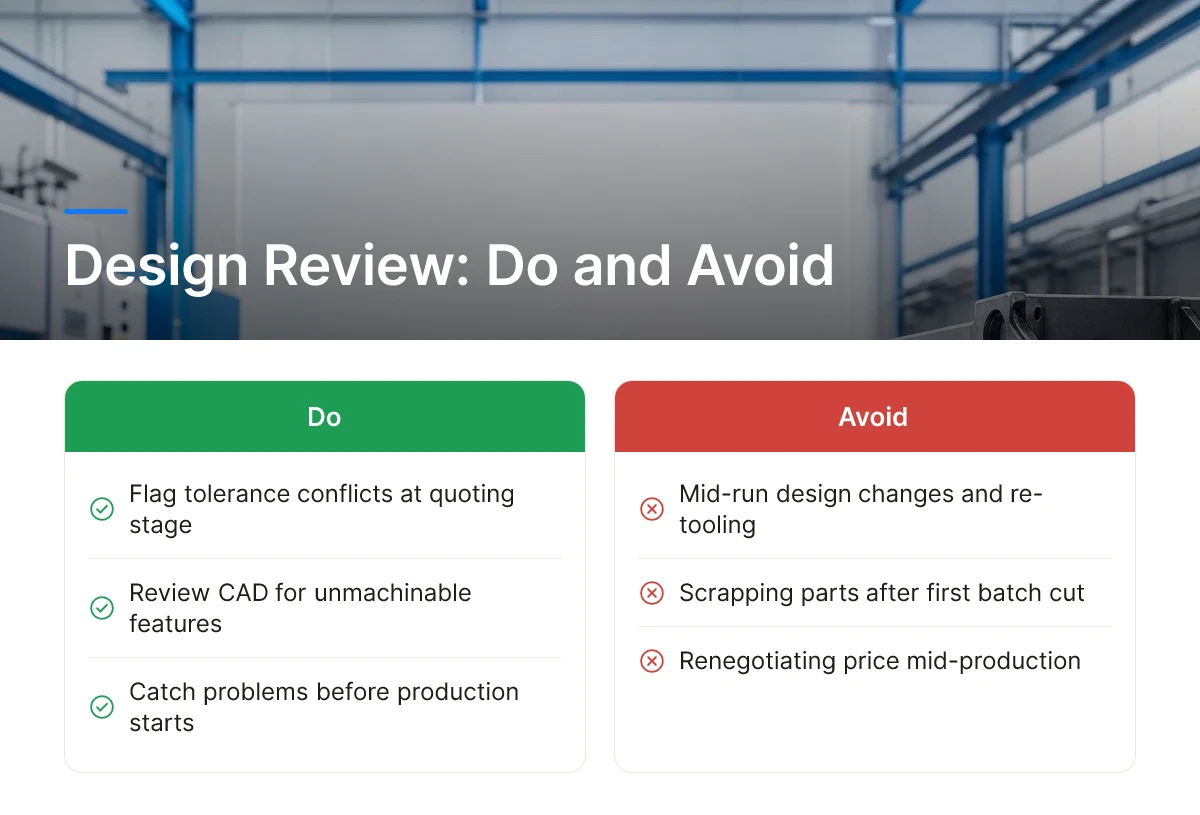
A design-for-manufacturing review at the quoting stage flags tolerance conflicts and unmachinable features before they turn into costly mid-run changes.
Catching a tolerance stack-up or a feature that can’t be reached by a standard tool at the drawing stage avoids re-tooling, re-fixturing, and re-quoting once a production run is already underway. Fixing a problem on a CAD file costs a review cycle. Fixing the same problem after the first batch has been cut and machined costs scrapped parts, a schedule slip, and a renegotiated price. This fits engineering teams finalizing prototypes before committing to production volume, where a missed detail multiplies across hundreds or thousands of units instead of one.
How Does Design-for-Assembly Reduce Lead Times and Improve Project Economics?
Design-for-assembly works alongside DFM by simplifying what happens after the parts are made. Standardizing hole patterns and cutting down the number of unique fastener types reduces assembly labor and the error rate on the shop floor, since technicians handle fewer part numbers and fewer chances to grab the wrong hardware.
The differentiator is who reviews the drawing. A fabrication partner that routes designs through production engineers, not just a sales estimator, before quoting catches interference issues, unreachable tolerances, and assembly conflicts that a generic quote process typically misses until parts are already in the machine.
3. Multi-Axis CNC Machining for Complex Geometries
Multi-axis CNC machining cuts cycle time on complex parts by reducing the number of separate setups a part needs to reach every feature. When considering metal fabrication services, this point stands out.
Machining time is lost primarily in fixture changes and re-zeroing, not in the cut itself. Every time a part comes off the machine to be repositioned, the shop loses time to setup and risks introducing a small alignment error. A 5-axis machine reaches compound angles, undercuts, and multiple faces in a single setup, which is why it fits parts where several features carry tight tolerance relationships to each other, a mounting face and a bore that must stay aligned, for example.
Fewer repositioning steps also means fewer chances for runout error to creep in, which is the quality side-benefit of consolidating setups: tighter tolerance holding as a direct result of touching the part fewer times. GC INDUS runs 5-axis and Swiss lathe CNC equipment capable of holding tolerances to ±0.001mm, which depends on this kind of setup discipline as much as on the machine itself. Readers wanting the deeper mechanics of runout tolerance and axis configuration should look at a dedicated technical guide on multi-axis CNC machining.
4. Laser Cutting and Automated Nesting for Faster Throughput
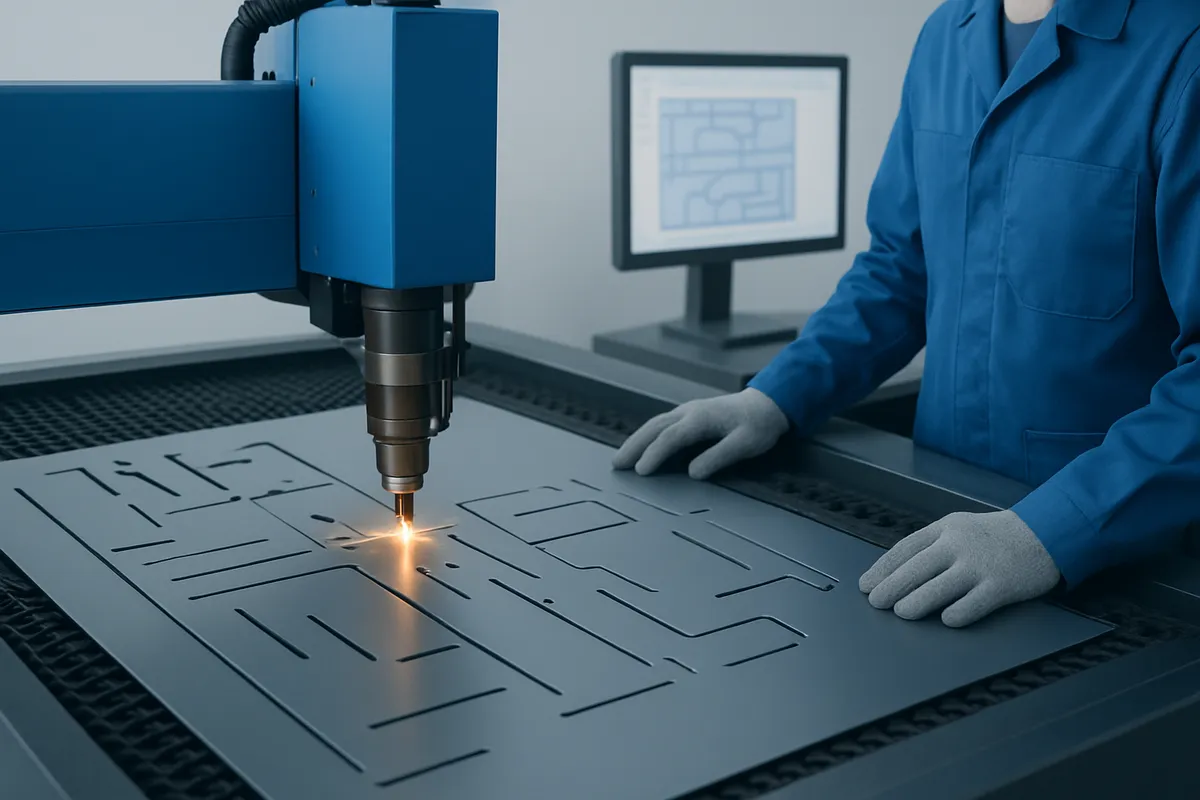
Automated nesting software packs parts tighter onto a sheet than manual layout, cutting material waste and the number of sheet changes per job.
Nesting software calculates the most efficient arrangement of parts on a given sheet size automatically, which reduces scrap and shortens the run by minimizing how often an operator has to load a new sheet. This fits flat-pattern sheet metal parts produced in small-to-mid batch runs, where layout efficiency has an outsized effect on both cost and schedule.
Laser cutting itself outperforms punching or manual cutting on irregular geometries, since a laser doesn’t need a dedicated tool or die for every new shape, it follows the programmed path directly. Punching remains competitive on high-volume simple shapes, but for mixed or complex outlines across metal fabrication services, laser cutting avoids tooling changeover entirely.
Nesting also speeds up quoting. Material usage is calculated by the software instead of estimated by hand, so a quote reflects actual sheet consumption rather than a rounded-up guess, shortening the time between RFQ and a firm number.
5. Flexible Minimum Order Quantities for Prototyping and Scale-Up
Accepting orders as small as one piece lets engineering teams validate a design before committing to tooling or a full production batch.
Low minimum order quantities remove the wait that comes with batch commitments. A team can test fit and function on a single part, adjust the design, and run another single part, instead of ordering a minimum batch of 50 or 100 units just to get a quote accepted. This fits R&D teams and companies iterating across multiple design revisions, where the cost of overordering an early, likely-to-change part outweighs any per-unit savings.
Single-piece runs sit at a budget-friendly entry point built for validation rather than unit economics; per-part cost drops as volume increases once the design is locked. GC INDUS quotes from 1 piece up through production volumes exceeding 100,000 units without forcing a minimum batch at the prototype stage. For those exploring metal fabrication services, this matters.
The differentiator is what a forced minimum does to a schedule: shops that require a minimum batch size push early-stage projects to either overorder or wait, both of which add delay. Flexible MOQ among metal fabrication services removes that bottleneck entirely, letting validation happen on the fabricator’s floor instead of a spreadsheet.
6. Material Selection Support for Steel, Aluminum, and Stainless
Material choice determines cost, weight, corrosion resistance, and machining time before a single cut is made, so the decision belongs at the design stage, not after.
How Do Material Choices Affect Both Fabrication Costs and Final Product Durability?
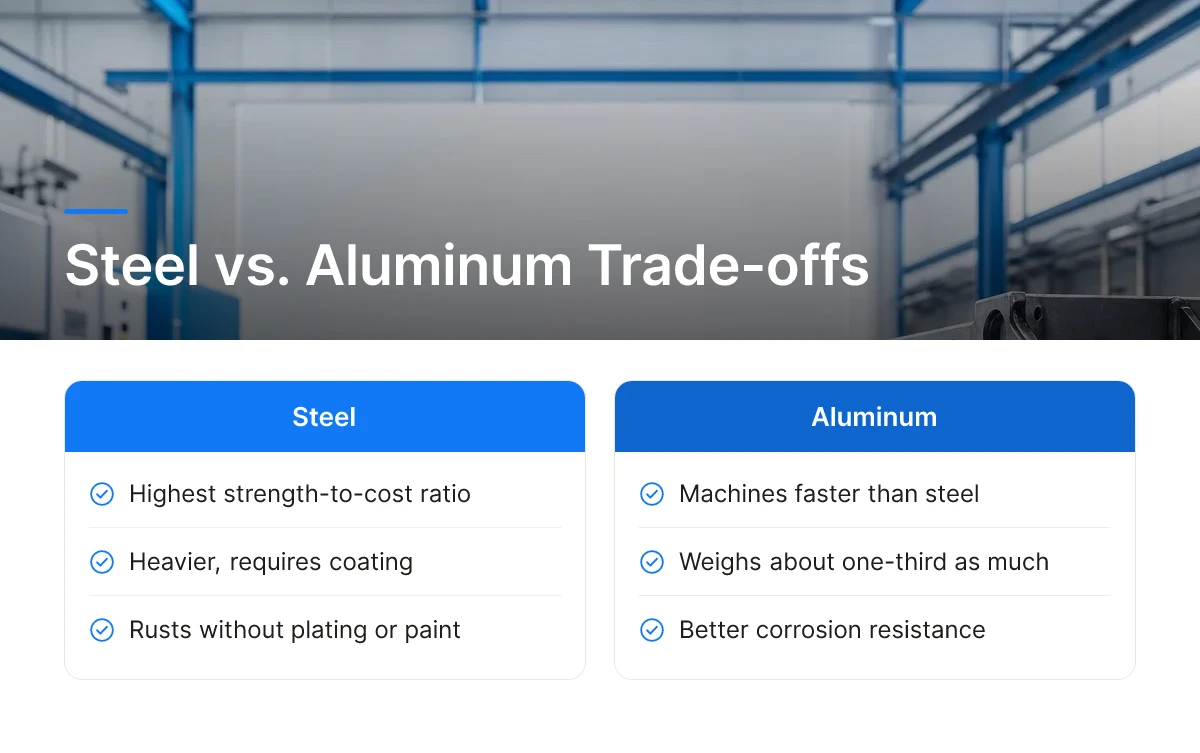
Steel offers the highest strength-to-cost ratio of the three, which makes it the default for structural brackets, frames, and load-bearing assemblies. The tradeoff is weight and corrosion exposure, uncoated steel rusts, so most steel parts need plating, painting, or galvanizing added to the process chain.
Aluminum machines faster than steel and weighs about a third as much, which suits parts where weight matters more than peak strength, enclosures, brackets for mobile equipment, aerospace-adjacent components. Its strength ceiling is lower, so it’s a poor substitute where steel-level load capacity is required.
Stainless steel gives the best corrosion and hygiene performance of the three, which is why medical devices and food-contact parts default to it despite the higher cost. It’s also the slowest to machine: stainless work-hardens under the cutting tool, which increases tool wear and forces slower cutting speeds. That mechanism, harder material, slower cutting, more tool changes, is the direct link between material choice and lead time on any quote for metal fabrication services.
GC INDUS works across aluminum, magnesium, iron, steel, and stainless, and flags material-driven lead time tradeoffs during quoting rather than after production starts.
7. ISO-Certified Quality Inspection Built Into the Workflow
Certified in-line inspection catches defects during production instead of at final QC, preventing an entire batch from being scrapped after the fact.
What Compliance Requirements Should You Verify for Your Industry and Application?
The mechanism is straightforward: a part checked mid-process against spec gets corrected or rejected before the next fifty pieces run behind it. Without in-line checks, a dimensional drift only surfaces at final inspection, by which point the whole batch may be out of tolerance and unusable.
This matters most in regulated industries, medical devices, aerospace, automotive, where a shipped defect isn’t just scrap cost but a compliance failure with documentation obligations. Buyers in these sectors should verify three things before signing a purchase order: ISO 9001 as the baseline quality management certification, ISO 13485 specifically for medical device manufacturing, and any sector-specific requirement relevant to the end application, such as automotive PPAP documentation. This directly impacts metal fabrication services outcomes.
A generic “we’re ISO certified” claim isn’t enough, ask which standard, and whether it covers the actual production line making the part. GC INDUS holds both ISO 9001 and ISO 13485 certifications and documents full inspection protocols per batch, which gives clients an audit trail rather than a bare pass/fail result, a meaningful difference when a regulatory auditor asks for traceability months after shipment.
How to Choose the Right Metal Fabrication Services Partner
Match a vendor’s in-house process list against your part’s full production chain, verify certification scope, and benchmark real lead times before committing.
Start by listing every process your part needs, machining, casting, coating, heat treatment, assembly, then check which of those the vendor actually performs in-house. Any gap means a hidden handoff to a subcontractor you can’t audit, and that’s where delays and quality escapes usually originate.
Next, verify certification scope matches your industry, not just a generic ISO 9001 badge on a website. A medical device part needs ISO 13485 coverage on the specific line producing it, not a corporate-level certificate that doesn’t apply to that facility.
Ask how design review actually works. A partner who reviews your CAD file with an engineer before quoting will catch tolerance or material issues early; one that only processes a web form usually finds those problems after tooling starts.
Request a sample lead-time comparison from a similar past project instead of relying on marketing promises, realistic turnaround numbers reveal more than a quoted “fast delivery” claim. Finally, weigh minimum order quantity against your project stage: prototyping needs a partner that accepts single-piece orders, while production scale needs volume pricing tiers. GC INDUS accepts orders from 1 piece and offers CNC, casting, molding, and assembly under one roof, which removes the multi-vendor coordination problem entirely.

Frequently Asked Questions
What are the most common cost drivers in metal fabrication projects?
Design complexity, material waste, and tolerance requirements drive most of the cost in a fabrication project. Tight bend radii, non-standard hole patterns, and excessive surface finish specs add setup time and tooling changes. Secondary operations, welding, heat treatment, assembly, also stack up quickly when they aren’t planned into the original design. Reviewing part drawings with your manufacturing partner before quoting catches most of these costs early. This is particularly relevant for metal fabrication services.
How can early partner involvement in design reduce rework and delays?
Involving your fabrication partner during design catches tolerance and manufacturability issues before tooling starts, cutting rework cycles later. A manufacturing engineer can flag problems a design engineer might miss, like a wall thickness that won’t survive die casting or a bend that needs custom tooling. At GC INDUS, we review CAD files (STEP, IGES) against process capability before quoting, which shortens the path from prototype to production.
What before-and-after metrics demonstrate the value of precision fabrication optimization?
Track scrap rate, first-pass yield, and lead time from RFQ to delivery before and after switching processes or partners. A drop in rework requests or inspection rejections signals real tolerance improvement. On-time delivery percentage and the number of supplier touchpoints per project are also useful, fewer vendors per part usually means fewer handoff delays and quality escapes.
How do we assess a partner’s capability to meet tight tolerances consistently?
Check certifications, equipment specs, and inspection protocols, not just quoted tolerance numbers. Ask for ISO 9001 or ISO 13485 documentation, sample inspection reports, and details on equipment like 5-axis CNC or EDM. GC INDUS holds tolerances to ±0.001mm and backs every order with full inspection records, which gives buyers a paper trail instead of a promise.
Conclusion
Faster, cheaper fabrication projects come from decisions made before the first cut: involve your manufacturing partner during design, consolidate processes with one vendor, and demand inspection data instead of tolerance claims. These three moves cut rework, shorten lead times, and remove the coordination overhead of juggling separate CNC, casting, and finishing suppliers.
Start your next project by sending your CAD files to a single-source partner capable of CNC machining, die casting, and assembly under one roof, and request a quote alongside a manufacturability review, not after tooling begins.
Recommended Articles
Explore more from our content library:


