
Book Appointment Now

GC INDUS / MANUFACTURING KNOWLEDGE
8 Traits of a Truly Great Automotive Parts Manufacturer

A great automotive parts manufacturer is judged by how well it controls variation, not by the equipment list on its website. The traits that separate a reliable precision partner from a risky one are: documented quality systems with built-in (not just end-of-line) inspection, relevant certifications backed by audit-ready records, engineers embedded in production rather than isolated in an office, clear answers on tolerance limits and special-process controls, vertical integration that reduces handoffs, proactive communication when problems arise, and the capacity to scale output without quality drift. Evaluating these traits together, not price alone, predicts whether a supplier will still be reliable a year into production.
1. Certifications and Compliance Built for Automotive Precision Work
The certificate on the wall confirms a documented quality system exists, it does not confirm anyone follows it consistently on the floor. Evaluating an automotive parts manufacturer means checking both the paperwork and the practice behind it.
Which Certifications Are Non-Negotiable for Automotive Precision Work?
ISO 9001 sets the baseline quality management system most manufacturers should hold, but it is a general standard, not an automotive one. IATF 16949 builds on ISO 9001 with requirements specific to automotive supply chains, defect prevention, reduced variation, and supply chain risk controls. AS9100 belongs to aerospace-adjacent work and matters less for standard automotive programs unless the part also serves a dual-use or aerospace application. Ask which standard applies to your specific part family before assuming the general certificate is enough.
How Do You Verify Compliance Documentation and Audit Readiness?
Request a recent third-party audit summary and a corrective action log from the last 12 months. A manufacturer with a mature quality system will produce these without hesitation and can walk through how a past nonconformance was resolved. Some automotive part families carry industry-specific requirements beyond the baseline certificate, specific PPAP documentation, customer-specific process controls, or material traceability rules. GC INDUS holds ISO 9001 and ISO 13485 certification and documents inspection protocols at each production stage, which gives buyers a paper trail to review rather than a certificate alone.
2. Quality Infrastructure That’s Built In, Not Bolted On
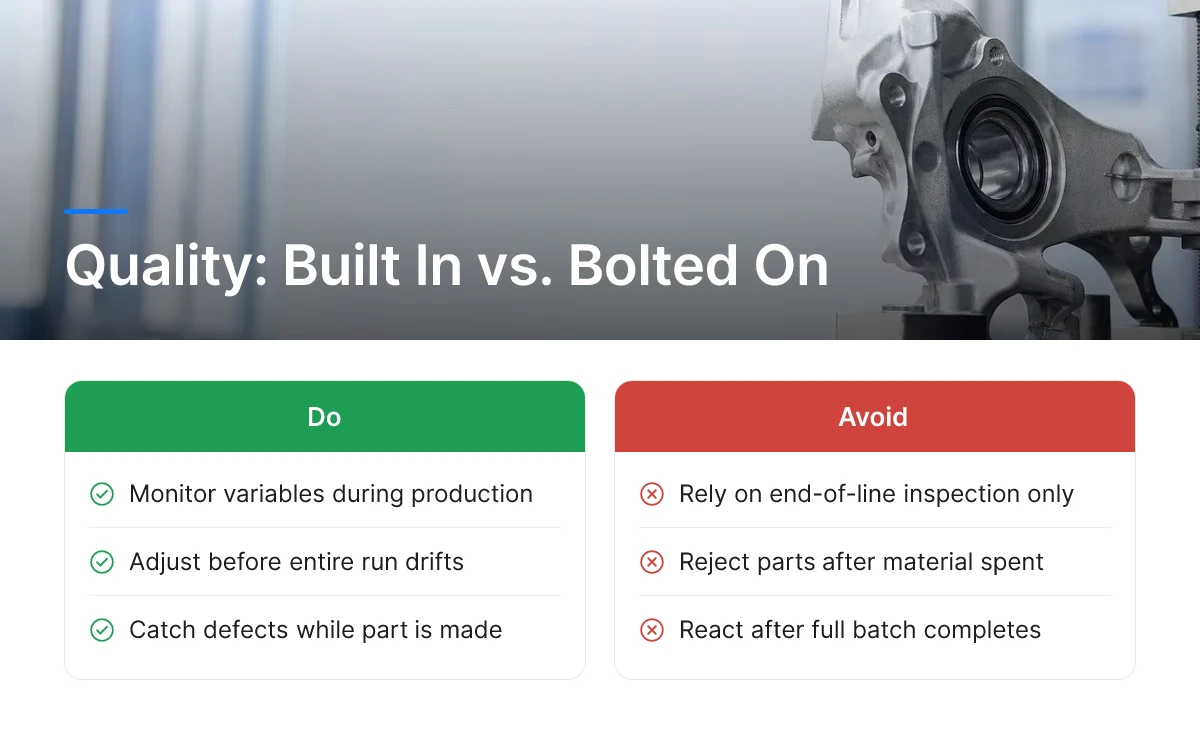
Quality built into each production step prevents defects before they happen, while inspection at the end of the line only catches them after material and time are already spent.
What’s the Difference Between End-of-Line Inspection and Built-In Quality?
End-of-line inspection checks finished parts against a specification and rejects what fails, useful, but reactive. In-process controls monitor the variables that create defects, spindle load, tool wear, dimensional drift, while the part is still being made, so a shop can adjust before an entire run goes out of tolerance. The mechanism matters because catching a defect at the last station means every part made since the last good check is now suspect.
How Should Documented Quality Procedures and Traceability Be Structured?
Traceability should tie a specific lot of raw material, with its certification, to a specific production run and the inspection records generated during that run. If a part fails in the field, that chain lets a manufacturer isolate exactly which batch is affected rather than recalling everything shipped that quarter. Ask to see first-article inspection reports, statistical process control charts, and calibrated gauge records, these are verifiable artifacts, not claims. This infrastructure matters most on tight-tolerance or safety-critical parts, where tracing a single missed defect back through an undocumented process can cost more than the part itself. GC INDUS runs full inspection protocols across CNC machining, casting, and molding processes, with documentation carried through each finishing step.
3. Engineering Involvement From Quote to Production
Engineers embedded in production catch manufacturability problems during setup, before a full run commits material, machine time, and schedule.
Why Does It Matter Whether Engineering Is Embedded in Production?
An engineer standing at the machine during first-article setup sees how a design actually behaves, where a wall thins out under a cutting load, where a tolerance stack-up creates fit problems. A manufacturer where engineering only reviews drawings on a screen and then hands the job to production loses that feedback loop entirely. Problems that would have surfaced in the first hour of machining instead surface after the full batch is done.
What Questions Reveal Whether a Manufacturer Understands Your Design Intent?
Ask directly who reviews the drawing before it reaches the floor, and whether that person asks about the part’s function rather than just reading print dimensions. A manufacturer that understands design intent will flag a feature that’s technically printable but functionally risky, rather than machining exactly what’s on the page and staying silent. That proactive feedback, not silent acceptance of a flawed print, is the signal worth testing for during the quoting stage, before the first purchase order is signed.
4. Honest Answers on Tolerances and Special Processes
A straight answer distinguishes the tightest tolerance a manufacturer can hit once from the tolerance it can hold reliably across an entire production run.
How Do You Get Honest Answers About Realistic Tolerances?
Ask two separate questions: what tolerance can you hold on a best-case sample, and what tolerance can you hold repeatably across a full production run. Those numbers are often different, and a manufacturer willing to explain the gap, rather than quoting the tighter number to win the job, is more trustworthy. A useful test is asking for a real example of a part they’ve held to a similar tolerance in ongoing production, not a one-off prototype built under lab conditions.
What Controls Should Exist for Special Processes Like Heat Treat or Plating?
Automotive parts commonly require heat treat, plating, or welding, and each needs its own documented controls: logged process parameters, qualified operators, and periodic verification rather than a one-time setup check. Ask what happens when a tighter tolerance band pushes scrap rate up, a manufacturer worth working with can name where costs shift and why, instead of promising ±0.001mm across every process without qualification. GC INDUS states its precision range plainly, holding tolerances as tight as ±0.001mm on CNC work while explaining where casting or molding processes carry wider standard bands.
5. Capacity to Scale Without Quality Drift
Scaling volume multiplies small process variations, so an automotive parts manufacturer needs process control that holds steady at higher run rates, not just capable machines.
What Metrics Indicate a Supplier Can Handle Growth Without Quality Degradation?
Ask about current capacity utilization, a shop running near full capacity has less room to absorb your volume without slippage. Ask about equipment redundancy on critical operations, so a single machine going down doesn’t stall the whole program. Also ask how lead times change when demand spikes; a vague answer usually means the shop hasn’t planned for it.
How Should You Assess Lead Times and Production Capacity Reliability?
Request a reference production run at a volume close to your own forecast, and ask what inspection sampling rate was used at that volume compared to a smaller pilot run. Flexible minimum order quantities are a useful signal here: a manufacturer that accepts orders from a single prototype piece through six-figure production runs is built to keep one program with one supplier, rather than forcing a switch once volume increases. GC INDUS accepts orders starting from 1 piece and works with 300+ companies globally, which lets a program move from prototype to full production without changing manufacturing partners mid-launch.
6. Vertical Integration That Reduces Handoffs and Protects Your Data
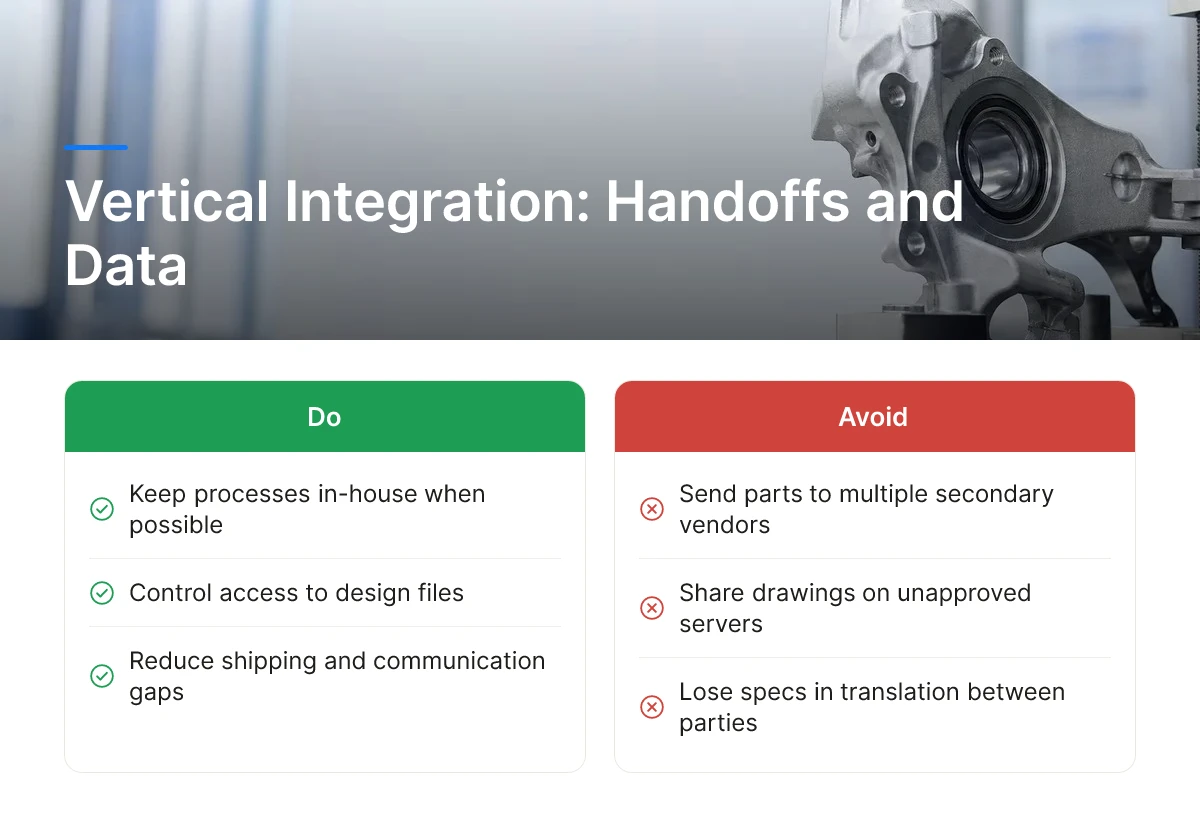
Fewer handoffs between vendors means fewer chances for your design file to leak, your part to arrive out of spec, or your schedule to slip on someone else’s shipping delay.
How Does Vertical Integration Reduce Handoffs and Improve Data Control?
Every time a part leaves for a secondary process, plating, heat treatment, assembly, it adds a shipping step, a communication gap, and a new party with access to your design file. Each handoff is a place where a spec can get lost in translation or a drawing can end up on a server you never approved.
A manufacturer running CNC machining, surface treatment, heat treatment, and assembly under one roof removes most of those gaps. GC INDUS structures its process this way specifically so a part doesn’t change hands between four different shops before it reaches final inspection. An automotive parts manufacturer that outsources most secondary operations, by contrast, is coordinating a chain of subcontractors on your behalf, and inheriting their delays and their security gaps along with them.
What Data Security and IP Protections Should You Require?
Ask for a signed NDA before any file transfer, documented access controls on who can open your CAD files internally, and a clear policy on where design data is stored and for how long. This matters far more for proprietary or safety-critical designs than for a simple bracket anyone could reverse-engineer from a caliper reading.
7. Communication and Change Management When Problems Arise
How a manufacturer handles a deviation or delay tells you more about the partnership than any capability sheet ever will.
What Communication Structures Indicate a Partner Will Keep You Informed?
Look for a named program contact rather than a rotating inbox, proactive status updates on production milestones, and early flags on potential delays instead of silence until the ship date slips. Path Machining’s evaluation framework makes the same point: how a shop communicates when things change matters as much as what they can machine.
An automotive parts manufacturer that only reaches out once a deadline is already missed is signaling how it will behave on a bigger problem later, with less warning and higher stakes.
How Do You Evaluate a Manufacturer’s Change Management Process?
A solid change management process produces documented deviation reports, a defined approval chain for any spec exception, and a clear record of what changed, when, and why. Don’t ask whether problems ever happen, they do, at every shop. Ask how they handled a specific past nonconformance and what they changed in their process afterward.
A vague answer or a shrug is worse than an honest account of a mistake with a corrective action attached to it. Responsiveness during a minor hiccup, a late shipment, a borderline dimension, is a reasonable predictor of how they’ll handle a major one.
8. Investment in Automation and Continuous Improvement
A manufacturer that keeps upgrading equipment and refining its process is telling you it plans to still be reliable in five years, not just today.
How Should You Evaluate Investment in Automation and Continuous Improvement?
Automation reduces the variation that comes from manual handling and frees skilled staff to focus on process control and inspection instead of repetitive loading and unloading. Modus Advanced frames this as a marker separating good shops from exceptional ones, verifiable quality infrastructure signals a quality culture rather than a marketing claim.
In practice, continuous improvement looks like tracked scrap rates, documented root-cause analysis on recurring issues, and work instructions that get updated when a better method is found, not ones that have sat unchanged for a decade. Ask directly: what’s changed in their process or equipment in the last two or three years, and why. A specific answer beats a general one.
What Ownership and Accountability Structures Indicate a Reliable Partner?
A shop that reinvests in its own capability tends to also take clearer ownership when something goes wrong, both behaviors come from the same instinct to treat the work as a long-term relationship rather than a single transaction. An automotive parts manufacturer that’s stopped investing usually stops improving in other ways too.
How to Choose the Right Automotive Parts Manufacturer
Score candidates against the eight traits above, weight them by part criticality, and confirm capability with a facility tour and a sample quality report before committing.
Build a short scorecard from the traits covered here, complexity fit, planning process, built-in inspection, communication, automation investment, scalability, regulatory readiness, and accountability, and bring it to the supplier meeting or RFQ review instead of relying on memory. Weight the scorecard by what’s actually at stake: a safety-critical or regulated part warrants heavier weighting on quality infrastructure, certifications like ISO 13485, and documented inspection protocols, while a low-risk bracket doesn’t need the same scrutiny.
Before committing to a first production run, request a facility tour or a virtual walkthrough and ask for a sample quality report from a comparable part. This surfaces gaps a sales conversation won’t, undocumented processes, inspection steps that get skipped under time pressure, or equipment that doesn’t match what was described.
Choose based on qualitative tier, budget-friendly, mid-range, or premium, rather than chasing the lowest quote. The cheapest number on a quote sheet often just defers cost to rework, missed deadlines, or a failed audit later. GC INDUS works with this framework directly: ISO 9001 and ISO 13485 certification, tolerances to ±0.001mm, and flexible minimum order quantities from a single piece let a buyer evaluate one partner against the same scorecard used for prototype runs and full production, without switching vendors in between.

Frequently Asked Questions
How does precision manufacturing for automotive differ from standard contract manufacturing?
Automotive precision manufacturing holds tighter dimensional tolerances and requires documented, repeatable process control, not just a finished part that measures correctly once. Standard contract manufacturing may accept broader tolerances and rely on manual fitting or rework. Automotive programs need process capability data, material traceability, and inspection records that prove every unit in a production run, not just a sample, meets specification.
What makes supplier evaluation different for complex or regulated automotive programs?
Regulated automotive programs demand proof of process control, not just a certificate on file. Evaluators should ask for documented inspection protocols, material certifications, and change-management procedures, how a supplier handles a design revision or a flagged deviation matters as much as their initial quote. A shop with ISO 9001 and experience in adjacent regulated industries, such as medical devices, typically has stronger process discipline already built in.
How do you verify that a manufacturer’s stated capabilities match its actual equipment and process maturity?
Ask for equipment lists by name, sample inspection reports, and references from comparable programs, vague capability claims without specifics are a warning sign. A shop that can name its machines (5-axis mills, Swiss lathes, CMM equipment) and walk through its inspection workflow demonstrates real process maturity. Request a sample part or first-article inspection report before committing to a production volume; this exposes gaps a capability sheet won’t show.
Which industry standards go beyond the minimum certification for automotive applications?
ISO 9001 is the baseline; automotive and safety-critical programs benefit from suppliers who also hold or work to standards like ISO 13485 for regulated component types. A supplier already meeting medical device compliance standards typically applies stricter documentation and traceability practices than one holding only a general quality certificate.
How do you evaluate a manufacturer’s capacity before committing to a long-term program?
Check whether the supplier can scale from a low-volume prototype run to full production without changing processes or subcontracting core steps. Ask about minimum order quantities, in-house versus outsourced processes, and how they’ve handled volume increases for existing clients. A partner offering MOQs from 1 piece up through high-volume runs signals flexibility without a vendor switch mid-program.
Conclusion
Choosing an automotive parts manufacturer comes down to three checks: verified process control (not just a certificate), equipment and inspection records you can name and inspect, and proven ability to scale from prototype to production without changing vendors. GC INDUS builds these into its operation directly, ISO 9001 and ISO 13485 quality systems, tolerances held to ±0.001mm, and MOQs starting at 1 piece across CNC machining, die casting, and injection molding under one roof. Before your next sourcing decision, request a first-article inspection report and a sample part from any shortlisted supplier, it will tell you more than any capability sheet.
Recommended Articles
Explore more from our content library:


