
Book Appointment Now

GC INDUS / MANUFACTURING KNOWLEDGE
9 Surface Finishing Techniques Compared for Metal Parts
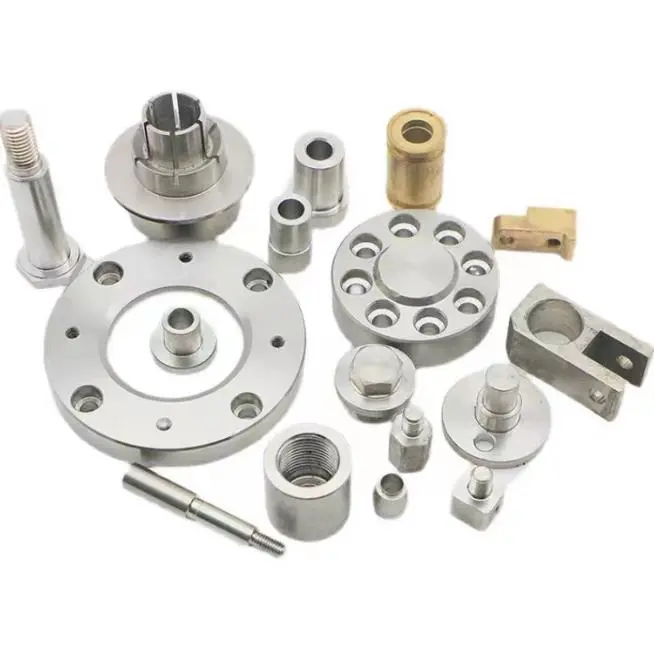
Understanding surface finishing techniques is essential. The best surface finishing technique depends on balancing tolerance requirements, functional needs (corrosion resistance, wear, appearance), and production volume against cost and lead time. Mechanical methods like bead blasting and polishing suit cosmetic and moderate-precision parts quickly and affordably, while electrochemical and coating processes (anodizing, electroplating, PVD) add corrosion or wear resistance at higher cost and longer cycles. For precision metal parts with tight tolerances, the right choice is the one that meets functional specs without unnecessary processing steps that add cost or risk dimensional drift. For a broader overview of how these methods are categorized, see this overview of surface finishing and this complete guide to surface finishing.
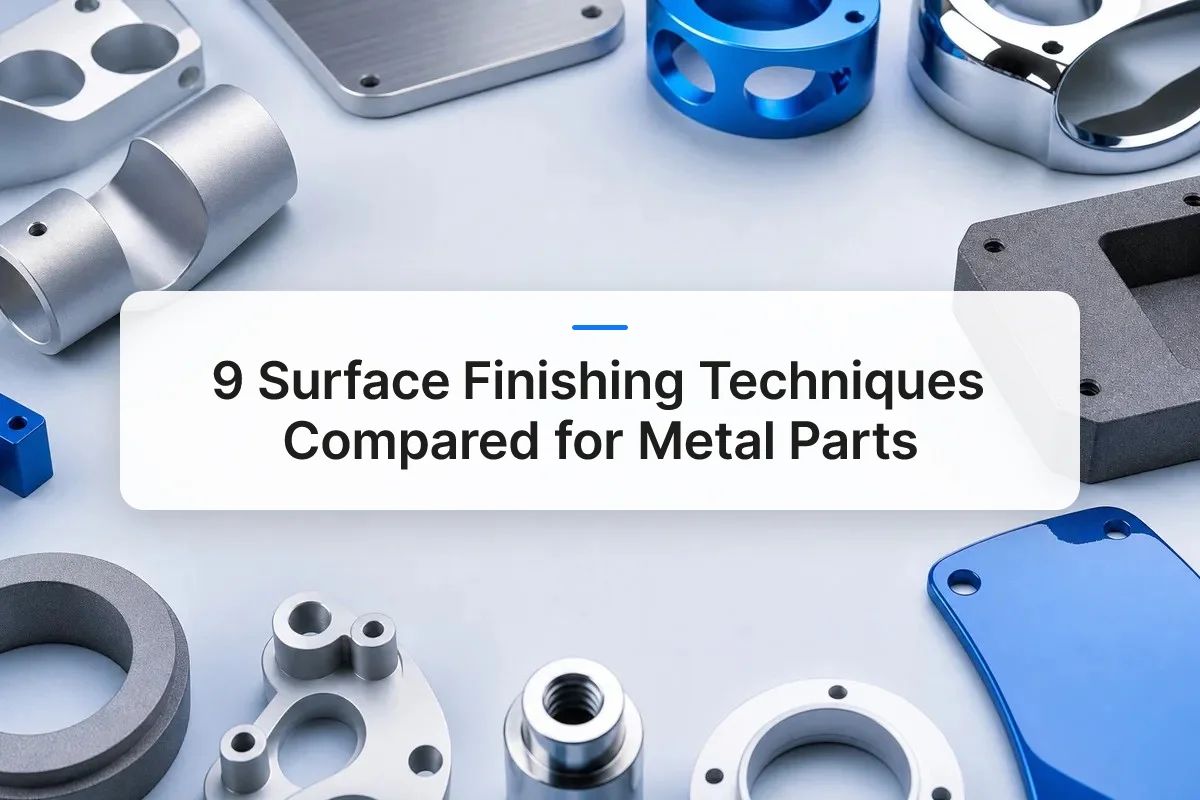
Before comparing each option in detail, it helps to see the most common surface finishing techniques side by side:
- Bead blasting — fast, affordable cosmetic cleanup with no dimensional change
- Anodizing — electrochemical oxide layer for corrosion resistance and color on aluminum
- Electroplating — deposits a functional or protective metal layer
- Electropolishing — chemically smooths and cleans without mechanical stress
- Powder coating — thick, durable, decorative protective layer
- Passivation — restores corrosion resistance on stainless steel with zero added thickness
- Tumbling and vibratory finishing — batch deburring and smoothing at low per-piece cost
- Mechanical polishing — progressive abrasives for mirror or near-mirror finishes
- PVD coating — ultra-thin, hard wear layer with negligible dimensional impact
1. Bead Blasting
Bead blasting propels fine glass or ceramic media at a part’s surface under controlled air pressure, producing a uniform matte texture without removing meaningful material. It’s one of the most common surface finishing techniques used purely for cosmetic cleanup rather than dimensional change.
The process masks tooling marks, light scratches, and minor surface imperfections left over from CNC machining or casting. Because it requires no chemicals or long cure times, it’s one of the fastest and most cost-effective ways to deliver a clean, consistent appearance on short lead times.
Aluminum housings, brackets, and enclosures that need a clean cosmetic look, but no tight dimensional shift, are good candidates. Electronics enclosures and automotive trim components are typical applications.
What’s easy to overlook: media size and blast pressure directly affect whether tight-tolerance features near the blasted zone stay in spec. A coarser bead or higher pressure can round sharp edges or add a few microns to a critical bore, so the finishing spec needs to be reviewed alongside the part’s tolerance drawing, not treated as an afterthought.
2. Anodizing
Anodizing is an electrochemical process that grows a hard oxide layer on aluminum, increasing both corrosion resistance and surface hardness.
The part is submerged in an electrolyte bath and current is passed through it, converting the outer layer of aluminum into aluminum oxide. This layer is harder than the base metal and can be dyed in a range of colors, which makes anodizing useful for both protection and part identification or branding on production runs.
Aluminum machined parts exposed to outdoor weathering, repeated handling, or abrasive wear benefit most, think enclosures, structural brackets, and fasteners used in aluminum machined parts for outdoor or industrial equipment.
The detail that trips up less experienced shops: the oxide layer itself consumes dimensional tolerance, typically adding a measurable thickness to every anodized surface. Designers need to specify pre-anodize dimensions, not just the final part size, or the finished component can land out of spec even though the machining was correct.
3. Electroplating
Electroplating uses an electric current to deposit a thin metal layer, nickel, zinc, or chrome, onto a part’s surface for function or appearance.
The part acts as a cathode in an electrolytic bath, and metal ions bond to its surface as current flows. Depending on the plating metal chosen, this can improve electrical conductivity, solderability, or wear resistance, making it one of the more functional surface finishing techniques rather than a purely cosmetic one.
Connectors, automotive components, and parts destined for corrosive or high-wear environments are common candidates, since the plated layer adds a sacrificial or protective barrier the base metal lacks.
The differentiator buyers often miss: plating thickness uniformity depends heavily on part geometry. Recessed features, blind holes, and sharp internal corners plate unevenly unless fixturing or anode placement is adjusted specifically for that geometry, a detail worth confirming with the finishing shop before production. For a side-by-side look at plating versus other options, this guide to surface finishing options for sheet metal parts covers the tradeoffs in more depth.

4. Electropolishing
Electropolishing reverses the electroplating process to remove a thin layer of material electrochemically, smoothing microscopic surface peaks.
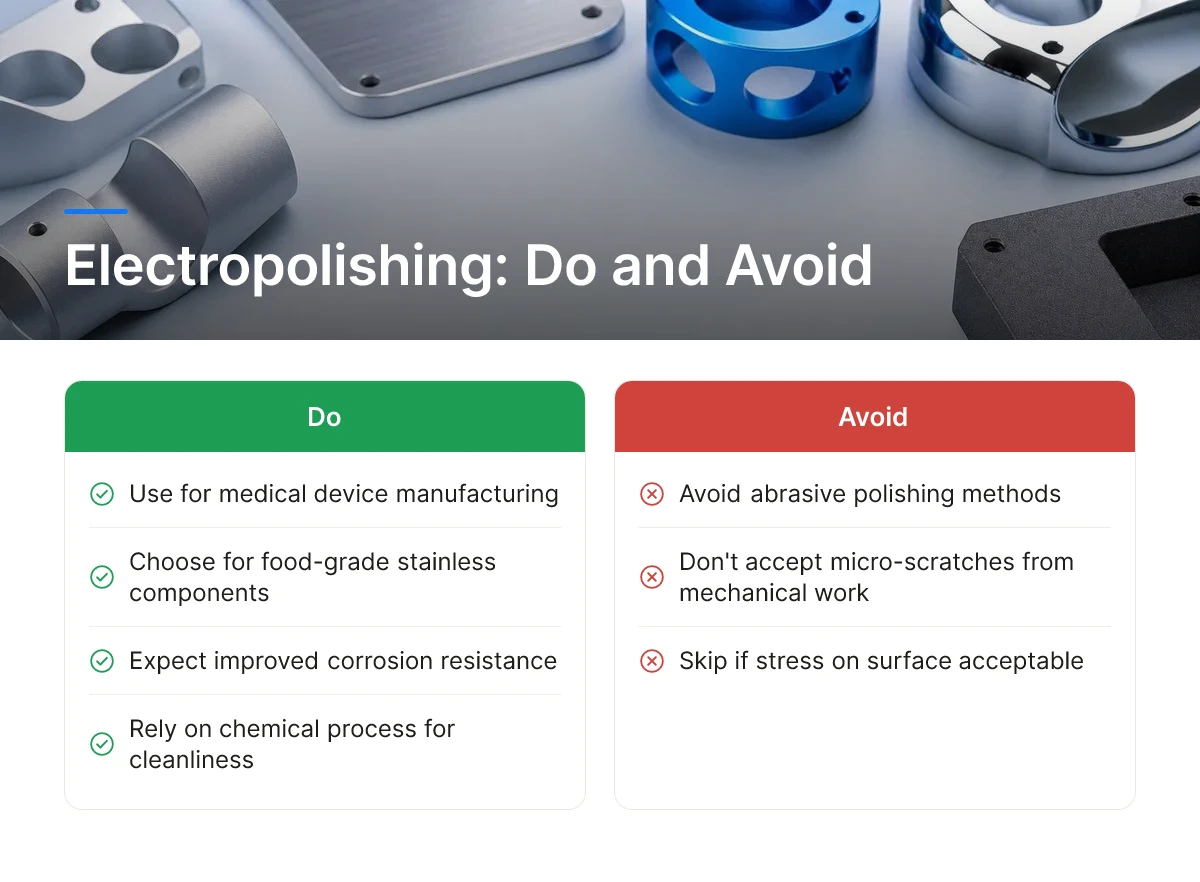
Instead of adding metal, the part acts as the anode and material dissolves from high points on the surface first, leveling it down to a smooth, reflective finish. Because the process is chemical rather than mechanical, it improves corrosion resistance and surface cleanliness without introducing the stress or micro-scratches that abrasive polishing can leave behind.
This makes it well suited to medical device manufacturing and food-grade stainless components, where a contamination-free, easy-to-clean surface is as important as appearance.
Unlike mechanical polishing, electropolishing reduces part dimensions slightly and uniformly across the surface. That shrinkage is small but must be accounted for at the design stage for tight-tolerance parts, since skipping it can push a finished component outside its acceptance window.
5. Powder Coating
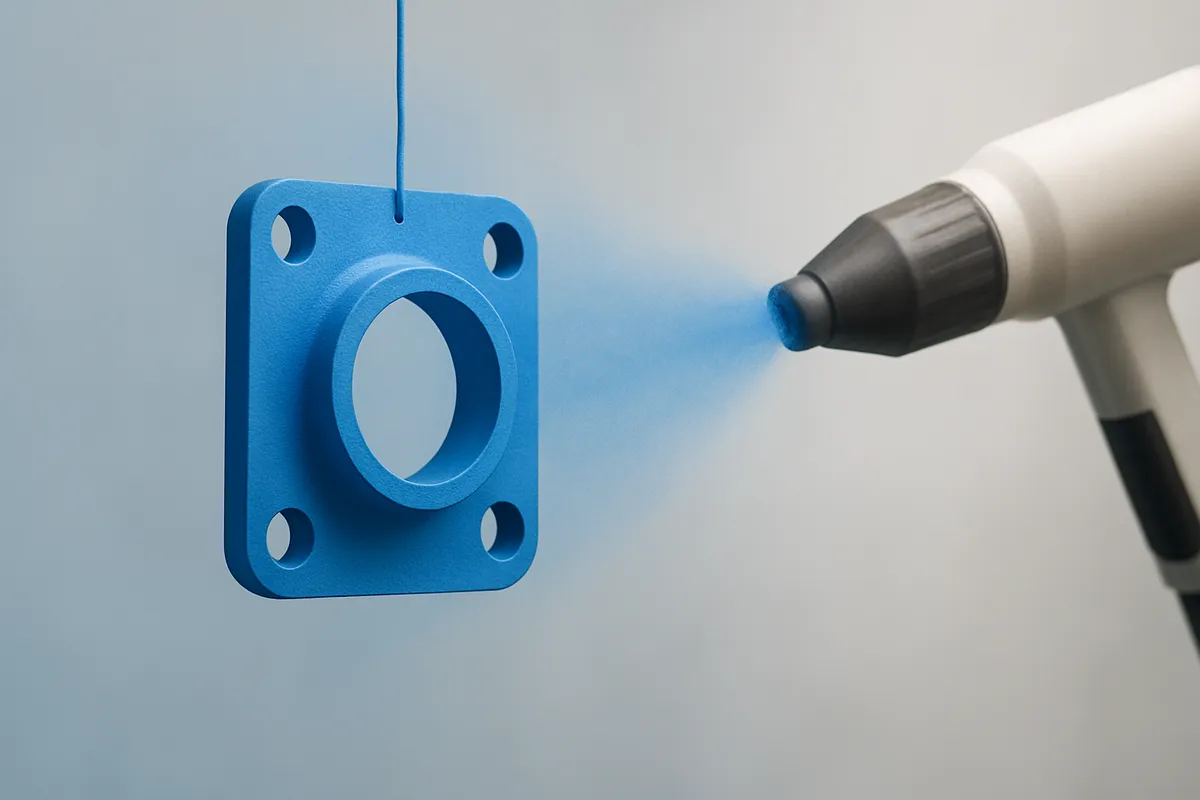
Powder coating applies dry powder electrostatically to a part, then cures it under heat to form a thick, durable protective layer.
The powder clings to the grounded part through static charge, and an oven cure melts it into a continuous film. Compared with liquid paint, powder coating typically delivers higher impact and chemical resistance, and it’s available in a wide variety of colors, gloss levels, and textures.
It’s a strong fit for automotive and industrial parts that need a tough exterior finish, including zinc die cast components used in automotive zinc die casting parts exposed to road chemicals, vibration, and repeated handling.
One tradeoff worth flagging: coating thickness can mask or fill small surface defects, which is useful cosmetically but can hide dimensional or cosmetic issues if the part isn’t inspected before coating. Among surface finishing techniques that add material, this makes pre-coat inspection a necessary step rather than an optional one. This overview of metal finishing methods breaks down how powder coating compares with other additive processes.
6. Passivation
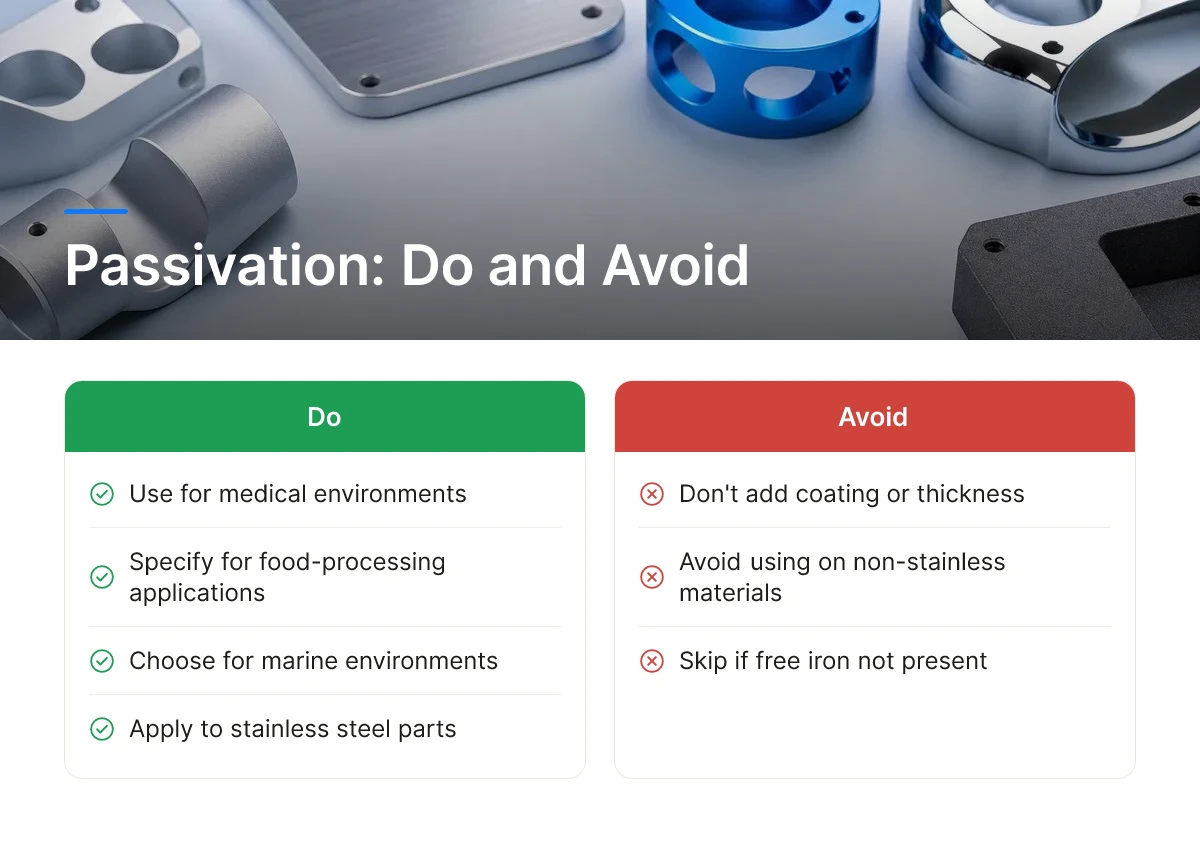
Passivation is a chemical treatment that removes free iron from stainless steel surfaces, restoring corrosion resistance without adding any coating or measurable thickness.
The process uses an acid bath, typically citric or nitric acid, to strip free iron particles left behind from machining. Once that iron is gone, the chromium already in the stainless steel alloy reacts with oxygen to form a thin, stable chromium oxide layer on its own. Unlike plating or painting, nothing is added to the part; the surface chemistry simply resets to its corrosion-resistant state.
Passivation is specified for stainless steel parts headed into medical, food-processing, or marine environments, where corrosion resistance is a functional requirement, not a cosmetic one. Because it changes no dimension and adds no layer, it works where tolerances cannot shift at all. That makes it one of the few surface finishing techniques suited to parts machined to micron-level tolerances, where even a plating thickness of a few microns would push a part out of spec.
7. Tumbling and Vibratory Finishing
Tumbling and vibratory finishing use agitated abrasive media to deburr and smooth batches of parts at once, cutting per-piece finishing cost on high-volume runs.
Parts and abrasive media load into a rotating drum or vibrating bowl together. As they move against each other, the media wears down sharp edges, knocks off burrs, and evens out surface texture across every part in the batch simultaneously. Because dozens or hundreds of parts finish in one cycle, the per-part cost drops well below what hand deburring or individual machining passes would cost.
This method fits small precision components produced in volume, fasteners, stamped brackets, small housings, where consistent edge condition matters more than a mirror finish. The catch is that cycle time and media selection have to match part geometry closely. Thin-walled or fragile features can chip or deform under media that is too aggressive or a cycle run too long, so the process needs tuning per part design rather than a one-size-fits-all setting.
8. Mechanical Polishing
Mechanical polishing removes surface roughness with progressively finer abrasives until the part reaches a mirror or near-mirror finish.
Each abrasive pass removes a thin layer of material and scratches left by the previous step, working down from coarse grit to fine compounds until the surface reflects light cleanly. This gets surface roughness values down to levels that matter for both appearance and function. Sealing surfaces, mold cavities, and cosmetic housings all depend on this level of surface control to perform or look as intended.
Among surface finishing techniques, mechanical polishing stands out for where hand work still beats automation: an experienced polisher can target a single feature, a sealing land, a visible edge, a mold detail, without touching the rest of the part. Tumbling or electropolishing treat the whole surface uniformly, but hand polishing lets a technician finish exactly the area that needs it and leave the rest alone. For more detail on how polishing compares with other finish types, see this guide to types and applications of surface finishing techniques.
9. PVD Coating
PVD coating vaporizes metal in a vacuum chamber so it condenses onto the part as an extremely thin, hard layer, adding wear resistance without changing dimensions.
The part sits in a vacuum chamber while a source material, titanium nitride and similar compounds are common, is vaporized and deposited atom by atom onto the surface. The resulting layer is measured in microns, yet it measurably increases hardness, wear resistance, and reduces friction on the coated surface. Because so little material builds up, tight-tolerance geometry underneath stays essentially unchanged.
PVD is the right call for cutting tools, medical implants, and high-wear precision components where any dimensional shift from coating would be unacceptable. At GC INDUS, PVD is one of the finishing options applied after CNC machining for clients needing wear resistance on parts held to tolerances as tight as ±0.001mm, a combination that rules out thicker coatings or plating processes that would eat into that margin.
How to Choose the Right Surface Finishing Technique
Pick a finish by working through four factors in order: the part’s functional requirement, material compatibility, tolerance impact, and then volume and cost.
What Factors Should Drive Your Decision?
Start with function: does the part need corrosion resistance, wear resistance, or a cosmetic appearance? That answer narrows the field immediately, passivation solves corrosion on stainless steel, PVD solves wear on tight-tolerance components, polishing solves appearance and sealing surfaces. Next, check material compatibility, since not every technique works on every alloy. Then assess tolerance impact: coatings and plating add thickness, while passivation and most mechanical methods remove or redistribute material without building it up. Volume and cost come last, because a technique that’s economical at 10,000 pieces may be wasteful at 10.
How Do You Avoid Over-Finishing or Under-Finishing a Part?
Match the finish grade to the part’s actual working environment, not to the highest-spec option on the list. A bracket hidden inside an enclosure doesn’t need a mirror polish, and a decorative part that never touches moisture doesn’t need passivation. Specify requirements clearly on the drawing, surface roughness callouts (Ra values), finish type, and any masked areas, so there’s no ambiguity for whoever machines the part. Combining steps, like tumbling followed by passivation, adds cost and schedule time versus a single-step finish, so stack processes only when the application actually demands each one. Raise finishing requirements with your manufacturing partner during design review, not after parts are cut, since reworking a finish after the fact usually costs more than specifying it correctly the first time.
A quick checklist for matching finish to function:
- Define the functional requirement first: corrosion resistance, wear resistance, conductivity, or cosmetic appearance
- Confirm the technique is compatible with the base material (aluminum, stainless steel, zinc die cast, etc.)
- Calculate tolerance impact: does the process add thickness, remove material, or leave dimensions unchanged
- Specify Ra values and finish callouts directly on the drawing, not as a verbal note
- Weigh volume and cost last, since the most economical choice shifts with batch size
- Flag any masked areas or features that should not be finished

Frequently Asked Questions
What do surface finish numbers like 0.2 Ra actually mean?
Ra measures average surface roughness in micrometers or microinches, a lower number means a smoother surface. A 0.2 Ra finish is near mirror-smooth and typical for medical implants or sealing surfaces, while 3.2 Ra is a common machined finish for general structural parts. The right value depends on function, not appearance: sealing surfaces, bearing races, and optical components need tighter Ra than brackets or housings.
What causes the most common surface finishing defects, and can they be fixed after the fact?
Most coating failures trace back to inadequate surface preparation, not the finishing process itself, contamination, residual oils, or oxide layers left before coating application. Some defects, like light scratches or uneven polish, can be reworked through re-grinding or re-blasting. Others, like adhesion failure from poor prep, usually require stripping the coating and restarting the entire process, which adds cost and lead time.
How does automated finishing equipment change lead time compared to manual finishing?
Automated finishing cuts cycle time and variation by running consistent parameters across every part, instead of relying on operator technique. Vibratory finishing and automated blasting process batches simultaneously, where manual polishing handles one part at a time. For production runs beyond small prototype batches, automation typically shortens total turnaround even after setup time is factored in.
Which surface finishing techniques produce the least chemical waste?
Mechanical processes, vibratory finishing, grinding, and sand-blasting, generate far less chemical waste than wet processes like electroplating. Powder coating also produces less hazardous runoff than liquid plating baths, since it uses dry powder cured by heat rather than a chemical bath. Electroplating remains necessary for certain corrosion or conductivity requirements despite the added waste handling.
Can you reduce surface finishing costs without hurting quality or delivery speed?
Yes, matching the finish spec to the part’s actual function, rather than defaulting to the tightest tolerance, is the single biggest cost lever. Combining finishing steps with the manufacturer that holds the part (CNC, casting, or molding) also removes shipping and queue time between vendors. GC INDUS builds surface treatment, heat treatment, and inspection into the same production line, which avoids the delays and markups of outsourcing finishing separately.
Conclusion
Surface finish selection comes down to three decisions: matching Ra values to actual function instead of defaulting to the tightest spec, catching preparation issues before coating rather than reworking after, and choosing mechanical processes over chemical ones when waste handling matters. Each choice affects cost and lead time directly, which is why finishing needs to be planned alongside machining, not bolted on afterward.
GC INDUS builds surface treatment, heat treatment, and inspection into the same production run as CNC machining, casting, or molding, under ISO 9001 and ISO 13485 protocols. Send your part drawing and target Ra values for a quote that specifies the finishing process before production starts, not after.
Recommended Articles
Explore more from our content library:


