
Book Appointment Now
Concentricity
Define this requirement in your drawing or specification so the engineering review has a clear starting point.

GC INDUS / ENGINEERED TO YOUR DRAWING
Machine shafts, threaded features, bores and rotational components from a defined datum strategy.
01 / ENGINEERING INTENT
A useful manufacturing decision connects function, geometry and inspection. Start with the requirements that matter to your part.
Define this requirement in your drawing or specification so the engineering review has a clear starting point.
Review its relationship with the selected process, material and production quantity.
Identify acceptance criteria and the information required for verification.
02 / PROCESS LOGIC
Explore the key stages. Select a step to follow the manufacturing route.
Locate the stock with appropriate grip, projection and datum control.
Produce outer diameters, shoulders and internal features around the spindle axis.
Machine thread forms, grooves and specified finish passes.
Check dimensions, runout and surface finish against the inspection requirements.
03 / MANUFACTURING IN DETAIL
04 / TECHNICAL LIBRARY
Explore CNC Turning by topic. Connect the process, materials and requirements before your engineering review.
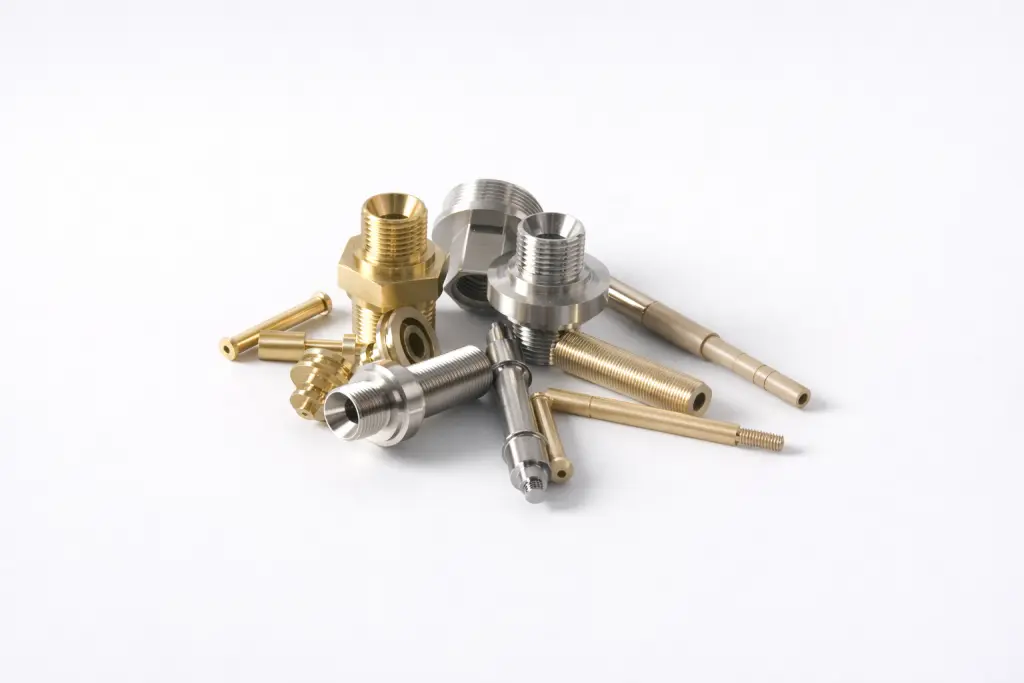
At GC INDUS , we provide professional CNC turning services for manufacturing high-precision cylindrical and rotational components used in demanding industries. With advanced CNC turning centers and experienced engineers, we can efficiently produce parts with tight tolerances, complex geometries, and excellent surface finishes .
Our CNC turning services support both prototype development and large-scale production , ensuring consistent quality and reliable performance. By combining modern turning equipment with strict quality control processes, GC INDUS delivers precision machined parts that meet international manufacturing standards.
Whether you require simple shafts or complex threaded components, our team can provide flexible and efficient turning solutions tailored to your project requirements.
GC INDUS offers comprehensive CNC turning capabilities to support a wide variety of manufacturing needs.
Our CNC turning centers can produce high-precision cylindrical parts with excellent dimensional accuracy. Typical turning operations include:
External and internal turning
Using advanced multi-axis turning equipment, we can manufacture components with complex geometries and multiple features. These machines allow milling, drilling, and turning operations to be completed in a single setup, improving accuracy and reducing production time.
Our CNC turning services support both rapid prototyping and batch production. Engineers optimize machining processes to ensure efficient manufacturing while maintaining consistent part quality.
GC INDUS also provides customized machining solutions based on customer drawings, CAD files, and performance requirements. Our engineering team assists in process optimization and manufacturability improvements to ensure the best production results.
Request a Quote for CNC Turning Services
CNC turning is commonly used to produce automotive components such as shafts, bushings, fasteners, and transmission parts that require high strength and durability.
CNC turning is ideal for producing small and precise medical components such as surgical instrument parts, orthopedic device components, and implant components.
Automation relies on precision turned parts including shafts, couplings, and mechanical components used in various machines and mechanical systems.
Machined components in the energy industry include turbine parts, sealing rings, flanges, connectors, and structural components designed in high-pressure environments.
Electronic equipment often requires precision turned parts such as connectors, housings, and heat dissipation components that require accurate dimensions and consistent quality.
In the aerospace industry, CNC turning helps manufacture critical components including precision connectors, structural parts, and turbine components that demand tight tolerances and high reliability.
Choosing GC INDUS as your CNC turning partner offers several important advantages.
Our modern CNC turning centers provide high precision, stable machining performance, and efficient production capabilities.
Our engineers have extensive experience in machining design optimization and manufacturing process planning, ensuring high-quality results for complex projects.
GC INDUS can achieve tight tolerances required for precision mechanical components, ensuring reliable performance in demanding applications.
We support both low-volume prototypes and high-volume production, providing flexible manufacturing solutions for different project requirements.
Our quality control process includes material verification, first article inspection, in-process checks, and final validation to ensure consistent product quality.
Common metals used in CNC turning include:
These materials offer advantages such as high strength, corrosion resistance, and excellent machinability.
Certain engineering plastics can also be processed using CNC turning, including:
Plastic materials are often chosen for applications requiring lightweight structures, electrical insulation, or chemical resistance.
CNC turning is a precision machining process in which a workpiece rotates while a cutting tool removes material to create cylindrical shapes and rotational features. The process is controlled by computer numerical control (CNC) technology, allowing highly accurate and repeatable manufacturing operations.
During CNC turning, the workpiece is fixed on a rotating spindle while cutting tools move along programmed paths to remove material. The process can create features such as shafts, threads, grooves, and precision diameters. Modern CNC turning centers can also integrate milling and drilling operations, allowing complex components to be produced in a single setup.
This machining method is widely used for manufacturing components that require high precision, excellent surface finish, and consistent production quality.
CNC turning is best suited for parts that have cylindrical or rotational geometry. Typical examples include shafts, bushings, connectors, threaded parts, and mechanical fasteners.
Many industrial components require precise diameters, concentricity, and smooth surfaces, which makes CNC turning an ideal manufacturing solution. Automotive transmission components, hydraulic fittings, medical instrument parts, and aerospace connectors are commonly produced using this process.
By combining turning with milling operations in modern turning centers, manufacturers can also produce parts with flats, holes, and slots in addition to rotational features.
CNC turning can achieve very tight tolerances depending on the material and part design. In most cases, tolerances between ±0.01 mm and ±0.005 mm can be achieved for critical dimensions.
High precision turning machines use advanced servo systems and cutting tools that allow precise control of tool movement. Additionally, quality control processes such as in-process measurement and final inspection ensure dimensional accuracy.
Industries such as aerospace, medical devices, and high-performance automotive systems often require tight tolerances to ensure proper component fit and functionality.
CNC turning supports a wide range of materials including metals and engineering plastics. Aluminum is commonly used because it is lightweight and easy to machine. Stainless steel is widely used for its strength and corrosion resistance.
Other materials include brass, copper, titanium, and carbon steel. Engineering plastics such as PEEK, nylon, and PTFE are also commonly used in applications requiring lightweight or chemical resistance.
Material selection depends on mechanical requirements, environmental conditions, and cost considerations.
CNC turning and CNC milling are two different machining processes used to create precision parts. In CNC turning, the workpiece rotates while the cutting tool remains stationary. This process is ideal for cylindrical components.
In CNC milling, the cutting tool rotates while the workpiece remains stationary or moves along multiple axes. Milling is used to create flat surfaces, slots, and complex shapes.
Many modern machines combine both turning and milling capabilities to produce complex parts more efficiently.
Yes, CNC turning is widely used for prototype manufacturing. It allows engineers to quickly produce functional parts that closely match final production components.
Unlike some rapid manufacturing methods, CNC turning uses the same materials and machining processes as production manufacturing. This makes it ideal for testing mechanical performance and product functionality.
Prototypes produced by CNC turning can be used for design verification, assembly testing, and performance evaluation before large-scale production begins.
CNC turned parts can undergo a variety of surface finishing processes depending on the material and application requirements. Common finishing options include polishing, anodizing, plating, sandblasting, and heat treatment.
Surface treatments improve corrosion resistance, wear resistance, and visual appearance. For example, anodizing is commonly used for aluminum parts to enhance durability and aesthetics.
The appropriate finishing process depends on the material type and the intended use of the component.
Quality assurance is a critical part of the CNC turning process. Manufacturers typically implement multiple inspection stages throughout production.
These inspections include material certification, first article inspection, in-process measurement, and final dimensional verification . Advanced inspection tools such as coordinate measuring machines (CMM) are used to verify dimensional accuracy.
Strict quality control ensures that each part meets engineering specifications and customer requirements.
Several factors influence the cost of CNC turning services. These include material type, part complexity, tolerance requirements, surface finish , and production quantity.
Parts that require tight tolerances, complex geometries, or difficult-to-machine materials may require additional machining time and specialized tools. Production volume also affects pricing because larger quantities allow for more efficient manufacturing.
Manufacturers typically analyze these factors to provide the most cost-effective machining solution.
To receive an accurate quotation for CNC turning services, customers usually provide 3D CAD files, technical drawings, material specifications, and required quantities .
Engineers review the design to evaluate machining feasibility and determine the most efficient manufacturing process. Based on this evaluation, a detailed quotation including cost and lead time is provided.
Providing clear technical documentation helps ensure a faster and more accurate quotation process.
READY FOR ENGINEERING REVIEW
Share the model, material, quantity and critical requirements.
Start your project ↗


