
Book Appointment Now
Thread standard
Define this requirement in your drawing or specification so the engineering review has a clear starting point.

GC INDUS / ENGINEERED TO YOUR DRAWING
Develop fasteners around load paths, thread engagement, material and assembly constraints.
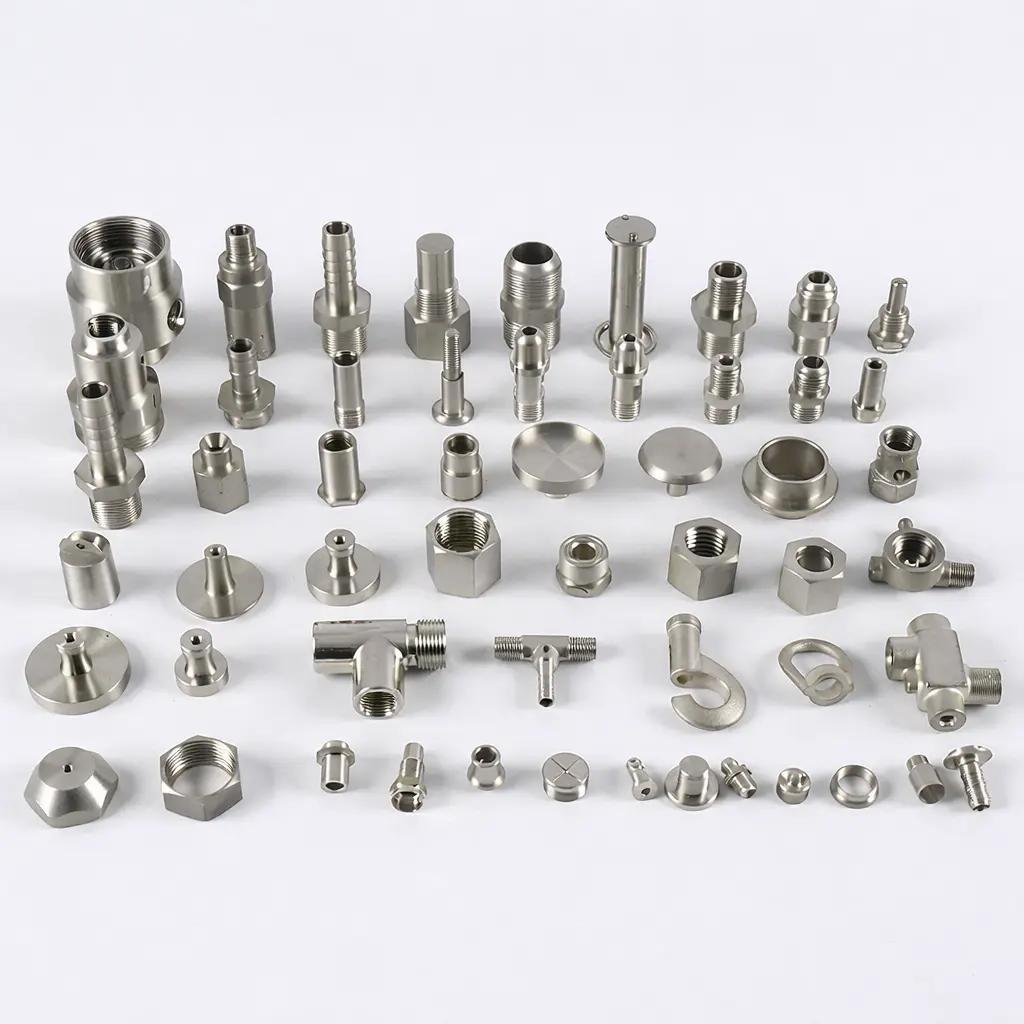
01 / ENGINEERING INTENT
A useful manufacturing decision connects function, geometry and inspection. Start with the requirements that matter to your part.
Define this requirement in your drawing or specification so the engineering review has a clear starting point.
Review its relationship with the selected process, material and production quantity.
Identify acceptance criteria and the information required for verification.
02 / PROCESS LOGIC
Explore the key stages. Select a step to follow the manufacturing route.
Define the mating parts, load requirements, thread engagement and assembly access.
Review forming or machining routes against material, geometry and production quantity.
Create the specified thread profile and other functional features.
Apply the agreed finish and verify threads, dimensions and documentation requirements.
03 / MANUFACTURING IN DETAIL
04 / TECHNICAL LIBRARY
Explore Custom Fasteners by topic. Connect the process, materials and requirements before your engineering review.
GC Indus provides comprehensive custom fastener manufacturing services designed to meet the unique requirements of industrial applications across a wide range of industries. Unlike standard fasteners that follow fixed specifications, custom fasteners are engineered according to specific design requirements, material selections, mechanical performance standards, and environmental conditions.
Our custom fastener solutions include precision bolts, screws, studs, pins, rivets, nuts, washers, threaded inserts, and specialty fastening components . With advanced manufacturing capabilities such as CNC machining , cold heading, thread rolling, precision turning , stamping, and heat treatment , GC Indus can produce fasteners with tight tolerances, complex geometries, and high-performance material properties.
Custom fasteners are essential for industries where standard off-the-shelf components cannot meet design constraints or performance demands. These applications often require specific dimensions, unique head shapes, specialized threads, corrosion-resistant materials, or high-strength alloys.
At GC Indus, we work closely with customers during the design and production stages to ensure optimal manufacturability, cost efficiency, and product reliability. Our engineering team supports clients with design optimization, material selection, surface treatment recommendations, and quality control solutions .
Whether the requirement is for prototype development, small batch production, or large-scale manufacturing , GC Indus delivers reliable custom fastener solutions that meet international standards and industry-specific performance requirements.
GC Indus offers a full range of custom fastener Manufacturing solutions tailored to different industries and product designs.
We manufacture various types of custom bolts including hex bolts, flange bolts, carriage bolts, socket head bolts, and special structural bolts designed for high-load applications.
Custom screws can be manufactured with specialized head types, drive systems, and thread configurations to meet unique assembly requirements.
Our production capabilities include lock nuts, flange nuts, coupling nuts, square nuts, and special application nuts designed for high vibration environments.
We manufacture threaded studs and rods used in high-temperature and high-pressure industrial systems.
Custom pins and rivets are widely used in mechanical assemblies where permanent or semi-permanent fastening is required.
GC Indus can design and manufacture specialty fasteners such as security fasteners, high-strength aerospace fasteners, and precision electronic fasteners .
Fasteners used in engines, chassis, suspension systems, and structural assemblies.
Micro fasteners used in electronic housings, circuit assemblies, and precision equipment.
Heavy-duty fasteners used in manufacturing equipment and automation systems
Start Your Custom Fastener Project Today
Our engineering team assists customers with design optimization and manufacturability improvements .
We maintain strict dimensional tolerances using advanced machining and forming technologies.
GC Indus offers a broad selection of metals and alloys suitable for different performance requirements.
We provide various finishing processes including plating, anodizing, passivation, and coating.
All products undergo rigorous inspection and testing to meet international standards.
We support both low-volume prototype production and high-volume manufacturing.
High strength after heat treatment
Cost-effective for large production
Excellent fatigue resistance
Suitable for structural components
Excellent corrosion resistance
Suitable for harsh environments
Good corrosion resistance
High strength-to-weight ratio
Extremely high strength-to-weight ratio
Excellent electrical conductivity
Custom fasteners are used when standard fasteners cannot meet specific design requirements. Many engineering applications require fasteners with unique dimensions, specialized materials, or unique mechanical properties that are not available in standard catalogs. For example, aerospace applications often require fasteners with extremely high strength-to-weight ratios and strict dimensional tolerances. In electronic equipment, micro fasteners may require extremely precise threads and compact head designs. Custom fasteners also allow engineers to integrate additional functions such as anti-rotation features, locking mechanisms, or specialized coatings for corrosion resistance.
Custom fasteners can be produced using several manufacturing processes depending on design complexity, material, and production volume. The most common method is cold heading , which forms fasteners by deforming metal wire under high pressure. This process is efficient for large-volume production. CNC machining is used when fasteners require complex shapes, special geometries, or tight tolerances. Thread rolling is another common process that improves thread strength by forming threads instead of cutting them. For special applications, fasteners may also undergo heat treatment, grinding, or surface finishing processes.
Material selection depends on several key factors including mechanical strength, corrosion resistance, temperature resistance, and weight requirements. For example, stainless steel is commonly used in environments exposed to moisture or chemicals due to its corrosion resistance. Titanium is preferred in aerospace and medical applications due to its high strength and lightweight properties. Carbon steel fasteners are often used in general industrial applications because they are cost-effective and strong.
Fastener strength is classified using standardized grading systems that define mechanical properties such as tensile strength, yield strength, and hardness. These classification systems ensure that fasteners meet the structural requirements of specific applications.
For metric fasteners , strength classes are defined by ISO standards. Common strength classes include 8.8, 10.9, and 12.9 . The first number represents the nominal tensile strength in hundreds of megapascals, while the second number represents the ratio of yield strength to tensile strength.
Class 8.8 → tensile strength of 800 MPa
Class 10.9 → tensile strength of 1000 MPa
Class 12.9 → tensile strength of 1200 MPa
In the United States, fastener strength is classified according to SAE grades such as Grade 2, Grade 5, and Grade 8. Grade 8 fasteners are commonly used in high-strength structural applications.
For stainless steel fasteners, strength classes are typically designated as A2-70, A4-70 , etc., where the number indicates tensile strength in hundreds of megapascals.
Selecting the correct fastener strength grade is essential to ensure structural integrity and prevent mechanical failure.
Custom fasteners must often comply with various international standards to ensure reliability, safety, and compatibility with global engineering practices. These standards define requirements for material composition, dimensional tolerances, mechanical properties, and testing procedures.
Some of the most widely recognized fastener standards include:
ISO Standards ISO provides internationally accepted specifications for metric fasteners, including thread dimensions, mechanical properties, and tolerance classes.
ASTM Standards ASTM standards are widely used in North America and define mechanical properties and material specifications for structural fasteners.
DIN Standards DIN standards originated in Germany and remain widely used in industrial manufacturing for fasteners and mechanical components.
SAE Standards SAE standards define fastener strength grades and material specifications commonly used in automotive and aerospace industries.
ANSI Standards ANSI standards establish dimensional and performance specifications for fasteners used in the United States.
Compliance with these standards ensures that custom fasteners meet global quality expectations and can be used safely in engineering systems worldwide.
Reliability testing is essential to ensure that custom fasteners can perform safely under real-world operating conditions. Several testing methods are commonly used to verify mechanical performance and durability.
One of the most important tests is tensile strength testing , which measures the maximum load a fastener can withstand before failure. This test determines whether the fastener meets the required strength grade.
Another important test is proof load testing , which verifies that the fastener can withstand a specified load without permanent deformation.
Hardness testing is also performed to confirm material properties after heat treatment. Common methods include Rockwell, Brinell, and Vickers hardness testing.
For applications exposed to harsh environments, corrosion resistance testing such as salt spray testing may be performed to evaluate coating performance.
Additional tests may include fatigue testing, torque testing, and dimensional inspection to ensure consistent quality and reliability in critical applications.
Fastener failure can lead to serious mechanical problems, so engineers must carefully consider several design and installation factors to minimize risk.
One of the most important considerations is proper preload control . Fasteners must be tightened to the correct torque to ensure adequate clamping force without causing material deformation.
Engineers must also ensure that the fastener material is compatible with the mating components to avoid issues such as galvanic corrosion .
Another important factor is fatigue resistance . Components subjected to repeated loads should use fasteners designed to withstand cyclic stress without cracking.
Proper thread engagement is also essential. Insufficient thread engagement may lead to stripping or loosening during operation.
Finally, using appropriate locking methods such as lock washers, thread-locking compounds, or self-locking nuts can help prevent loosening caused by vibration.
Through proper design, material selection , and installation practices, engineers can significantly reduce the risk of fastener failure and improve system reliability.
When designing custom fasteners, several engineering principles should be considered.
Choose the correct thread pitch, profile, and tolerance to ensure proper engagement.
Fasteners must be designed to handle tensile, shear, and fatigue loads.
Material choice should consider corrosion resistance, temperature conditions, and mechanical performance.
Avoid unnecessarily complex geometries that increase production cost.
Proper finishing processes can significantly improve corrosion resistance and durability.
Design fasteners to meet international standards such as ISO, ASTM, or DIN whenever possible.
READY FOR ENGINEERING REVIEW
Share the model, material, quantity and critical requirements.
Start your project ↗


