
Book Appointment Now
Draft & parting lines
Define this requirement in your drawing or specification so the engineering review has a clear starting point.

GC INDUS / ENGINEERED TO YOUR DRAWING
Review thin walls, ribs and interfaces with the die, filling route and secondary machining in mind.
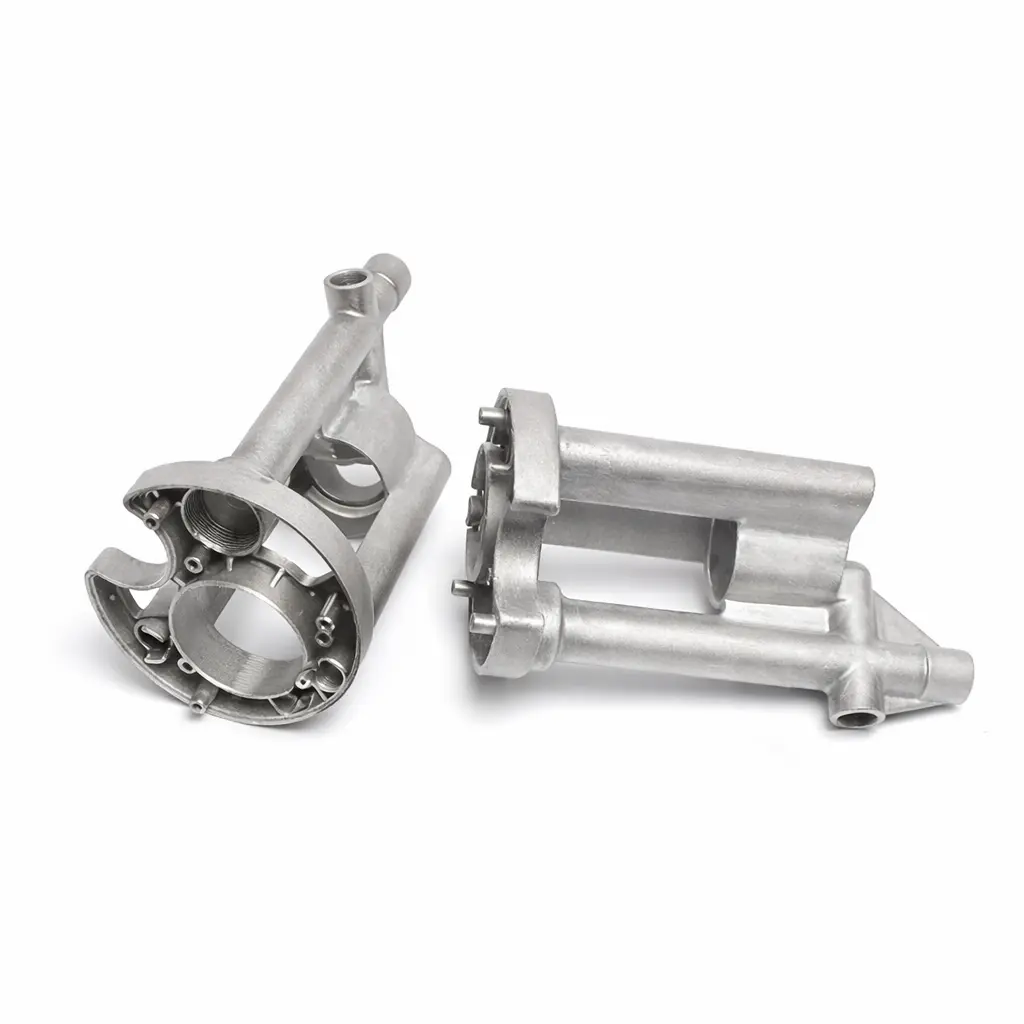
01 / ENGINEERING INTENT
A useful manufacturing decision connects function, geometry and inspection. Start with the requirements that matter to your part.
Define this requirement in your drawing or specification so the engineering review has a clear starting point.
Review its relationship with the selected process, material and production quantity.
Identify acceptance criteria and the information required for verification.
02 / PROCESS LOGIC
Explore the key stages. Select a step to follow the manufacturing route.
Review draft, wall transitions, parting lines and the cavity filling route.
Introduce molten alloy into the die using the selected die-casting process.
Allow the component to solidify before opening the tool and ejecting the casting.
Remove runners and flash, machine interfaces and inspect the agreed features.
03 / MANUFACTURING IN DETAIL
04 / TECHNICAL LIBRARY
Explore Die Casting by topic. Connect the process, materials and requirements before your engineering review.
GC Indus provides professional die casting manufacturing services for high-precision metal components used in demanding industrial applications. Our die casting capabilities include aluminum die casting, zinc die casting, and magnesium die casting , supporting both prototype development and high-volume mass production.
Die casting is a highly efficient manufacturing process in which molten metal is injected into precision molds under high pressure. This process enables the production of complex metal parts with excellent dimensional accuracy, smooth surface finish, and high repeatability .
At GC Indus , we combine advanced die casting equipment, experienced engineering teams, and strict quality control systems to deliver reliable components that meet international manufacturing standards. In addition to die casting, we provide secondary machining, surface finishing , assembly, and inspection , allowing customers to receive fully finished parts ready for installation.
Whether your project requires lightweight structural components, complex housings, automotive parts, electronic enclosures, or industrial hardware , GC Indus provides cost-effective die casting solutions tailored to your application.
Start Your Custom Die Casting Project Today
Our engineering team assists customers in optimizing designs for manufacturability, improving structural integrity while reducing production cost.
We design and manufacture high-precision die casting molds to ensure long mold life, stable production, and consistent part quality.
We support multiple die casting processes including: Aluminum high pressure die casting, Zinc alloy die casting, Magnesium alloy die casting
Engine housings, transmission components, brackets, heat sinks, and structural parts.
Electronic housings, communication equipment frames, connectors, and heat dissipation components.
Lighting fixtures, appliance housings, smart home devices, and hardware components.
Lightweight structural parts, precision mechanical components, and control system housings
Our die casting technology enables tight dimensional tolerances and excellent consistency for large production runs.
Die casting allows the production of parts with thin walls, intricate shapes, and integrated structures , reducing assembly requirements.
Compared with traditional machining processes, die casting enables fast cycle times and high productivity , making it ideal for mass production.
Once the mold is developed, die casting offers a very competitive cost per part for medium and high volume production.
Die cast components typically have smooth surfaces , reducing the need for additional finishing processes.
GC Indus integrates die casting, CNC machining, finishing, and assembly , reducing supplier management complexity for customers.
Aluminum alloys are widely used due to their excellent strength-to-weight ratio, corrosion resistance, and thermal conductivity .
Common aluminum die casting materials include:
Zinc alloys provide excellent dimensional accuracy, high strength, and superior surface finish .
Common zinc die casting materials include:
Magnesium alloys are among the lightest structural metals , offering excellent strength-to-weight ratios.
Common magnesium die casting materials include:
Die casting is a manufacturing process in which molten metal is injected into a precision steel mold under high pressure. Once the metal solidifies, the mold opens and the part is ejected. This process allows manufacturers to produce complex metal components with high dimensional accuracy and smooth surface finishes. Die casting is particularly suitable for aluminum, zinc, and magnesium alloys, which have excellent fluidity and casting properties. The process is widely used in automotive, electronics, and industrial equipment manufacturing because it allows high production efficiency and consistent product quality. Modern die casting systems also integrate automated injection, cooling, trimming, and quality inspection to ensure stable and repeatable manufacturing results.
Die casting and CNC machining are both important metal manufacturing processes, but they serve different production needs. Die casting is generally more suitable for high-volume production because once the mold is created, the production cycle is extremely fast and the cost per unit becomes very low. It also allows complex geometries and thin wall structures that may require multiple machining operations. CNC machining, on the other hand, is more flexible and suitable for low-volume production or prototypes because it does not require expensive tooling. Many high-precision die casting components still require secondary CNC machining to achieve tight tolerances. Combining die casting with CNC machining provides both cost efficiency and high precision.
Die casting parts are widely used in industries that require durable metal components with complex geometries. The automotive industry uses die casting extensively for engine housings, transmission components, brackets, and structural parts. The electronics industry uses die casting for heat sinks, communication device housings, and structural frames. Industrial machinery manufacturers use die cast parts for pumps, motor housings, and mechanical support structures. Consumer electronics, lighting products, medical devices, and aerospace equipment also frequently use die casting technology due to its ability to produce lightweight yet strong components with excellent dimensional accuracy.
Die casting is capable of producing components with relatively tight tolerances compared with other casting processes. Typical dimensional tolerances range between ±0.05 mm and ±0.1 mm depending on part size, material, and mold design. Surface finish quality is also very good, often reducing the need for extensive finishing operations. However, for parts that require extremely tight tolerances or critical features such as threads, sealing surfaces, or precise holes, secondary CNC machining may be necessary. Proper mold design, temperature control, and process optimization are essential to maintain consistent dimensional accuracy during production.
The total production timeline for die casting depends on several factors, including part complexity, mold design, and production volume. Tooling manufacturing typically takes 3–6 weeks , depending on mold size and complexity. Once the mold is completed and approved, production can begin quickly because the die casting process has a very fast cycle time. For large production volumes, die casting can produce thousands of parts per day. Additional processes such as machining, finishing, and assembly may add extra time to the overall schedule. At GC Indus , we optimize production planning to deliver projects efficiently while maintaining strict quality standards.
Yes, die casting is particularly suitable for producing thin wall structures. Aluminum die casting can typically achieve wall thicknesses of around 1.5 mm to 3 mm , while zinc die casting can achieve even thinner walls due to its excellent fluidity. However, extremely thin walls require careful mold design and process control to avoid defects such as incomplete filling or porosity. Proper gate design, injection pressure, and cooling systems are essential to ensure successful production. Engineers often perform design optimization to maintain sufficient structural strength while achieving lightweight components.
Die cast components can undergo various surface finishing processes to improve appearance, corrosion resistance, and durability. Common finishing methods include sandblasting, powder coating, anodizing, electroplating, painting, and polishing. Zinc die casting parts often receive electroplating finishes such as nickel or chrome plating, while aluminum die casting parts are frequently anodized or powder coated. Surface finishing also helps remove minor casting marks and improve the overall aesthetic quality of the component.
Several factors influence the quality of die cast components. These include mold design, injection pressure, molten metal temperature, cooling rate, and mold maintenance. Poor mold design may cause defects such as air entrapment, shrinkage porosity, or incomplete filling. Maintaining stable production parameters and regular mold inspection are essential for ensuring consistent quality. Advanced die casting manufacturers also use simulation software to optimize mold design and reduce potential defects before production begins.
The lifespan of a die casting mold depends on several factors, including the material used, production volume, and maintenance quality. Aluminum die casting molds typically last 50,000 to 100,000 cycles , while zinc die casting molds can last even longer due to lower casting temperatures. Proper mold maintenance, cooling control, and lubrication significantly extend mold life. High quality mold steel and precision machining also contribute to longer service life.
Material selection depends on performance requirements. Aluminum alloys are ideal for structural parts that require strength and corrosion resistance. Zinc alloys provide excellent precision and surface quality, making them suitable for small complex components. Magnesium alloys are preferred for lightweight applications where weight reduction is critical, such as automotive and aerospace products. Engineers typically evaluate mechanical strength, weight, thermal conductivity, cost, and manufacturing feasibility before selecting the appropriate material.
To ensure successful die casting production, engineers should consider the following design guidelines:
Consistent wall thickness helps prevent shrinkage defects and ensures even cooling during solidification.
Use fillets and rounded edges to improve metal flow and reduce stress concentration.
Draft angles are required to allow parts to be easily removed from the mold.Typical draft angles:External surfaces: 1°–2°, Internal surfaces: 2°–3°
Ribs can improve structural strength while maintaining lightweight design
Design parts to reduce unnecessary machining operations.
Proper metal flow paths help avoid air entrapment and improve casting quality.
READY FOR ENGINEERING REVIEW
Share the model, material, quantity and critical requirements.
Start your project ↗


