
Book Appointment Now
Clamping access
Define this requirement in your drawing or specification so the engineering review has a clear starting point.

GC INDUS / ENGINEERED TO YOUR DRAWING
Design and machine tooling that supports stable positioning, access and repeatable inspection.
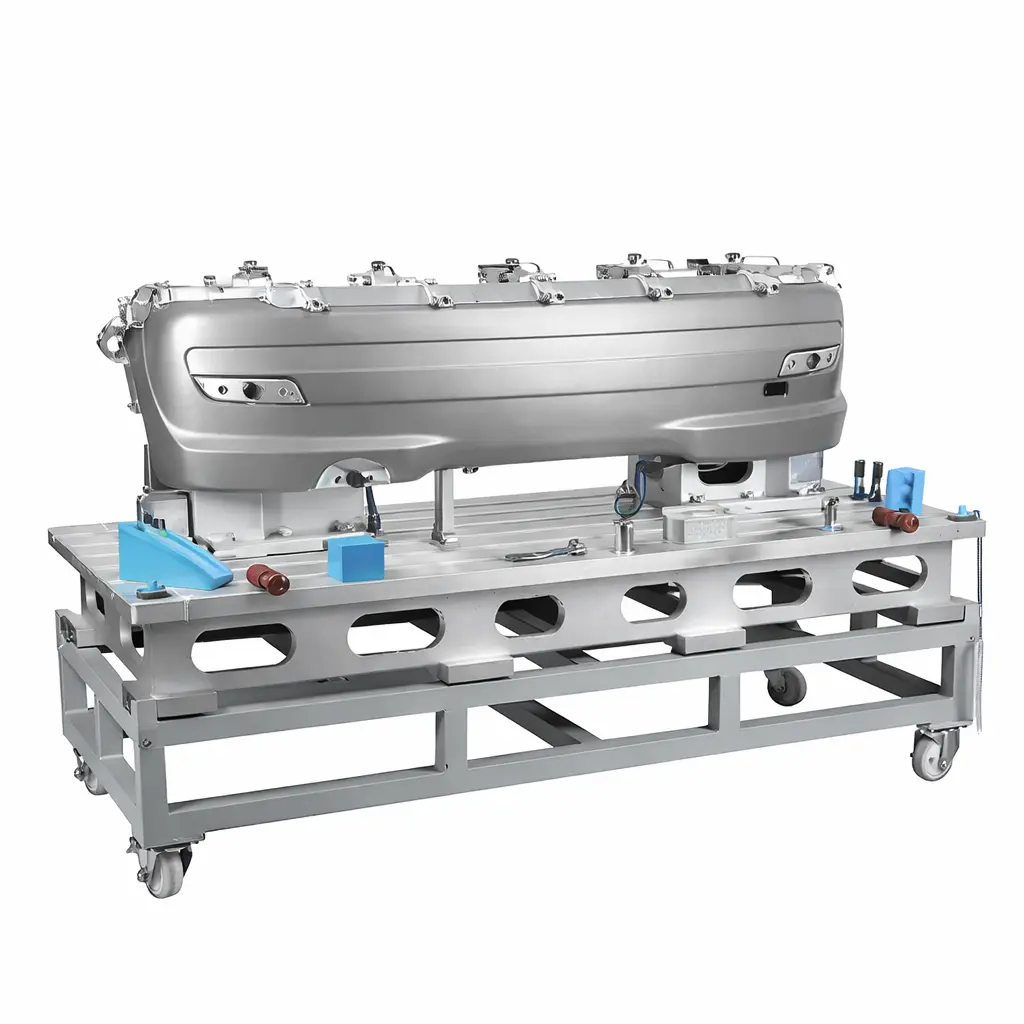
01 / ENGINEERING INTENT
A useful manufacturing decision connects function, geometry and inspection. Start with the requirements that matter to your part.
Define this requirement in your drawing or specification so the engineering review has a clear starting point.
Review its relationship with the selected process, material and production quantity.
Identify acceptance criteria and the information required for verification.
02 / PROCESS LOGIC
Explore the key stages. Select a step to follow the manufacturing route.
Establish the locating datums, part variation and the intended operation.
Design contacts and clamps with access, loading and part protection in mind.
Machine the tooling elements and assemble the locating and clamping features.
Check the fixture against the agreed reference and repeatability requirements.
03 / MANUFACTURING IN DETAIL
04 / TECHNICAL LIBRARY
Explore Fixtures & Jigs Machining by topic. Connect the process, materials and requirements before your engineering review.
GC Indus provides professional Fixtures & Jigs Machining services to support precision manufacturing , assembly operations, and quality control processes. Fixtures and jigs are essential tools used to locate, hold, guide, and stabilize workpieces during machining or assembly , ensuring consistent accuracy, efficiency, and repeatability in manufacturing operations.
In modern industrial production, fixtures and jigs are widely used in CNC machining , welding, inspection, assembly lines, and automated manufacturing systems. Well-designed fixtures significantly reduce setup time, improve machining accuracy, and increase production efficiency.
GC Indus specializes in the design, engineering, and manufacturing of custom fixtures and jigs tailored to specific production requirements. Our engineering team works closely with customers to develop optimized tooling solutions that improve production workflow and reduce manufacturing costs.
With advanced manufacturing capabilities including CNC milling, turning , grinding, wire EDM, and precision assembly , GC Indus can produce high-precision fixtures and jigs with tight tolerances and excellent durability. We support both prototype tooling and high-volume production fixtures , ensuring reliable performance across different industrial applications.
GC Indus offers a wide range of custom fixtures and jigs designed for different manufacturing environments.
Designed to hold parts in the correct position during welding processes, ensuring consistent joint quality and alignment.
Used in production lines to guide operators during assembly processes, improving accuracy and reducing human error.
Used to securely position workpieces during CNC milling, turning , and drilling operations to ensure precise machining.
Get Custom Fixtures & Jigs CNC Machining Services
Our tooling solutions are designed to maintain tight tolerances and high repeatability.
We assist customers with fixture design optimization to improve manufacturability and efficiency.
GC Indus uses CNC machining , EDM, and precision grinding to produce high-quality fixtures.
We select appropriate materials to ensure long service life under demanding production conditions.
Optimized fixture designs reduce setup time and improve production efficiency.
We offer design, machining, assembly, and inspection services in one complete solution.
Fixtures should include precise locating elements such as pins or surfaces to accurately position workpieces.
Clamping mechanisms must hold parts securely without causing deformation.
Design fixtures that allow quick loading and unloading of parts.
Fixtures should be rigid enough to resist machining forces and prevent vibration.
Fixture designs must allow cutting tools to reach all required machining areas.
Fixtures should prevent chip accumulation that may affect machining accuracy.
Using standardized components can reduce manufacturing costs and simplify maintenance.
Fixtures and jigs are both manufacturing tools used to hold and position workpieces, but they serve slightly different purposes. A fixture primarily holds and supports the workpiece in the correct position during machining operations. It ensures stability and prevents movement while cutting tools perform operations such as milling, turning, or grinding. Fixtures do not guide the cutting tool itself.
A jig , on the other hand, not only holds the workpiece but also guides the cutting tool during machining processes such as drilling or tapping. Jigs often include bushings or guide holes that direct the cutting tool to the precise location.
Fixtures are commonly used in CNC machining centers, while jigs are more frequently used in drilling operations or manual machining environments.
Designing an effective machining fixture requires careful consideration of several engineering factors to ensure accuracy, stability, and efficiency during manufacturing operations. One of the most important factors is workpiece location , which determines how the part is positioned relative to the machine tool. The fixture must accurately locate the workpiece using reference surfaces or locating pins to ensure consistent positioning across multiple production cycles.
Another critical factor is clamping force . The fixture must hold the workpiece securely to prevent movement during machining while avoiding excessive force that could deform or damage the part. Proper clamping also helps minimize vibration, which can affect surface finish and dimensional accuracy.
Rigidity and structural strength are also essential. Fixtures must withstand cutting forces generated during machining operations without deflection. Materials with high stiffness such as tool steel or hardened alloy steel are often used in fixture construction.
Additionally, designers must consider tool accessibility . The fixture should allow cutting tools to reach all required machining areas without interference. Poor fixture design can restrict tool paths and limit machining efficiency.
Other considerations include chip evacuation, ease of loading and unloading parts, operator safety, and compatibility with automation systems. A well-designed fixture balances these factors to improve production efficiency and maintain consistent machining quality.
Clamping mechanisms are essential components of machining fixtures because they secure the workpiece in position during machining operations. Various types of clamps are used depending on workpiece geometry, machining forces, and production requirements.
One common clamping mechanism is the mechanical screw clamp , which uses threaded bolts or screws to apply clamping force. This type of clamp is simple, reliable, and widely used in many machining fixtures.
Another popular option is the toggle clamp , which provides quick and secure clamping using a lever mechanism. Toggle clamps are commonly used in fixtures that require frequent loading and unloading of parts because they allow rapid operation.
Hydraulic clamps are used in high-volume production environments where strong and consistent clamping force is required. Hydraulic systems provide precise control of clamping pressure and can be integrated into automated machining systems.
Pneumatic clamps operate using compressed air and are often used in automated production lines where quick clamping cycles are needed.
Magnetic clamps may also be used when machining ferromagnetic materials, allowing workpieces to be held securely without mechanical contact.
Selecting the appropriate clamping mechanism depends on factors such as workpiece size, required clamping force, production volume, and automation requirements.
Proper maintenance is essential to ensure that fixtures continue to perform accurately and reliably throughout their service life. Over time, repeated machining operations can cause wear, contamination, or misalignment of fixture components.
One of the most important maintenance tasks is regular cleaning . Chips, coolant residue, and debris can accumulate on fixture surfaces and interfere with workpiece positioning. Cleaning fixtures after each production cycle helps maintain accuracy.
Another important maintenance practice is inspection of locating elements and clamping components . Locating pins, bushings, and clamps may wear over time due to repeated contact with workpieces. Worn components should be replaced promptly to maintain proper positioning.
Fixtures should also be periodically checked for dimensional accuracy and alignment . Mechanical stresses and machining forces can cause slight deformation or loosening of fixture components.
Lubrication of moving parts such as clamps or sliding mechanisms is also important to prevent friction and ensure smooth operation.
By implementing regular maintenance procedures, manufacturers can extend fixture service life and maintain consistent machining performance.
Ensuring the dimensional accuracy of fixtures is essential because any errors in the fixture can directly affect the accuracy of the machined parts. Several inspection methods are used to verify fixture dimensions and alignment.
One common inspection method is coordinate measuring machine (CMM) inspection , which uses precision probes to measure fixture geometry with high accuracy. CMM inspection can verify the position of locating surfaces, pins, and clamping components relative to design specifications.
Another method is optical measurement , which uses cameras and image processing software to analyze fixture dimensions.
Fixtures may also be inspected using dial indicators, height gauges, and precision squares to verify flatness, perpendicularity, and alignment.
In some cases, trial machining tests are performed to confirm that the fixture produces parts within specified tolerances.
Regular inspection ensures that fixtures maintain their precision and continue to support accurate machining operations.
Fixtures play a critical role in automated manufacturing systems by enabling consistent and repeatable positioning of workpieces. In automated production lines, robots or automated loading systems must place workpieces into fixtures with high precision.
Fixtures designed for automation often include self-locating features that guide workpieces into the correct position. This reduces the need for manual adjustments and ensures reliable operation in automated environments.
Many automated fixtures also incorporate pneumatic or hydraulic clamping systems , which allow workpieces to be clamped and released automatically. This significantly reduces cycle times and increases production efficiency.
Sensors may also be integrated into fixtures to detect whether a workpiece is properly positioned before machining begins. If a part is incorrectly loaded, the system can stop the operation to prevent damage.
By enabling precise positioning and automated clamping, fixtures allow manufacturers to implement fully automated production systems with minimal operator intervention.
READY FOR ENGINEERING REVIEW
Share the model, material, quantity and critical requirements.
Start your project ↗


