
Book Appointment Now

GC INDUS / MANUFACTURING KNOWLEDGE
How to Brief Rapid Prototyping Services for Faster Results

Understanding rapid prototyping services is essential. Brief a rapid prototyping vendor effectively by giving them four things upfront: a complete CAD file in the right format (STEP or native), a written spec sheet covering critical tolerances and surface finish, your target material and its required mechanical properties, and your functional test or end-use case. Vendors quote and build faster when they don’t have to chase clarifications, ambiguous specs are the single biggest cause of delayed or mismatched prototypes.
What You’ll Need Before You Brief Rapid Prototyping Services
Gather four items before you contact any vendor: your CAD files, a written spec sheet, a clear statement of the prototype’s function, and internal sign-off on budget, quantity, and deadline. Skipping any one of these is the most common reason quotes come back wrong or late.
What Documentation a Vendor Needs From You
Every shop evaluating your part needs a CAD model, a dimensioned drawing, and, if your project has more than one component, a bill of materials.
- CAD model: Send a STEP or IGES file, or the native format from SolidWorks, Fusion 360, or similar. Neutral formats like STEP transfer geometry cleanly between systems and avoid the version-compatibility errors that stall quoting.
- 2D drawing with GD&T callouts: A 3D model alone doesn’t communicate tolerances. A drawing that calls out geometric dimensioning and tolerancing tells the machinist exactly which features are critical and which can run to standard shop tolerance.
- Bill of materials: For multi-part assemblies, list each component, its material, quantity, and any purchased hardware (fasteners, bearings, electronics) that needs to be sourced or integrated during assembly.
GC INDUS works from STEP, IGES, and native CAD files alongside GD&T drawings, which is why complete documentation on the front end translates directly into a faster, more accurate first quote.
How to State Precision and Performance Requirements Clearly
A complete spec sheet names critical dimensions, tolerance bands, surface finish, and material grade, not just overall part size.
- Critical dimensions and tolerance bands: Flag which dimensions are functional (mating surfaces, bore diameters, thread engagement) versus cosmetic. Vague tolerancing forces a vendor to guess, and guessing produces parts that don’t fit.
- Surface finish requirements: State whether you need a specific Ra value, a bead-blasted texture, or an as-machined finish. This affects both process selection and cost.
- Material grade: Name the exact alloy or resin grade (6061-T6 aluminum, 17-4PH stainless, ABS versus polycarbonate) rather than a generic category like “aluminum” or “plastic.”
Just as important: state the prototype’s functional purpose. A fit check tolerates a different process and material than a load test or an end-use material validation run, and that purpose should drive which method, CNC machining, die casting, or molding, the vendor recommends.
Before you send the brief, lock down three internal approvals: a budget tier (budget-friendly, mid-range, or premium), the quantity you need, and your deadline. Rapid prototyping services quote faster and more accurately when these constraints are fixed rather than left open for negotiation mid-project.
Define Your Prototyping Method Before Requesting Rapid Prototyping Services
Pick the method first, 3D printing, CNC machining, or injection molding, because each one demands a different brief and delivers a different kind of prototype.
Vendors can’t fill this gap for you. A request that just says “prototype this part” forces the shop to guess at your priorities, and guesses turn into revisions. Decide what the prototype needs to prove, shape, fit, or production-representative performance, and the method choice follows.
3D printing (additive manufacturing) wins when geometric complexity and iteration speed matter most. Internal lattices, undercuts, and organic shapes that would require multi-axis setups or custom fixtures in machining come out of a printer in one build. The tradeoff is material strength: printed polymers and resins generally can’t match the fatigue resistance, surface hardness, or load tolerance of machined metal or production-grade plastic. If your prototype only needs to confirm form and fit for a design review, this gap rarely matters.
CNC machining suits prototypes that need to behave like the final part, not just look like it. Milling, turning, and 5-axis machining cut directly from aluminum, steel, or engineering plastics, so a functional prototype can be tested under real loads, temperatures, or assembly torque before anyone commits to tooling. GC INDUS holds tolerances to ±0.001mm on CNC work, which matters when a prototype has to validate a press-fit, a bearing seat, or a sealing surface, not just a rough outline.
Injection molding with bridge tooling comes in when you need to validate the exact resin and molding process planned for full production. Low-volume aluminum or soft-steel tooling produces parts with the same flow characteristics, shrinkage, and surface finish customers will see at scale, something no printed or machined prototype can replicate.
How Material and Performance Needs Vary by Method
Name the performance requirement in the brief instead of leaving it to inference. State explicitly if the part must withstand heat above a given temperature, flex without cracking, or carry a defined load, these details steer material selection and sometimes the method itself.
How Lead Times Differ Across Prototyping Methods
Lead time gaps between methods come from setup and tooling, not raw machine speed. A 3D printer starts building from a file with no tooling step. CNC machining needs fixture setup and programming before the first cut. Bridge tooling requires building a mold, the slowest step of the three. Understanding this mechanism, rather than assuming one process is universally “faster,” keeps expectations realistic when you request rapid prototyping services and compare vendor timelines.

Write a Precision and Tolerance Brief the Vendor Can Quote Against
A precision brief separates critical-to-function dimensions from cosmetic ones, states inspection requirements, and specifies finish by number, not adjective. Vendors providing rapid prototyping services quote faster and more accurately when the brief removes guesswork.
Start by marking which dimensions actually matter. On a drawing with 40 dimensions, maybe six control fit, function, or mating with another part. Flag those as critical-to-function and tell the vendor the rest carry standard commercial tolerance. Without this split, a vendor either machines every feature to the tightest tolerance on the page, driving up cost and lead time, or assumes looser tolerances apply everywhere and delivers parts that fail assembly. Use GD&T callouts where possible, and if you can’t produce full GD&T, a simple table listing dimension, nominal value, and tolerance band next to a “critical: yes/no” column works.
What Quality Metrics and Tolerance Data to Request
Ask for the vendor’s inspection protocol before you place the order, not after parts show up on your dock.
- Request a first-article inspection (FAI) report tied to your critical dimensions, with actual measured values against nominal and tolerance.
- Ask whether measurement will be done on a coordinate measuring machine (CMM) for tight tolerances, and request the CMM report format in advance so it matches your incoming inspection process.
- State surface finish numerically, an Ra value in micrometers or microinches, or by reference standard, rather than asking for “smooth” or “polished,” which means different things to different shops.
- Specify cosmetic requirements by zone: visible surfaces may need a defined finish grade, while hidden mounting faces can carry looser cosmetic allowance.
This level of detail also tells you something about the vendor before you commit. A shop that can produce a CMM report on request, with traceable calibration records, is signaling a documented quality system, not just equipment that’s capable of tight tolerances on a good day.
How to Compare Vendor Quotes on More Than Price
Certifications are a shortcut for verifying that a vendor’s quality system is documented and audited, not just claimed. ISO 9001 certification means a vendor has process controls, corrective action procedures, and record-keeping in place, relevant when you’re trying to confirm a shop can hold ±0.001mm across a production run, not just on the first sample part. For medical or regulated parts, ISO 13485 compliance matters for the same reason: it verifies the documentation trail regulators will ask for later.
GC INDUS holds both ISO 9001 and ISO 13485 certification, which is part of why clients requesting tight-tolerance prototypes can ask for CMM-based first-article inspection as a standard step rather than a special request.
When quotes come back, ask each vendor to break out tooling cost, material cost, and per-part cost separately rather than quoting one lump figure. Compare these as qualitative tiers, budget-friendly, mid-range, or premium, against what each tier includes: inspection depth, material certification, and finishing steps. A lower per-part price that excludes FAI reporting or skips surface treatment isn’t actually cheaper once you account for rework.
Confirm When Rapid Prototyping Fits and When Traditional Manufacturing Is the Better Call
Use project stage as the deciding factor: concept checks and fit testing favor rapid prototyping services, while validated designs headed for high-volume output favor traditional tooling.
Early in development, the goal is learning fast, does the part fit, does the mechanism work, does the shape feel right in a user’s hand. Rapid prototyping services answer those questions in days using CNC machining or additive methods, without committing to hard tooling. Once a design is locked and the next step is thousands or millions of identical units, injection molding or die casting tooling becomes the more economical path, because the per-unit cost drops sharply at volume in a way single-piece or short-run processes cannot match.
Industry-Specific Requirements to Mention in Your Brief
Medical, automotive, and aerospace parts carry documentation obligations that a generic prototyping brief often omits, so state them explicitly.
- Material certifications and traceability back to a specific heat or batch, not just an alloy name.
- Regulatory context, note if the part supports an ISO 13485 medical device submission or an automotive PPAP process, so the vendor applies matching inspection rigor.
- Full documentation trail: dimensional reports, material certs, and process records retained for audit, not just final part photos.
GC INDUS holds ISO 9001 and ISO 13485 certifications, which matters here, a prototype destined for a medical device file needs the same quality system behind it as the eventual production run, not a separate, lower-rigor process.
Limitations That Signal Traditional Manufacturing Instead
Certain alloys, large production volumes, and extremely tight cosmetic finishes often sit outside what rapid methods handle well, and the brief should flag these up front.
- Specialty alloys or castings (magnesium, certain stainless grades) that need die casting or precision casting rather than additive or quick-turn machining.
- Production quantities in the thousands, where mold amortization beats piece-by-piece machining cost.
- Class-A cosmetic surfaces or tight assembly fits that need production-grade tooling and finishing passes rather than a prototype-grade surface.
A short checklist settles most routing decisions: how many parts do you need, does the material have to match final production exactly, and is the goal visual approval or functional testing under load. Answer those three, and the right process, rapid or traditional, becomes clear before the quote stage.
Common Mistakes to Avoid When Briefing Rapid Prototyping Services
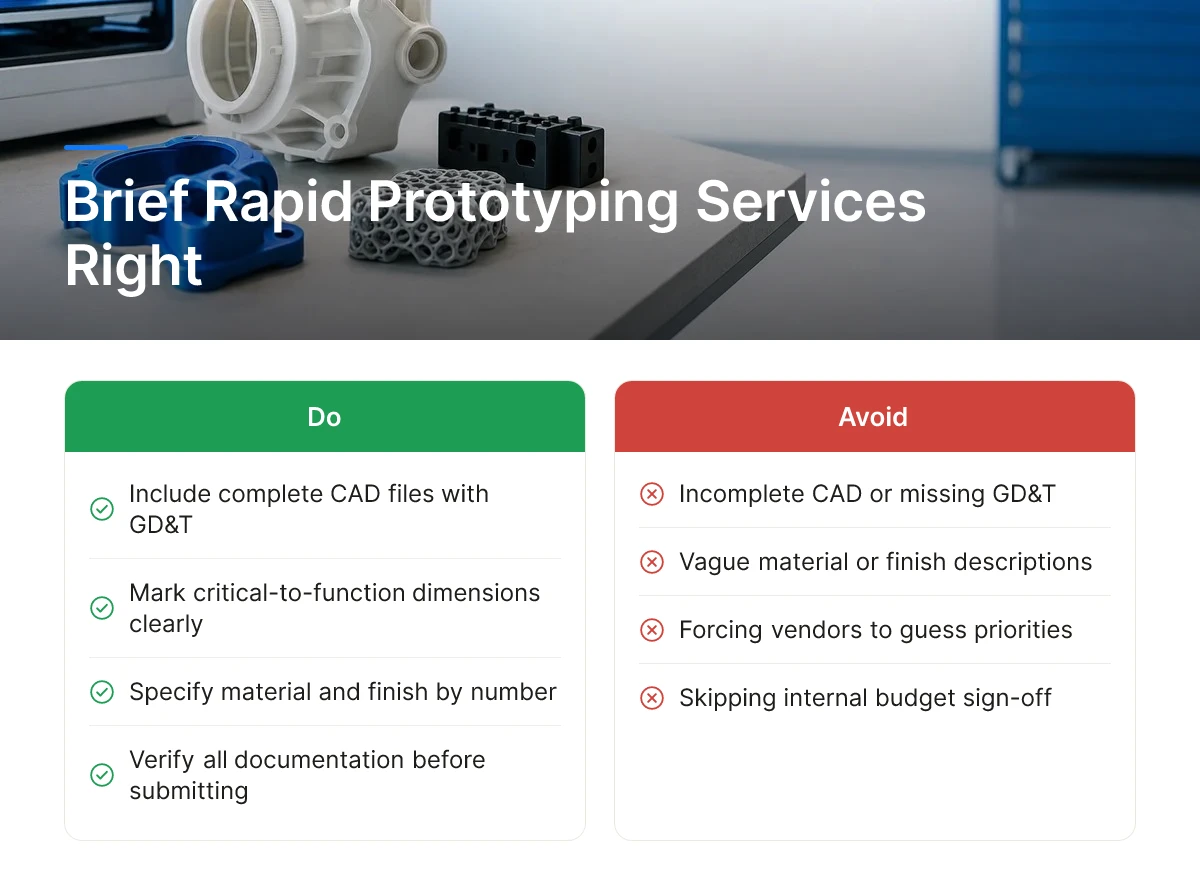
Most delays and mismatched parts trace back to five recurring errors in how teams brief rapid prototyping services, not to vendor capability. Each one is avoidable with a quick self-audit before the request for quote goes out.
Checklist: What to Verify Before You Submit
- Incomplete CAD files or missing GD&T. A native CAD file without geometric dimensioning and tolerancing forces the vendor to guess which surfaces are critical. This is the single biggest cause of quote delays and back-and-forth clarification emails, the vendor stops to ask, you stop to answer, and a same-day quote turns into a three-day exchange.
- Vague material callouts. Specifying “plastic” or “metal” instead of a named grade, ABS versus polycarbonate, 6061-T6 versus 7075 aluminum, leaves the vendor guessing at strength, heat resistance, or flexibility requirements. Two materials in the same family can behave very differently under load or temperature, and the wrong guess means a prototype that fails testing for reasons unrelated to the design itself.
- No stated functional test purpose. If the brief doesn’t say whether the part needs to survive a drop test, hold a seal, or just look right in a sales meeting, the vendor optimizes for the wrong property. A prototype built for visual review and one built for load testing rarely use the same process, wall thickness, or finish.
- Choosing a method on cost alone. Picking the cheapest process without confirming it can hit the stated tolerance or material spec often means a second round of parts. Tolerances as tight as ±0.001mm are achievable with precision CNC machining, but not every process holds that number, checking capability against spec first avoids paying twice.
- Skipping a documented inspection request. Without a specified inspection protocol, dimensional reports, material certifications, or first-article inspection, there’s no way to verify the delivered part actually meets spec. A written request tied to ISO 9001 or ISO 13485 quality procedures gives both sides a record to check against, rather than a judgment call after the parts arrive.
Run the brief against these five points before sending it out. Vendors that work under ISO 9001 and ISO 13485 quality systems, including GC INDUS, can usually flag a gap during the quoting stage, but a clear brief gets the correct prototype built on the first pass instead of the second.
Frequently Asked Questions
Which companies and industries rely on rapid prototyping services most?
Medical device makers, automotive suppliers, and electronics manufacturers use rapid prototyping services most, because their products demand tight tolerances and regulatory proof before scaling production. OEMs validating a new assembly or a Tier-1 automotive supplier testing a bracket design also rely on it heavily. Any company moving from design to a production decision benefits from a working physical part early.
What stages of product development benefit most from rapid prototyping?
Concept validation and pre-production testing benefit most, since both stages need a physical part to confirm fit, function, or manufacturability before committing capital. Early-stage prototypes catch design flaws cheaply. Later-stage functional prototypes, built in production-intent materials, confirm that a part will perform correctly once tooling and full-scale manufacturing begin.
How much does rapid prototyping typically cost compared to traditional manufacturing?
Rapid prototyping generally costs less per part than traditional tooled manufacturing, since it skips hard tooling and supports low or single-piece order quantities. Traditional injection molding or die casting requires expensive tooling upfront, which only pays off at volume. Prototyping methods like CNC machining or 3D printing avoid that tooling investment, trading some per-unit efficiency for speed and flexibility during development.
What should we document before sending a prototyping request for quote?
Document your CAD file in a standard format, critical tolerances, material requirements, and intended use of the prototype before requesting a quote. Note surface finish needs, assembly interfaces, and whether the part must survive functional testing. Clear documentation prevents miscommunication and reduces the number of revision cycles a vendor needs to produce an accurate part.
When is rapid prototyping not suitable for a project?
Rapid prototyping is not suitable when a project needs thousands of identical parts at the lowest possible unit cost. At that volume, tooled processes like injection molding or die casting become more economical. It also falls short when a design still requires major structural changes, since repeated prototyping cycles add cost without resolving the underlying design problem.
Conclusion
Clear communication with a prototyping vendor comes down to three things: a complete CAD package with stated tolerances, an explicit choice of process and material matched to what the prototype needs to prove, and a quality check built into the request rather than added afterward. Vendors that hold tolerances to ±0.001mm and carry ISO 9001 or ISO 13485 certification, like GC INDUS, can move a documented spec into a functional part without extra clarification rounds. Before your next RFQ, pull together your CAD file, tolerance callouts, and test requirements into one package and send it as a single, complete request rather than a partial spec followed by revisions.
Recommended Articles
Explore more from our content library:


