
Book Appointment Now

GC INDUS / MANUFACTURING KNOWLEDGE
How to Choose a Die Casting Parts Manufacturer Wisely

Choose a die casting parts manufacturer by evaluating four things in order: documented tolerance capability matched to your drawings, quality certifications relevant to your industry, in-house finishing and tooling support, and a cost structure that reflects your actual volume and MOQ needs. The right partner will show inspection data and process controls rather than just quoting a price. Skipping any of these four checks is the most common reason buyers end up with parts that fail inspection or a partnership that breaks down after the first production run.
Verify What to Check Before Choosing a Die Casting Parts Manufacturer
Before contacting any supplier, assemble four inputs: toleranced part drawings, annual volume estimates, target alloy, and surface finish requirements, incomplete inputs produce incomplete quotes.
Die casting quotes are only as accurate as the data behind them. A manufacturer working from a rough sketch or a verbal description cannot commit to a real tolerance range, a realistic lead time, or a firm price. Gather your 2D drawings with GD&T callouts, your 3D CAD model, projected volume over 12 to 24 months, and your preferred alloy, aluminum, zinc, or magnesium each behave differently under pressure injection and require different die designs. Note any surface finish or cosmetic requirements up front, since these affect both tooling design and post-casting processing.
What Tolerance Capabilities and Quality Standards to Require
Ask for process capability data tied to your part geometry, not a generic tolerance range printed on a capabilities sheet.
Die casting can hold tight tolerances on thin-walled, complex geometries better than most other high-volume metal forming processes. But “tight tolerance” claims on a website mean little without supporting data. Request Cpk or process capability reports from parts similar in size and wall thickness to yours, and ask how the manufacturer measures and documents dimensional accuracy on the shop floor, not just at final inspection. A supplier quoting ISO 9001 certification should be able to show you the inspection protocol a specific part runs through, including fixture-based checks and any coordinate measuring machine (CMM) reports for critical dimensions. If the part is destined for a medical device, confirm ISO 13485 compliance specifically, since general quality certification does not cover the traceability and documentation requirements that regulated industries demand.
How to Assess In-House Design and Finishing Capabilities
Treat design-for-manufacturability review and in-house finishing as one evaluation, since both determine whether a part leaves the die usable.
Some shops will quote whatever drawing you send without flagging a wall thickness transition, an undercut, or a draft angle that will cause sink marks or ejection problems. A manufacturer worth contracting will instead review your drawing for moldability before pricing it, pointing out changes that reduce scrap rate or tooling cost. Ask the same supplier how they handle finishing: CNC machining for features the die cannot produce, plating or powder coating for corrosion resistance, and heat treatment where strength specs demand it. GC INDUS handles this as a connected workflow, die casting in aluminum, magnesium, and steel alloys followed by in-house CNC finishing, surface treatment, and assembly, so tolerances set at the casting stage carry through to the finished part rather than getting lost between vendors.
Compare Certifications and Production Capabilities Across Manufacturers
Certifications tell you what a shop’s quality system can prove on paper; machine capability and sample inspection reports tell you what it can actually hold on your part. Compare both before you shortlist any die casting parts manufacturer.
What Role Do ISO and AS9100 Certifications Play
ISO 9001 verifies that a manufacturer has documented, repeatable process controls, it confirms consistency, not a specific tolerance or defect rate. AS9100 builds on that same framework but adds aerospace-specific traceability requirements, including material lot tracking, configuration management, and first-article inspection records that ISO 9001 alone does not mandate.
For a buyer sourcing automotive brackets or consumer enclosures, ISO 9001 is often sufficient. For aerospace or flight-adjacent components, AS9100 is the baseline, not a bonus. Reading the certificate scope matters too, ask which part families and processes it actually covers, since certification can apply to one facility and not a sister plant.
Which Industries Demand the Highest Precision Standards
Industries where failure has high consequence, automotive safety components, medical device housings, aerospace brackets, need tighter in-process inspection than general industrial hardware. A bracket on a conveyor system tolerates more variation than a housing that protects an implantable sensor or a bracket holding a steering component.
Medical device work typically calls for ISO 13485 alongside ISO 9001, since it governs risk management and design controls specific to patient safety. GC INDUS holds both ISO 9001 and ISO 13485, which matters when a client needs die cast or machined housings that must pass regulatory audit, not just a visual check.
Reading Machine Capability as a Production Signal
Tonnage range and shot capacity determine whether a shop can run your part size and wall thickness without secondary workarounds. A manufacturer quoting a 150-ton machine for a part that needs 600 tons of clamping force will struggle with flash and dimensional drift regardless of certification.
Ask about secondary operations too: CNC machining for critical features, leak testing for sealed housings, and heat treatment for strength requirements. These secondary steps often determine final part performance more than the casting shot itself.
Requesting a Sample Inspection Report
A capability brochure lists equipment; a CMM inspection report proves a manufacturer actually hits the tolerances it claims. Request a sample report from a comparable part, dimensional results against drawing callouts, not just a pass/fail summary.
This single document separates marketing claims from verifiable performance, and it costs the manufacturer nothing to share if their process control is real.

Calculate Cost, Lead Time, and MOQ Fit for Your Production Needs
Compare total landed cost and realistic delivery dates across quotes, not just the per-piece price on page one of the proposal, tooling, rejects, and MOQ terms often decide the real winner.
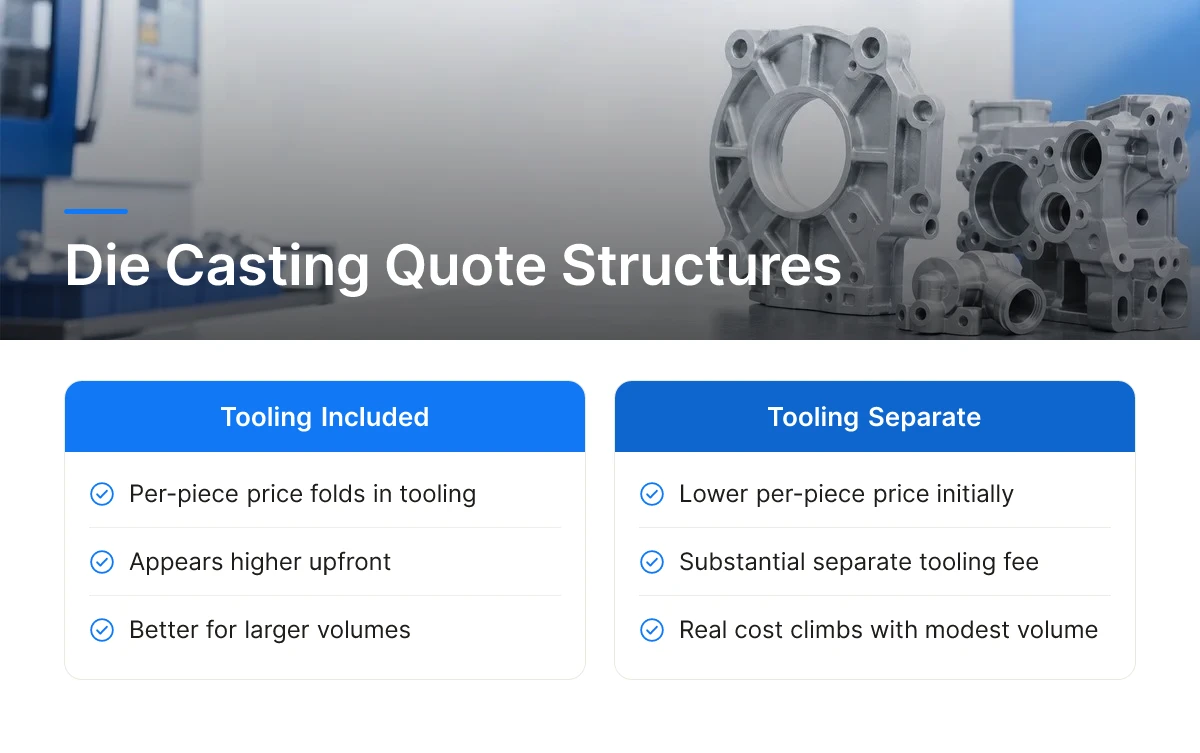
Die casting quotes typically break down one of two ways: a per-piece price that already folds in tooling amortization, or a lower per-piece price paired with a separate, often substantial, tooling fee. The second structure looks cheaper at first glance, but if your production volume is modest, that tooling cost gets spread across fewer parts and the real cost per unit climbs. Ask every die casting parts manufacturer to show both numbers separately, piece price and tooling cost, then model your own total cost at the volume you actually expect to order, not the volume the salesperson assumes.
The bigger cost lever, though, is rarely the unit price itself. It is what happens after the parts ship. A manufacturer with tight process control and full inspection protocols sends you fewer rejected parts, less rework on your line, and fewer emergency reorders that force expedited freight. Those costs rarely show up on the original quote, but they show up on your production floor. When evaluating a potential partner, ask how they document first-article inspection and in-process checks, a supplier running under ISO 9001, as GC INDUS does, has a structured basis for catching dimensional drift before a bad batch reaches your dock.
How Do MOQ Requirements Differ, and What Flexibility Should You Negotiate
MOQ depends heavily on process and tooling investment, and die casting generally demands higher minimum volumes than CNC machining because steel dies cost more to build and amortize than a machining setup. A manufacturer sizing their dies for 50,000-unit annual programs may be a poor fit for a 2,000-unit pilot run. Ask directly how volume requirements shift if you need a smaller test batch before committing to full production.
- Ask whether bridge tooling, a lower-cost, shorter-life die, is available to validate a design before investing in a production-grade mold.
- Ask whether your run can be combined with another client’s compatible order to hit a shared minimum.
- Confirm whether low-volume or single-piece machining can substitute for casting during prototyping, which is why flexible MOQ policies, including orders starting from one piece, matter even on programs that will eventually scale into die casting.
What Production Timelines Should You Expect
Request tooling lead time and production lead time as two separate figures, because a quoted “lead time” frequently covers only the casting run and omits the weeks needed to design, machine, and test the die itself. A die build that takes several weeks adds directly to your first-shipment date, regardless of how fast the casting cycle runs afterward. Ask for a written timeline that separates die fabrication, first-article approval, and volume production, and confirm who owns schedule risk if die rework is needed after sampling.
Address Die Casting Limitations Through Manufacturer Capability
Die casting is not the right fit for every part, and a capable die casting parts manufacturer will tell you so before cutting steel for a tool, not after a failed first article.
The process has three structural limits worth knowing before you commit. Thick sections trap gas during rapid solidification, creating porosity that weakens the part or causes leaks under pressure. Design is constrained by draft angles and minimum wall thickness, so deep pockets, sharp internal corners, or highly variable wall sections push the process past its comfort zone. And tooling is expensive to cut and slow to modify, which means short runs and early-stage prototypes rarely justify the upfront cost.
What Are the Downsides of Die Casting, and When Should You Consider Alternatives
Die casting makes sense when geometry is moldable within draft and wall-thickness rules and volume is high enough to amortize tooling cost, outside that window, CNC machining or sheet metal fabrication usually serves the part better.
CNC machining from billet skips tooling entirely, so it fits prototypes, design iterations, and low-volume orders where a die would never pay for itself. It also handles tighter tolerances and sharper internal features than die casting allows, since there is no mold to eject from. Sheet metal fabrication is the better call for large, thin-walled enclosures or brackets where casting would need unreasonably thick ribs just to fill the mold. The decision point is simple: if your annual volume is in the hundreds rather than tens of thousands, or your geometry fights draft-angle rules, tooling cost stops making sense.
How Advanced Finishing Overcomes Die Casting Constraints
Secondary processes can neutralize most of die casting’s weak points if the manufacturer actually runs them in-house rather than outsourcing and marking up the result.
Vacuum die casting pulls air from the die cavity during injection, cutting the porosity that plagues thick or structurally critical sections. CNC finishing takes over where cast tolerances fall short, critical bores, mating surfaces, or sealing faces that need machining after the part comes out of the die. Impregnation sealing fills residual microporosity with resin, which matters for parts that hold pressure or fluid, such as pump housings or hydraulic fittings. Ask any prospective manufacturer whether these are standard offerings or special requests, and ask to see inspection data proving the porosity reduction actually happened.
The decision rule is straightforward: weigh limitation severity against your production volume and the part’s criticality before tooling is cut. A low-pressure decorative bracket tolerates ordinary porosity; a pressure-rated housing does not. GC INDUS runs die casting alongside CNC machining and sheet metal fabrication in-house, so when a geometry or volume doesn’t suit casting, the recommendation to switch process comes before tooling spend, not after a rejected batch.
Common Mistakes to Avoid When Choosing a Die Casting Manufacturer
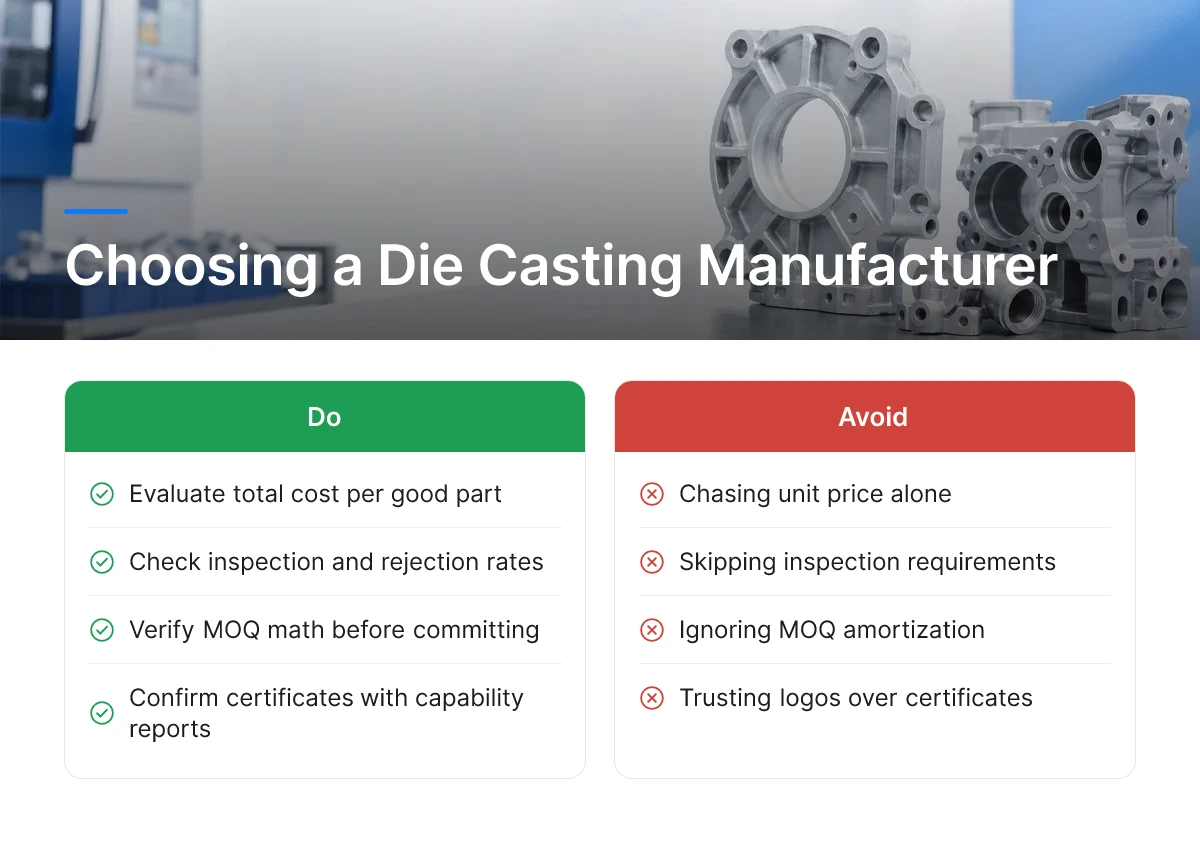
Most sourcing failures trace back to four decisions: chasing unit price, skipping inspection, ignoring MOQ math, and trusting a logo instead of a certificate. Each one is avoidable if you check it before signing a tooling agreement.
Mistake 1: Choosing on unit price alone
A low per-piece quote means little if tooling cost is amortized unevenly or rejection rates eat the savings. Die casting tooling is a fixed, upfront investment, a supplier who underbids on unit price may recover margin through tooling fees, slow revisions, or higher scrap that shows up later as rework and missed ship dates. Evaluate total cost per good part, not the quoted price per cavity, and ask how the manufacturer calculates and reports scrap rate on comparable jobs.
Mistake 2: Skipping first-article inspection
Approving full production without a sample inspection report or first-article inspection removes your last checkpoint before thousands of parts are committed. Die casting’s high-pressure injection process can produce excellent dimensional accuracy, but porosity, flash, and die wear still cause drift between the first shot and the thousandth. Require a documented first-article report with dimensional data tied to your print before releasing full production, regardless of how experienced the supplier claims to be.
Mistake 3: Ignoring MOQ and tooling lead time mismatches
A minimum order quantity that doesn’t match your actual demand, paired with a tooling lead time that outlasts your launch window, strands you with excess inventory or a missed deadline. This mismatch is common with suppliers built for high-volume runs rather than flexible production. Confirm MOQ and tooling lead time together, in writing, against your launch date, not as separate line items quoted in isolation.
Mistake 4: Assuming a listed certification is an active, audited system
A certification badge on a website is not proof of an active, audited quality system covering your part category. Ask for the current certificate, its scope, and the issuing body before you treat ISO 9001 or ISO 13485 as settled. A qualified die casting parts manufacturer will produce this documentation without hesitation; hesitation itself is a signal.
Run through these four checks before you commit tooling budget. A supplier who answers all four clearly, with documentation rather than reassurance, is the one worth building a long-term relationship with as a die casting parts manufacturer for your program.
Frequently Asked Questions
How many quotes should you get before choosing a die casting manufacturer?
Request quotes from at least three manufacturers before committing to a partner. This gives you a real baseline for pricing, lead time, and tooling cost without dragging the process out. Compare how each quote handles tolerance callouts and finishing requirements, not just the bottom-line number, a cheaper quote that skips surface treatment or inspection detail usually costs more later in rework.
Can a die casting manufacturer also handle CNC machining and finishing in-house?
Many precision manufacturers combine die casting with CNC machining, heat treatment, and assembly under one roof. GC INDUS runs die casting alongside CNC milling, turning, and 5-axis machining, so cast parts needing tighter features move to finishing without a second vendor. This single-source setup cuts handoffs and shortens the path from raw casting to a ready-to-install part.
What documents should a die casting manufacturer provide to prove quality control?
Ask for ISO 9001 certification, material certifications, and a sample inspection report before placing an order. For medical or regulated parts, ISO 13485 compliance matters as well. A credible manufacturer should also share dimensional inspection data tied to your drawing’s critical tolerances, not a generic certificate of conformance with no part-specific measurements attached.
Is a higher MOQ always a sign of a better die casting manufacturer?
No, a high minimum order quantity often signals rigid tooling setups, not superior quality. Manufacturers that accept low or flexible MOQs, including single-piece prototype runs, tend to offer more adaptable production without sacrificing tolerance control. MOQ reflects a manufacturer’s operating model more than its precision or reliability.
Conclusion
Choosing a die casting parts manufacturer comes down to three checks: verified certifications (ISO 9001, and ISO 13485 for medical work), documented inspection data tied to your actual tolerances, and production flexibility that matches your order size rather than forcing you into one. Manufacturers that combine die casting with CNC machining, heat treatment, and assembly in-house, like GC INDUS, remove the coordination risk of juggling separate vendors for each process. Before signing with any supplier, request a sample inspection report for a part similar to yours and confirm the tolerance data matches your drawing’s critical dimensions, not just a general conformance statement.
Recommended Articles
Explore more from our content library:


