
Book Appointment Now

GC INDUS / MANUFACTURING KNOWLEDGE
How to Choose Contract Manufacturing Solutions That Scale

Understanding contract manufacturing solutions is essential. Choose a contract manufacturing partner that can scale by verifying three things: proven capacity to grow volume without re-tooling delays, quality certifications matched to your industry (ISO 9001, ISO 13485, etc.), and transparent total cost of ownership rather than just unit price. Start by auditing your tolerance, volume, and compliance needs, then shortlist partners who can show evidence of handling similar production ramps. The right fit balances precision and cost efficiency today with the flexibility to expand capacity as your orders grow.
Define What You Need Before Comparing Contract Manufacturing Solutions
Write down your part specifications, certifications, volume targets, and trade-off priorities before contacting a single supplier. Comparing contract manufacturing solutions without this groundwork means you end up comparing price quotes instead of actual fit.
Start with the physical requirements. Document the material (aluminum, stainless steel, magnesium, engineering plastics), the tightest tolerance your design requires, surface finish specifications, and your expected annual volume range, including a realistic growth projection for year two and three. A part that needs ±0.001mm tolerance on a critical bore demands different machine capability than a bracket with ±0.1mm tolerance, and quoting both the same way wastes everyone’s time.
- Material grade and any alloy certifications required
- Critical-to-function tolerances versus non-critical dimensions
- Surface treatment: anodizing, passivation, plating, heat treatment
- Current annual volume and a 12-24 month growth estimate
Next, identify the certifications your industry requires before you talk to anyone. General industrial production typically calls for ISO 9001. Medical device components require ISO 13485, which governs design controls, traceability, and risk management specific to patient-contact or implantable parts. Aerospace work usually demands AS9100. A supplier without the certification your regulator expects is disqualified regardless of price or lead time, this filter should happen before the first phone call, not after a quote comes back. This is particularly relevant for contract manufacturing solutions.
Put a real number on scalability. Instead of asking “can you grow with us,” state your target: “we need capacity for 5,000 units a month within 18 months, up from 800 today.” Vague scalability questions get vague answers; concrete volume targets force a concrete yes or no.
Finally, rank your priorities internally, lead time, unit cost, or quality control depth, because few partners lead in all three at once. A manufacturer optimized for fast turnaround may carry a cost premium; one offering the lowest unit price may run longer lead times or lighter inspection. Knowing your own ranking before you negotiate keeps you from choosing a vendor that happens to be fast but weak where you actually needed depth.
Verify Quality Certifications and Precision Capabilities
Confirm certifications with audit dates and documentation, then request first-article inspection data before signing, claims on a website prove nothing on their own.
Most shops list ISO 9001 or ISO 13485 somewhere on their homepage. That tells you almost nothing about how consistently they apply those systems. Ask for the actual certificate, the issuing body, and the date of the last surveillance audit. A certification that lapsed 18 months ago or was issued by a body you don’t recognize is a red flag worth chasing down before you commit production volume to a partner.
What Quality Certifications and Tolerance Capabilities Matter Most for Your Industry?
Medical device programs need ISO 13485 specifically, ISO 9001 alone doesn’t cover the design controls and risk management documentation regulators expect. Automotive and aerospace buyers should ask about IATF 16949 or AS9100 depending on the application. Beyond paperwork, request sample inspection reports or first-article inspection (FAI) data from parts with specs close to yours. If your drawing calls for ±0.005mm on a critical bore and the FAI report only shows capability at ±0.02mm, that mismatch will surface as scrap once you’re in production, not before. GC INDUS runs full inspection protocols on every order and holds tolerances as tight as ±0.001mm across CNC milling, turning, and 5-axis work, figures worth asking any prospective partner to match or explain honestly if they can’t. When considering contract manufacturing solutions, this point stands out.
Equipment age matters more than most buyers realize. A machine that holds tolerance on a one-off prototype can drift once you’re running 10,000 units across three shifts. Ask when machines were last calibrated, how often calibration happens, and whether that schedule is tied to a documented preventive maintenance program. Shops that can’t answer quickly, or that calibrate only when something breaks, are telling you how they’ll handle your production run six months from now.
How Do You Compare Total Cost of Ownership Across Contract Manufacturers?
Unit price is the easiest number to compare and the least reliable one to decide on. Scrap rates, rework labor, shipping costs from overseas suppliers, and incoming inspection all add cost that never appears on the quote sheet. A supplier charging 15% more per part but delivering a near-zero defect rate often costs less once you tally rework hours and missed shipments. When evaluating contract manufacturing solutions, build a simple comparison: unit price, expected scrap percentage, freight and duties, and the inspection labor you’ll need on your end. That total, not the line-item quote, is what determines whether a partner actually fits your production budget.

Ask the Right Questions and Test Scalability Before You Commit
A short list of direct questions and a paid pilot run reveal whether a manufacturer can grow with you faster than any reference call will.
When Does Outsourcing Make Financial Sense Versus Nearshoring?
Outsourcing to a contract manufacturer wins on cost when order volumes are variable, capital equipment would sit idle between runs, or the parts require processes, die casting, injection molding, multi-axis CNC, that would take months to bring in-house. Building that capability internally means buying machines, hiring certified operators, and carrying the overhead even in slow quarters. For companies in aerospace, defense, or industrial sectors, that upfront investment can run into the hundreds of thousands of dollars before a single part ships.
Nearshoring or keeping production in-house tends to win when lead time and direct oversight matter more than unit cost, think regulatory-sensitive assemblies that need frequent engineering changes, or products where a two-week shipping delay breaks a launch schedule. The trade-off is rarely all-or-nothing. Many OEMs split the difference: core, high-mix components stay local, and high-volume or process-intensive parts go to a contract manufacturer with the equipment and certifications already in place.
What Questions Should You Ask Potential Contract Manufacturers?
Ask these questions before signing anything, and listen for specifics, not reassurance: For those exploring contract manufacturing solutions, this matters.
- How would you handle a sudden 3x order increase, and what’s your realistic lead time to ramp?
- What is your current capacity utilization on the equipment that would run our parts?
- Who is your backup supplier for the key raw materials our parts require?
- What’s your documented defect rate on comparable parts, and how is it measured?
- What happens to our order if a machine goes down or a material shipment is delayed?
Vague answers to any of these are a warning sign. A manufacturer that can’t name a backup material supplier or quote a current utilization figure likely hasn’t stress-tested its own operation.
Before committing to full volume, request a trial or pilot run, even a small batch reveals more than a facility tour. Track three things during that run: the defect rate against your print, whether delivery hit the promised date, and how quickly the team answers questions or flags problems. A partner offering genuine contract manufacturing solutions will welcome a pilot, because it proves capability instead of asserting it.
Finally, confirm contingency planning on both sides. Dual-source critical components where possible, and ask the manufacturer directly how they cover equipment downtime or material shortages, a documented backup plan beats a verbal promise every time.
Structure the Contract to Protect Quality, IP, and Delivery
A contract for contract manufacturing solutions should lock down three things in writing: who owns what, how quality gets measured, and what happens when either side falls short. Verbal commitments and friendly emails don’t hold up when a tooling dispute or a missed deadline puts your production schedule at risk.
Start with a non-disclosure and non-use agreement that covers not just the existence of your project but the technical details inside it, drawings, process parameters, test data. Separately, specify who owns the tooling, fixtures, and CAD files once the engagement ends; this matters most when you’ve paid for custom tooling but the manufacturer holds the physical asset. Add exit clauses tied to measurable triggers, missed on-time delivery thresholds, scrap rates above an agreed limit, or failure to hit scale-up volumes, so you’re not stuck negotiating an exit under pressure.
How Do You Safeguard Proprietary Designs and Processes With External Manufacturers?
Protect proprietary designs by limiting who sees the complete picture and, where the project justifies it, splitting sensitive steps across more than one trusted partner.
- Restrict full documentation access to a named list of engineers and quality staff at the manufacturer, rather than sharing complete drawing packages with the whole production floor.
- For designs with a genuinely sensitive feature, a proprietary geometry, a unique material treatment, consider manufacturing that step in-house or with a separate certified partner, so no single vendor holds the complete process.
- Require signed individual NDAs for engineers assigned to your project, not just a company-level agreement.
- Audit how your manufacturing partner stores and transmits your CAD files; ask whether access logs exist and who can export native files.
GC INDUS works under ISO 9001 and ISO 13485 quality systems, which include documented access controls and traceability, relevant for OEMs and medical device companies that need auditable proof of where their designs have traveled. This directly impacts contract manufacturing solutions outcomes.
How Do You Monitor Lead Times and On-Time Delivery Performance?
Monitor performance with a short list of agreed metrics, on-time delivery rate, defect rate, and responsiveness to corrective action, reviewed on a fixed cadence, not only when something breaks.
Set the review cycle at contract signing: quarterly for high-volume production, monthly during ramp-up. Tie contract renewal explicitly to whether those metrics were met, so performance has a consequence instead of being a conversation nobody has.
Pricing and lead times for higher volumes should also be pre-agreed in the contract through change-order and scale-up clauses, not renegotiated once you’re already committed. A supplier who won’t commit to volume pricing in advance is signaling how a future negotiation will go.
Avoid These Common Mistakes When Choosing a Scaling Partner
Most failed partnerships trace back to five preventable errors made during selection, not during production. Catching them early protects both your budget and your timeline.
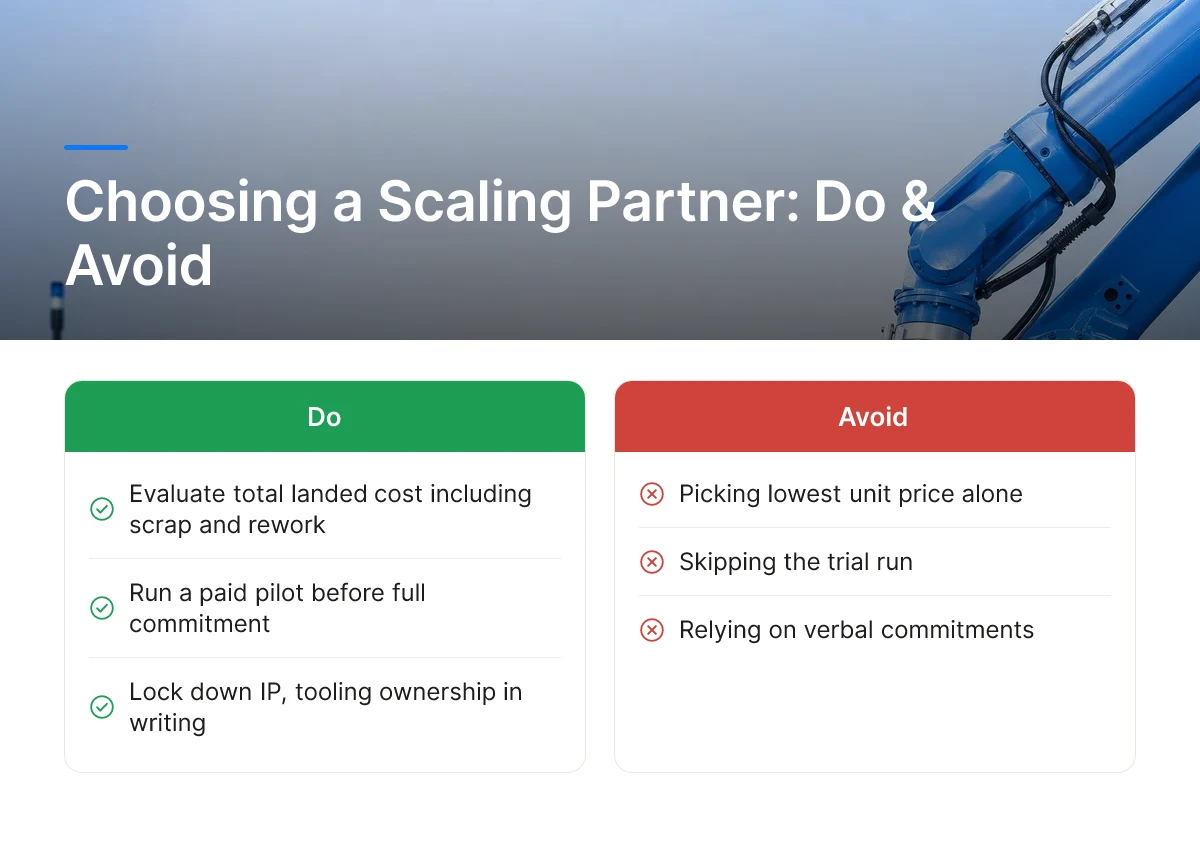
1. Picking the lowest unit price
A low quote looks attractive until scrap rates, rework labor, and freight delays erase the savings. A part priced 10% cheaper but running a 5% defect rate often costs more once you add inspection time and replacement shipments. Evaluate contract manufacturing solutions on total landed cost, unit price plus scrap, rework, tooling amortization, and logistics, not the number on the quote sheet.
2. Skipping the trial run
Committing to full-volume production before a pilot batch confirms repeatability is a common and costly shortcut. A trial run of 50 to 500 units, depending on part complexity, exposes tolerance drift, material inconsistency, or finishing defects before they multiply across a production order of 10,000. If a supplier resists a trial order, treat that as a warning sign. This is particularly relevant for contract manufacturing solutions.
3. Leaving IP and tooling ownership undocumented
Sharing CAD files and proprietary specs without a signed agreement on intellectual property and tooling ownership creates legal exposure that’s hard to unwind later. Define who owns the tooling, who can use it for other customers, and what happens if you switch suppliers, before any design file leaves your hands.
4. Mistaking current capacity for future capacity
A shop that comfortably handles your prototype volume may not handle a demand spike three times that size. Ask directly how the manufacturer adds shifts, equipment, or secondary lines when orders surge, and whether they’ve done it before for a comparable client.
5. Not setting measurable checkpoints
Without defined quality and delivery metrics, defect rate thresholds, on-time percentage, response time for corrective action, problems surface only after they’ve become expensive. Build these checkpoints into the contract from day one, and review them on a fixed schedule rather than waiting for a failure to prompt the conversation.
Frequently Asked Questions
What are the trade-offs between cost savings and supply chain control when outsourcing?
Outsourcing lowers capital costs but hands some day-to-day production control to your partner. You save on equipment, labor, and facility overhead, yet you depend on another company’s scheduling, quality systems, and communication speed. The trade-off narrows when you choose a partner with transparent reporting, ISO-certified quality processes, and direct engineering contact rather than a layer of account managers.
What contingency plans should you have for supply chain disruptions?
Qualify a backup supplier for critical parts and keep safety stock for your highest-risk components. Ask your primary manufacturer about their own material sourcing redundancy and factory capacity buffers. A partner with multiple process capabilities in-house—CNC, casting, molding—can absorb some disruptions internally instead of waiting on third-party subcontractors. When considering contract manufacturing solutions, this point stands out.
What legal protections are essential when outsourcing production?
Secure a signed NDA, a clear IP ownership clause, and a quality agreement that defines inspection standards and rejection criteria before production starts. The manufacturing contract should spell out tooling ownership, liability for defects, lead-time penalties, and termination terms. For regulated industries, confirm the agreement references applicable standards like ISO 13485 so compliance obligations are documented, not assumed.
How do you assess whether a manufacturer can scale with your growth?
Check their minimum and maximum order quantities, equipment capacity, and whether they’ve handled volume jumps for other clients. A partner that accepts orders from 1 piece through high-volume runs without changing vendors avoids the disruption of requalifying a new supplier mid-growth. Ask for references from clients who scaled with them.
Conclusion
Choosing a contract manufacturing partner comes down to three checks: verified certifications (ISO 9001, ISO 13485 for medical work), documented tolerance capability, and a minimum order quantity structure that matches your growth stage, not just your current order size. Skip any supplier who can’t produce inspection reports or a sample part before you commit. GC INDUS works across CNC machining, die casting, injection molding, and sheet metal fabrication with tolerances to ±0.001mm and MOQs starting at one piece. Request a sample part and inspection report from your top two candidates before signing a production agreement—compare turnaround time and documentation quality side by side.
Recommended Articles
Explore more from our content library:


