
Book Appointment Now

GC INDUS / MANUFACTURING KNOWLEDGE
How to Compare Casting Manufacturers Before You Commit

Compare casting manufacturers by matching their process capabilities (sand, investment, or die casting) to your part’s tolerance and volume needs, verifying certifications relevant to your industry (ISO 9001, IATF 16949, or AS9100), and testing lead time claims against a real quote rather than a brochure. The right partner shows evidence, sample parts, inspection reports, and references, not just marketing claims. Cost should be weighed against scrap rate, rework, and on-time delivery history, not just the quoted unit price.
Prerequisites: What to Gather Before Comparing Casting Manufacturers
Gather four things before contacting any casting manufacturers: finalized part drawings with tolerances, expected annual volume, material specification, and the quality standards your industry requires. Without these in hand, every quote you receive will answer a slightly different question.
Part drawings need to show more than the nominal dimensions. Mark which features are critical-to-function, and state tolerances explicitly rather than leaving them to default assumptions. A caster quoting a drawing with no tolerance callouts will price for standard shop tolerance, often far looser than what your assembly actually needs. When specs are vague, the resulting bids cannot be compared on equal terms, because each manufacturer is pricing a different implicit part.
Volume matters just as much as geometry. A quantity of 50 pieces a year points toward investment or sand casting with low tooling investment; a run of 50,000 a year makes die casting tooling economical. Quoting without a volume number forces manufacturers to guess, and guesses do not produce quotes you can trust.
Decide your quality documentation requirements before you send the first RFQ. If your part needs material certifications, dimensional inspection reports, or specific certifications like ISO 9001, IATF 16949, or AS9100, say so upfront. Asking for this after quotes come back means you are now comparing a documented proposal against an undocumented one, not a fair comparison.
- Finalized drawings with GD&T and critical tolerances marked
- Annual volume estimate, including expected ramp or seasonality
- Material specification and any alloy-grade requirements
- Required certifications and inspection documentation
Once this packet is assembled, build a short list of three to five candidate casting manufacturers rather than requesting quotes from a dozen. A narrower list keeps the evaluation manageable and lets you dig into process capability and quality systems instead of drowning in paperwork.
Evaluate Casting Manufacturers on Precision and Process Fit
Match the casting process to your part geometry and volume first, then verify the tolerance data with documented process capability studies, not sales claims.
Most buyers ask casting manufacturers if they can hold “tight tolerances.” That question invites a vague yes. Ask instead for Cpk or Ppk data from a part with comparable geometry, wall thickness, and alloy. A manufacturer with a mature quality system can produce this on request; one that cannot is asking you to trust a claim with no record behind it. GC INDUS backs tolerance claims with documented inspection protocols and holds machining tolerances as tight as ±0.001mm across its CNC and casting lines, figures a buyer can verify against part-specific capability data rather than a brochure statement.
What Are the Differences Between Investment Casting, Sand Casting, and Die Casting?
Investment casting, sand casting, and die casting solve different geometry and volume problems, and picking the wrong one drives up cost or rework regardless of how skilled the foundry is.
- Investment casting suits complex geometry, thin walls, and fine surface detail. It costs more per part but reduces secondary machining on intricate shapes.
- Sand casting fits large parts, low-volume runs, and designs where tooling cost needs to stay low. Tolerances are looser, and surface finish typically needs more post-processing.
- Die casting is built for high-volume metal parts, mainly in aluminum, magnesium, or zinc, where repeatability across thousands of units matters more than per-unit flexibility.
A sand-casting supplier quoted on a thin-wall, high-detail part is a mismatch no matter how good their general reputation is. Confirm which process a shortlisted vendor actually runs in-house versus subcontracts, vertical integration on the specific process you need reduces handoffs and the quality risk that comes with them.
How Do Industry Requirements Affect Which Casting Method to Choose?
Industry context shifts the right casting method: aerospace pushes toward tighter tolerance and full traceability, automotive favors high-volume die casting, and consumer goods often favors cost-efficient sand or investment casting.
Aerospace buyers typically need material certs, lot traceability, and documented inspection records tied to each batch, which narrows the field to casting manufacturers with formal quality systems and audit trails. Automotive programs lean on die casting because unit cost drops sharply at volume and dimensional repeatability across a production run matters more than part-to-part flexibility. Consumer goods manufacturers often prioritize tooling cost and lead time over extreme precision, which makes sand or investment casting a better economic fit depending on part complexity.
Beyond process selection, check quality assurance maturity directly: ask how in-process checks are performed, what final inspection methods are used (CMM, X-ray, dye penetrant), and whether a documented corrective action process exists for nonconformances. Review their inspection and tolerance documentation as a sanity check against any precision claim made during the quote stage, paperwork that doesn’t exist usually means the capability doesn’t either.
Verify Certifications and Quality Standards
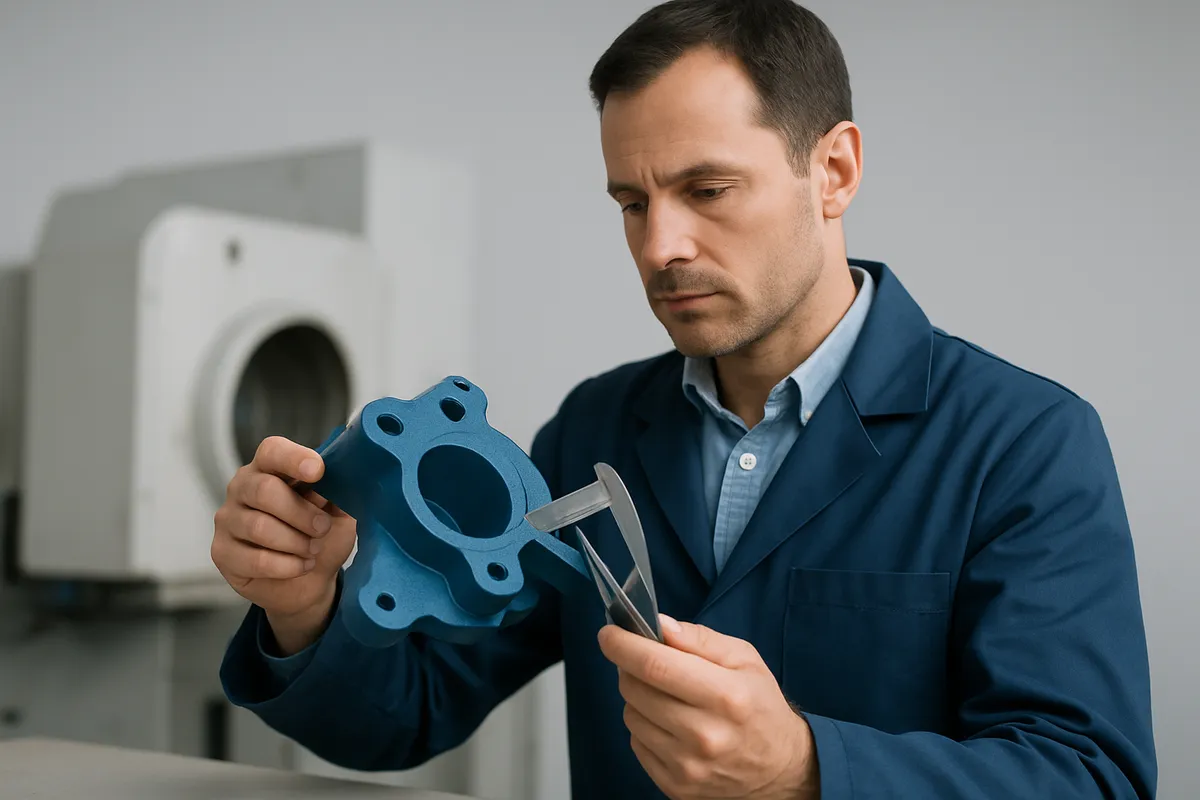
A certification logo on a website proves nothing on its own, confirm the certificate number, its scope, and its expiry date before trusting it. Many casting manufacturers display badges that are outdated, scoped to the wrong facility, or unrelated to the industry you serve.
What Do ISO, IATF, and AS9100 Certifications Mean, and How Do They Differ Between Manufacturers?
ISO 9001 certifies a general quality management system, IATF 16949 adds automotive-specific traceability and defect-prevention requirements, and AS9100 layers on aerospace demands around configuration control and risk management. A casting manufacturer holding only ISO 9001 but pitching itself for automotive production parts is a mismatch worth questioning, the extra layers in IATF 16949 exist because automotive buyers need supplier-level defect tracking that generic ISO 9001 does not require. The same logic applies to medical device work, where ISO 13485 governs process validation and risk management specific to that sector. Ask directly which standard applies to your part category, and treat a vague answer as a warning sign rather than a formality.
- Match the certification to your industry, not just to “quality” in general terms.
- Ask which standard the shop actually audits against for parts like yours, by name.
- Treat a certification that doesn’t map to your sector as a gap to investigate, not ignore.
Certificates expire, get suspended, or cover a narrower scope than a sales deck suggests. Request the certificate number and the issuing registrar, then confirm the expiry date and the specific standard version listed (ISO 9001:2015, for example, not an older revision). Scope matters as much as validity: a certificate can apply to one production line, one facility, or one process, while the quote you received covers a different plant entirely. This is common among casting manufacturers with multiple regional sites, one location may carry full certification while a sister facility handling overflow work does not.
- Request the certificate number and registrar name in writing.
- Confirm the certificate’s expiry date and the specific facility it covers.
- Ask whether the plant quoting your job is the same plant named on the certificate.
GC INDUS holds both ISO 9001 and ISO 13485 certification, covering general quality management and medical device manufacturing compliance across its production facilities. Before placing an order with any casting manufacturers, ask for a sample quality documentation package, a material certificate, a dimensional inspection report, and a written non-conformance process, to see how the shop actually enforces its stated standards on the floor, not just on paper.
Compare Lead Times and Costs Across Casting Manufacturers
Compare casting manufacturers on total delivered cost and verified delivery history, not the lowest number on a one-page quote. A headline price that omits tooling amortization, finishing, or rework risk tells you almost nothing about what the part will actually cost.
What Cost Breakdown Should We Expect for Different Casting Types?
Cost structure differs by casting process, and understanding why keeps you from comparing apples to oranges. Die casting typically carries high upfront tooling investment offset by fast cycle times at volume, while investment casting spreads cost differently because tooling is simpler but cycle times run longer and yield per pour is lower. Sand casting sits at the low end of tooling cost but usually needs more secondary machining to hit tight tolerances, which adds cost downstream rather than upfront.
Ask each supplier to itemize four categories separately: tooling investment, per-part cost at your target volume, material yield or scrap rate, and secondary operations such as machining, surface treatment, or heat treatment. A quote that bundles these into one number hides where the cost actually sits. Vertical integration, having CNC machining, finishing, and assembly under one roof, tends to reduce the hidden markup that happens when a casting manufacturer outsources finishing to a third party and passes along coordination costs.
When requesting quotes from multiple casting manufacturers, send the same drawing package, tolerance callouts, and volume assumptions to each. Ask for the breakdown in the same four categories so you’re comparing structure, not just a final figure. GC INDUS provides this tiered breakdown as standard practice, separating tooling, per-part pricing, and finishing so clients can see exactly where cost sits across aluminum, magnesium, iron, and steel casting projects.
How Do Production Timelines Vary Between Manufacturers, and What Drives Those Differences?
Lead time variation usually comes down to four factors: tooling fabrication time, where your order sits in the supplier’s production queue, your batch size, and whether finishing happens in-house or gets shipped to a third party. Tooling fabrication alone can be the single largest lead-time variable, since die and mold complexity determines how many weeks pass before the first shot or pour even happens.
Queue position matters as much as capacity, a foundry with excess equipment but a full order book will still push your delivery date back. Don’t rely on a single quoted lead time as a predictor of performance. Ask each candidate for historical on-time delivery rates across recent orders similar in size and complexity to yours, since a quoted date and a delivered date are not the same promise.
Scrutinize the lowest bid carefully. A below-market quote often hides cost in scrap rates, rework cycles, or missed deadlines that surface only after production starts. Factor those risks into your comparison before signing, not after the first late shipment.
Common Mistakes to Avoid When Switching Casting Manufacturers
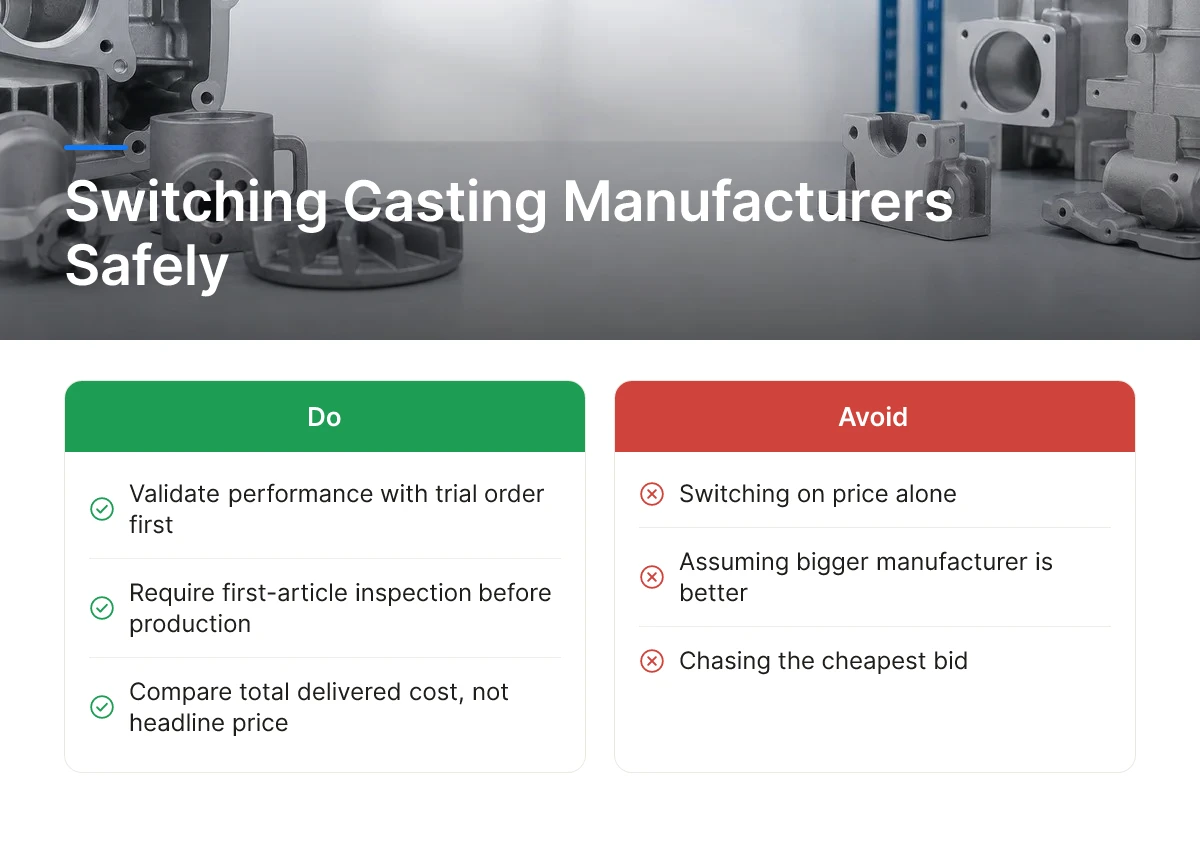
Most failed supplier transitions share one root cause: switching casting manufacturers on price alone without validating performance through a trial order first.
A lower quote means nothing if the parts arrive out of tolerance or the fourth shipment is late. Eagle Group Manufacturers points out that buyers who assume “bigger is better” or chase the cheapest bid often end up with defective parts, overpriced rework, and logistical headaches that cost more than the original supplier ever did. The fix is simple in principle, harder in practice: require a first-article inspection and a small trial run before committing production volume to a new foundry. Treat the pilot order as a test of the full relationship, not just the casting itself.
What Metrics and ROI Indicators Should We Track When Evaluating a New Casting Partner?
Track scrap rate, on-time delivery rate, defect and rework rate, and responsiveness to engineering changes, before and after the switch, using the same formulas each time.
Scrap rate and defect rate tell you whether the new foundry’s process control matches its sales pitch. On-time delivery rate, measured over several purchase orders rather than one, exposes whether quoted lead times hold up under real production schedules. Responsiveness to engineering changes, how fast a supplier turns around a revised drawing or answers a design-for-manufacturability question, often predicts future friction better than any spec sheet. Modus Advanced notes that engineering support and the share of staff who can give direct DFM feedback are strong indicators of a manufacturing partner’s actual capability, not just its marketing claims. Without hard numbers on both sides of the switch, you’re guessing, not measuring.
Skipping a transition plan is the next common failure. Moving 100% of volume to an unproven supplier overnight leaves no buffer if first-run parts fail inspection or a shipment slips. A short dual-sourcing or overlap period, keeping the incumbent live while the new casting manufacturer ramps, protects production continuity during qualification. Several investment casting buyers run this overlap for multiple quote cycles specifically to confirm certification claims and alloy experience hold up in production, not just on paper.
Finally, document a baseline from your current manufacturer before you start evaluating alternatives. Without recorded scrap rates, delivery performance, and response times from the incumbent, there’s no way to prove the new casting manufacturers actually improved outcomes rather than just lowered the invoice.
Frequently Asked Questions
What precision tolerances and capabilities should we require from a casting manufacturer?
Require a tolerance specification matched to your part’s function, not just a general claim of “high precision.” Ask for process capability data (Cpk) on parts similar to yours, and confirm the manufacturer’s measured tolerance range against your drawing requirements. GC INDUS holds tolerances to ±0.001mm across CNC machining and casting, which covers most medical, automotive, and electronics applications. Also confirm which alloys and processes, die casting, investment casting, Swiss lathe turning, they run in-house rather than outsource.
How do we assess a casting manufacturer’s quality assurance process before committing?
Ask for their certifications, inspection protocols, and defect-rate data before signing any agreement. ISO 9001 should be a baseline; ISO 13485 matters if parts go into medical devices. Request a sample inspection report showing dimensional checks, material certs, and traceability records. A manufacturer that hesitates to share this data, or treats quality metrics as proprietary, is a warning sign worth taking seriously.
Is it worth switching casting manufacturers if our current supplier meets deadlines but costs more?
Switching makes sense only if the cost gap is large enough to offset requalification risk and potential disruption. On-time delivery has real value, many switching decisions driven purely by price lead to the same mistakes that caused the original switch. Benchmark total cost, including rework and communication overhead, before moving.
Can one casting manufacturer handle both prototype and high-volume production runs?
Yes, if the manufacturer offers flexible minimum order quantities and scalable tooling, not fixed production tiers. GC INDUS accepts orders starting from 1 piece and scales into volume production without requiring a vendor change, which avoids requalifying a new supplier mid-program.
Conclusion
Choosing among casting manufacturers comes down to three checks: verified tolerance data instead of marketing claims, certifications that match your industry (ISO 9001 at minimum, ISO 13485 for medical work), and proof of on-time delivery under real production conditions. Avoid picking on price or size alone, the research is consistent that fit matters more than scale. Treat MOQ flexibility as a filter too; a supplier that can’t take a 10-piece prototype run won’t support you through later design changes.
Next step: pull your last three supplier quality reports and compare their Cpk data and certification scope against your next project’s specs before issuing a new RFQ.
Recommended Articles
Explore more from our content library:


