
Book Appointment Now

GC INDUS / MANUFACTURING KNOWLEDGE
How to Find Reliable Manufacturers Overseas and at Home

Understanding how to find reliable manufacturers is essential. A reliable manufacturer is one you can verify, not just one that quotes a good price or fast lead time. Confirm their certifications directly with the issuing body, request references from current clients in your industry, review their quality documentation (inspection reports, process capability data), and test them with a paid sample run before committing volume. Reliability shows up in consistency across repeat orders, not in a single good sample, so your qualification process should check track record, communication discipline, and documented quality control, whether the factory is overseas or domestic.
Verify What Makes a Manufacturer Reliable Before You Commit
Three checks separate a reliable manufacturer from a risky bet: independently confirmed certifications, verified production capacity, and references from clients making parts like yours.
Most buyers researching how to find reliable manufacturers start with a certificate PDF and a sales call. That’s not verification, it’s trust on faith. A factory can scan an expired ISO 9001 certificate or one belonging to a different facility under the same parent company. The only way to confirm it’s current is to contact the issuing registrar directly and check the certificate number against their database. For medical device work, the same applies to ISO 13485, don’t take a logo on a website as proof of compliance.
What Certifications, Track Record, and Production Capacity Should You Verify?
Confirm certifications with the issuing body, then test stated capacity against your actual order volume before signing anything. Ask for the equipment list, number and type of CNC mills, lathes, or molding presses, along with shift patterns and current utilization rates. A shop claiming to handle your 50,000-unit run on three machines running one shift a day is telling you something different from what their sales quote implies. Quality surveys of importers consistently find that managing product quality ranks as the top sourcing concern, which is why capacity and process verification matter as much as the certificate itself.
Request two or three references from current clients who order similar parts at similar volumes, not just a satisfied one-time prototype customer. Ask those references directly about on-time delivery rates and how the manufacturer handled a quality issue or missed deadline, the answer tells you more than any sample part.
How Do You Compare Manufacturers Across Regions or Sourcing Platforms?
Domestic shops let you verify in person, a site visit confirms the machine list and inspection process match what’s claimed. Overseas sourcing usually requires more structural safeguards: third-party inspection agencies, sourcing agents with local presence, or platforms that pre-vet suppliers, because documentation alone is easier to misrepresent at a distance. Factors like production capacity, certifications, and lead time apply in both cases, but the verification method shifts with geography.
Whichever route you take, treat one successful sample as a starting point, not proof. Reliability shows up over several repeat orders, where consistency in tolerance, packaging, and delivery timing becomes visible, a single good batch can happen by chance.
Identify Red Flags When Vetting Manufacturers Internationally
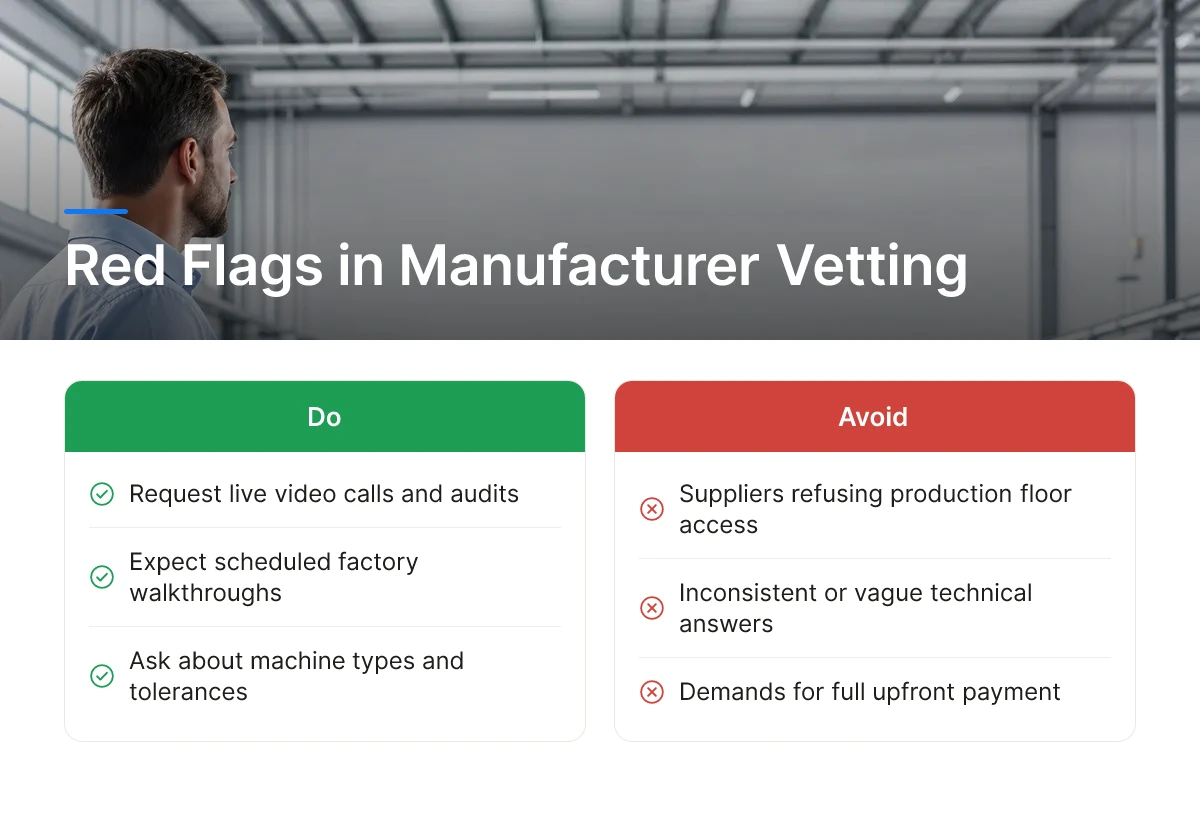
A reluctance to show the factory floor, inconsistent technical answers, and demands for full upfront payment are the clearest signs a manufacturer is not what it claims to be.
What Are the Common Warning Signs of Unreliable or Fraudulent Manufacturers?
Any supplier who refuses a live video call or an in-person audit of the production floor is telling you something, even if they frame it as a security policy. Legitimate shops with real equipment rarely object to a scheduled walkthrough, because they have nothing to hide and everything to gain from proving their capability.
- Inconsistent or vague answers about machine types, tolerances, or plant location, a real CNC shop can name its equipment (3-axis vs. 5-axis, Swiss lathe, EDM) without hesitation.
- Pressure to wire 100% of payment before producing a single sample, especially to a personal bank account rather than a registered business account.
- Business registration details that shift between the quote, the invoice, and the website, different company names, addresses, or tax IDs are a common sign of a reseller hiding behind a manufacturer’s identity.
- Unwillingness to provide references from existing clients or export records showing prior shipments in your product category.
Cross-check the registered address, business license, and export history against independent sources, not just what the sales contact sends you. Government business registries, customs/export databases, and industry association directories exist precisely because self-reported documents can be edited. Mismatches between the sourcing survey a supplier completes and public records are a documented reason sourcing relationships fail.
How Do You Protect Yourself During Initial Outreach and Qualification?
Protect your money and your designs before you protect anything else. Use traceable payment methods, letters of credit, escrow services, or business-to-business transfers with paper trails, and start with a small paid trial order before committing to a production run. Avoid wiring full payment to personal accounts regardless of how urgent the discount offer sounds.
During first contact, share only the detail needed to get a capability match: material, rough dimensions, tolerance class, and volume. Hold back critical design files, proprietary geometry, and full drawings until an NDA is signed and the manufacturer has passed basic verification.
Part of learning how to find reliable manufacturers is telling a trading company apart from an actual factory, ask direct questions about in-house equipment, request the factory’s business license tied to its manufacturing registration (not just a trading license), and compare answers across multiple calls. GC INDUS clients can verify ISO 9001 and ISO 13485 certifications and request a facility walkthrough before any tooling commitment, which removes most of this guesswork upfront.
Evaluate Quality Control and Inspection Protocols Before You Commit
Checking a quality system means reading actual inspection data and process records, not a sales deck claiming “strict quality control.” A critical part of how to find reliable manufacturers is separating documented proof from marketing language before you sign anything.
Start by requesting the paperwork a disciplined supplier generates as a matter of routine: first-article inspection reports, process capability studies (Cpk data), and in-process check logs, not just a final inspection summary. A manufacturer that only inspects at the end of the line has no way to catch a drifting tool or a worn fixture mid-run, which is exactly when tight-tolerance parts start failing silently. In-process checks, by contrast, show the supplier is monitoring the process itself, not just sorting good parts from bad after the fact. Product quality is consistently cited as importers’ top manufacturing concern, which is one reason this documentation matters more than any verbal assurance.
What Quality Metrics and Third-Party Testing Should You Require?
For parts that carry safety, regulatory, or high-cost-of-failure implications, require independent verification rather than relying only on the supplier’s internal QC team. A manufacturer’s own inspectors have an incentive, however unintentional, to pass borderline parts; a third-party lab or inspection firm has none. Ask what the supplier’s quality requirements document covers for prohibited practices too, unauthorized repairs or undisclosed process changes are the kind of thing that should trigger disqualification outright, and established manufacturers typically spell this out in writing for their own supply chains. If a prospective partner can’t produce an equivalent document for how they manage their own suppliers, treat that as a gap.
How Do You Verify a Manufacturer’s Ability to Meet Tight Tolerances Consistently?
A stated tolerance on a spec sheet tells you what a machine can theoretically hold under ideal conditions, not what it holds on your part, in your material, at production volume. Ask for first-article inspection reports on parts comparable to yours in geometry, material, and tolerance band, this is concrete evidence, not a capability claim.
- Order a small pilot run of 10-50 units, not a single prototype, since one part can look perfect by chance while the process behind it is not yet stable.
- Measure dimensional variation across that batch to see whether the supplier holds tolerance consistently or only on the first few pieces.
- Request calibration records for the measurement equipment used, traceable, dated calibration logs are a concrete marker of a disciplined quality system, distinct from a supplier simply stating “we check everything.”
GC INDUS backs this kind of scrutiny with ISO 9001 and ISO 13485 certification, documented inspection protocols, and tolerances held to ±0.001mm across CNC machining, die casting, and injection molding, so clients can verify capability with real inspection data rather than a spec sheet alone.
Negotiate Legal Protections and Contract Terms That Protect Your Interests
A contract that protects you spells out IP ownership, enforceable delivery milestones, staged payments tied to inspection, and a jurisdiction where you can actually sue if something goes wrong. Verbal agreements and informal purchase orders leave too much room for interpretation once a dispute starts. Part of learning how to find reliable manufacturers is accepting that reliability has to be written down, not just observed during a factory visit.
What Should an NDA and IP Protection Clause Cover?
An NDA should name exactly who owns the design files, drawings, and any process improvements the manufacturer develops while producing your part. Without that clause, a supplier can treat your CAD files as shared knowledge and quote your design to a competitor the following month.
- Ownership of designs: state explicitly that IP created from your specifications, including derivative modifications, belongs to you, not the manufacturer.
- Third-party disclosure restrictions: prohibit sharing drawings, tooling specs, or production data with other clients, subcontractors, or sister facilities without written consent.
- Tooling and mold disposition: define what happens to molds and fixtures after the relationship ends, whether that means destruction, return, or purchase at a pre-agreed value. Unaddressed, tooling can sit in a supplier’s facility indefinitely or resurface in another company’s production run.
How Do You Negotiate MOQ, Pricing, and Delivery Terms That Protect Your Interests?
Treat minimum order quantity as a negotiation, not a fixed policy. Ask for a lower MOQs tied to a pilot run, with a written path to higher volumes once the supplier demonstrates consistent tolerances and on-time shipments over several cycles. GC INDUS structures this kind of relationship directly, accepting orders from a single piece and scaling production as trust builds through verified performance rather than forcing OEMs into volume commitments upfront.
- Tie delivery dates to specific production milestones, such as “tooling complete,” “first article inspection passed,” and “ship date confirmed,” rather than a single vague promise of “4-6 weeks.”
- Write penalty or remedy clauses for late shipment, such as cost credits or rights to source the next batch elsewhere without breach.
- Structure payment in stages tied to inspection outcomes rather than paying in full upfront or on shipment alone, so cash is withheld if parts fail quality checks.
- Specify pricing terms for volume breaks in writing, so costs don’t shift once you’re dependent on the supplier.
Cross-border agreements carry added risk because contract enforcement varies by country. Have the agreement reviewed under a jurisdiction and legal framework you can realistically act on, since a contract that looks solid on paper is worthless if local courts won’t enforce it or arbitration costs exceed the value of the dispute.
Avoid Common Mistakes When Qualifying a Manufacturing Partner
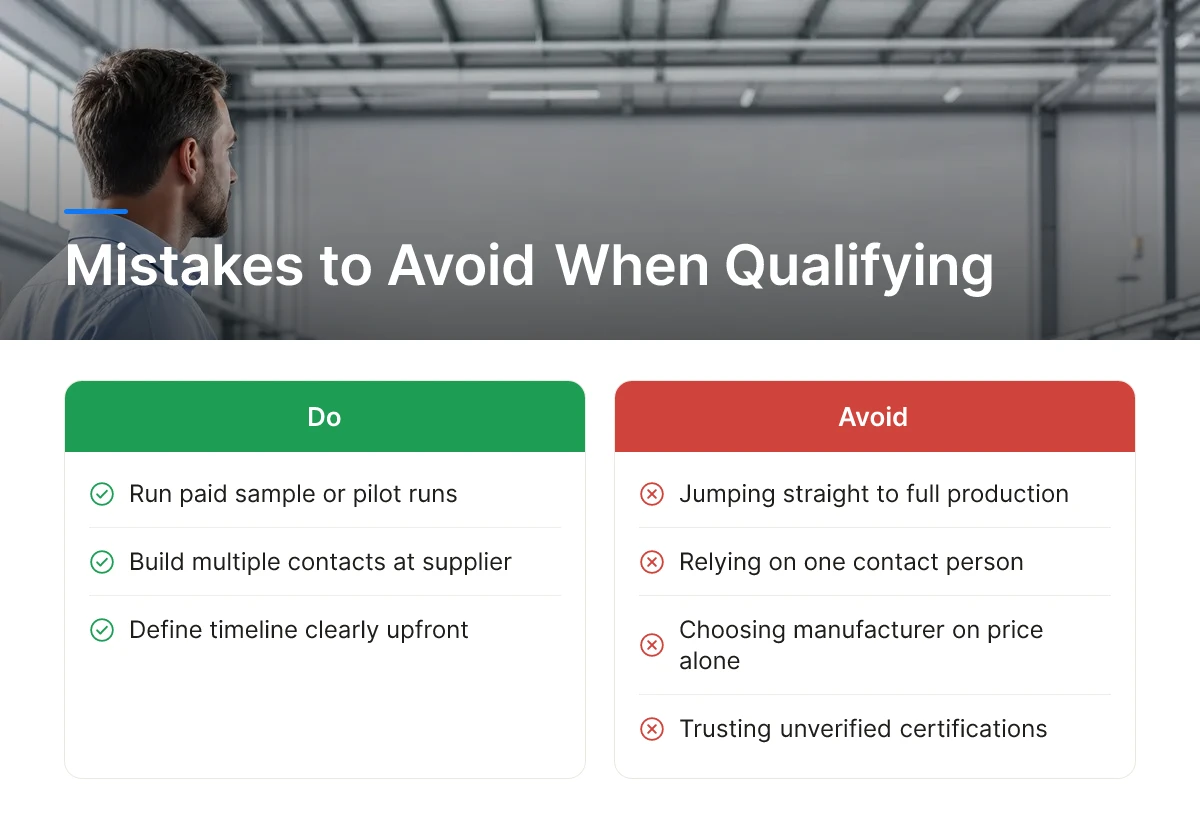
Most failed sourcing relationships trace back to five avoidable mistakes: skipping pilot runs, relying on one contact, trusting unverified certifications, choosing on price alone, and leaving the timeline undefined. Learning how to find reliable manufacturers means learning to recognize these patterns before they cost you a production run.
How Do You Move From Identifying a Candidate Manufacturer to Sample Approval?
The biggest misstep is jumping from a promising first conversation straight to a full production order. A paid sample or small pilot run shows how a shop handles tolerances, material substitutions, and finishing under real conditions, not just what a sales deck claims. Skipping this step means your first real test of the relationship is a container of parts you’ve already paid for.
- Request a paid sample batch before any volume commitment, even if it adds a week to the timeline.
- Insist on written agreements covering specs, tolerances, and inspection criteria, not just email threads with one sales rep.
- Verify certifications like ISO 9001 or ISO 13485 directly through issuing bodies rather than accepting a PDF on a company website; self-reported compliance has no built-in accountability.
- Avoid single points of contact with no documentation trail, if your only record of an agreement is a chat log, you have no use when a dispute arises.
Price and lead time matter, but treating them as the deciding factor without checkpoints tied to sample approval and inspection results is how buyers end up with out-of-tolerance parts and no recourse. A quote that looks ten percent cheaper is irrelevant if the parts fail inspection on arrival. GC INDUS builds sample approval and full inspection protocols into every engagement specifically to remove this guesswork before a client commits to volume.
What Milestones Should Structure Your Qualification Timeline?
Define four checkpoints before you start outreach: initial inquiry, sample approval, pilot run, and contract signing. Without these fixed points, qualification tends to drift, months pass, informal promises accumulate, and no one can say exactly what was agreed to or when.
- Inquiry: document scope, specs, and target tolerances in writing.
- Sample approval: set objective pass/fail criteria tied to inspection reports, not subjective sign-off.
- Pilot run: test at a modest volume before scaling, with agreed-upon defect thresholds.
- Contract signing: lock in pricing, MOQs, and lead times only after the pilot clears inspection.
Mapping these milestones turns a vague vetting process into a structured one you can defend internally and repeat with the next supplier.
Frequently Asked Questions
How long does it typically take to qualify a new manufacturer?
Plan for four to eight weeks if you want a sample order, document review, and a reference check done properly. Overseas qualification often runs longer because of shipping time for samples and factory audit scheduling. Rushing this stage is where most quality escapes start.
Should you always require a factory audit before placing an order?
For first-time orders above a meaningful volume or for regulated parts, yes, an audit catches problems a document review misses. Smaller trial orders with a known-good supplier type, like a shop already holding ISO 9001 or ISO 13485, can sometimes skip a full on-site audit in favor of a desk review and sample inspection.
What’s the difference between a trading company and an actual manufacturer?
A trading company resells parts made by a factory it doesn’t own, while a manufacturer runs the equipment and controls the process directly. Trading companies add a markup and a communication layer between you and the production floor. Working directly with the manufacturer gives you faster answers on tolerances, tooling changes, and defect root cause.
Do domestic manufacturers need the same level of vetting as overseas ones?
Yes, though the risk profile shifts rather than disappears. Domestic shops remove language and time-zone friction but can still miss tolerances, understate lead times, or lack the right certification for medical or automotive work, so document checks and sample parts still matter.
Conclusion
Finding a reliable manufacturer comes down to three checks: verify certifications against the standards your industry actually requires, confirm process capability with a sample part before committing to volume, and favor partners who handle multiple processes in-house to avoid supplier fragmentation. GC INDUS applies this model directly, ISO 9001 and ISO 13485 certification, CNC milling, turning, and casting under one roof, and MOQs starting at one piece for sample runs. Your next step: request a sample order with full inspection data before issuing a production purchase order, regardless of how strong the supplier’s pitch sounds.
Recommended Articles
Explore more from our content library:


