
Book Appointment Now

GC INDUS / MANUFACTURING KNOWLEDGE
How to Improve Production Speed Without Losing Quality

Understanding how to improve production speed is essential. Precision manufacturers improve production speed without losing quality by removing non-value-adding time, setup, inspection delays, material waits, rather than cutting the machining or verification steps that hold tolerances. Speed gains come from faster changeovers, better-programmed toolpaths, synchronized supply chains, and inspection built into the process instead of bolted onto the end. The tolerance itself never gets faster to hold; the time around it does.
Understand How Production Speed and Tight Tolerances Interact
Speed and precision compete for the same resource: time at the machine. Any question about how to improve production speed in a tight-tolerance shop has to start with what happens when you push a process past the rate it was proven at.
Why Precision Shops Can’t Just Run Machines Faster
Turning up feed rates or cutting cycle times sounds like the obvious lever, but at tolerances as tight as ±0.001mm, acceleration introduces variables a general machine shop never has to price in. Higher spindle loads generate more heat, and thermal expansion alone can push a part out of spec before it ever leaves the machine. Faster feed rates also accelerate tool wear, which changes cutting geometry mid-run and produces dimensional drift between the first part and the hundredth.
Environmental stability matters just as much. Precision manufacturing relies on controlled temperature, humidity, and vibration to hold micron-level accuracy across a production run. A general manufacturer chasing throughput can tolerate some variation part to part. A medical device or aerospace component cannot, a missed tolerance can halt production, trigger rework, or create a compliance failure during audit.
Where the Real Time Savings Exist in a Tolerance-Driven Process
Cycle time on the actual cut is mostly fixed by material hardness, tool geometry, and the tolerance band itself, physics sets that number, not willpower. The speed that’s actually available to recover sits in the time around the cut: setup and fixturing, changeover between jobs, waiting on inspection results, and handoffs between machining, finishing, and assembly.
That is the direct answer to whether tight tolerances and faster production can coexist: yes, but only by attacking non-cutting time, not by speeding up the cut or skipping verification steps. Automation applied to machine tending and part handling, for example, improves consistency and reduces the dead time between operations without changing the cutting parameters that hold the tolerance.
This is also why a precision shop’s answer to how to improve production speed looks different from a high-volume plant’s. Scrap at ±0.001mm is expensive, re-inspection is mandatory, and certifications like ISO 13485 add documentation steps a commodity manufacturer skips entirely. GC INDUS builds its own production flow, CNC machining, die casting, injection molding, and assembly, around that constraint, holding ISO 9001 and ISO 13485 compliance while still compressing the setup and handoff time between each stage.
How to Improve Production Speed With Process and Workflow Changes
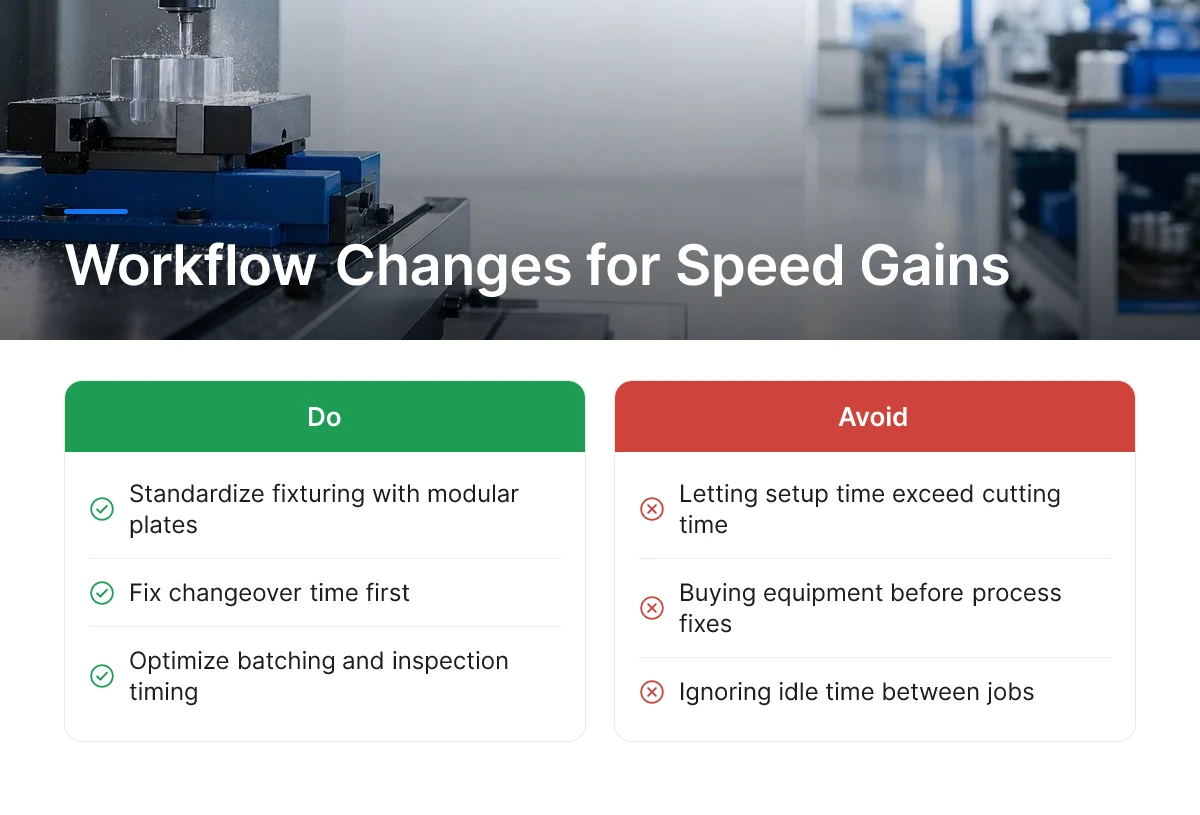
The fastest, cheapest way to improve production speed is to fix changeover time, batching logic, and inspection timing before buying new equipment.
Operational Changes That Deliver Measurable Speed Gains
Changeover time is usually the largest hidden drag on throughput in a precision shop, not the cutting time itself. A machine running a part in three minutes but sitting idle for forty-five minutes between jobs for re-fixturing and re-verification is losing most of its potential output to setup, not machining.
- Standardize fixturing. Use modular fixture plates and repeatable workholding so operators can swap jobs without re-machining jaws or hunting for custom clamps. This alone removes a large share of manual setup variation between operators and shifts.
- Pre-stage tooling. Pull tools, gauges, and fixtures for the next job while the current one is still running, so the machine stops only for the physical swap.
- Verify programs offline. Simulate and prove out G-code on a separate workstation before it touches the machine, catching collisions or tolerance errors before they cost spindle time.
Batching and sequencing decisions matter just as much as the changeover mechanics. Grouping jobs by tolerance band and material, running all ±0.005mm aluminum parts in sequence, for example, before switching to ±0.001mm stainless steel work, cuts the number of times a machine needs re-calibration, new tooling, or a different coolant setup. Random job sequencing, by contrast, forces repeated recalibration even when the part geometry barely changes.
In-process inspection is the third lever, and it’s the one most shops under-use. Checking critical dimensions at key stages, after roughing, after heat treatment, before final finishing, catches a deviation while the part can still be corrected or scrapped cheaply. Waiting until final QC to find an out-of-tolerance feature means the scrap cost and the lost cycle time both land at the most expensive point in the process.
Industry priorities differ here. Automotive suppliers lean on repeatable high-volume cells where speed comes from consistency across thousands of identical parts. Medical device manufacturers can’t skip documentation steps for speed, traceability under ISO 13485 has to run in parallel with faster cycles, not instead of them. Aerospace work is often paced by first-article inspection and certification sequencing, where speed gains come from getting the paperwork and the part approved together, not from cutting corners on either.
These changes echo standard lean manufacturing principles, reducing waste, matching flow to demand, and stabilizing processes before automating them. GC INDUS applies this sequence across its ISO 9001 and ISO 13485-certified lines: standardized fixturing and staged tooling across CNC milling, turning, and 5-axis work, with in-process checks built into each stage rather than reserved for the end. That combination is where most learn how to improve production speed without trading away the tolerance control their customers audit for.
Choose Technology and Equipment That Speed Up Production Without Sacrificing Precision
The equipment and software stack on the shop floor decides how how to improve production speed plays out in practice, scheduling systems cut idle time, smarter CNC programs cut air-cutting, and the right tooling cuts the number of operations per part.
Which Software Systems Enable Faster Production Cycles
Manufacturing Execution Systems (MES) and Enterprise Resource Planning (ERP) platforms speed up production by closing the gap between what a shop plans and what actually happens on the floor. An MES tracks machine status in real time, so a scheduler can assign the next job the moment a spindle goes idle instead of waiting for a supervisor to notice an empty machine during a walkthrough.
ERP systems extend that visibility upstream, tying material arrival, tooling availability, and order priority together so a job doesn’t get released to the floor before everything it needs is actually on hand. Automation platforms that combine CNC machining with robotic machine tending build on this by keeping machines running through unattended shifts, which supports more consistent cycle times across a production run. The mechanical effect is straightforward: less time spent searching for the next job, less time spent waiting on missing inputs, and earlier flags when a workcenter is becoming a bottleneck rather than discovering it at the end of the week.
How CNC Programming and Tooling Choices Affect Speed
Toolpath optimization removes non-cutting time from a program before it ever reaches the machine. Simulation software lets a programmer run the full cycle virtually, catching collisions, excess air-cutting, and inefficient tool approaches without burning machine time or risking a crash on a real part, a meaningful advantage when a single tight-tolerance setup can take hours to dial in.
Tooling strategy matters just as much as the program. Quick-change tooling systems cut the minutes lost to manual tool swaps between operations, and structured tool life management, tracking wear and replacing inserts on a schedule rather than after a failure, prevents the slow drift in surface finish and dimensional accuracy that forces rework. Equipment selection compounds these gains: a 5-axis machine or Swiss lathe can complete a part in one setup that would otherwise require three or four separate operations on simpler equipment, each with its own fixturing and alignment time. GC INDUS applies this logic across its CNC milling, turning, 5-axis, and Swiss lathe capabilities, selecting the process that removes setups rather than just running faster on the same one.
None of this is free. Workflow software sits at a budget-friendly tier for smaller shops, while multi-axis machining centers and automated tending cells represent a premium investment best justified by part complexity and production volume rather than purchased for its own sake. Whatever the investment level, tolerance control, runout checks, in-process dimensional inspection, has to stay in place; a faster cycle that drifts out of ±0.001mm tolerance isn’t a gain, it’s scrap waiting to happen.
Reduce Supply Chain and Logistics Bottlenecks That Slow Production
Material flow upstream and secondary processing downstream often decide production speed more than anything happening at the machine. A shop can run three shifts and still miss delivery dates if certified stock or outside plating is late.
How Material and Supplier Lead Times Limit Production Speed
A precision job cannot start, or restart after a quality hold, until certified material with the right mill certs and traceability documentation is on the floor. For medical and automotive parts, that certification step is non-negotiable, so a supplier’s delay becomes the shop’s delay no matter how fast the CNC equipment runs.
This is where most answers to how to improve production speed get incomplete, they focus only on cycle time and ignore the days a job sits waiting on stock. One unreliable aluminum or stainless supplier can stall an entire production schedule, even when every downstream step is optimized.
- Qualify at least one backup supplier for each critical material, tested and approved before it’s needed, not during a crisis.
- Hold strategic buffer stock of high-turn materials and common grades to absorb short delays without tying up excess capital.
- Track supplier on-time performance over rolling periods to catch degrading reliability before it causes a missed delivery.
Logistics Changes That Shorten Time-to-Delivery
Coordinating outsourced steps like plating, anodizing, or heat treat in parallel with other operations, rather than sending parts out sequentially one vendor at a time, removes days from the schedule. Consolidated shipping and scheduling agreements with secondary processors also reduce the dead time parts spend waiting for a truck or a slot in someone else’s queue.
Proximity matters too. A heat-treat partner located near the primary machining operation cuts transit legs that otherwise stack up across a multi-process job traveling between three or four separate facilities.
Flexible minimum order quantities and tight outsourcing coordination are part of this picture. GC INDUS runs CNC machining, die casting, injection molding, surface treatment, and assembly under one operation and accepts orders from a single piece, which keeps small-batch and prototype work moving without the handoffs that slow multi-vendor supply chains. Fewer vendor transfers means fewer chances for a job to sit idle between steps, which is often the real answer to how to improve production speed on complex parts.
Common Mistakes to Avoid When Speeding Up Production
Most failed attempts at how to improve production speed share the same root cause: a shortcut that trades a small time saving now for a larger quality cost later. Knowing the common traps makes it easier to avoid them.
Cutting Inspection to Save Time
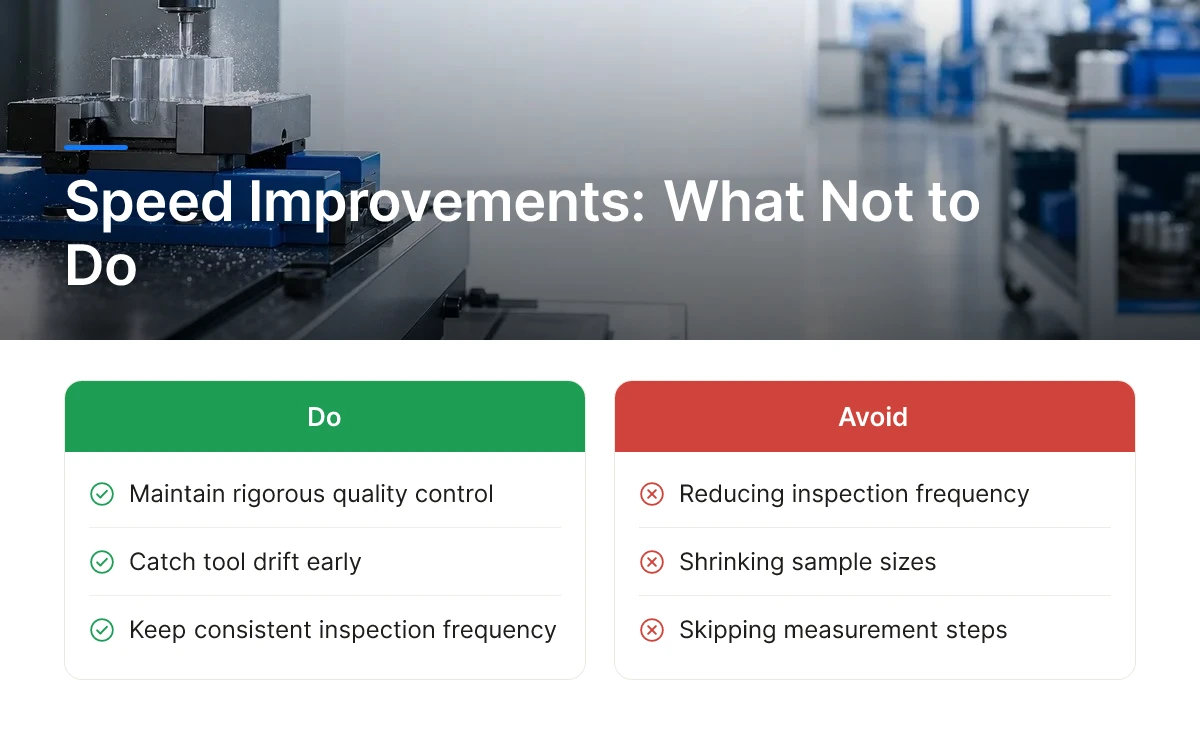
Reducing inspection frequency or shrinking sample sizes feels like an easy way to shave minutes off a cycle, but it is the fastest way to erase any speed gain. Tight tolerance work depends on catching drift early, tolerance bands as fine as ±0.010 inch or tighter require rigorous, consistent quality control, not occasional spot checks. Skip a measurement step and a worn tool or thermal shift can run undetected through dozens of parts before anyone notices, turning a shaved minute per part into hours of rework, scrap, and a missed delivery date.
Pushing Feeds and Speeds Without Revalidation
Increasing spindle speed or feed rate without re-checking tool wear and thermal behavior puts tolerance-critical features at risk. Heat buildup and accelerated tool wear change dimensional accuracy in ways that do not show up until parts are measured, and by then, a batch may already be out of spec. Any change to cutting parameters needs a validation run against the print, not just a visual check, before it goes into full production.
Treating Speed as a One-Time Fix
Speed improvement is not a project with an end date, it is an operating habit. Shops that make one round of changes and stop lose the gains within a few months as tool wear, material lot variation, and staff turnover erode the improvement. Tracking performance continuously is what separates a lasting gain from a temporary spike.
Metrics to Track Before and After Making Changes
Four numbers tell you whether a change actually worked: cycle time per part, first-pass yield, on-time delivery rate, and scrap rate. Record each one before any change, then again at 30, 60, and 90 days after. If cycle time drops but first-pass yield or scrap rate moves the wrong direction, the change did not improve production, it just moved the cost downstream.
Weigh any investment against what it saves per part. A process or workflow change, adjusting a changeover sequence, reordering operations, costs little and pays back within weeks. Software, such as scheduling or quality management tools, sits in the mid-range and typically takes a few months to show return. New equipment, like added CNC capacity or inline metrology, requires the largest investment and the longest payback window, often spanning a full production cycle or more before it validates against tolerance-critical requirements. GC INDUS builds this validation into its own production planning, running full inspection protocols under ISO 9001 and ISO 13485 before any speed-related process change reaches a client’s parts.
Set expectations accordingly: process and workflow fixes show measurable results in weeks, while equipment and technology changes need longer implementation and validation before full-speed, tolerance-safe production resumes.
Frequently Asked Questions
Can you speed up production without loosening tolerances?
Yes, but only by removing waste, not precision, faster changeovers, better fixturing, and automation cut cycle time without touching the tolerance band. Problems start when shops try to hit speed targets by cutting inspection steps or running machines past their stable operating window, which is where scrap and rework creep back in.
What’s the fastest change a precision shop can make to improve production speed?
Reducing changeover time usually delivers the quickest win, since setup and fixture adjustments often eat more time than actual cutting. Standardizing workholding and pre-staging tooling can shrink changeover windows within weeks, before any capital investment in new equipment is needed.
Do medical device and aerospace manufacturers approach production speed the same way?
No, both want faster cycles, but medical device work layers in ISO 13485 documentation and traceability requirements that aerospace and general industrial parts don’t always carry. That means speed gains in regulated industries have to come with equivalent gains in inspection and record-keeping, not instead of them, otherwise the compliance burden slows the next batch down.
How long does it typically take to see results from production speed improvements?
Changeover and workflow fixes often show measurable results within a few production cycles, sometimes two to four weeks. Automation or equipment upgrades take longer, often several months, because of installation, programming, and operator training before output stabilizes.
Does upgrading equipment always improve production speed?
No, new equipment only helps if the surrounding process, fixturing, scheduling, inspection, is ready to support the faster cycle. A 5-axis machine or robotic tending cell added to a bottlenecked workflow just moves the bottleneck somewhere else.
Conclusion
Faster production in precision manufacturing comes from removing friction, not pressure, shorter changeovers, tighter process control, and automation applied where variation already causes delay. The shops that gain speed without losing tolerance are the ones that treat quality systems as part of the speed equation, not an obstacle to it.
GC INDUS holds tolerances to ±0.001mm across CNC machining, die casting, and injection molding while running ISO 9001 and ISO 13485 inspection protocols on every order, from a single prototype to full production volume. If a current supplier’s changeover delays or inconsistent tolerances are slowing your next part launch, start by requesting a quote on your most time-sensitive drawing and compare the turnaround directly.
Recommended Articles
Explore more from our content library:


