
Book Appointment Now

GC INDUS / MANUFACTURING KNOWLEDGE
How to Meet FDA Rules in Medical Device Manufacturing
Meeting FDA rules in medical device manufacturing means building precision, documentation, and quality systems into every production decision from day one, not inspecting for compliance after the fact. This requires an ISO 13485-based quality management system, validated processes with full traceability, and manufacturing partners or internal teams who understand how tolerances, material selection, and process documentation connect directly to regulatory submissions. Companies that treat compliance as a parallel workflow, rather than part of the manufacturing process itself, face delays, rework, and failed audits.
Prerequisites: What You Need Before Starting Medical Device Manufacturing
Before any part reaches a machine, three things must already exist: a quality management system, design documentation, and defined specifications tied to the device’s intended use.
A quality management system built on ISO 13485 is non-negotiable. The FDA’s Quality Management System Regulation, effective February 2, 2026, amended 21 CFR Part 820 to incorporate ISO 13485:2016 directly by reference, replacing the older Quality System Inspection Technique with an updated inspection process. Alongside the QMS, you need groundwork for a design history file and device master record, plus tolerance and material specifications written down before sourcing a manufacturing partner, not negotiated after production starts.
FDA requirements and the customer’s own specifications work together to determine which manufacturing process fits the job. A tolerance that’s acceptable for an industrial bracket may be unacceptable for an implant interface, and the regulatory pathway, 510(k), PMA, or De Novo, shapes how much validation documentation that process must generate. Process selection, in other words, is a compliance decision as much as an engineering one.
Key Aspects That Differ From Standard Precision Engineering
Medical device manufacturing layers traceability, validation, and risk management on top of the same machining or molding steps used in other industries.
- Traceability: every lot of material and every production run needs a documented link back to the device master record.
- Validation (IQ/OQ/PQ): installation, operational, and performance qualification confirm the process, not just the part, performs consistently.
- Risk management under ISO 14971: failure modes get assessed and documented before production, not discovered during a field complaint.
A standard precision shop can hold a tight tolerance. A compliant manufacturing process has to prove, on paper, that it will hold that tolerance every time.
One decision has to happen before tooling gets committed: do your tolerances and expected volumes point toward CNC machining, injection molding, or 3D printing? GC INDUS works through this with clients using ±0.001mm CNC capability for low-volume or prototype runs and injection molding for higher-volume production, under an ISO 13485-compliant quality system, so the process choice and the compliance documentation get built together, not reconciled later.
Select the Right Manufacturing Process for Medical Device Production
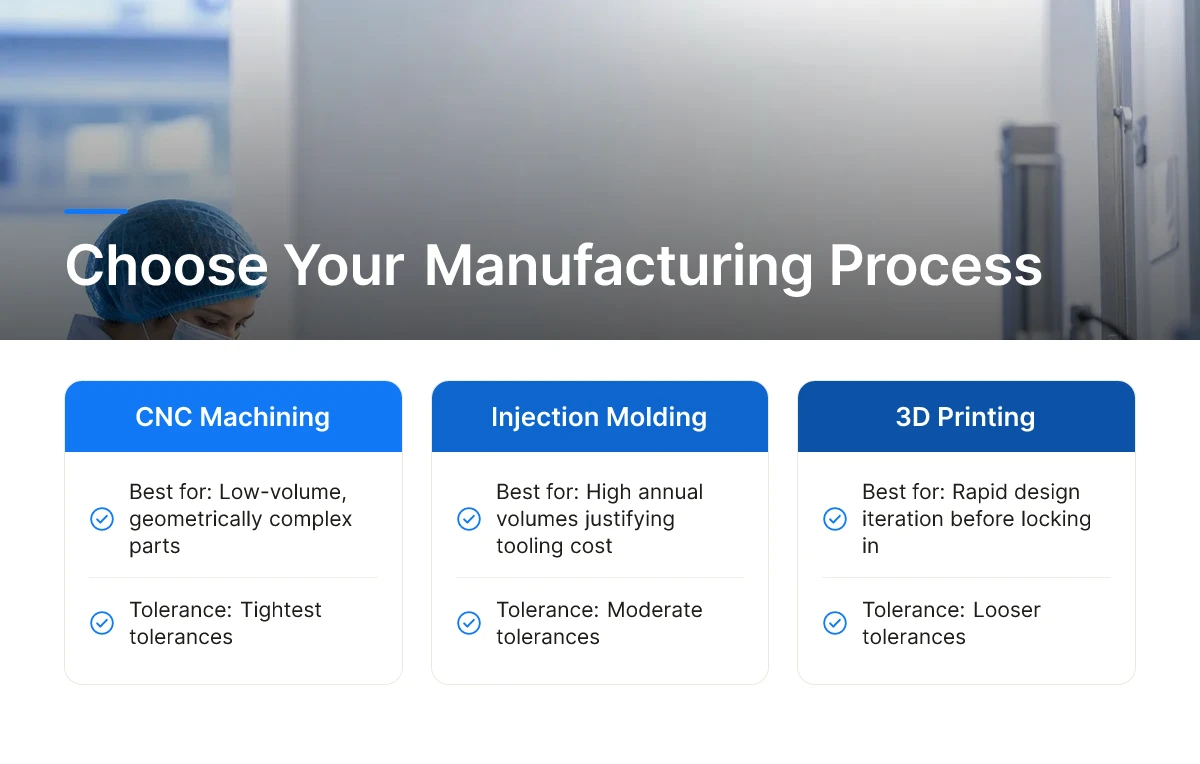
Choose CNC machining for low-volume or geometrically complex parts, injection molding once annual volumes justify tooling cost, and 3D printing for rapid design iteration before either is locked in.
The decision shapes everything downstream in medical device manufacturing, material qualification, validation protocol, and how fast you can respond when a design change comes back from a clinical review. Getting it wrong means re-tooling mid-program or carrying inspection costs that a different process would have avoided.
Comparing Injection Molding, CNC Machining, and 3D Printing
CNC machining holds the tightest tolerances of the three and works directly from a CAD file, which is why GC INDUS runs 5-axis milling, Swiss lathe turning, and wire EDM to hit tolerances as tight as ±0.001mm on single parts or short runs. There’s no tooling to build, so a first article can ship in days rather than weeks. Cost per part is higher than molding at volume, making it a mid-range to premium choice depending on material and finish.
Injection molding achieves good repeatability across thousands of identical parts once the mold is cut, but that tooling investment is the gating factor, it only pays off when projected volumes are high enough to amortize it. Lead time from mold design to first molded part typically runs longer than CNC because the tool itself has to be machined, tested, and adjusted before production starts.
3D printing fills the gap earlier in the process: it’s the fastest and most budget-friendly route to a physical part for fit checks and early design reviews, but layer-based builds generally can’t match CNC or molding on tolerance or surface finish for final production components.
Realistic Timelines From Design to FDA-Ready Production
A workable sequence runs from design freeze, to process selection and first-article production, to dimensional and material verification, to design validation testing, and finally to submission-ready documentation. Each stage depends on the one before it, rushing first-article inspection to save a week usually costs more time later when verification testing flags a dimension the process can’t reliably hold.
FDA’s Quality Management System Regulation, effective since February 2026, incorporates ISO 13485:2016 by reference and ties quality system requirements directly to how the device is produced and inspected. That means the manufacturing process you select has to be defensible in the design history file, not just technically capable.
Material choice follows the process: medical-grade polymers suited to injection molding carry their own biocompatibility and lot-traceability documentation, while implantable metals machined on CNC equipment need material certification and surface finish validation specific to the alloy. Custom medical device manufacturing projects face validation requirements that scale with how novel the material-process pairing is, particularly for patient-specific or low-volume devices. Matching process to material early avoids re-qualifying a supply chain after tooling is already cut.
Implement a Quality Management System to Meet FDA Rules
A quality management system that satisfies the FDA means building document control, design controls, process validation, CAPA, and management review into one connected system, not five separate binders.
Since February 2, 2026, the FDA’s Quality Management System Regulation (QMSR) has incorporated ISO 13485:2016 by reference into 21 CFR Part 820, replacing the older Quality System Inspection Technique with an inspection process aligned to the international standard. For any manufacturer running medical device manufacturing operations, that change removes ambiguity: ISO 13485 is no longer a parallel certification sitting next to FDA compliance, it’s the compliance framework itself.
Steps to Implement ISO 13485 and Avoid Common Failures
- Establish document control first. Every procedure, work instruction, and record needs version control and approval sign-off before anything else gets built. Auditors check this before they check anything technical.
- Build design controls around risk. Design inputs, outputs, verification, and validation steps need documented traceability back to patient risk, consistent with the design control and risk management expectations that frameworks like ISO 13485 require.
- Validate every process before it touches production parts. A CNC program, a molding cycle, or a heat-treatment step needs Installation Qualification, Operational Qualification, and Performance Qualification (IQ/OQ/PQ) to prove it produces consistent, in-spec output, not just once, but across repeated runs. Skipping this step is why regulatory requirements shape process design directly: a process isn’t “ready” for medical parts until it’s proven statistically repeatable, not merely capable on a good day.
- Run CAPA as a closed loop. Corrective and preventive action records need root-cause analysis, not just a fix, open CAPAs with no verification of effectiveness are a recurring audit finding.
- Hold management review on a fixed cadence. Leadership needs to see quality metrics, not just receive a summary; this is where systemic issues surface before an external audit does.
The most common ways manufacturers fail audits trace back to gaps in this same sequence: incomplete device history records, process changes pushed to the floor without re-validation, supplier controls that never verify incoming material certs, and risk documentation that was written once and never updated.
GC INDUS holds ISO 9001 and ISO 13485 certification and treats full inspection protocols, lot tracking, material certifications, and dimensional reports, as the traceability backbone that makes an audit a formality instead of a scramble. For OEMs sourcing precision components, that means every part ships with a paper trail connecting raw material to finished inspection data, which is exactly what an FDA auditor asks to see first.
Qualify Suppliers and Manage the Medical Device Supply Chain
Qualify every supplier against a documented quality system review, not just price and lead time, because a single uncontrolled change at a contract manufacturer can trigger a regulatory finding months later.
How Medical Device Supply Chains Differ From Standard Vendor Management
Standard vendor management asks whether a supplier delivers on time and on budget. Medical device manufacturing adds a second question: can this supplier prove, with records, that nothing changed without your approval? ISO 13485 pushes that burden down the supply chain, a device maker’s quality management system is only as strong as the suppliers feeding it.
That means an approved supplier list isn’t a formality. Each entry needs a signed change-notification agreement requiring the supplier to flag any shift in material source, process parameter, or subcontractor before it ships, because unannounced changes are one of the most common root causes behind quality escapes and corrective actions. Grand Avenue’s quality control guidance frames this as part of a broader plan that tracks inputs, monitors outputs, and documents standards at every stage, not just at final inspection.
Qualification itself runs in three steps: review the supplier’s quality system documentation (certifications, procedures, calibration records), request objective evidence of process capability (Cpk data, first-article inspection reports), and validate with sample parts under your own incoming inspection before production volume starts. Skipping the sample validation step is the most common shortcut that comes back as a nonconformance later.
Outsourcing vs. In-House: Weighing ROI and Capability
Outsourcing to a qualified contract manufacturer usually beats building in-house capacity unless volume is high and stable enough to justify the capital and certification overhead. Building an in-house machining or molding line means buying equipment, hiring operators, and maintaining your own ISO 13485 scope for every process you add, a fixed cost that doesn’t flex when volume dips.
A contract manufacturer that already holds ISO 9001 and ISO 13485 certification spreads that regulatory overhead across many clients, which is why flexible minimum order quantities, sometimes as low as one piece, are possible without the per-part cost penalty of a dedicated line. GC INDUS runs this model: CNC machining, die casting, and injection molding under one certified quality system, so a device maker validating a new design doesn’t need to qualify three separate vendors for three separate processes.
Run the decision as a straight tradeoff. In-house wins on direct process control and long-run unit cost at high volume. Outsourcing wins on changeover flexibility between prototype and production runs, scalability when forecasts shift, and a lighter burden of keeping regulatory expertise current in-house. For most mid-market device programs, that balance favors a qualified partner over a new internal line.
Common Mistakes to Avoid in Medical Device Manufacturing Compliance
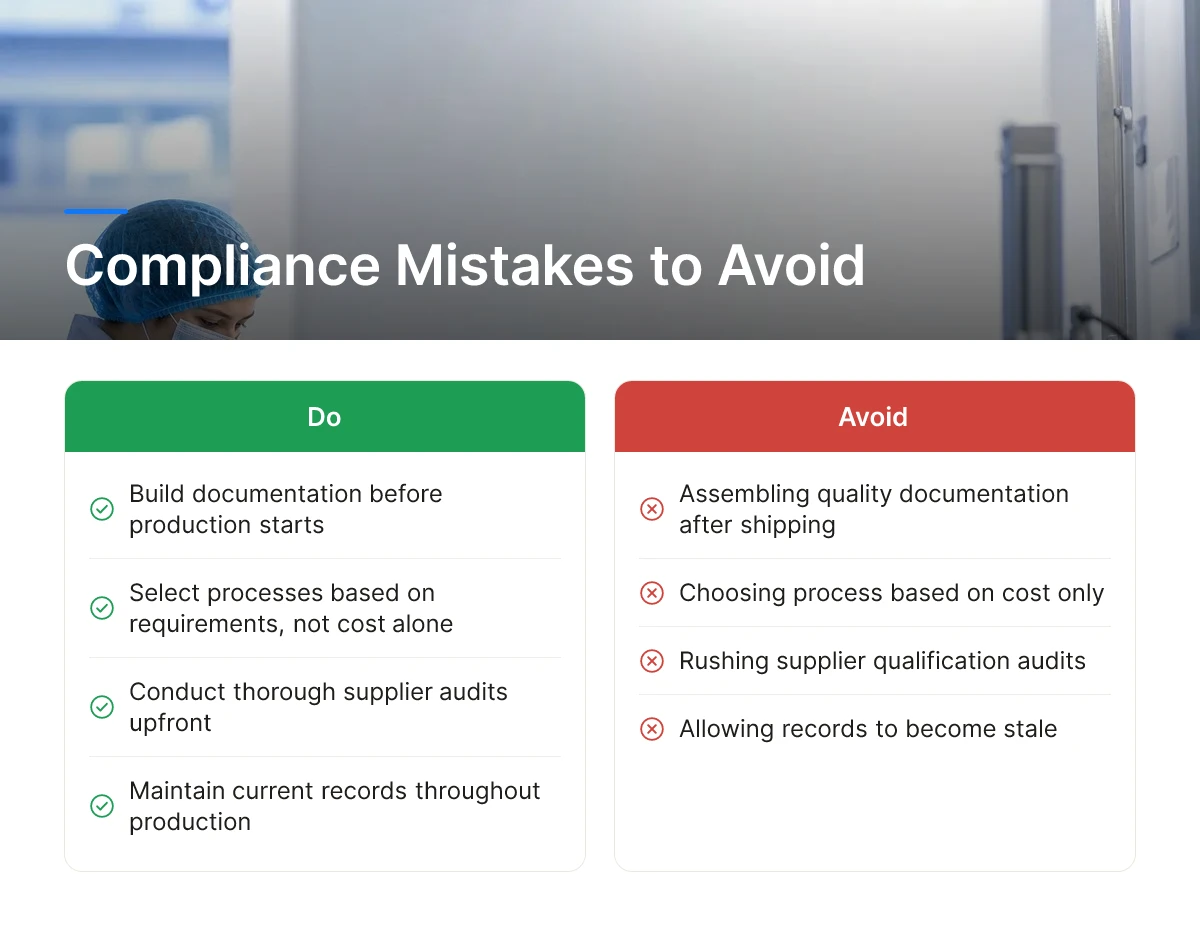
Most compliance failures in medical device manufacturing trace back to four root causes: late documentation, cost-only process selection, rushed supplier audits, and stale records.
Each one is avoidable with a process check before production starts, not after an FDA inspector or a notified body asks for evidence.
Documentation built after the fact
Some manufacturers treat quality documentation as paperwork to assemble once parts are already shipping. That backward approach contradicts how process validation is supposed to work, the QMSR (21 CFR Part 820, now aligned with ISO 13485:2016) expects design controls, risk management, and validation records to be built in parallel with the process itself. Reconstructing records after production means gaps, inconsistent revisions, and an inspection that turns up questions nobody can answer with confidence.
Choosing a process on unit cost alone
A lower per-part price looks attractive until validation and rework costs eat the savings. A molding or casting process that’s cheaper per unit but harder to hold at tight tolerances can trigger more first-article failures, more deviation reports, and a longer validation cycle than a process priced higher but inherently more repeatable. For custom and patient-specific devices especially, process selection has to weigh dimensional consistency and validation burden, not sticker price.
Underestimating supplier qualification time
Material and component suppliers need to be audit-ready before they’re integrated into the build, not after a schedule is already set. Supplier qualification routinely takes longer than procurement teams expect, and a supplier who can’t produce traceability documentation or process validation evidence on request will stall a launch date regardless of how good their parts look.
Forgetting to update the device master record
Every process change, supplier swap, or material substitution has to flow into the device master record and the risk file. Skipping that step is one of the most common audit findings, because it leaves a gap between what’s documented and what’s actually being built. GC INDUS addresses these risks directly: ISO 13485 processes, full inspection protocols, and documentation built into the workflow from the first article, not bolted on before an audit.
Frequently Asked Questions
What are the key aspects of medical device manufacturing that differ from standard precision engineering?
Medical device work adds documented traceability, validated processes, and risk management on top of dimensional accuracy. Every lot needs material certificates, process validation records, and a device history file showing exactly how each part was made. Standard precision engineering tolerates process drift if parts measure in spec; medical manufacturing requires proving the process itself stays in control over time, with design controls tied to patient safety outcomes.
How do injection molding, CNC machining, and 3D printing compare for medical device production?
CNC machining suits low-to-mid volume parts needing tight tolerances and metal or engineering plastics; injection molding fits high-volume plastic components once tooling is validated; 3D printing serves prototypes and patient-specific devices. Each process needs separate validation under ISO 13485, since switching methods mid-program can trigger new risk assessments. GC INDUS runs CNC milling, turning, and 5-axis work alongside die casting and injection molding, so teams can prototype on CNC and scale to molding without changing suppliers.
What qualification and audit processes must suppliers meet to support medical device production?
Suppliers need ISO 13485 certification, documented quality management systems, and the ability to pass customer and FDA-aligned audits. Qualification typically includes process validation, material traceability checks, and on-site or remote audits of inspection protocols before a supplier ships production volume. Buyers should request audit history and corrective action records as part of vetting.
What are the most common ISO 13485 compliance failures manufacturers should watch for?
The most frequent failures involve incomplete design controls, weak risk management documentation, and gaps in post-market surveillance records. Material qualification is another common gap, manufacturers sometimes change suppliers or lots without re-validating the material against the original device specification. Inconsistent monitoring of quality outputs across production runs also triggers audit findings.
Conclusion
Medical device manufacturing succeeds or fails on three things: documented process control, supplier qualification, and a quality management system that holds up under audit. Treat material traceability and process validation as non-negotiable from the first prototype, not something added before a 510(k) submission. Choosing a single partner who can move a part from CNC prototype to molded production, without re-qualifying a new vendor, cuts both risk and lead time. As a next step, pull your current device history file and check whether every material lot and process change in the last six months has a validation record attached.
Recommended Articles
Explore more from our content library:


