
Book Appointment Now

GC INDUS / MANUFACTURING KNOWLEDGE
Protect On-Time Delivery Manufacturing When Demand Spikes

Understanding on-time delivery manufacturing is essential. To protect on-time delivery when demand spikes, a precision manufacturer needs flexible capacity (cross-trained staff, qualified backup suppliers), real-time visibility into production status, and a prioritization system that flags at-risk orders before they slip. The key is building slack into workforce and machine scheduling before a surge hits, not scrambling once orders back up. Manufacturers that pair capacity buffers with daily production tracking catch delays early enough to recover, through overtime, outsourcing, or re-sequencing jobs, before a customer ever notices a missed date.

What You’ll Need to Protect On-Time Delivery Manufacturing During a Demand Spike
Four things need to exist before demand spikes, not during them: cross-trained operators, vetted backup suppliers, live production tracking, and a written prioritization rule. Skip the prep and every later step in this guide becomes a scramble instead of a procedure for sustaining on-time delivery manufacturing.
- Cross-trained operators who can move between work centers as bottlenecks shift
- A short list of pre-qualified backup suppliers vetted on quality and lead time
- A live production tracking system visible to planners and floor supervisors
- A documented order-prioritization rule that removes on-the-fly guesswork
Cross-trained operators who can move between work centers
A single-skill workforce turns one bottleneck into a line-wide stoppage. Operators who can run a mill one shift and a lathe the next let a shop absorb an unexpected order without waiting for a specific person to be free. This is workforce slack, and it has to be built before volume climbs, training someone mid-surge is too late.
A short list of pre-qualified backup suppliers
Overflow work needs somewhere to go, and that somewhere has to be chosen before the order backs up, not after. Vet two or three contract partners in advance on quality systems and realistic lead time, the same way you’d vet a primary supplier. Production delays often start upstream, with late materials or components from a supplier that was never pressure-tested for speed, a pre-qualified backup list prevents that gap from becoming your customer’s problem. A machine shop that routinely misses delivery windows often traces the pattern back to exactly this kind of unvetted overflow relationship, as outlined in this breakdown of how the right machine shop avoids costly delays.
A live production tracking system
Job status has to be visible against promised ship dates in real time, even if that’s a shared dashboard rather than a full ERP module. Production schedule management works only when the person planning and scheduling can see where every job stands, which is why continuous-improvement programs build delivery performance tracking in from the outset. This kind of real-time visibility is central to the four-step approach to improving on-time delivery through production schedule management. Without that visibility, GC INDUS and any other precision manufacturer practicing on-time delivery manufacturing is reacting to a missed date instead of catching it three days early.
A documented order-prioritization rule
Staff should never be deciding on the fly which job jumps the queue. A written rule, earliest promise date, contractual penalty exposure, or customer tier, removes guesswork and keeps prioritization consistent when multiple orders compete for the same machine time. Late deliveries rarely stay contained to one shipment; a single delayed component can cascade through an entire schedule, which is exactly what a documented rule is meant to stop before it starts.
Build Workforce and Capacity Flexibility Before the Surge Hits
A sudden order spike only threatens ship dates when staffing and machine capacity are rigid; flexible capacity absorbs the surge without missing a delivery window. The work happens weeks before demand arrives, not after the purchase orders land. On-time delivery manufacturing depends on this groundwork being in place long before an order backlog forms.
How Do You Build Workforce Flexibility for Production Surges?
Cross-train operators across multiple machines and processes so headcount can shift to wherever the bottleneck shows up that week. A Swiss lathe operator who can also run a CNC mill gives a shop floor two points of coverage instead of one, which matters when a single absent specialist would otherwise stall a production line.
Pair that with a bench of qualified temporary or contract labor whose onboarding, badge access, and safety training are already complete. The difference between activating help in days versus weeks often decides whether a surge order ships on time or slips. Shops that treat contract labor as a pre-qualified pool rather than an emergency hire pipeline can bring capacity online almost as fast as flipping a schedule, a model explained further in this look at delivering on time regardless of demand without destroying profit margins.
Overtime and shift restructuring should work as a planned lever with defined triggers, not a last-resort reaction after a ship date is already at risk. Set a rule in advance, for example: if backlog on a work center exceeds a fixed number of machine-hours, authorize a second shift automatically rather than waiting for a scheduling meeting to approve it.
What Capacity Planning Strategies Prevent Bottlenecks?
Model machine-hour capacity against a rolling demand forecast so a bottleneck is visible before it forms, not after a late shipment exposes it. Traditional batch-focused scheduling often hides where a work center is approaching its limit until orders are already queued behind it; shorter planning intervals surface that constraint while there’s still time to react.
Keep a short, pre-vetted list of overflow manufacturing partners for specific processes, heat treatment, a secondary finishing step, overflow CNC runs, so outsourcing decisions aren’t improvised mid-crisis. Vetting a partner’s tolerances and lead times in advance turns a potential supply chain gap into a routine subcontract. GC INDUS applies this logic internally: cross-trained operators across CNC milling, turning, 5-axis, and wire cutting let capacity shift toward whichever process a client’s surge order demands, which is part of how on-time delivery manufacturing holds up even when volumes jump without notice.

Identify and Fix the Root Causes of On-Time Delivery Failures
Missed ship dates in precision manufacturing trace back to four mechanisms: material delays, quality rework, poor scheduling, and late internal communication. Each one compounds under demand pressure unless addressed at the source, not patched after the fact. Understanding these mechanisms is the first step toward building reliable on-time delivery manufacturing practices.
- Material delays from single-source suppliers with no backup path
- Quality rework discovered late, after capacity was already committed elsewhere
- Scheduling built around first-in-first-out instead of true bottleneck constraints
- Late internal communication that flags risk only after an order is already behind
How Do Supply Chain Disruptions Affect Your Ability to Deliver on Time?
A single-source material dependency turns a minor supplier delay into a missed ship date, because there is no second path to get the part moving again. Lead-time variability on raw stock, aluminum billet, stainless bar, specialty alloys, is often the first domino, and it rarely gets noticed until a job is already queued and waiting.
Late materials and unacknowledged purchase orders are among the most common causes of production delays, and commit dates that change without updating the ERP make the problem worse because planners keep scheduling against a date that no longer holds. This pattern is detailed further in this overview of the causes and costs of production delays and how to reduce them. A delayed precision component rarely affects just one shipment, it can disrupt an entire production schedule, push back other customer orders, and force unplanned overtime to recover.
The fix is dual-sourcing critical materials before a shortage forces the decision, and keeping supplier commitments current in the system planners actually use. GC INDUS maintains outsourcing relationships for spare parts, fasteners, and electronic components specifically to avoid single-point failures in the supply chain feeding a build.
What Role Does Quality Assurance Play in Avoiding Delivery Delays?
Inconsistent inspection lets defects slip through early stages, and the rework or scrap discovered later consumes capacity that was scheduled for the next job in line. One bad batch caught at final inspection, instead of at the operation that caused it, can push an entire week’s queue backward.
This is where scheduling mechanics quietly erode on-time delivery manufacturing even when a shop looks on track: changeover time and poor job sequencing eat capacity invisibly, and a schedule built around first-in-first-out rather than true bottleneck constraints leaves machines idle on low-value setups while urgent jobs wait. Traditional batch-focused scheduling was not designed for the shorter, more frequent runs that today’s custom part orders demand.
Tighter inspection checkpoints at each process step, not just at final inspection, catch deviations before they cascade. GC INDUS applies this logic under ISO 9001 and ISO 13485 protocols, inspecting in-process rather than only at handoff, which is part of why tolerances hold at ±0.001mm without late-stage rework.
The fourth cause is procedural: an order flagged as at-risk only after it’s already late gives planners no room to react. Flagging risk days ahead, when a tool breaks, a supplier slips, or an inspection fails, lets a shop resequence before the delay reaches the customer.
Track On-Time Delivery Performance in Real Time to Catch Risk Early
Calculate on-time delivery rate daily, orders delivered by promise date divided by total orders due, and review it on a rolling basis, not once a month after the damage is done. A monthly report tells you what already went wrong. A rolling dashboard tells you which job is about to. This kind of daily discipline is what separates on-time delivery manufacturing in name from on-time delivery manufacturing in practice, and buyers increasingly scrutinize this metric directly, as seen in this discussion of on-time delivery rate requirements and expectations.
During a demand spike, the gap between those two approaches widens fast. A late component on Monday can cascade through five downstream operations by Thursday, and if nobody flags it until the end-of-month report, there’s no time left to recover the ship date. Reliable delivery performance depends on catching variance at the milestone level, raw material receipt, first-article inspection, final finishing, not just at the final shipping dock.
What’s the Difference Between On-Time Delivery and On-Time in Full (OTIF)?
On-time delivery (OTD) measures whether a shipment arrives by the promised date; on-time-in-full (OTIF) also requires that it arrives with the correct quantity and specification.
That distinction matters more, not less, when demand spikes push shops to rush orders out the door. A supplier can hit a 95% OTD rate while quietly shipping parts that are short on quantity or slightly out of tolerance, a failure that shows up later as a quality escape or a return. For OEM and medical device buyers, OTIF is the more honest number because it accounts for the exact failure mode that rushed production creates: speed at the expense of completeness or precision. GC INDUS reports both figures internally and ties OTIF to its ISO 9001 and ISO 13485 inspection protocols, so a part that ships on the promised date still has to pass full dimensional and functional checks before it counts as a fulfilled order.
What Software Tools Give You Visibility Into Delivery Risk?
Visibility comes from systems that surface a job’s status against its milestones in real time, not from spreadsheets updated after a shift ends. ERP and MES dashboards that track work-order progress against the schedule, shared scheduling boards visible to planners and floor supervisors alike, and automated alerts triggered when a job misses an intermediate milestone all reduce the lag between a problem starting and someone noticing it. Unacknowledged purchase orders and commit dates that drift without updating the ERP are common, quiet causes of missed delivery windows, and they’re exactly the kind of gap a real-time alert is built to close.
How Should You Set Realistic On-Time Delivery Benchmarks?
Set your benchmark from your own historical variability and current capacity, not from a generic industry figure that ignores your specific process mix. A shop running mostly 5-axis CNC with tight tolerances has different failure modes than one running high-volume die casting, so the two should not share a target number pulled from a general industry average. Build the benchmark from your own order history, then adjust it as capacity utilization climbs during a demand surge, the honest target during a spike is usually tighter than the comfortable one you set in a slow quarter.
Finally, connect on-time delivery manufacturing metrics to lead time variability and perfect order rate. A supplier that shortens lead time but widens its variability, or that fixes delivery dates while quietly dropping its perfect order rate, has not actually solved the problem, it has relocated it downstream, often into the customer’s receiving dock.
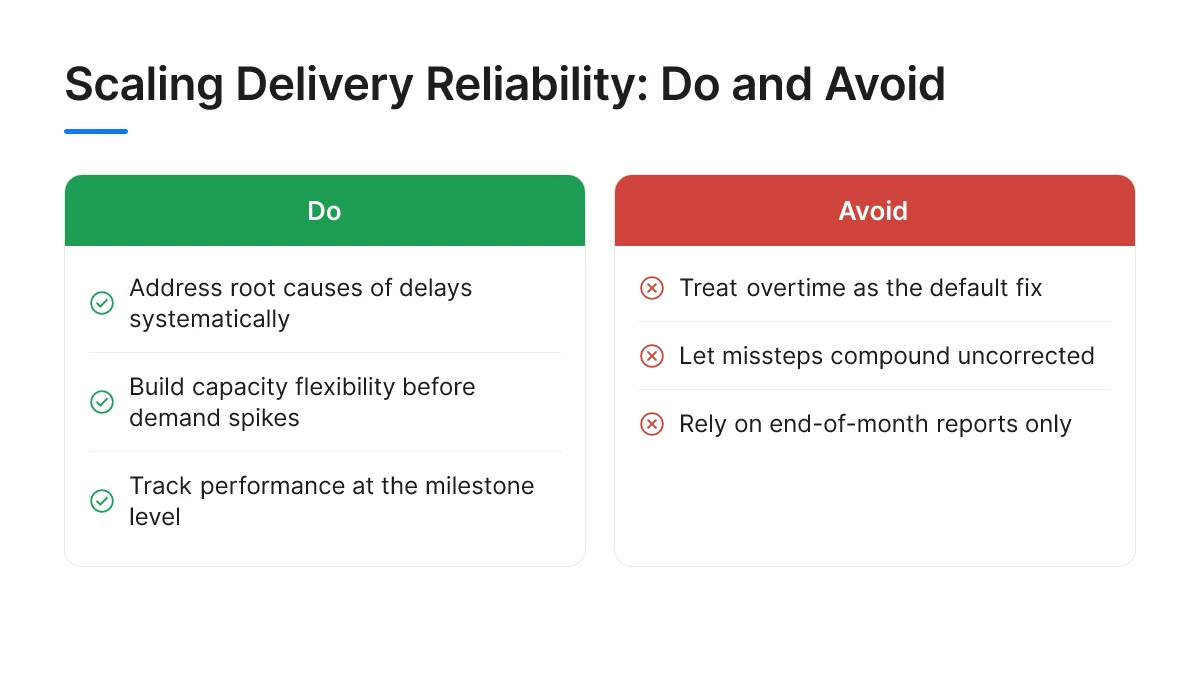
Common Mistakes to Avoid When Scaling Delivery Reliability
Most failures in on-time delivery manufacturing come from five repeatable missteps, not from one catastrophic event, and each one compounds the next if left uncorrected.
1. Treating overtime as the default fix
Adding hours to an existing shift feels like the fastest response to a demand spike, but it only masks a capacity constraint rather than solving it. Extended overtime raises fatigue-driven defect rates and accelerates staff turnover, which shrinks the very capacity a shop needs during its busiest stretch. A machine or cell that is already running at its practical limit does not produce more good parts just because the shift runs longer.
2. Saying yes to every rush order
Accepting a rush order without checking real, machine-level capacity protects one customer’s date while quietly pushing several others past theirs. Production schedule management works best when planning is handled in small intervals rather than large batches, so shops can see true available capacity before making a promise. A single unchecked “yes” can turn one at-risk order into five.
3. Relying on end-of-month reporting
Monthly or weekly reporting cycles surface problems only after the ship date has already passed, when nothing can be done. Daily or shift-level tracking catches a slipping job while there is still time to re-sequence work or add a shift. Disciplined order tracking and current commitment dates, not static reports, are what let a team intervene early.
4. Outsourcing overflow to an unvetted partner
Under deadline pressure, sending overflow work to a partner without checked certifications or inspection history trades a delivery delay for a quality escape. A late part can be expedited; a defective part that reaches a customer cannot. GC INDUS qualifies overflow capacity in advance, operating under ISO 9001 and ISO 13485, so added volume never bypasses inspection protocols.
5. Chasing OTD while ignoring OTIF
Hitting the promised date with the wrong quantity or an out-of-spec part still damages the relationship, even if the on-time percentage looks good on a dashboard. Delivery performance should be measured on-time-in-full, not on date alone, since late deliveries and incomplete or incorrect ones carry the same downstream cost to the customer’s schedule.
Frequently Asked Questions
How does OTIF change your approach to order fulfillment compared to OTD alone?
OTIF (on-time, in-full) forces you to measure completeness alongside timing, so a shipment delivered on schedule but short on quantity still counts as a miss. This changes planning priorities: you cannot simply expedite a partial order to hit a date. We track piece counts against promised dates at every stage, because a precision part delivered early but 10 units short still disrupts the customer’s assembly line.
How do you integrate on-time delivery metrics with other KPIs like lead time variability and perfect order rate?
On-time delivery works best as one input in a scorecard, not a standalone number, because it hides problems that lead time variability and perfect order rate expose. A supplier can hit 95% on-time delivery while lead times swing by weeks order to order. We review all three together: consistent lead times predict future on-time performance, and perfect order rate catches quality or paperwork issues that a delivery date alone misses.
What’s the fastest way to recover a production schedule once an order is already at risk of being late?
Re-sequence the shop floor to prioritize the at-risk order ahead of lower-priority jobs, and confirm every upstream input is on hand before committing to a new date. Production delays often trace back to late materials or unacknowledged purchase orders rather than the machine itself, so checking supply status first prevents a second missed date.
Should a precision manufacturer turn down new orders during a demand spike to protect existing delivery commitments?
Sometimes, yes, protecting committed dates matters more than capturing every new order during a spike. A manufacturer that overcommits risks late deliveries that disrupt an entire downstream production schedule for an existing customer. Flexible capacity, including on-demand labor to scale output without permanent headcount, often lets shops accept more work instead of declining it.
What’s a practical first step for a shop that wants to improve its on-time delivery manufacturing performance this quarter?
Start by auditing the last ten late orders to find the recurring root cause, whether that’s a material bottleneck, a scheduling gap, or a communication breakdown between planning and the floor. Most shops find the pattern concentrates in one or two fixable areas rather than spreading evenly, which makes the first corrective step cheaper and faster to implement than a full process overhaul.

Conclusion
Protecting on-time delivery during a demand spike comes down to three habits: build schedule buffers before you need them, fix supplier and purchase-order communication gaps before they cause late materials, and treat flexible capacity as a planning tool rather than a last resort. Manufacturers that track delivery performance alongside lead time variability catch risk early, before a single late shipment cascades into a missed customer launch. GC INDUS applies this approach to on-time delivery manufacturing across CNC machining, die casting, and assembly for 300+ clients, backed by ISO 9001 and ISO 13485 inspection protocols. Start by auditing your last ten late orders to find the recurring cause, it usually points to one fixable gap in scheduling or supplier follow-up.
Recommended Articles
Explore more from our content library:


