
Book Appointment Now

GC INDUS / MANUFACTURING KNOWLEDGE
How to Qualify an Aerospace Parts Manufacturer for AS9100

Qualifying an aerospace parts manufacturer means verifying their AS9100 certification, auditing their quality management system, and confirming their process controls before you place a single order. AS9100 matters because it layers aerospace-specific requirements, configuration management, risk management, and traceability, on top of the general ISO 9001 framework, so certification alone signals a supplier can document and repeat every step from raw material to finished part. Beyond the certificate, check audit history, first-article inspection records, and how they handle nonconformance to confirm the paperwork matches real practice on the shop floor.

What You’ll Need Before Qualifying an Aerospace Parts Manufacturer
Before you evaluate any aerospace parts manufacturer, gather four documents, assemble three internal stakeholders, and write down your own part specifications as a fixed benchmark.
Start with the paperwork. Request these upfront, before any plant tour or sample order:
- AS9100 certificate, confirms the supplier holds current registration, not an expired or pending one.
- Scope of registration, states which processes and locations the certificate actually covers.
- Latest audit report, shows findings, corrective actions, and whether the registrar flagged any nonconformances.
- Quality manual, documents how the supplier’s quality management system is built and maintained internally.
A certificate by itself proves little. AS9100 layers aerospace-specific controls, configuration management, risk management, traceability, on top of ISO 9001, but the certificate is a snapshot, not a guarantee of ongoing performance. Scope matters because a supplier can be certified for assembly work while their machining operation runs outside that scope entirely. Audit history matters because it shows whether the registrar found gaps, and how the supplier closed them, over time rather than at a single inspection.
Certification bodies verify a QMS meets the standard’s structure; they don’t verify that every part off the line meets your drawing.
Pull in three groups before you start scoring suppliers. Quality engineering checks the technical fit, inspection methods, first-article process, measurement equipment. Procurement handles commercial terms, lead time, and total cost. Program management confirms the supplier’s capacity aligns with your production schedule and any customer flow-down requirements.
Finally, define your own requirements before you compare anyone. Write down tolerances, materials, and volumes as a fixed benchmark, a supplier who excels at high-volume aluminum brackets may not be the right fit for low-volume titanium housings held to ±0.001mm. Without this benchmark, every supplier looks adequate on paper.
Verify AS9100 Certification and Aerospace Compliance Requirements
Confirm certification directly with the issuing registrar and check the exact scope of registration, a logo on a website proves nothing on its own.
What Does AS9100 Certification Cover and Why Does It Matter?
AS9100 builds on ISO 9001 by adding requirements written specifically for aviation, space, and defense work. The standard folds in configuration management, so a supplier can trace exactly which revision of a drawing, process, and material batch went into a given part. It also requires documented risk management across the production process, counterfeit parts prevention controls for purchased materials and components, and first article inspection to confirm a new or changed process produces parts that match the full technical specification before a production run begins.
These additions exist because a single out-of-tolerance or counterfeit component can ground an aircraft or trigger a safety investigation. When you evaluate an aerospace parts manufacturer, ask to see how each of these four elements is documented, not just whether a certificate exists, but how configuration changes get recorded and how incoming materials get screened for authenticity.
What Other ISO Standards and Compliance Requirements Apply?
AS9100 rarely stands alone, check for NADCAP accreditation on any special process the part requires, and confirm ITAR or export control registration if the program involves controlled technical data.
- Ask the registrar, not the supplier, to confirm certification is active. Every accredited certification body maintains a public database or will verify by phone; a supplier’s own claim or a badge image is not verification.
- Check the scope statement on the certificate itself. AS9100 registrations list specific processes, machining, sheet metal fabrication, welding, assembly, and a certificate scoped to sheet metal work does not qualify that shop for machined structural parts.
- Confirm the certificate covers the correct facility address if the manufacturer runs multiple sites, since certification is issued per location, not per company name.
- Verify NADCAP accreditation separately for heat treatment, plating, non-destructive testing, or welding, since these special processes carry their own audit requirements beyond AS9100.
- Confirm ITAR registration and export control procedures where the program involves defense articles or controlled technical data, since AS9100 does not substitute for these legal requirements.
Certification bodies audit against the AS9100 requirements on a fixed cycle, and a lapsed or suspended registration should disqualify a bidder regardless of past performance. GC INDUS holds ISO 9001 and ISO 13485 certification and documents inspection protocols at each production stage, giving buyers a paper trail to check rather than a claim to take on faith.

Evaluate Precision Capabilities and Quality Assurance Processes
Verify tolerance and quality claims with data, request capability studies, first-article inspection reports, and delivery records before you commit a program to any aerospace parts manufacturer.
What Tolerance Levels Should You Expect From a Qualified Supplier?
A capable supplier backs up any “tight tolerance” claim with measured data, not a marketing line. Ask for Cpk (process capability index) values on comparable parts, not just the tolerance printed on a drawing. A Cpk above 1.33 on critical dimensions is a common benchmark in precision machining; anything lower means the process drifts closer to the spec limit than an aerospace program can tolerate.
Request a sample capability study for a feature similar to yours, same material, same tolerance band, same process (5-axis milling, Swiss turning, grinding). If the supplier can’t produce this data on demand, that’s a signal their tolerance claims are unverified. Shops that hold tolerances as tight as ±0.001mm, for example, should be able to show the equipment and inspection method that confirms it, not just state the number.
How Do You Verify Quality Assurance and On-Time Delivery Track Record?
Ask for a first-article inspection (FAI) report on a representative part, then check delivery performance data and nonconformance records before signing a contract. An FAI report, typically built to AS9102 format, documents every dimension, material certification, and process step for the first unit off a production run, giving you a verifiable snapshot of whether the supplier’s actual output matches the design intent. Review a sample FAI report before you commit volume; it tells you more about real capability than a sales conversation does.
Beyond the first article, ask two direct questions: what is your on-time delivery rate over the last 12 months, and how do you track and close nonconformances? A supplier with a mature quality system will have documented corrective action records (CAPA), not just verbal assurances. AS9100-certified manufacturers are required to maintain this kind of traceability because a single nonconforming aerospace component can cause program delays or safety risks.
Sustained tolerance across a production run, not just on one sample part, depends on statistical process control (SPC) and calibrated measurement equipment. SPC charts flag drift before parts go out of spec, and calibration records confirm the gauges checking those parts are themselves accurate. GC INDUS applies this combination, ISO 9001 and ISO 13485-certified quality systems, full inspection protocols, and tolerances held to ±0.001mm, across CNC, casting, and molding processes, which is the level of documentation an aerospace parts manufacturer should be able to produce on request, not just claim in a proposal.
Compare Domestic and International Suppliers for Lead Time and Supply Chain Resilience
Location changes three things at once: how predictable your lead times are, how much export control paperwork you carry, and how fast problems get resolved. Weigh all three together, not one at a time, before picking an aerospace parts manufacturer.
How Do Location and Regulatory Environment Affect Your Choice?
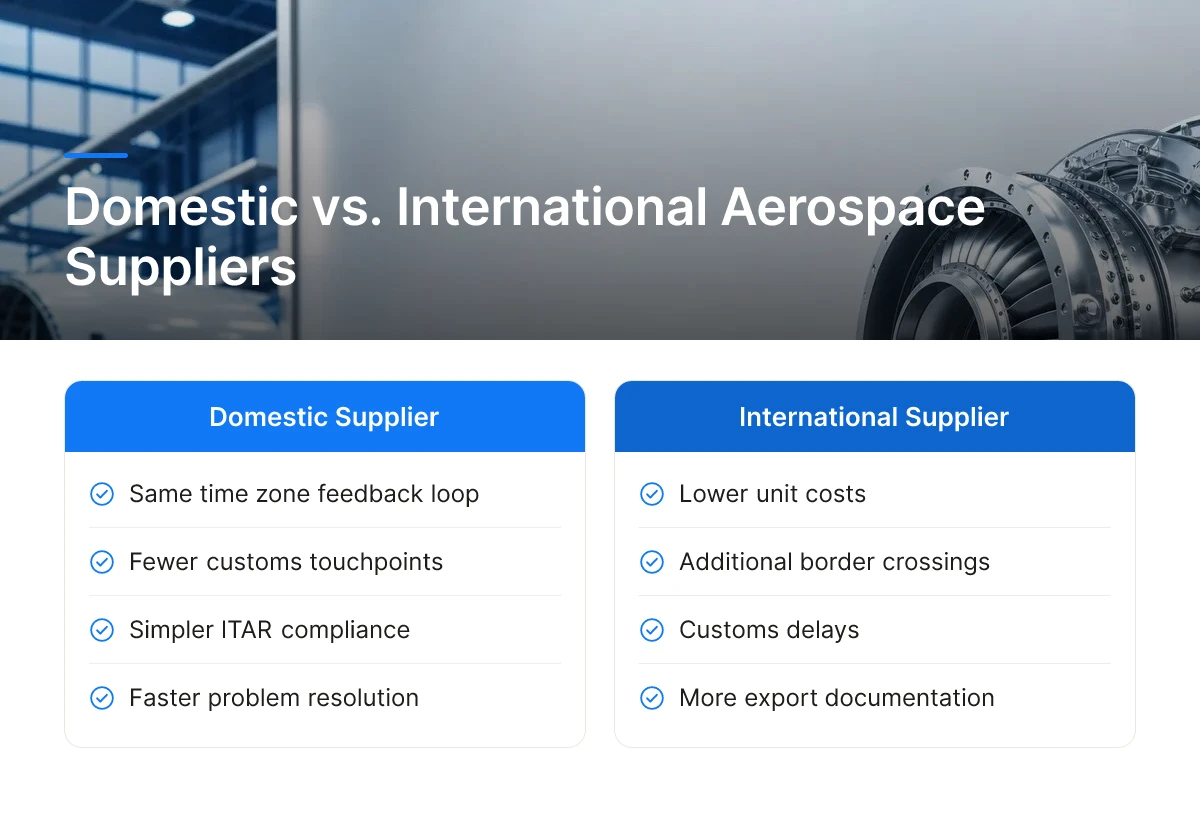
A domestic supplier shortens the feedback loop, same time zone, fewer customs touchpoints, and often simpler compliance under ITAR or similar export rules. An overseas aerospace parts manufacturer can offer lower unit costs, but every additional border crossing adds a customs delay, a document check, and a chance for a shipment to sit in a bonded warehouse while paperwork clears.
- Confirm whether your parts or drawings fall under export control restrictions before quoting international suppliers, this alone can eliminate certain regions from consideration.
- Map the realistic response window for engineering questions or nonconformance reports; a 10 to 12-hour time-zone gap can turn a same-day fix into a two-day delay.
- Ask for average lead time on a comparable part, not a quoted best case, and get it in writing.
The trade-off is straightforward: lower piece price overseas versus added risk from freight transit, customs holds, and slower back-and-forth on technical clarifications. For high-mix, low-volume aerospace programs, the hidden cost of a six-week freight delay often outweighs the per-part savings.
How Do You Evaluate Supplier Redundancy for Critical Components?
Redundancy matters because a single-source supplier, domestic or overseas, becomes a program risk the moment they miss a delivery or fail an audit. AS9100 itself pushes suppliers toward disciplined risk management and traceability, but the standard doesn’t guarantee a second source exists if your primary supplier has a fire, a labor shortage, or a raw material shortage.
- Qualify a backup supplier for any component where failure would halt final assembly, even if that backup only produces low volumes initially.
- Build contingency clauses into supply agreements: defined escalation timelines, penalty terms for missed dates, and rights to requalify a second source without renegotiating the whole contract.
- Track raw material lead time separately from part lead time, titanium and specialty alloys can add months to a quoted schedule regardless of the machinist’s own capacity.
- Factor geopolitical exposure into sourcing decisions: tariffs, export restrictions, and regional instability can change a supplier’s viability faster than a quality audit ever will.
Minimum order quantity and rapid prototyping capability are useful signals here too. A supplier willing to run a single prototype part, then scale to a short production run without renegotiating terms, is usually built for the low-volume, high-mix reality of aerospace programs. GC INDUS accepts orders starting from one piece, which lets engineering teams validate a design before committing to a production batch, a flexibility that rigid, high-MOQ shops often can’t match.
Common Mistakes to Avoid When Qualifying an Aerospace Parts Manufacturer
Most qualification failures trace back to five repeatable errors, not bad luck, and each one is checkable before a purchase order goes out.
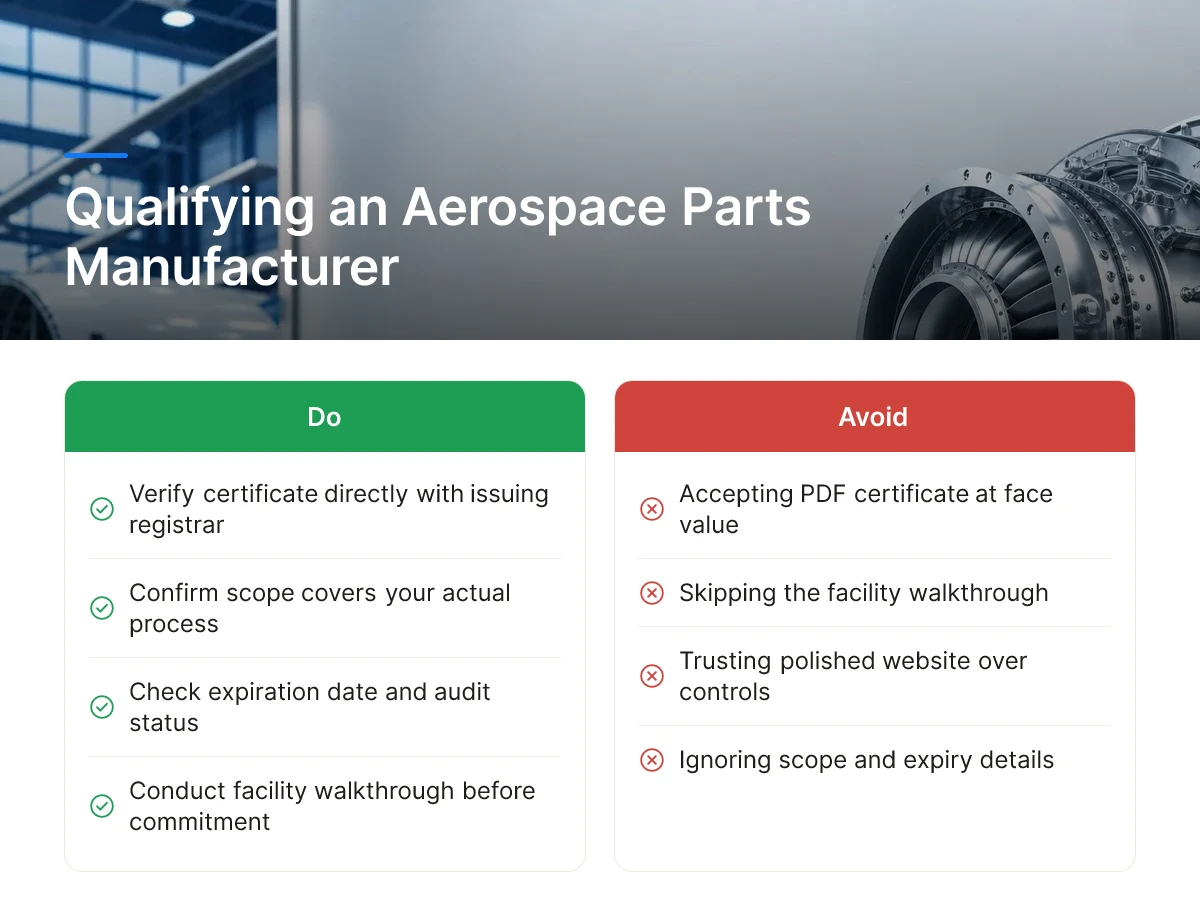
- Accepting a certificate at face value. A PDF of an AS9100 certificate tells you nothing about scope, expiry, or whether the registrar is accredited. Verify the certificate directly with the issuing registrar, confirm the scope covers the actual process you need (machining, casting, assembly), and check the expiration date, certifications lapse, and audits get postponed.
- Skipping the facility walkthrough. A polished website and a clean sales deck are not proof of a controlled shop floor. Insist on a virtual or in-person audit before committing volume, since AS9100’s value comes from the discipline it enforces in day-to-day production, not the paperwork it generates.
- Ignoring minimum order quantity and customization limits. Many buyers only discover MOQ restrictions or design-change fees after the first purchase order is placed. Confirm these terms up front, especially if your program moves from prototype to production runs of varying size.
- Treating cost as the deciding factor. The lowest quote often hides weak lead-time reliability or no backup capacity if a machine goes down. Weigh price against delivery consistency and redundancy planning, a single missed shipment on a flight-critical part costs far more than the savings from a cheaper supplier.
- Starting conversations without internal requirements defined. Vague tolerance bands or undefined material specs force suppliers to guess, and guesses turn into quality escapes. Nail down tolerances, materials, and inspection criteria internally before the first RFQ goes out.
Every one of these mistakes is an audit gap, not a supplier failure. GC INDUS addresses this directly: ISO 9001 and ISO 13485 certifications are verifiable, tolerances down to ±0.001mm are stated up front, and minimum order quantities start at one piece so buyers aren’t locked into volume commitments before they’ve validated fit. Building a checklist against these five errors before you engage any aerospace parts manufacturer is the difference between a supplier relationship and a recurring liability.
Frequently Asked Questions
Is AS9100 certification legally required to sell aerospace parts?
No, AS9100 is not a government-mandated legal requirement, but most aerospace primes and Tier 1 contractors will not place orders without it. The standard functions as a market-access gate rather than a legal one: it satisfies contractual quality clauses and gives buyers audit-backed proof of traceability and process control.
How long does it typically take a manufacturer to become AS9100 certified?
Most manufacturers need several months to a year to build the required quality management system before an audit even begins. Timelines depend on existing ISO 9001 maturity, documentation gaps, and how quickly corrective actions from the initial audit get closed out.
Can a supplier be ISO 9001 certified but not AS9100 certified?
Yes, AS9100 builds directly on ISO 9001:2015 but adds aerospace-specific clauses, so a supplier can hold one without the other. ISO 9001 alone covers general quality management; it omits requirements like configuration management, risk management, and product safety that AS9100 requires.
What is the difference between a first article inspection and ongoing quality control?
A first article inspection verifies a single production sample meets every drawing and spec requirement before a full run starts; ongoing quality control monitors every subsequent batch. First article inspection catches design or process errors early, at low cost, while running inspections catch drift, tool wear, or material variation across a production lifecycle.
Conclusion
Vetting an aerospace parts manufacturer comes down to three checks: confirm AS9100 certification is current and audit-verified, not just claimed on a website; ask for traceability records and first article inspection reports from a comparable past part; and verify the shop’s tolerance capability matches your drawing, not just its marketing claims. GC INDUS holds ISO 9001 and ISO 13485 certifications, machines to tolerances as tight as ±0.001mm, and runs full inspection protocols across CNC, casting, and assembly. Before engaging any supplier, request their current AS9100 or ISO certificate number directly from the issuing registrar’s public database to confirm it’s active, not expired.
Recommended Articles
Explore more from our content library:


