
Book Appointment Now

GC INDUS / MANUFACTURING KNOWLEDGE
How to Reduce Manufacturing Costs Through Smarter Design

Understanding how to reduce manufacturing costs is essential. Manufacturing costs drop most reliably when design decisions and process choices are optimized together, not when either is treated alone. Parts designed for manufacturability need fewer operations, less rework, and tighter scrap control, while process and supply chain efficiency determine how consistently those savings show up on the unit cost. The highest-use starting points are identifying your real cost drivers (material, labor, overhead, energy), simplifying part geometry and tolerances before production, and standardizing components to cut procurement complexity, all without loosening the tolerances or quality your parts require.

Identify Your Main Cost Drivers Before You Start Cutting Costs
A cost breakdown by category, material, labor, overhead, energy, tells you where money actually leaks before you commit budget to fixing it. Skip this step and you risk solving a problem that was never your biggest one.
Labor, Material, Overhead, and Energy: What Each Actually Costs You
Each cost category behaves differently in precision manufacturing, and treating them as one lump “production cost” hides the real driver. Material cost scales with volume and scrap rate, tight tolerances and complex geometries increase scrap directly, since out-of-spec parts in a ±0.001mm tolerance band get rejected, not reworked down a grade. Labor cost scales with cycle time and the number of manual operations, including inspection and deburring steps that do not show up in a basic time study.
Overhead is the category most teams underestimate. In precision shops, overhead is driven largely by changeover frequency and part complexity, not batch size, a shop running small batches of varied parts carries far more setup, tooling change, and programming overhead per unit than one running long, stable production. Energy cost tends to track machine hours and idle time, particularly on multi-axis CNC equipment and heat treatment furnaces that draw power even between cycles.
Without separating these four, a company can spend months on a labor-reduction initiative while overhead from excessive changeovers was the actual problem.
How to Prioritize Based on Company Size and Operational Maturity
Where you start depends on your size and how mature your current processes already are, not on a generic checklist. Smaller shops and lower-volume OEMs typically get the fastest return from design and tolerance review, tightening only the specs that function actually requires, and removing features that drive secondary operations.
Larger operations with established design controls usually have less to gain from design review alone, since that work is often already done. Their bigger opportunity sits in process automation, supply chain consolidation, and inventory strategy, where volume makes efficiency gains compound across thousands of units.
- Build a rough cost breakdown by category before selecting any fix
- Smaller, lower-maturity operations: start with design for manufacturability and tolerance review
- Larger, higher-maturity operations: prioritize automation, supply chain, and inventory optimization
- Revisit the breakdown after each change to confirm the saving held
This is also where sequencing matters most for how to reduce manufacturing costs without creating new problems downstream. Optimizing design in isolation can shift cost into process changeovers; optimizing process in isolation can lock in a design that was never cost-efficient to begin with. GC INDUS reviews design and process together during quoting, which is why tolerance and geometry decisions get flagged before a part ever reaches the CNC floor.
How to Reduce Manufacturing Costs Through Smarter Design
Design decisions made before a part ever reaches the shop floor determine most of its lifetime production cost, which is why design for manufacturability (DFM) is the starting point for how to reduce manufacturing costs without touching quality standards.
DFM means shaping a part so its geometry, tolerances, and features match what the chosen process does well, instead of fighting it. In practice that means simplifying geometry, reducing part counts, and holding tight tolerances only where the part’s function actually requires them. A bracket that needs to locate within ±0.1mm doesn’t benefit from a ±0.01mm callout on every dimension, it only adds inspection time, machine time, and rejection risk. At GC INDUS, engineers reviewing incoming CAD files regularly flag over-specified tolerances before quoting, because every dimension tighter than ±0.001mm capability requires adds cost somewhere downstream, whether in cycle time, fixturing, or scrap.
How Designing for Manufacturability Reduces Scrap and Rework
Simplified geometry reduces scrap and rework by cutting the number of setups, fixturing changes, and tolerance stack-ups a part passes through on its way to final inspection.
Every additional setup on a CNC mill or lathe is a chance to introduce location error, and every tight, non-functional tolerance multiplies the variation exposure across a production run. Fewer setups also mean fewer fixturing changes, which is where a large share of dimensional drift actually originates on multi-axis equipment. Lean manufacturing literature frames this as waste elimination at the source rather than inspection after the fact, and the logic holds for precision machining: a part that can be completed in one or two operations carries less risk of out-of-tolerance rejects than one requiring five. Reducing part counts has a compounding effect here too, since simpler assemblies mean less labor and fewer interfaces where tolerances can stack unfavorably.
What Capital Investment and Payback to Expect from Design Changes
Design changes and new tooling carry upfront cost, but that cost should be weighed against the lower per-unit cost it generates across the full production run, not against the next invoice.
Redesigning a feature to remove an undercut, or investing in a dedicated fixture for a high-volume part, adds cost at the start of a program. The payback shows up later: shorter cycle times, fewer secondary operations, and lower scrap rates compound over thousands of units. Design decisions made early in a program have an outsized effect on total cost because they cascade into tooling, material selection, and inspection requirements downstream. The right question isn’t whether a design change costs money now, it’s whether the unit economics over the expected production volume justify it.
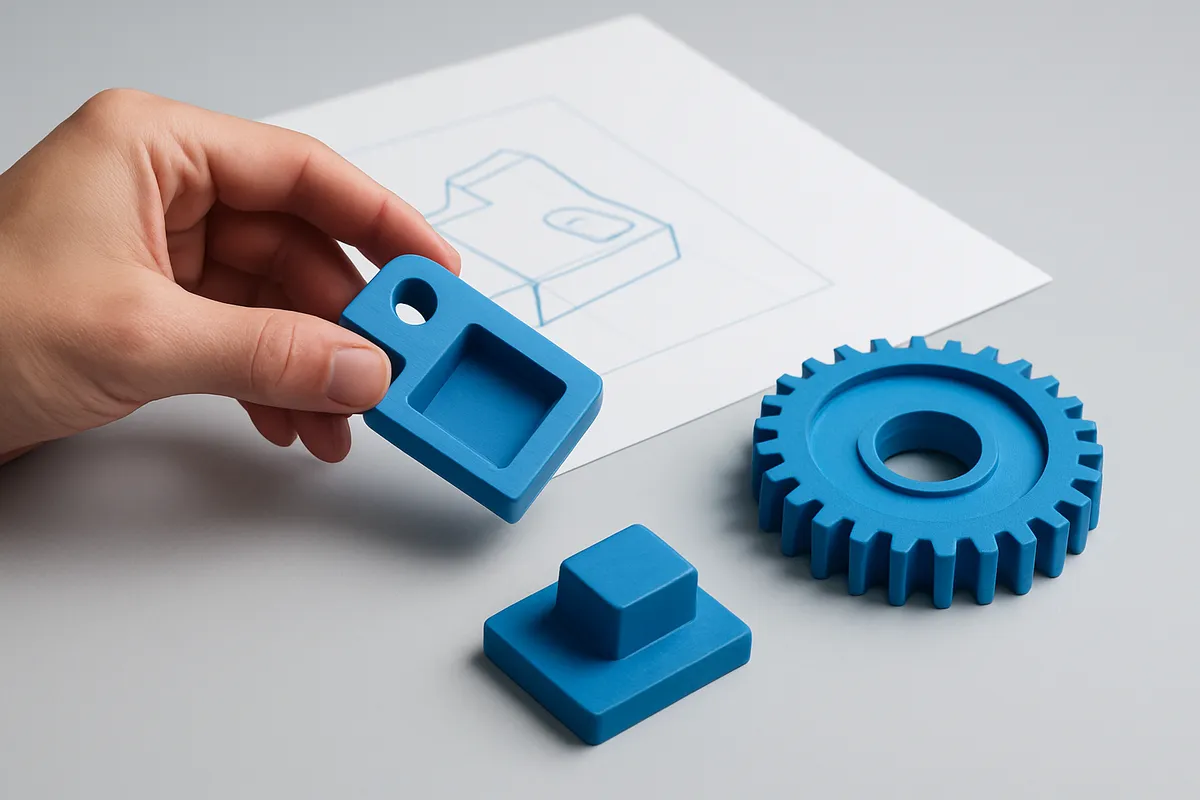
Concrete levers worth checking on any drawing: consolidate features that could be machined in a single setup, standardize hole sizes and thread callouts so tooling doesn’t change between operations, and avoid thin walls or deep pockets that force slower feeds and speeds to control deflection and tool wear. None of these levers touch the part’s functional tolerance. They remove waste, extra setups, extra inspection, extra rework, rather than loosening the specification that protects quality, which is the distinction that separates real cost reduction from a short-term shortcut.
Improve Process Efficiency and Automation to Lower Per-Unit Costs
Automation and lean operations cut cost per part by removing manual touchpoints, shortening changeovers, and catching defects before they turn into scrap. This is the operational half of how to reduce manufacturing costs, design sets the ceiling, process efficiency determines how close you get to it.
Automation’s main value is not raw speed. It is consistency. A CNC-machined bracket produced on a manual lathe depends on operator skill for every cut; the same part on an automated line repeats the exact same path thousands of times with no drift. Fewer manual touchpoints mean fewer chances for human error, which means fewer defects, less rework, and lower labor-hours charged against each finished part. Automation also frees skilled operators to handle programming, setup, and inspection instead of repetitive loading and unloading, work that adds more value per hour.
How Lean Manufacturing and Waste Elimination Create Measurable Savings
Lean principles save money by attacking the gaps between value-adding steps, not the steps themselves.
- Reduced work-in-progress: Smaller batches and pull-based scheduling mean less capital tied up in half-finished parts sitting on the shop floor.
- Shorter changeover time: Standardizing tooling and fixtures across similar parts cuts the downtime between production runs, which raises usable machine hours without adding equipment.
- Less motion and waiting: Redesigning workstation layout and material flow removes the walking, searching, and idle time that inflate labor cost without producing anything.
Lean Six Sigma programs also target defect reduction directly, since rework and scrap consume the same labor and material as a good part while producing nothing sellable.
What ROI to Expect from Preventive and Predictive Maintenance
Preventive and predictive maintenance pay for themselves by replacing expensive, unplanned failures with scheduled, low-cost interruptions. Unplanned downtime stops an entire line, often with no warning, and frequently damages the parts in process at the moment of failure, compounding machine repair cost with scrap cost and missed delivery dates. A worn tool or drifting spindle alignment that goes undetected does not just stop production; it produces out-of-tolerance parts for hours before anyone notices. Scheduled maintenance and condition monitoring catch that drift early, trading a planned few hours of downtime for the much larger cost of a defect-driven recall or late shipment.
Not every part justifies heavy automation investment. High-volume or repeat-run jobs recover tooling and programming costs quickly because those costs spread across thousands of identical units. Low-volume or highly variable work rarely reaches that payback point, so design simplification and smarter process selection, fewer setups, standardized fixtures, simpler geometries, deliver more savings per dollar spent. GC INDUS applies this logic across its CNC machining, die casting, and injection molding lines, matching automation and tolerance strategy to order volume so clients from 1-piece prototypes to production runs pay only for the precision and process investment their part actually needs.
simplify Supply Chain and Inventory to Cut Procurement Costs
Procurement and inventory decisions often drive manufacturing cost as much as anything happening on the shop floor, through part standardization, product line discipline, and order timing. Teams researching how to reduce manufacturing costs frequently focus on machine cycle times and labor, then overlook the purchasing and stockroom decisions that quietly inflate the unit price.
How Standardizing Components Reduces Procurement Costs
Fewer unique part numbers means higher volume per part number, which gives you real use when negotiating with suppliers. A fastener used across five product variants can be purchased in one large batch instead of five small ones, which typically earns a better unit price and fewer separate purchase orders to administer.
Standardization also cuts hidden production costs. Every unique component requires its own setup or changeover on the production line, its own tooling, and its own inspection plan. Reducing part counts and reusing proven components across designs shortens changeover time and simplifies assembly, which is one of the more direct levers on total cost.
Inventory Holding Costs vs. Supply Chain Timing: What Matters More
Holding inventory is not free. Capital tied up in stock cannot be used elsewhere, components risk obsolescence if a design changes, and warehouse space and handling add ongoing cost. But under-ordering carries its own penalty: expedite fees, air freight charges, and production downtime when a line runs out of a critical part.
Neither extreme is the goal. The real objective is timing, ordering the right quantity at the right moment based on actual demand and lead time, not simply driving stock to the lowest possible number. Strategic inventory management, paired with supply chain and procurement optimization, addresses both the cash tied up in excess stock and the disruption cost of running short.
Rationalizing a product line supports the same goal. Each unique variant carries its own tooling, inspection routine, and documentation, overhead that persists whether the variant sells in volume or trickles out a few units a year. Consolidating qualified suppliers, rather than spreading purchases across many partially-vetted sources, also reduces fragmentation, cuts the administrative burden of multiple quality audits, and simplifies the supply chain overall. GC INDUS addresses this directly by combining CNC machining, die casting, injection molding, and assembly under ISO 9001 and ISO 13485 quality systems in one operation, so clients qualify one partner instead of managing several.
Avoid These Common Mistakes When Trying to Reduce Manufacturing Costs
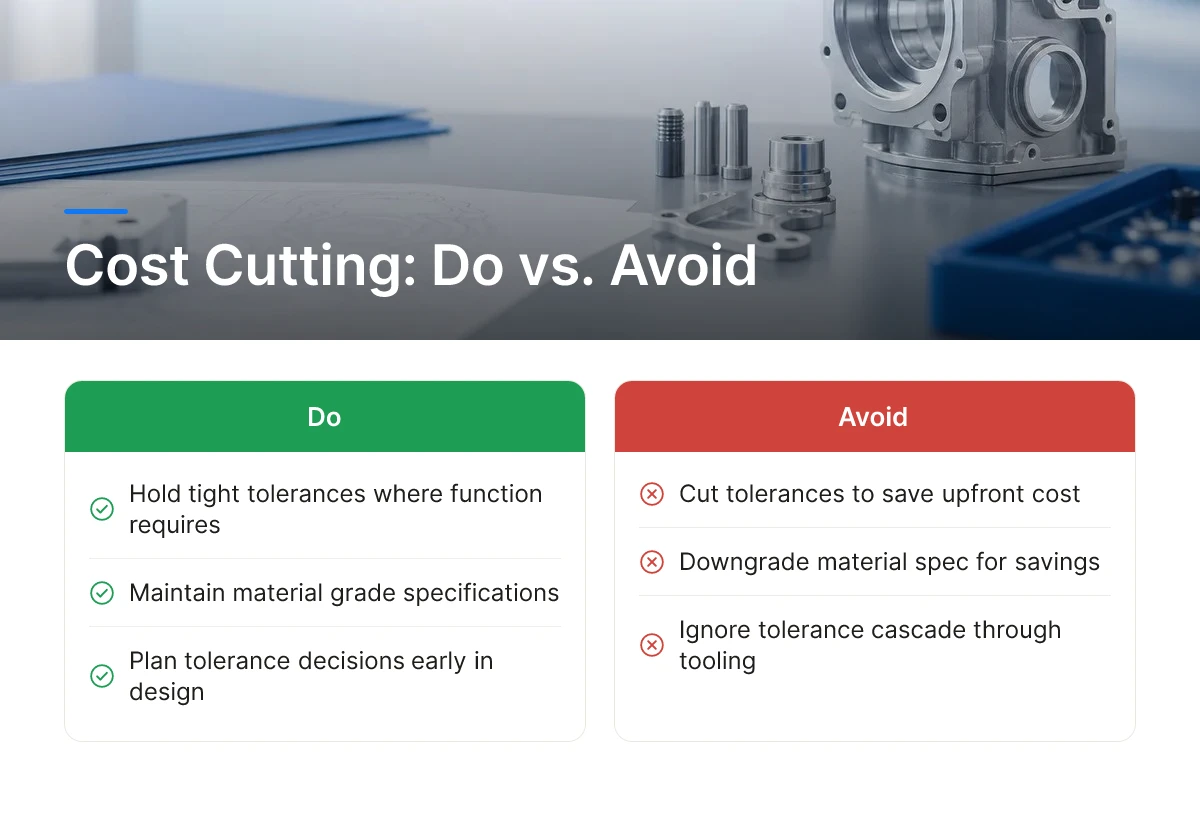
The most common mistake in how to reduce manufacturing costs is cutting tolerances or material grade to save money upfront, then paying far more later in warranty claims and rework.
A part machined to a looser tolerance may pass initial inspection and still fail in the field once it’s under load, heat, or repeated cycling. Downgrading a material spec to save a few percentage points on cost can trigger premature wear, corrosion, or fit issues in assembly. Modus Advanced notes that tolerance and material decisions made early in design cascade through tooling, inspection, and quality control for the life of the part, so a shortcut at the design stage rarely stays contained to that stage. The fix isn’t avoiding cost discipline; it’s applying it at the design phase, where a change actually reduces cost instead of deferring it.
A second mistake is optimizing one department in isolation. Procurement teams chasing the lowest unit price often qualify a cheaper supplier with longer lead times or less consistent tolerances, which forces the plant to carry more safety stock and run more incoming inspection. The purchasing line item looks better; total landed cost does not. Cost reduction only works when design, purchasing, production, and quality are measured against the same total-cost outcome, not against separate departmental budgets that can trade costs with each other instead of eliminating them.
The third mistake is treating cost reduction as a one-time project rather than an ongoing discipline. A single redesign or supplier switch produces a one-time drop in cost per part, but without tracking, that gain erodes as tolerances drift, suppliers change processes, or scrap creeps back up.
Which Systems Help Track Manufacturing KPIs and Cost Metrics
Sustaining a cost reduction requires tracking scrap rate, cycle time, on-time delivery, and cost per part consistently, not just checking them once after a change.
Budget-friendly spreadsheet tracking can work for a single product line with low part variety, but it breaks down fast once volume or SKU count grows. Mid-range manufacturing execution and quality tracking tools give shop floors real-time scrap and cycle-time data tied to specific work orders. Enterprise-tier ERP platforms go further, linking cost-per-part trends to purchasing, inventory, and production data so a creeping cost in one area shows up before it erases the savings from an earlier initiative. GC INDUS runs full inspection protocols on every order precisely because catching tolerance drift early is what keeps a cost-per-part gain from reversing itself months later.
How to Calculate ROI on a Cost Reduction Initiative
Calculate ROI by comparing cost per part before and after the change, then subtracting any capital invested in tooling, equipment, or process redesign.
- Record baseline cost per part, including material, labor, scrap, and inspection time, before the change.
- Implement the change and measure the same cost components over a comparable production run.
- Subtract one-time capital costs (new fixtures, tooling, automation) from the total savings to find net gain.
- Divide net savings by the capital invested to get payback period and ongoing ROI.
Run this calculation quarterly, not just once, to confirm the gain holds as volume and suppliers change.
Frequently Asked Questions
What’s the difference between labor, material, overhead, and energy costs in precision manufacturing?
Each cost category tracks a different input: labor pays for operator and setup time, materials cover raw stock and consumables, overhead spreads facility and equipment costs, and energy covers power draw for machining, casting, and heat treatment. Labor and materials scale with each part; overhead and energy are fixed or semi-fixed costs you spread across production volume. Separating them helps pinpoint where a specific cost-reduction action will actually move the number.
How do you prioritize cost reduction strategies based on company size?
Smaller shops get the fastest payback from design simplification and supplier consolidation, since these require no capital investment. Mid-size and larger manufacturers can justify automation, predictive maintenance, and lean programs because higher volumes spread the implementation cost across more parts. Start with design and process changes regardless of size, then layer in capital-intensive measures as volume justifies them.
Can reducing manufacturing costs affect part quality or tolerances?
Poorly planned cost cutting can affect quality, but well-targeted changes usually protect it. Tightening tolerances beyond functional need drives up machining time and inspection cost without adding value, so relaxing non-critical tolerances cuts cost while critical features keep their original specification. The goal is matching tolerance to function, not loosening standards across the board.
How does outsourcing support functions help control manufacturing costs?
Outsourcing non-core work removes fixed costs like specialized labor, equipment, and facility space from your books. A contract manufacturer such as GC INDUS spreads CNC machining, die casting, and finishing equipment across many clients, which lets a single order of 1 piece or 100,000 pieces run without you owning the machinery. This converts fixed overhead into variable, per-part cost.
How often should a manufacturer review its cost reduction strategy?
Review cost performance quarterly, with a deeper annual audit of suppliers, tooling, and production data. Quarterly checks catch drift in scrap rates or energy use early, while the annual review resets priorities against new volume, material prices, or design changes.
Conclusion
Cutting manufacturing costs without sacrificing tolerances comes down to three moves: simplify the design before it reaches the shop floor, match tolerances to actual function instead of defaulting to tight specs, and consolidate suppliers to cut the hidden cost of fragmentation. Lean waste elimination and preventive maintenance compound these gains over time. None of this requires a tradeoff between cost and quality—it requires sequencing the right changes in the right order.
Next step: pull your top five highest-volume parts and run a tolerance audit against their functional requirements. Any tolerance tighter than the application demands is a cost-reduction opportunity waiting to be acted on.
Recommended Articles
Explore more from our content library:


