
Book Appointment Now
Alloy selection
Define this requirement in your drawing or specification so the engineering review has a clear starting point.

GC INDUS / ENGINEERED TO YOUR DRAWING
Develop cast geometry with tooling, shrinkage allowance and finishing requirements considered together.
01 / ENGINEERING INTENT
A useful manufacturing decision connects function, geometry and inspection. Start with the requirements that matter to your part.
Define this requirement in your drawing or specification so the engineering review has a clear starting point.
Review its relationship with the selected process, material and production quantity.
Identify acceptance criteria and the information required for verification.
02 / PROCESS LOGIC
Explore the key stages. Select a step to follow the manufacturing route.
Develop the pattern and tooling allowances for the selected casting route.
Prepare the mold or shell with the required gating and venting arrangement.
Introduce the alloy and control solidification for the intended casting geometry.
Remove gates, clean the casting and machine critical interfaces where required.
03 / MANUFACTURING IN DETAIL
04 / TECHNICAL LIBRARY
Explore Precision Casting by topic. Connect the process, materials and requirements before your engineering review.
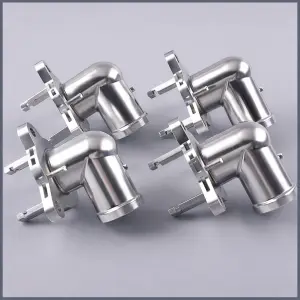
GC Indus provides professional precision casting services , also known as investment casting , for producing complex metal components with excellent dimensional accuracy and surface finish . Precision casting is a manufacturing process that uses a wax pattern and ceramic mold to create highly detailed metal parts that would be difficult or costly to produce using traditional machining or casting methods.
Precision casting is widely used for components requiring complex shapes, thin walls, excellent surface quality, and tight tolerances . It significantly reduces the need for extensive machining and allows manufacturers to produce intricate metal parts with high efficiency.
At GC Indus , we combine advanced casting technology, experienced engineers, and strict quality control processes to deliver precision cast components for demanding industries. We also provide CNC machining , heat treatment, surface finishing, and assembly , offering customers a complete manufacturing solution from concept to finished product.
Molten metal is poured into ceramic molds under controlled conditions to ensure stable casting quality.
Multiple ceramic layers are applied to create durable molds capable of handling high temperature molten metals.
High precision wax patterns are created to ensure accurate replication of part geometry.
Our engineering team assists customers with design optimization to ensure parts are suitable for the investment casting process.
Turbocharger components, brackets, pump housings, and engine system parts.
Valve bodies, pump components, gears, and precision mechanical parts.
Power generation components, turbine parts, and fluid control systems.
Surgical instruments, medical device components, and precision housings.
Start Your Precision Casting Project Today
Precision casting allows the creation of intricate shapes that are difficult to manufacture with conventional machining.
Investment casting typically produces smooth surfaces, reducing the need for extensive finishing processes.
Compared with machining from solid blocks, precision casting minimizes raw material waste.
The process enables tight tolerances and consistent repeatability.
Precision casting supports a broad range of metal alloys including stainless steel, carbon steel, aluminum, and superalloys.
For complex components, precision casting can significantly reduce machining time and overall production costs.
GC Indus provides casting, machining, finishing, and assembly , delivering a complete production solution.
Material selection is critical in precision casting because it determines mechanical strength, corrosion resistance, heat resistance, and overall product performance. Below are common materials used in investment casting.
Stainless steel provides excellent corrosion resistance and strength.
Carbon steel offers good strength and cost efficiency.
Alloy steels provide enhanced mechanical performance.
Aluminum alloys are lightweight and corrosion resistant.
Used for extreme temperature environments.
Precision casting, also known as investment casting, is a manufacturing process that produces metal parts using a wax pattern and ceramic mold. Compared with traditional casting methods such as sand casting, precision casting provides significantly higher dimensional accuracy and smoother surface finishes. The process allows manufacturers to produce intricate geometries and thin wall structures that would be extremely difficult to achieve using conventional casting techniques. Because the molds are made from ceramic materials that accurately replicate the wax pattern, the final parts closely match the original design. This reduces the need for additional machining and improves overall production efficiency.
Precision casting and CNC machining are both important manufacturing technologies, but they serve different purposes. Precision casting is particularly advantageous when producing complex parts with intricate shapes that would require extensive machining if made from solid material. By creating near-net-shape components, precision casting reduces raw material waste and machining time. CNC machining is often used as a secondary process to achieve tight tolerances in critical areas. Combining both processes allows manufacturers to produce highly accurate parts while maintaining cost efficiency.
Precision casting is widely used in industries that require complex metal components with high performance and reliability. Aerospace manufacturers use precision casting for turbine blades and structural parts. Automotive companies use it for turbocharger housings and engine components. Industrial machinery manufacturers rely on precision casting for pump housings, valves, and mechanical components. Medical equipment companies use it to produce surgical instruments and precision housings. The ability to produce complex shapes and high-performance materials makes precision casting ideal for these industries.
Precision casting typically achieves tolerances of approximately ±0.1 mm to ±0.3 mm , depending on part size and geometry. This level of accuracy is significantly better than many traditional casting processes. For features requiring extremely tight tolerances, secondary machining operations may be required. Proper mold design and process control are essential to maintain dimensional accuracy.
Investment casting produces parts with relatively smooth surfaces directly from the mold. Typical surface roughness ranges from Ra 3.2 to Ra 6.3 µm . Additional finishing processes such as polishing, sandblasting, electroplating, or coating can further improve appearance and functionality. Surface finishing is often applied to improve corrosion resistance, wear resistance, or aesthetic quality.
Lead times for precision casting depend on mold complexity and production volume. Tooling and mold development typically require 3 to 5 weeks . Once tooling is completed, casting production can begin quickly. Secondary processes such as machining, finishing, and inspection may extend the overall timeline depending on part complexity.
Yes, precision casting can produce relatively thin wall structures compared with traditional casting methods. Typical wall thickness ranges from 1.5 mm to 4 mm , depending on the material and part design. Proper mold design and metal flow analysis are essential to ensure complete filling and structural integrity.
Several factors affect casting quality, including mold design, metal temperature, cooling rate, wax pattern accuracy, and ceramic shell strength. Proper process control and quality inspection are necessary to prevent defects such as porosity, shrinkage, or incomplete filling.
Unlike permanent metal molds used in die casting , investment casting molds are single-use ceramic shells . Each casting cycle requires a new ceramic mold created from the wax pattern. However, wax pattern molds can be reused many times, making the process efficient for medium to large production runs.
Material selection depends on mechanical performance requirements, operating environment, corrosion resistance, and cost considerations. Stainless steel is often used for corrosion resistance, carbon steel for strength and affordability, aluminum alloys for lightweight applications, and nickel-based alloys for extreme temperature environments. Engineers evaluate these factors carefully to determine the most suitable material for each application.
When designing parts for precision casting, engineers should consider the following guidelines:
Consistent wall thickness helps ensure proper metal flow and reduces the risk of defects.
Rounded corners improve metal flow and reduce stress concentration.
Fillets strengthen the structure and improve casting quality.
Metal contracts during cooling, so mold dimensions must account for shrinkage.
Thick sections can cause internal shrinkage and porosity.
Proper gating ensures smooth metal flow and reduces air entrapment.
READY FOR ENGINEERING REVIEW
Share the model, material, quantity and critical requirements.
Start your project ↗


