
Book Appointment Now

GC INDUS / MANUFACTURING KNOWLEDGE
Titanium CNC Machining: How to Control Heat, Tool Wear, Tolerances and Surface Integrity
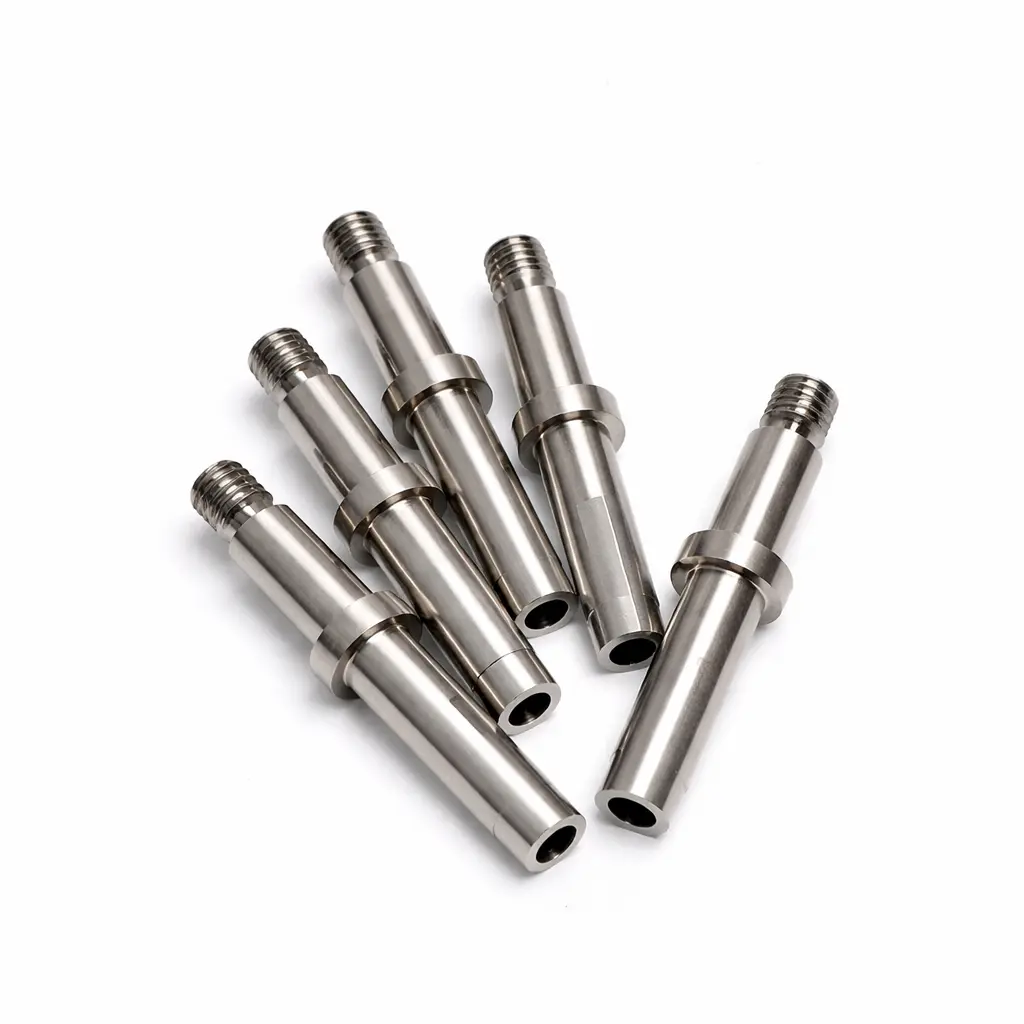

Titanium is one of the most valuable engineering materials for demanding applications.
It combines high strength, relatively low density, excellent corrosion resistance, and strong performance in elevated-temperature environments. These characteristics make titanium attractive for aerospace components, medical devices, energy equipment, automotive applications, electronics, and precision industrial systems.
But the same properties that make titanium valuable can also make it difficult to machine.
Compared with easier-to-machine materials such as aluminum, titanium requires more careful control of:
- Cutting heat
- Tool engagement
- Tool wear
- Cutting parameters
- Workholding
- Chip evacuation
- Surface integrity
- Dimensional stability
- Inspection
A titanium part may look relatively simple on a CAD model but still require a carefully planned manufacturing process.
This is especially important when a component contains deep cavities, thin walls, tight tolerances, complex surfaces, or critical sealing and mating features.
For titanium CNC machining, the objective is not simply to remove material.
The objective is to remove material in a controlled way while protecting the tool, the workpiece, and the final surface quality.
GC INDUS approaches titanium machining around three important engineering considerations: the titanium grade, thermal management, and surface integrity. The manufacturing route is then matched to the drawing, geometry, quantity, and inspection requirements.
1. Why Is Titanium Difficult to Machine?
Titanium has several characteristics that create machining challenges.
The most important include:
Low thermal conductivity
Heat generated during cutting does not dissipate through the workpiece as easily as it does with many other metals.
A significant amount of heat can remain concentrated around the cutting zone.
This can accelerate tool wear and affect surface quality.
High strength
Titanium maintains high strength during machining.
The cutting tool therefore encounters significant resistance while removing material.
Chemical reactivity
Titanium can react with cutting-tool materials at elevated temperatures.
This can contribute to tool wear and edge degradation.
Elastic behavior
Titanium can deflect during machining, especially when the component contains thin walls or slender sections.
This can create dimensional problems if workholding and cutting conditions are not carefully controlled.
Work hardening
Certain titanium machining conditions can create localized hardening.
If the tool repeatedly passes over an already hardened surface, tool wear can increase.
These characteristics mean that titanium machining requires more than simply changing the material selection in a CNC program.
The complete process needs to be considered.
2. Titanium Grade Selection Comes First
Not all titanium behaves the same way during machining.
The material grade affects:
- Strength
- Hardness
- Ductility
- Corrosion resistance
- Thermal behavior
- Machinability
- Heat-treatment response
- Final application performance
One of the most widely used titanium alloys is Ti-6Al-4V, commonly known as Grade 5 titanium.
It offers a useful combination of:
- High strength
- Low density
- Corrosion resistance
- Fatigue performance
- Temperature capability
However, other titanium grades may be more appropriate depending on the application.
Commercially pure titanium may be selected when corrosion resistance and formability are more important than maximum strength.
Other titanium alloys can be selected when specific strength, temperature, or corrosion requirements dominate.
The correct approach is therefore:
Application → Required properties → Titanium grade → Machining process
Rather than simply choosing the most familiar titanium grade.
3. Titanium Machining Starts With the Engineering Drawing
A good titanium machining project begins before CNC programming.
The manufacturer should review:
- Material grade
- Part geometry
- Critical dimensions
- Datums
- GD&T
- Surface finish
- Thread specifications
- Heat treatment
- Surface treatment
- Quantity
- Inspection requirements
The same titanium grade can require very different machining strategies depending on geometry.
A simple turned shaft is different from a thin-wall aerospace housing.
A small medical component is different from a large structural component.
Therefore, the drawing and 3D model should be reviewed together.
4. Thermal Management Is Critical
Heat is one of the biggest challenges in titanium machining.
When a cutting tool removes material, energy is converted into heat.
With materials that conduct heat efficiently, some of that heat can move into the workpiece and surrounding material.
Titanium has relatively low thermal conductivity.
As a result, more heat can remain concentrated around the cutting zone.
Excessive heat can contribute to:
- Faster tool wear
- Edge chipping
- Poor surface finish
- Dimensional instability
- Surface damage
- Reduced tool life
This makes coolant delivery and cutting strategy particularly important.
The objective is to maintain a stable cutting zone rather than simply increasing cutting speed.
5. Cutting Speed Must Be Carefully Controlled
One common mistake is assuming that harder or more expensive materials should simply be machined at higher cutting speeds using more powerful machines.
Titanium generally requires controlled cutting conditions.
If cutting speed becomes excessive, cutting temperature can rise rapidly.
This may reduce tool life and make the process less stable.
The correct cutting speed depends on:
- Titanium grade
- Tool material
- Tool diameter
- Tool geometry
- Radial engagement
- Axial engagement
- Machine rigidity
- Coolant strategy
- Operation type
Roughing and finishing should not necessarily use identical parameters.
A stable roughing strategy may prioritize material removal and tool life.
A finishing strategy may prioritize surface integrity and dimensional control.
6. Tool Selection Matters
Tool selection can have a major influence on titanium machining performance.
Carbide tooling is commonly used for precision titanium machining because it provides the hardness and thermal resistance required for demanding cutting conditions.
Tool geometry also matters.
Engineers may evaluate:
- Flute count
- Helix angle
- Rake angle
- Edge preparation
- Coating
- Tool diameter
- Corner radius
The best tool is not necessarily the tool with the highest theoretical cutting capability.
It is the tool that provides a stable combination of:
Tool life + material removal + surface quality + dimensional consistency
7. Tool Engagement Should Be Controlled
Tool engagement is particularly important when machining titanium.
Large radial engagement can increase cutting forces and heat generation.
Very small engagement can sometimes create inefficient cutting conditions.
A stable toolpath should therefore control how much of the tool is engaged with the workpiece.
Modern CNC strategies can use:
- Adaptive roughing
- Trochoidal-style toolpaths
- Constant engagement strategies
- Controlled radial depth of cut
- Optimized stepovers
The exact strategy should be selected according to the geometry and machine capability.
8. Roughing Titanium Requires Stability
Roughing removes the largest amount of material.
This is where machining forces and heat generation can become significant.
A good roughing strategy should focus on:
- Stable engagement
- Controlled chip thickness
- Effective coolant
- Tool rigidity
- Workpiece rigidity
- Predictable chip evacuation
It is usually better to maintain a stable cutting condition than to maximize instantaneous material removal at the expense of tool life.
For expensive titanium material, uncontrolled tool failure can also create significant production risk.
9. Finishing Titanium Requires a Different Mindset
After roughing, finishing operations establish the final:
- Dimensions
- Surface finish
- Profile
- Edge condition
- Functional surfaces
Finishing may use lighter radial and axial engagement.
The objective is to maintain a stable tool path and avoid unnecessary heat accumulation.
Critical surfaces may require additional finishing passes.
If the drawing specifies a particularly demanding surface finish, the process may need additional operations beyond conventional milling or turning.
10. Thin-Wall Titanium Parts Need Special Attention
Thin-wall components are challenging because the material can move during machining.
Cutting forces can cause the wall to deflect away from the tool.
After the cutting force disappears, the material may partially return toward its original position.
This creates a common problem:
The machine follows the programmed path, but the final wall does not match the intended geometry.
Thin-wall machining may therefore require:
- Better workholding
- Reduced cutting forces
- Optimized tool engagement
- Multiple finishing passes
- Strategic machining sequences
- Support features where possible
The design should also avoid unnecessarily thin walls unless they are functionally required.
GC INDUS’s titanium design guidance specifically highlights avoiding excessively thin walls, reducing deep cavities, optimizing corner radii, and considering tool access.
11. Deep Cavities Increase Machining Difficulty
Deep cavities are challenging for several reasons.
A long tool may be required to reach the bottom.
Long tools are generally less rigid than short tools.
This can increase:
- Tool deflection
- Vibration
- Chatter
- Dimensional variation
- Surface roughness
If the geometry allows it, engineers should consider:
- Increasing cavity width
- Reducing unnecessary depth
- Increasing internal corner radius
- Improving tool access
- Changing the machining orientation
For extremely complex geometry, multi-axis machining may provide a better tool orientation.
12. 5-Axis CNC Machining for Titanium
5-axis machining can be particularly useful for complex titanium components.
Instead of limiting the cutting tool to a small number of fixed orientations, 5-axis machining allows the tool and workpiece relationship to change throughout the process.
This can provide:
- Better tool access
- Fewer setups
- Improved surface continuity
- Reduced repositioning
- Better access to complex surfaces
However, 5-axis machining should not be selected simply because the material is titanium.
The decision should depend on:
- Geometry
- Number of orientations
- Surface complexity
- Tool access
- Tolerance requirements
- Production quantity
GC INDUS lists 5-axis titanium machining as part of its titanium manufacturing capability for complex components.
13. Titanium CNC Turning
Titanium is also widely used for rotational components.
Examples include:
- Shafts
- Bushings
- Pins
- Connectors
- Threaded components
- Sleeves
- Precision fittings
CNC turning can provide efficient production for cylindrical titanium components.
However, the same fundamental challenges remain:
- Heat
- Tool wear
- Workholding
- Surface integrity
- Dimensional control
For small-diameter precision components, Swiss-type machining may also be considered when the geometry and production requirements justify it.
14. Workholding for Titanium Parts
Workholding is sometimes overlooked during material selection.
But a titanium component can be difficult to machine accurately if it is not held securely.
The fixture needs to provide enough support to resist cutting forces without deforming the component.
This becomes particularly important for:
- Thin walls
- Long shafts
- Large lightweight structures
- Complex housings
- Thin plates
The workholding strategy should be designed around the actual machining sequence.
A rigid setup can help improve:
- Dimensional stability
- Surface quality
- Repeatability
- Tool life
15. Avoid Excessive Clamping Force
More clamping force is not always better.
If a thin titanium component is clamped excessively, it may deform during setup.
The part can appear dimensionally correct while clamped.
After removal from the fixture, it may relax and change shape.
This is why fixture design should balance:
Stability + accessibility + controlled clamping force
The engineering team should identify where the component can safely be supported.
16. Coolant Delivery Matters
Titanium machining can benefit from effective coolant delivery.
The objective is to:
- Control cutting temperature
- Remove chips
- Reduce friction
- Protect the cutting edge
- Improve process stability
Simply flooding coolant around the machine may not be enough.
The coolant should reach the cutting zone effectively.
For deep cavities or difficult tool orientations, coolant access can become another manufacturing consideration.
17. Chip Evacuation Should Not Be Ignored
Poor chip evacuation can create problems.
Accumulated chips can:
- Re-enter the cutting zone
- Scratch the surface
- Increase heat
- Damage the tool
- Interfere with coolant flow
This is particularly important during deep-pocket machining.
Toolpath strategy, coolant direction, machine configuration, and chip-breaking behavior should be considered together.
18. Surface Integrity Is More Important Than Appearance Alone
A titanium component can have an acceptable visual appearance but still have an undesirable machined surface.
Surface integrity includes more than surface roughness.
Depending on the application, engineers may care about:
- Surface roughness
- Surface damage
- Residual stress
- Heat-affected conditions
- Microstructural changes
- Burrs
- Tool marks
Critical titanium components may therefore require controlled machining and inspection procedures.
This is especially relevant for aerospace, medical, and high-performance industrial applications.
19. Burr Control
Burrs can form around:
- Drilled holes
- Milled edges
- Intersections
- Threaded features
- Thin sections
Uncontrolled burrs can interfere with:
- Assembly
- Sealing
- Electrical contact
- Fatigue performance
- Safety
Deburring should therefore be included in the manufacturing plan.
Depending on the component, the process may involve:
- Manual deburring
- Controlled edge breaking
- Vibratory finishing
- Brushing
- Specialized finishing
20. Titanium Threads Require Careful Control
Threaded titanium components may require special attention.
Potential concerns include:
- Thread geometry
- Galling
- Surface condition
- Thread fit
- Coating
- Assembly torque
The thread specification should clearly identify:
- Thread standard
- Diameter
- Pitch
- Tolerance
- Depth
- Internal or external thread
For critical assemblies, the manufacturer should also understand the mating material and assembly conditions.
21. Surface Treatment for Titanium Components
Titanium components can undergo different surface treatments depending on the application.
Possible treatments include:
- Passivation-related processes
- Polishing
- Specialized coatings
- PVD
- Anodizing for selected titanium applications
- Surface enhancement processes
The correct treatment depends on:
- Corrosion requirements
- Wear requirements
- Appearance
- Friction
- Biocompatibility
- Electrical properties
- Dimensional requirements
Surface treatment should therefore be specified as part of the complete manufacturing route.
GC INDUS provides a range of surface-treatment capabilities across precision metal components, including plating, anodizing, passivation, PVD, electropolishing and other finishing processes.
22. Titanium and Heat Treatment
Some titanium alloys may require heat treatment to achieve specified mechanical properties.
The manufacturing team should understand:
- Material grade
- Required hardness or strength
- Heat-treatment specification
- Temperature requirements
- Holding time
- Cooling method
- Dimensional requirements after treatment
Heat treatment can also influence dimensional stability.
If extremely tight dimensions are required after heat treatment, the manufacturing sequence may need to include additional finishing operations.
23. Plan the Machining Sequence Before Cutting
Machining sequence can influence final accuracy.
A typical titanium component might follow:
Material verification
↓
Workholding
↓
Rough machining
↓
Stress management / intermediate process if required
↓
Semi-finishing
↓
Heat treatment if specified
↓
Finish machining
↓
Deburring
↓
Surface treatment
↓
Final inspection
The actual sequence depends on the component.
The important point is that final dimensions should be considered from the beginning rather than at the last machining operation.
24. Titanium Machining and Tolerance Control
Tight tolerances should be assigned according to functional requirements.
For example:
A bearing seat may require precise dimensional control.
A general external surface may not.
A threaded connection may require controlled pitch diameter.
A non-functional pocket may accept a broader tolerance.
This is especially important with titanium because unnecessary machining difficulty can increase cost.
GC INDUS states that achievable precision depends on material, geometry and machining process, with tighter tolerances requiring appropriate equipment and process control.
25. Inspection of Titanium Parts
Inspection should be planned around the critical characteristics.
Possible inspection methods include:
- Calipers
- Micrometers
- Bore gauges
- Pin gauges
- Thread gauges
- Height gauges
- Optical inspection
- CMM
For complex titanium components, CMM inspection can verify:
- Hole positions
- Profiles
- Datums
- Geometric relationships
- Complex surfaces
The inspection method should match the tolerance and feature.
Not every dimension needs the same inspection equipment.
26. Material Verification Is Important
Titanium material should be verified against the specified grade.
Depending on project requirements, documentation may include:
- Material certificate
- Heat number
- Chemical composition
- Mechanical properties
- Traceability documentation
For critical applications, material traceability should be maintained throughout production.
GC INDUS’s precision machining service describes material certification, first-article inspection, in-process checks and final validation as part of its quality approach.
27. Titanium for Aerospace Applications
Aerospace is one of the major application areas for titanium.
Titanium can be attractive because it combines:
- High strength-to-weight ratio
- Corrosion resistance
- Temperature capability
- Fatigue performance
Typical components may include:
- Brackets
- Structural components
- Fittings
- Housings
- Shafts
- Fasteners
- Engine-related components
However, aerospace components can have demanding requirements for:
- Traceability
- Inspection
- Surface integrity
- Documentation
- Process control
Therefore, aerospace titanium machining should be approached as a controlled manufacturing process rather than simply a CNC cutting operation.
28. Titanium for Medical Components
Titanium is also widely used in medical applications.
Its properties can make it suitable for:
- Surgical instruments
- Orthopedic components
- Implant-related components
- Medical equipment
- Precision connectors
Medical components can require particularly careful control of:
- Material
- Surface condition
- Geometry
- Cleanliness
- Documentation
The manufacturing route should therefore be defined around the final application.
29. Titanium for Energy and Industrial Equipment
Titanium can also be useful in environments where corrosion resistance is important.
Applications may include:
- Chemical equipment
- Energy systems
- Offshore equipment
- Heat-transfer components
- Precision industrial equipment
The correct titanium grade and surface condition depend on the operating environment.
Material selection should consider temperature, chemicals, mechanical loads, and expected service life.
30. How to Reduce Titanium CNC Machining Cost
Titanium is generally more expensive to machine than easier-to-cut materials.
However, cost can be controlled through good engineering decisions.
Reduce unnecessary material removal
Use geometry that does not require excessive machining.
Optimize toolpaths
Maintain stable tool engagement.
Select appropriate tooling
Match tool geometry to the operation.
Reduce unnecessary setups
Consider multi-axis machining where justified.
Avoid unnecessary tolerances
Specify tight tolerances only where function requires them.
Improve workholding
Support the part without unnecessary deformation.
Plan secondary operations
Avoid creating unnecessary rework after heat treatment or finishing.
Consider near-net-shape processes
For high-volume components, casting or forging may reduce the amount of titanium that must be machined.
31. When CNC Machining Is the Best Titanium Process
CNC machining is particularly useful when:
- Geometry is complex
- Production quantity is low or medium
- Tight tolerances are required
- Design changes are expected
- Complex pockets are required
- Multiple material-removal operations are needed
- Prototype validation is required
GC INDUS supports titanium projects from prototypes through small-batch and mass production.
32. When Another Manufacturing Process May Be Better
CNC machining is not always the best answer.
For high-volume titanium components, engineers may evaluate:
- Forging
- Investment casting
- Near-net-shape processes
- CNC machining combined with forming
The best route depends on:
- Annual quantity
- Geometry
- Material utilization
- Tolerance
- Tooling investment
- Required mechanical properties
A good manufacturer should evaluate the complete route rather than automatically quote one process.
33. A Practical Titanium DFM Checklist
Before sending a titanium component for quotation, review:
Material
- Is the titanium grade clearly specified?
- Is the material certification requirement defined?
Geometry
- Are walls unnecessarily thin?
- Are cavities excessively deep?
- Are internal radii practical?
Tool access
- Can standard tools reach the features?
- Would 5-axis machining improve access?
Tolerances
- Which dimensions are functionally critical?
- Are GD&T requirements clearly defined?
Workholding
- Can the part be held without deformation?
- Are sufficient support surfaces available?
Finishing
- Is the surface finish requirement realistic?
- Is additional surface treatment required?
Inspection
- Which features require CMM?
- Is first-article inspection required?
Production
- What is the prototype quantity?
- What is the annual production volume?
- Could forging or casting become more economical at higher volume?
34. What Should Be Included in a Titanium CNC RFQ?
A complete RFQ should include:
3D CAD model
Preferably STEP or another widely supported format.
2D engineering drawing
Include dimensions, tolerances, datums and GD&T.
Titanium grade
For example, identify the exact alloy rather than simply writing “Titanium.”
Quantity
Provide prototype, batch, and expected annual quantities when possible.
Surface treatment
Specify anodizing, polishing, coating, passivation, or other requirements.
Heat treatment
Include the required specification if applicable.
Inspection
Identify critical features and required documentation.
Application
If possible, explain the function and operating environment of the part.
This information allows the manufacturer to develop a more reliable process and quotation.
Frequently Asked Questions
1. Why is titanium difficult to machine?
Titanium has high strength, relatively low thermal conductivity, and challenging heat-management characteristics. These properties can increase cutting temperature and tool wear.
2. What is the most common titanium alloy for CNC machining?
Ti-6Al-4V, also known as Grade 5, is one of the most widely used titanium alloys for CNC machining.
3. Can titanium be CNC milled?
Yes. Titanium can be milled using appropriate tooling, cutting parameters, coolant strategies and workholding.
4. Can titanium be CNC turned?
Yes. Titanium shafts, pins, bushings, connectors and other rotational components can be produced through CNC turning.
5. Is 5-axis CNC machining necessary for titanium?
Not always. It becomes valuable when the geometry requires multiple tool orientations, complex surfaces or reduced setups.
6. How can titanium machining costs be reduced?
Cost can be reduced through better DFM, optimized toolpaths, appropriate tooling, fewer setups, controlled tolerances, effective workholding and reduced unnecessary material removal.
7. Does titanium require special cutting tools?
Titanium generally benefits from tooling and cutting strategies specifically selected for its high strength and heat-generation characteristics.
8. Can titanium parts receive surface treatment?
Yes. Depending on the application and titanium grade, various finishing and surface-treatment options can be considered.
Conclusion
Titanium offers an impressive combination of strength, weight efficiency, corrosion resistance and performance.
But machining titanium successfully requires deliberate process planning.
The most important factors are not simply the CNC machine itself.
They include:
Titanium grade
Tool selection
Thermal management
Tool engagement
Workholding
Machining sequence
Surface integrity
Tolerance strategy
Inspection
Surface treatment
A successful titanium machining process connects all of these elements.
For complex components, the engineering review should begin with the drawing and material specification, then move through tool access, workholding, machining strategy, finishing and inspection.
The objective is not simply to produce a titanium part.
It is to produce a titanium component that meets its functional requirements consistently, efficiently and repeatably.
If you are developing a titanium component for aerospace, medical, energy, automotive or precision industrial equipment, provide the CAD model, drawing, titanium grade, quantity and critical requirements.
GC INDUS can evaluate the geometry and identify a practical manufacturing route covering CNC machining, 5-axis machining, turning, finishing and inspection.
Bring the drawing. Define the requirements. Build the right manufacturing route.


