
Book Appointment Now
Titanium grade
Define this requirement in your drawing or specification so the engineering review has a clear starting point.

GC INDUS / ENGINEERED TO YOUR DRAWING
Plan titanium components around alloy grade, tool engagement, thermal control and inspection.
01 / ENGINEERING INTENT
A useful manufacturing decision connects function, geometry and inspection. Start with the requirements that matter to your part.
Define this requirement in your drawing or specification so the engineering review has a clear starting point.
Review its relationship with the selected process, material and production quantity.
Identify acceptance criteria and the information required for verification.
02 / PROCESS LOGIC
Explore the key stages. Select a step to follow the manufacturing route.
Review the model and drawing together, including critical datums and tolerances.
Choose workholding, tool access and a sequence that supports stable feature location.
Remove material through planned roughing and finishing operations.
Measure the agreed characteristics and prepare the requested inspection documentation.
03 / MANUFACTURING IN DETAIL
04 / TECHNICAL LIBRARY
Explore Titanium Machining by topic. Connect the process, materials and requirements before your engineering review.
Titanium machining is widely used in industries that require exceptional strength-to-weight ratio, corrosion resistance, and high temperature performance. At GC Indus , we specialize in high-precision titanium machining for complex components and critical applications.
Our advanced CNC machining centers, multi-axis milling machines, and Swiss-type lathes allow us to process titanium alloys with extremely tight tolerances and superior surface finishes . Titanium is known for its excellent mechanical properties but also presents significant machining challenges due to its low thermal conductivity and high strength. GC Indus leverages extensive machining experience, optimized tooling strategies, and advanced cooling technologies to ensure reliable production and consistent quality.
We support projects from rapid prototyping to high-volume production , providing customized machining solutions tailored to customer requirements. Our titanium machining capabilities include precision turning, milling, drilling, tapping, and complex multi-axis machining operations.
With strict quality control systems and experienced engineering teams, GC Indus delivers titanium parts that meet the highest standards for aerospace, medical, automotive, energy, and industrial equipment sectors.
Our multi-axis CNC milling centers allow us to produce complex titanium components with intricate geometries, deep cavities, and precise dimensional control.
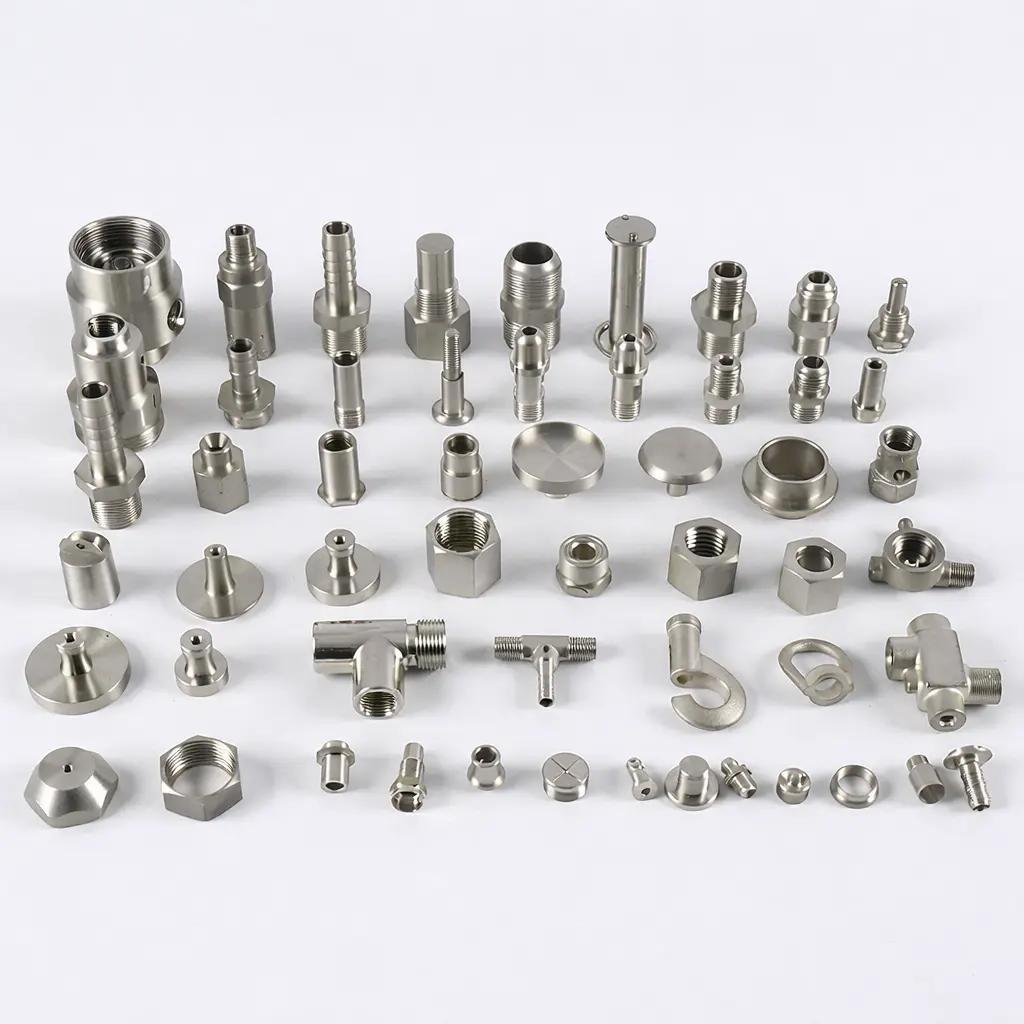
We manufacture precision cylindrical titanium parts such as shafts, bushings, fasteners, and connectors using high-performance turning equipment.
For highly complex parts, our 5-axis CNC machining capabilities enable efficient machining of complex surfaces while maintaining high precision.
We offer rapid prototyping services to support product development and design validation before mass production.
Whether customers require low-volume prototypes or large-scale production, our flexible manufacturing system ensures stable quality and fast delivery.
Titanium machining plays a critical role in many high-end industries. GC Indus supplies titanium components for a wide range of applications.
Titanium alloys are essential for aircraft structures, engine components, and landing gear due to their strength and lightweight characteristics
Titanium is biocompatible and corrosion-resistant, making it ideal for surgical implants, orthopedic devices, and medical instruments.
High-performance automotive parts such as racing components, turbocharger systems, and lightweight structural elements often use titanium.
Titanium parts are used in offshore equipment, chemical processing systems, and energy infrastructure where corrosion resistance is critical.
Titanium is increasingly used in high-end electronics housings, semiconductor equipment, and precision mechanical systems.
Titanium requires specialized machining knowledge. Our engineers understand the unique characteristics of titanium alloys and apply optimized cutting strategies.
Our facility is equipped with high-performance CNC machining centers, Swiss lathes , and 5-axis machines capable of producing complex titanium parts.
We routinely achieve tolerances as tight as ±0.005 mm , ensuring dimensional accuracy for critical applications.
Using advanced tooling and optimized machining parameters, we deliver titanium components with superior surface finishes.
Every part undergoes detailed inspection using coordinate measuring machines (CMM), optical inspection systems, and precision gauges.
From prototypes to large production runs, GC Indus offers scalable manufacturing solutions.
Ready to Start Your Titanium Machining Project?
Titanium alloys vary significantly in strength, corrosion resistance, and machinability. Choosing the right alloy is essential for performance and manufacturability.Below are commonly used titanium materials for machining:
Commercially pure titanium grades provide excellent corrosion resistance and good formability. These materials are often used in chemical processing equipment, marine applications, and medical devices.
Highest ductility among titanium grades
Excellent corrosion resistance
Easy to machine compared to other titanium alloys
Most widely used commercially pure titanium
Good weldability and formability
Applications include chemical equipment, marine hardware, and heat exchangers .
Higher strength than Grade 2
Good corrosion resistance
Suitable for structural components
Strongest commercially pure titanium
Widely used in medical implants
This is the most widely used titanium alloy , accounting for nearly 50% of titanium production worldwide .
Excellent strength-to-weight ratio
Good high-temperature performance
high-performance automotive components
Superior corrosion resistance
Excellent resistance to acids
Used in chemical processing equipment .
Excellent cold workability
Often used in aerospace tubing and bicycle frames .
ELI stands for Extra Low Interstitial , meaning it has lower oxygen and iron content compared with Grade 5.
Superior fracture toughness
Excellent biocompatibility
Improved fatigue resistance
Widely used for medical implants and surgical devices .
Titanium is difficult to machine primarily because of its low thermal conductivity and high strength . During machining, heat generated at the cutting zone does not dissipate quickly, causing high temperatures at the tool edge. This can lead to rapid tool wear and reduced tool life.
Additionally, titanium tends to work-harden quickly and has a strong chemical affinity with cutting tools, which increases friction during machining. The combination of these factors requires specialized tooling materials, optimized cutting speeds, and effective cooling strategies.
To address these challenges, GC Indus uses carbide and coated cutting tools, controlled cutting parameters, and high-pressure coolant systems to maintain stable machining performance and ensure high-quality finished parts.
Titanium machining is widely used in industries where strength, corrosion resistance, and lightweight properties are essential.
The aerospace industry is the largest consumer of titanium components, using them in structural parts, engine components, and landing gear systems.
The medical industry relies heavily on titanium because it is biocompatible and resistant to corrosion within the human body. It is commonly used for implants, prosthetics, and surgical tools.
Other industries that use titanium machining include:
electronics manufacturing
GC Indus supports customers across these industries by providing customized titanium machining solutions.
Titanium parts can be machined to extremely tight tolerances when processed with advanced CNC equipment.
At GC Indus, typical machining tolerances range between:
±0.01 mm for standard parts
±0.005 mm for high-precision components
Tolerance capability depends on several factors including part geometry, material grade, machining method, and part size.
Complex components manufactured using 5-axis CNC machining can maintain excellent dimensional accuracy while reducing setup errors and improving production efficiency.
Titanium components can undergo several surface finishing processes to improve both performance and appearance.
Common finishing options include:
These processes help enhance corrosion resistance, reduce surface roughness, and create aesthetic finishes suitable for consumer products and high-end equipment.
The most widely used titanium alloy in machining is Ti-6Al-4V (Grade 5) .
This alloy accounts for nearly 50% of global titanium usage because it provides an excellent balance of strength, corrosion resistance, and weight reduction.
Ti-6Al-4V is commonly used in:
high-performance automotive parts
Yes. Although titanium machining is more challenging than aluminum or steel, modern CNC equipment allows efficient production of titanium components.
At GC Indus, we support both low-volume prototyping and high-volume production , using optimized machining strategies to improve efficiency and reduce costs.
Machining titanium requires high-performance cutting tools designed to withstand high temperatures and cutting forces.
Common tool materials include:
Proper tool selection significantly improves machining stability and surface finish quality.
Titanium and aluminum differ significantly in machinability.
Aluminum is relatively easy to machine due to its low hardness and high thermal conductivity. Titanium, on the other hand, generates higher cutting temperatures and requires slower machining speeds.
Despite the higher machining difficulty, titanium offers superior strength and corrosion resistance.
Titanium offers several advantages over stainless steel , including:
higher strength-to-weight ratio
superior fatigue performance
These properties make titanium ideal for aerospace and medical applications.
Titanium machining costs can be optimized by:
improving part design for manufacturability
reducing unnecessary machining features
selecting the appropriate titanium grade
using multi-axis machining to reduce setups
optimizing cutting parameters
GC Indus engineers work closely with customers to ensure cost-effective manufacturing solutions .
Designing parts for titanium machining requires special attention to ensure efficient manufacturing and high-quality results.
Thin sections may deform during machining due to cutting forces.
Sharp internal corners should be avoided because cutting tools require clearance.
Deep pockets increase machining difficulty and tool wear.
Using standard threads improves machining efficiency.
Titanium is expensive, so efficient part design can significantly reduce production costs.
Ensure that machining tools can reach all critical surfaces.
READY FOR ENGINEERING REVIEW
Share the model, material, quantity and critical requirements.
Start your project ↗


