
Book Appointment Now

GC INDUS / MANUFACTURING KNOWLEDGE
Polishing vs. Grinding in Precision Surface Finishing

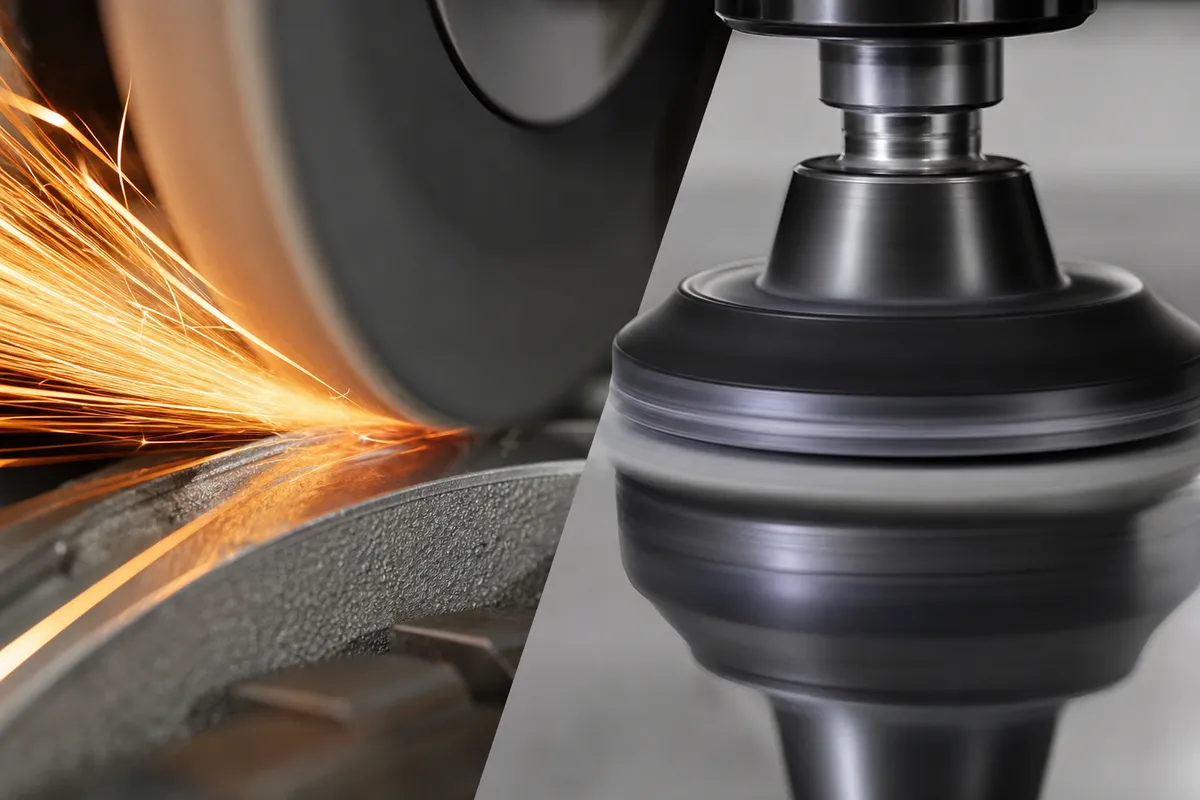
Understanding polishing vs grinding precision is essential. Grinding removes material with a bonded abrasive wheel to correct dimensions and hold tight tolerances, while polishing uses fine abrasives to refine surface texture without significantly changing part geometry. Choose grinding when the part needs precise dimensional correction or flatness; choose polishing when the priority is surface smoothness, appearance, or reducing friction and corrosion risk. Most precision parts use both in sequence: grinding first to set dimensions, polishing after to refine the surface finish.
Polishing vs Grinding Precision: What’s the Real Difference?
Grinding and polishing sit at opposite ends of the same finishing sequence: one shapes the part, the other refines what’s already been shaped. For a closer technical breakdown of how the two processes differ, Metkon’s overview of the difference between grinding and polishing is a useful reference point.
How Do Grinding and Polishing Remove Material Differently?
Grinding uses a bonded abrasive wheel—grains fused into a rigid disc—to cut into a workpiece and remove material at a controlled, often aggressive rate. This is how a shop corrects flatness, roundness, or a dimension that’s out of spec. The wheel’s grit size, hardness, and speed determine how much stock comes off per pass, and grinding routinely holds tolerances measured in microns.
Polishing works differently. It uses loose abrasive compounds or fine-bonded pads—often in the 1,000 to 8,000 grit range or finer—to smooth peaks and valleys left by upstream operations. Material removal is minimal, sometimes just microns of surface texture rather than shape. The goal isn’t to change size; it’s to lower roughness (Ra) and produce a consistent, reflective, or friction-reducing surface.
Why Are Grinding and Polishing Not Interchangeable Processes?
Grinding governs geometry and tolerance. Polishing governs surface roughness and cosmetic or functional finish. Confusing the two on a print or a work order creates a part that fails inspection or fails in service.
Consider a shaft that’s 0.02mm oversized. Polishing that shaft cannot correct the dimension because it isn’t designed to remove bulk material—it will only make the oversized surface smoother. Only grinding, with its bonded abrasive and defined material removal rate, can bring that shaft back into tolerance. Conversely, a ground surface that meets dimensional spec but still shows visible tool marks or a rough Ra value needs polishing, not more grinding, to reach the finish a customer or application requires.
Weighing polishing vs grinding precision starts with asking what’s actually wrong: a size problem or a surface problem. Most finished precision parts need both, applied in the right order and for the right reason. In practice, the questions worth asking before choosing a process include:
- Is the part currently out of tolerance on diameter, flatness, or roundness?
- Does the surface show visible tool marks, scratches, or a rough Ra value despite being within dimensional spec?
- Will the surface contact another part, seal a joint, or bear a load in service?
- Does the application require a cosmetic or reflective finish, or is function the only requirement?
What Precision Tolerances Can Grinding and Polishing Each Achieve?
Grinding holds tight dimensional and geometric tolerances; polishing refines surface texture rather than correcting size, roundness, or flatness. That split defines every real polishing vs grinding precision decision on the shop floor.
What Tolerances Can Precision Grinding Deliver?
Precision grinding removes material through bonded abrasive wheels that cut with controlled, repeatable force, which is why it stays the process of choice for flatness, roundness, and parallelism control. A rigid grinding machine with a well-dressed wheel can correct dimensional errors left by turning or milling, bringing a shaft or bore back within a tight geometric band.
This is fundamentally a metal-removal operation. Action Stainless frames centerless grinding versus polishing as the step that establishes correct diameter, roundness, and straightness on a stainless bar before any cosmetic work begins. Grinding earns its place wherever a part must mate with another component, seal against a bore, or hold a bearing fit.
What Surface Finish Quality Can Polishing Achieve Compared to Grinding?
Polishing achieves a much smoother surface texture than grinding but does little to correct size or shape. It works the outer skin of the material, knocking down peaks left behind by the previous operation rather than repositioning the whole surface plane.
That distinction matters because grinding, even when well executed, leaves a pattern of microscopic scratches and directional marks from the abrasive grains. Polishing exists specifically to remove those irregularities, producing the smoothness and cleanability a food-grade or medical-grade surface requires.
Neither capability is fixed to the process name alone. Machine rigidity, wheel or abrasive selection, coolant control, and operator discipline all shape how tight a grinding tolerance actually lands, or how uniform a polished finish turns out. At GC INDUS, we pair CNC grinding with controlled surface treatment under one inspection protocol, so dimensional accuracy and finish quality are verified together rather than assumed.
When Should You Choose Grinding Over Polishing, or Vice Versa?
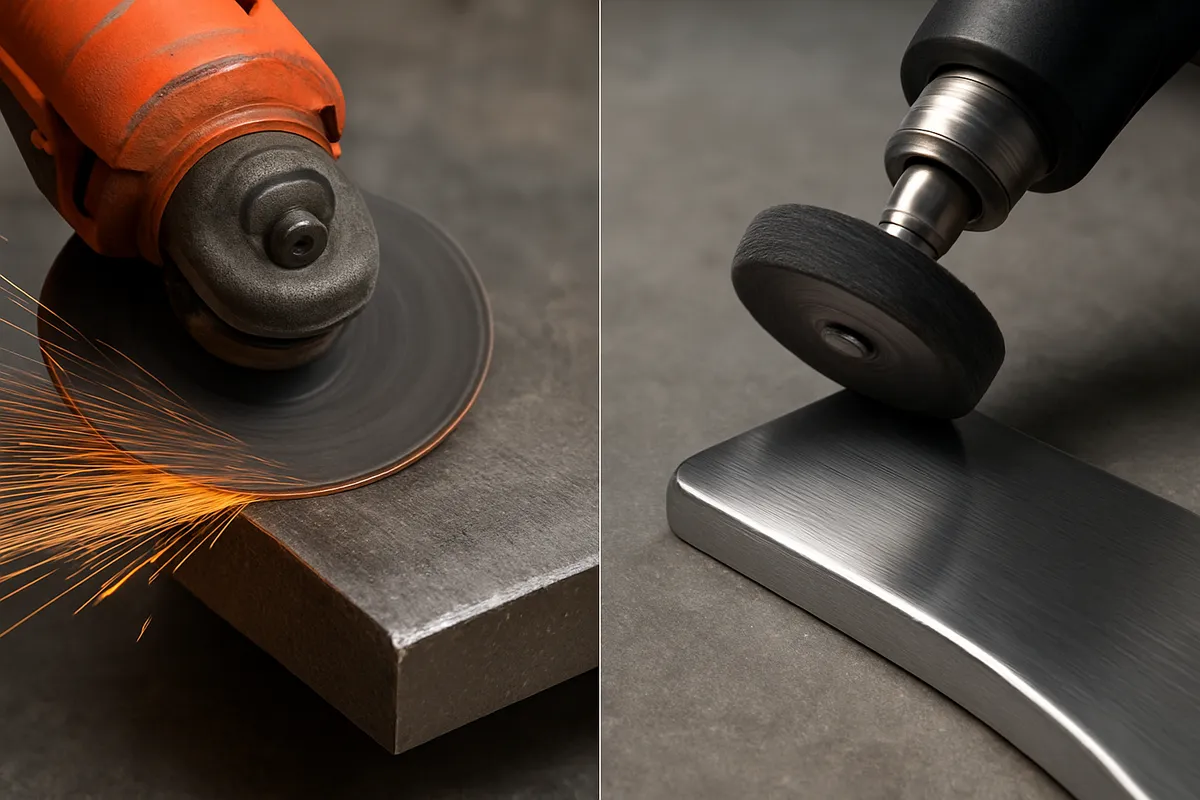
The choice comes down to part function: grind first when dimensional accuracy carries the load, polish first when the surface itself is the working feature. For more information, see Invisalign Teeth Grinding.
Part function is the starting point for any polishing vs grinding precision decision. A shaft that seats a bearing, a mating flange, or a bore that holds a press-fit component needs grinding to establish flatness, roundness, and size within tight tolerance bands. Skip that step and no amount of polishing will correct an out-of-round journal or a bore that’s 0.02mm oversize. Polishing comes into play once the geometry is correct and the concern shifts to how the surface behaves in service, friction, bacterial adhesion, fatigue crack initiation, or visual finish. Medical implants, hydraulic seals, and food-contact components lean toward polishing because roughness peaks, not just overall size, determine whether the part performs and stays clean.
Which Process Fits Your Material Type and Part Geometry?
Material hardness and part shape often decide which process is even practical. Common pairings that shops rely on include:
- Hardened tool steel and many stainless grades: respond well to grinding wheels but can load or smear under aggressive polishing compounds.
- Soft aluminum and some exotic alloys: can gum up a grinding wheel and are often better finished with lighter polishing passes.
- Flat plates and straight cylindrical shafts: suit centerless or surface grinding for dimensional control.
- Complex contours, internal cavities, and freeform surfaces: are often impossible to grind and require manual or robotic polishing instead.
How Do Industry Requirements Affect the Grinding-or-Polishing Decision?
Aerospace and medical device specifications frequently call for both processes on the same part, tight dimensional tolerance from grinding plus low roughness from polishing to meet fatigue and biocompatibility requirements. Automotive production, by contrast, often prioritizes cost-efficiency and cycle time, accepting a grind-only finish where the surface isn’t safety-critical. At GC INDUS, engineers weigh these same variables, function, material, geometry, and industry standard, when sequencing grinding and polishing across CNC-machined and cast components for medical and industrial clients.
How Do Grinding and Polishing Work Together in a Finishing Sequence?
Grinding and polishing precision work as a sequence, not a choice: rough grinding sets dimensions, fine grinding tightens tolerance, and polishing removes the residual marks that grinding leaves behind.
A typical finishing pass on a machined part moves through three stages:
- Rough grinding: removes bulk stock and brings a part close to its target dimension.
- Fine grinding: uses lighter cuts and finer abrasive grit, closing in on the final tolerance and smoothing the surface enough for polishing to be effective.
- Polishing: refines the surface texture without touching the underlying geometry.
Why Does Grinding Typically Come Before Polishing?
Grinding must precede polishing because polishing cannot correct a dimensional error, it only refines what grinding has already shaped. Polishing compounds and wheels remove microscopic amounts of material, measured in fractions of a micron, which is enough to improve surface finish but nowhere near enough to fix a bore that is out of round or a shaft that is oversized. Any part that isn’t within tolerance after grinding stays out of tolerance after polishing.
What Defects Result From Choosing the Wrong Process Order?
Skipping fine grinding or rushing straight to polish leaves visible grind lines trapped under a mirror finish, because polishing at that stage only smooths the peaks of the scratch pattern rather than removing it. Reversing the sequence, or polishing a part before dimensional checks confirm it’s within spec, wastes finishing time on a part that may get scrapped or reworked anyway. Inconsistent finish across a batch is often a symptom of operators skipping intermediate grit stages.
Inspection checkpoints between grinding and polishing stages exist for this reason. Checking dimensions and surface roughness before polishing begins catches an out-of-tolerance part while it still costs only grinding time to fix, not grinding plus wasted polishing labor. At GC INDUS, this staged inspection runs through the same quality protocols that support ISO 9001 and ISO 13485 compliance, so a part only reaches polishing once its grind dimensions are confirmed.
What Are the Cost and Quality Trade-Offs Between Grinding and Polishing?
Grinding costs more upfront because of machine investment and cycle time, while polishing costs scale with labor and surface-finish demands—so the right balance depends on the part’s actual tolerance and finish requirement.
Weighing polishing vs grinding precision against cost is a question of where the money buys function versus where it just buys appearance. Grinding machines—centerless, surface, or cylindrical—represent a capital-intensive investment. Wheel dressing, coolant systems, and machine rigidity all add setup time before a single part gets processed. That investment pays off when dimensional tolerance is the deliverable: diameter control, roundness, and straightness that downstream assembly depends on.
Polishing, in contrast, is often more labor-intensive per part. A skilled operator working a multi-stage abrasive sequence by hand takes real time, and that time multiplies with part complexity—internal radii, undercuts, or multiple cosmetic faces all add labor hours rather than machine hours.
How Should You Weigh ROI Between Grinding and Polishing for Your Tolerance Target?
Match the process investment to the tolerance and finish the part actually needs, not the tightest or shiniest result available. A hydraulic fitting that never sees daylight after assembly does not need a mirror finish—that cosmetic step adds labor cost with no gain in sealing performance or fatigue life. Conversely, spending on polishing while skipping proper grinding to true diameter wastes the polish, since a mirror finish over an out-of-round surface still fails dimensionally.
At GC INDUS, we specify finishing steps against the part’s functional print rather than defaulting to the highest available finish, which keeps inspection results tied to requirement rather than to habit.
How Do Equipment Specifications Affect Cost and Precision Outcomes?
Machine rigidity and abrasive quality set the ceiling on what any grinding or polishing line can achieve, and automation level determines how consistently it gets there. A budget-friendly manual polishing setup can produce acceptable results on simple geometries but struggles with repeatability across a production run. Mid-range automated polishing cells improve consistency and throughput. Premium-tier grinding equipment, with rigid spindles and higher-grade abrasives, holds tolerance bands that manual processes cannot reliably reach—an investment justified only when the print calls for it.
Frequently Asked Questions
Can polishing fix a part that failed dimensional tolerance after grinding?
No, polishing removes microns of material for surface refinement, not enough to correct a dimensional error from grinding. If a part is out of tolerance on diameter, flatness, or roundness, it needs to go back through grinding or another material-removal step. Polishing only comes into play once the underlying geometry is already correct.
Does polishing weaken a part’s structural precision?
Done correctly, polishing does not weaken structural precision because it removes only a thin surface layer and doesn’t alter core dimensions. The bigger risk is over-polishing rounding off sharp edges or critical features, which is why polishing depth is controlled and inspected on tight-tolerance parts.
Is polishing always required after precision grinding?
No, polishing is only necessary when the application demands a smoother surface than grinding alone provides, such as sealing surfaces, medical implants, or optical components. Many structural and mechanical parts ship straight from grinding because their function depends on dimensional accuracy, not surface reflectivity or cleanability.
How do you know which surface finish specification to request from a manufacturer?
Base the specification on how the surface will function in the final assembly, not on appearance alone. Sealing surfaces, bearing fits, and medical contact points need defined roughness values (Ra) and sometimes cleanability standards. Share the part’s operating environment and mating components with your manufacturer so they can recommend grinding, polishing, or both, rather than guessing from a drawing alone.
Can the same machine perform both grinding and polishing?
Some CNC and centerless grinding machines can be fitted with polishing heads or abrasive belts, but the two operations usually run as separate steps with different tooling. Most shops, including GC INDUS, treat grinding and polishing as distinct stages within one production line rather than a single combined pass.
Conclusion
Grinding sets the dimension; polishing refines the surface that dimension leaves behind. Treat them as sequential decisions, not a single choice, specify grinding tolerances first, based on fit and function, then decide whether the application actually needs the added cost and time of polishing. Skipping this order, or specifying both by default, adds cost without improving part performance.
Before your next RFQ, pull the functional requirement for each critical surface, sealing, bearing fit, cosmetic, or none of these, and match it to a specific Ra value rather than a generic “fine finish” note. Send that spec sheet to GC INDUS for a quote that separates grinding and polishing operations line by line, so you can see exactly what each step costs and why it’s there.
Recommended Articles
Explore more from our content library:


