
Book Appointment Now

GC INDUS / MANUFACTURING KNOWLEDGE
Powder Metallurgy Custom Manufacturing for Strong Parts

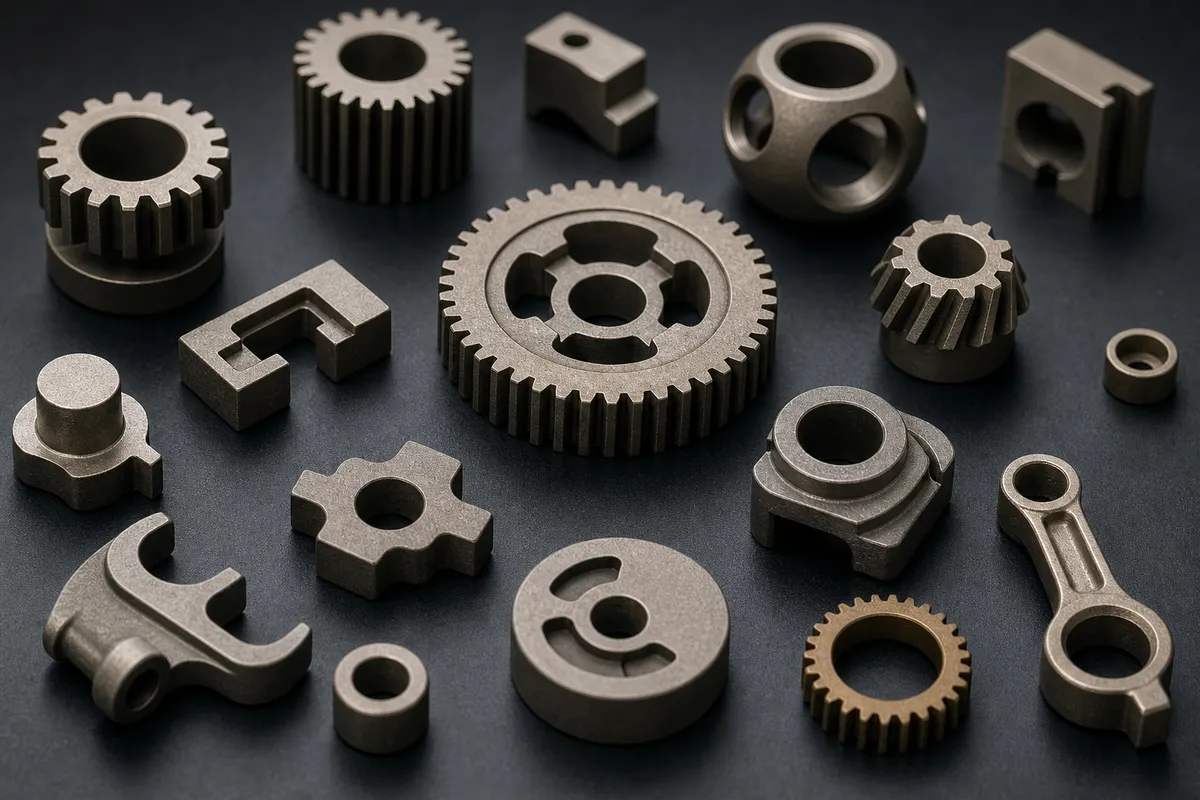
Powder metallurgy custom manufacturing shapes metal parts by compacting fine metal powders under high pressure and then sintering them in a controlled furnace, fusing particles into a solid, dense component without melting the metal. It suits parts needing complex geometries, tight tolerances, and minimal material waste, especially in medium-to-high production volumes. Compared to casting or machining, it reduces scrap since powder is pressed near final shape, and it can blend multiple metal powders into alloys that are difficult to achieve with conventional melting. Automotive, industrial, and medical manufacturers use it for gears, bushings, and structural components.
What Is Powder Metallurgy Custom Manufacturing and How Does the Process Work?
Powder metallurgy custom manufacturing turns metal powder into a finished part through four controlled stages: blending, compaction, sintering, and secondary finishing tailored to the drawing.
What are the main steps involved in converting powder into finished metal parts?
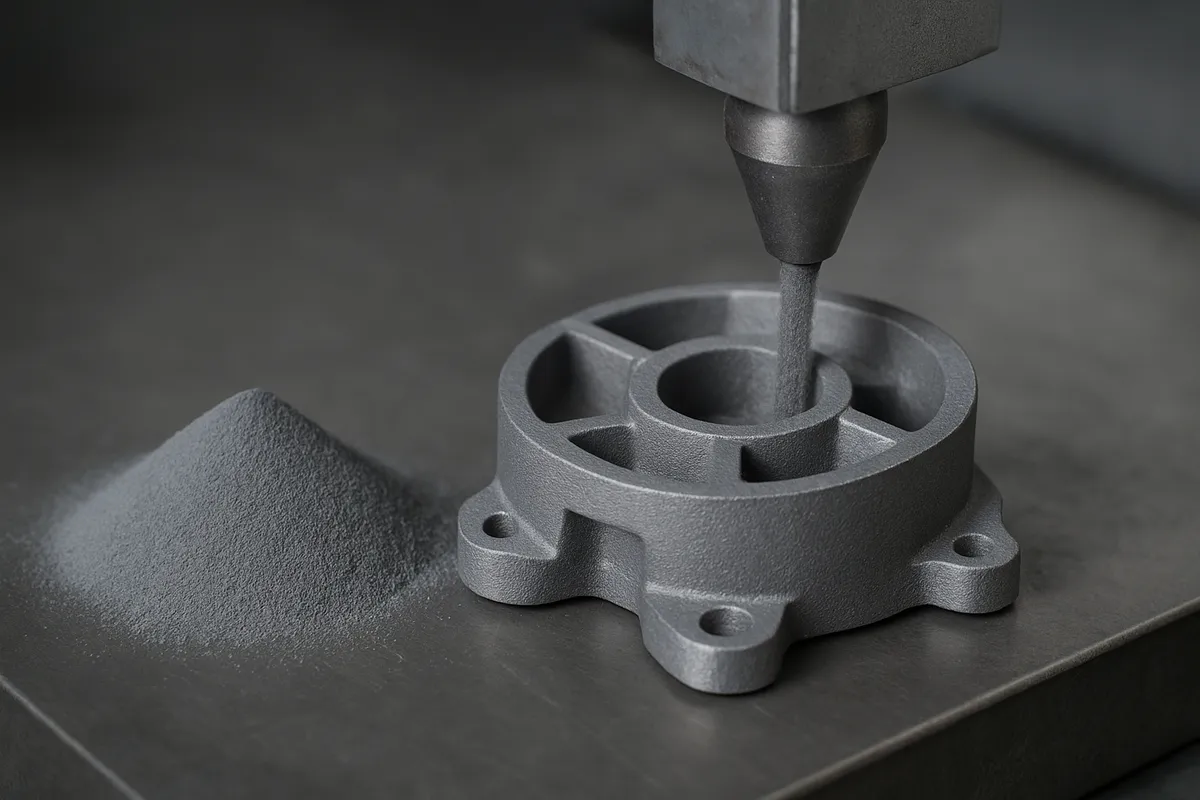
The process starts with powder blending, where a manufacturer mixes base metal powder, iron, stainless steel, bronze, or copper, with alloying elements and a lubricant to reach the mechanical properties a part needs. That blend goes into a die and gets pressed under high compaction pressure, forming a “green” part that holds its shape but isn’t yet strong.
Sintering follows: the pressed part moves through a furnace below the metal’s melting point, and heat fuses the powder particles together into a solid mass. Compaction pressure and sintering temperature and time together set the final density of the part, and density drives hardness, strength, and wear resistance. Higher pressure and longer, hotter sintering cycles push density up; lower settings leave more controlled porosity, which is sometimes the goal for self-lubricating bushings.
Many parts then go through secondary operations, sizing to hold a tight tolerance, infiltration with a second metal to fill pores, or heat treatment to boost strength.
How do powder metallurgy parts differ from parts made through casting or machining?
Casting melts metal and pours it into a mold, while powder metallurgy never reaches a liquid state, which limits shrinkage and distortion and produces a near-net shape part. Compared to machining, powder metallurgy removes far less material, the part comes out of the die close to final geometry, so scrap stays low and grain structure stays more uniform than a part cut from bar stock.
Custom manufacturing adapts every stage to the client’s part: a custom die matches the exact geometry, the alloy blend gets tuned to the load and wear requirements, and sizing operations dial in the tolerance callout on the drawing.
What Tolerances and Quality Standards Can Powder Metallurgy Achieve for Custom Parts?
As-sintered powder metallurgy parts typically hold tolerances in the range of ±0.05mm to ±0.13mm per 25mm of dimension, with tighter results requiring secondary operations. That gap between “as-sintered” and “finished” is the first thing an engineer needs to understand before specifying PM for a critical part.
Compaction and sintering alone produce good repeatability for non-critical dimensions—bore diameters, overall length, general envelope geometry. But sintering introduces shrinkage and slight dimensional shift as the compact densifies, which limits as-sintered precision on tight-fit features like bearing bores or gear teeth.
Can powder metallurgy meet tight tolerance requirements like ±0.001mm?
Yes, but only through secondary operations layered on top of the sintered part—not from pressing and sintering alone.
Sizing (a light re-pressing step) and coining (a higher-pressure re-strike that also improves surface density) can bring critical dimensions down to a few microns of variation. For features that demand true micron-level control, precision grinding or light machining passes finish the surface after sintering. This mirrors how CNC-based precision manufacturing achieves its tightest tolerances—through controlled material removal after the primary forming step, not during it. A shop offering powder metallurgy custom manufacturing alongside CNC and grinding capability can route a print to whichever combination of processes actually hits the callout, rather than forcing PM to do a job it isn’t suited for.
What certifications and quality assurance processes ensure precision in powder metallurgy manufacturing?
Repeatable tolerances depend on documented process control, not just capable equipment.
That means dimensional inspection on sampled or full lots, density checks (since density directly affects strength and dimensional stability), and material certification traceable back to the specific powder lot and blend. Manufacturers operating under ISO 9001 quality systems build these checks into the routing sheet for every job, so a buyer can trace a finished part back to its raw powder batch. GC INDUS applies this same discipline—full inspection protocols and material traceability—across its CNC, casting, and molding lines, which is the standard buyers should expect from any partner regardless of process.
Because achievable tolerance depends heavily on part geometry, wall thickness, and hole-to-wall ratios, discuss tolerance targets with the manufacturer during quoting, before tooling is cut. A print calling for ±0.001mm on a thin-walled boss may need a design change or a different process entirely, and catching that early avoids costly rework later. For more information, see Cpg Brand Dilemma Omnichannel Marketing Vs Customer Experience.
How Does Powder Metallurgy Compare to Traditional Manufacturing in Cost and Lead Time?
Powder metallurgy custom manufacturing costs less per part at volume but demands more upfront tooling investment than CNC machining, with a longer initial lead time before production starts.
The savings come from near-net-shape forming. Because a die presses powder directly into the part’s final geometry, PM uses upwards of 97% of input material, far more than subtractive processes like CNC machining, which cut away stock to reach the finished shape. Less scrap means lower material cost and fewer secondary machining passes, since sintered parts often need only minor finishing rather than full profiling.
That efficiency comes with a tradeoff: tooling. Every PM project requires a custom die, precision-engineered to the part’s dimensions and hold pattern. Building that die is the dominant upfront cost, and it’s a fixed expense regardless of whether you order 500 parts or 50,000. That math flips the cost curve, high tooling cost divided across a larger run drives per-part cost down, which is why PM suits recurring, medium-to-high volume production far better than one-off prototypes.
What is the typical timeline and lead time for custom powder metallurgy projects?
A PM project moves through three stages: tooling design and fabrication, trial runs with first article inspection, then full production. Tooling design and fabrication is the longest stage, since the die must be validated before any parts get pressed. Trial runs confirm density, dimensional accuracy, and sintering behavior before committing to a production batch. CNC machining skips the tooling stage entirely, which is why it wins on prototyping speed, a machinist can cut a first article from a CAD file in days. But that speed advantage doesn’t scale; every additional machined part still consumes machine time and material at roughly the same rate.
When is powder metallurgy more cost-effective than alternative manufacturing approaches?
PM pays off when volume is recurring and geometry is complex enough that machining would require extensive setup or multiple operations. Parts with holes, flanges, or gear teeth that come out of the die close to final form need little finishing, which compounds PM’s cost advantage. Machining or casting wins when volume is low, geometry is simple, or the project needs a fast turnaround on a handful of prototypes, situations where tooling investment can’t be justified.
What Industries and Applications Benefit Most from Custom Powder Metallurgy Parts?
Automotive, industrial equipment, and appliance manufacturers rely most on powder metallurgy custom manufacturing because it produces complex, moderate-to-high-volume parts with less waste than machining or casting.
What are real-world examples of industries using custom powder metallurgy components?
Automotive OEMs and Tier suppliers use powder metallurgy for gears, bearings, and structural brackets that sit inside transmissions, engines, and steering assemblies. These parts run in high volumes and need dimensional consistency across every batch, a natural fit for a die-based process that reproduces the same geometry thousands of times over.
Industrial equipment makers turn to PM for bushings, filters, and cams that operate under constant friction or vibration. Consumer and appliance manufacturers use it for smaller structural components and mechanism parts, door hinges, motor components, pump housings, where cost-per-part matters as much as performance. Across all three categories, the draw is the same: PM technology uses a large share of its input material rather than cutting it away as scrap, which is why the process is often classified as a resource-efficient option in metal manufacturing.
What specific part specifications and performance requirements make powder metallurgy the right choice?
Parts that point toward PM share a few traits: small-to-mid size, moderate-to-high production volumes, and geometries with flanges, steps, or bosses that can be molded in a single compaction step rather than machined afterward. That single-step forming is what separates PM from subtractive processes on cost at volume.
Performance requirements matter too. Controlled porosity lets manufacturers create self-lubricating bearings that hold oil within the material itself, reducing maintenance needs. Consistent alloy composition, achieved by blending powders before compaction, gives engineers repeatable strength-to-weight ratios across a production run. Typical part types include gears, cams, sprockets, and structural brackets, components where geometry, alloy flexibility, and volume all favor a pressed-and-sintered approach over forging or full machining.
How Do Different Powder Atomization Methods Affect Final Part Quality?
The atomization method used to make the metal powder sets the ceiling on strength, density, and consistency long before compaction begins. In powder metallurgy custom manufacturing, this upstream choice is often the real driver of part performance, not the pressing or sintering step that gets more attention.
What are the trade-offs between water atomization, gas atomization, and other powder production techniques?
Water atomization forces molten metal through a high-pressure water jet, producing irregular, jagged particles. That irregularity is an advantage for structural parts: rough-edged particles interlock mechanically during compaction, and the process costs less than alternatives, which is why it dominates high-volume automotive and industrial components.
Gas atomization uses inert gas instead of water, producing spherical particles with higher purity and fewer trapped oxides. Spherical powder flows more predictably through feeders and dies, which matters for tight-tolerance or high-performance parts where consistency across batches is non-negotiable. The trade-off is cost, gas atomization runs more expensive per kilogram than water atomization.
Other methods, including mechanical milling and plasma-based processes, sit further along the purity-versus-cost spectrum. They can produce specialized powder chemistries or finer particle sizes, but generally at a cost premium that only makes sense for niche or aerospace-grade applications rather than general OEM production.
How does the choice of atomization method impact part strength, density, and material properties?
Particle shape and size distribution directly determine green density, how tightly the powder packs before sintering. Spherical gas-atomized powder packs more uniformly, reducing voids and supporting higher sintered density, which translates into better tensile strength and lower porosity in the finished part.
Irregular water-atomized powder can still reach strong mechanical properties for structural applications, but porosity control requires tighter process discipline during compaction and sintering. Batch-to-batch consistency also depends on how tightly the powder supplier controls particle size distribution, wide variation there shows up later as inconsistent shrinkage or dimensional drift in production runs.
Frequently Asked Questions
Can powder metallurgy parts be made from multiple metal alloys in one component?
Yes, blended or bonded powders let one part combine properties from different alloys, such as iron mixed with copper or nickel for wear resistance and strength. Multi-material powder metallurgy also supports bi-layer or gradient structures, where a hard outer zone protects a tougher core. This is harder to achieve consistently with CNC machining or die casting alone.
Is powder metallurgy suitable for low-volume or prototype production?
Powder metallurgy usually favors higher volumes because tooling costs are front-loaded into die design and sintering setup. For prototypes or runs under a few thousand units, CNC machining is typically more cost-effective and faster to iterate. GC INDUS accepts orders from 1 piece, which covers this gap when a project needs prototypes before scaling to production tooling.
What surface finishing options are available for powder metallurgy parts?
Powder metallurgy parts accept most standard finishing processes, including steam treatment, plating, tumbling, and oil impregnation for self-lubricating applications. Because sintered parts retain some surface porosity, finishers often choose sealing or infiltration steps first. Heat treatment can also follow sintering to raise hardness on load-bearing surfaces.
How does porosity in powder metallurgy parts affect their strength?
Porosity lowers density, and lower density generally reduces tensile strength and impact resistance compared to fully wrought metal. Manufacturers control this through compaction pressure, sintering temperature, and secondary operations like re-pressing or infiltration. For parts under heavy cyclic load, controlling pore size and distribution matters more than eliminating porosity entirely.
Conclusion
Powder metallurgy delivers net-shape parts with high material utilization and consistent repeatability, but it works best when volume, geometry, and tolerance requirements line up with die-based production. For prototypes, low-volume runs, or parts needing tolerances beyond what sintering alone can hold, CNC machining or a hybrid approach often makes more sense. GC INDUS supports both paths, from single-piece prototypes machined to ±0.001mm to production parts requiring casting, molding, or assembly, under one ISO 9001 and ISO 13485-certified operation. Before committing to tooling, send your part drawing for a manufacturability review that compares powder metallurgy against CNC or die casting for your specific tolerance and volume needs.
Recommended Articles
Explore more from our content library:
- How Electrochemical Polishing Precision Parts Boosts Finish
- How Reverse Engineering Precision Manufacturing Works
- <a href="https://gcindus.com/what-is-insert-molding-and-how-it-combines-multiple/" title="How Insert Molding Precision Manufacturing Merges Materials”>How Insert Molding Precision Manufacturing Merges Materials
- Electrical Discharge Machining Precision for Complex Shapes
- Electropolishing Precision Parts for Better Surface Quality


