
Book Appointment Now

GC INDUS / MANUFACTURING KNOWLEDGE
What a Rapid Prototyping Manufacturer Can Do in One Week

A rapid prototyping manufacturer can deliver machined or printed parts, dimensional inspection, and documentation within one week by compressing quoting, programming, and scheduling steps that traditional shops run sequentially over weeks. In that timeframe you can expect tight tolerances (often to ±0.001mm on CNC work), material certifications, and full inspection protocols, not just a rough mockup. The tradeoff is usually batch size: one-week delivery favors low-volume runs (flexible MOQ from 1 piece) over large production orders, which still need longer scheduling.

What Does a Rapid Prototyping Manufacturer Actually Do Differently?
A rapid prototyping manufacturer runs quoting, programming, and material sourcing at the same time instead of one after another, which is what actually compresses the calendar.
Traditional job shops schedule work sequentially: a quote goes out, the customer signs off, the shop orders material, then a programmer writes the CNC code, then the part enters the queue behind whatever else is running. Each handoff adds a wait. A rapid prototyping manufacturer collapses those handoffs, the quoting engineer, the CAM programmer, and the buyer look at the same CAD file within hours of each other, not days apart.
Why Are Manufacturers Turning to Rapid Prototyping Services Instead of Conventional Methods?
Product teams now cycle through design revisions faster than tooling budgets can keep up, so they need physical validation before committing to production-grade molds or fixtures. A redesign that once took one iteration now often takes three or four, and each round needs a real part to test fit, function, and assembly, not a rendering. Committing to injection mold tooling or a casting die before confirming the geometry works is an expensive mistake, so engineering teams push that commitment later in the process and lean on machined or printed parts to de-risk the design first.
This is also why rapid prototyping covers more than show-and-tell models. It spans functional prototypes that get bolted into test rigs, fit-checked against mating parts, and sometimes run in low-volume production, a few dozen to a few hundred units, while tooling for the full run is still being built.
What Does a Rapid Prototyping Manufacturer Actually Do?
Day to day, the work starts with digital file intake, STEP or IGES files reviewed against the shop’s open machine capacity, not a fixed production schedule. From there, a rapid prototyping manufacturer typically delivers design-for-manufacturability (DFM) feedback within hours, flagging thin walls, tight internal radii, or tolerance call-outs that would slow machining before the job is even accepted.
Programming happens the same day the file is approved, and jobs get slotted into whatever machine has open capacity that shift rather than waiting for a dedicated line. GC INDUS applies this approach across CNC milling, turning, 5-axis work, and Swiss lathe operations, batching prototype orders around existing production runs so a one-piece order and a two-hundred-piece order can both move through the shop without one blocking the other.
What Capabilities and Quality Standards Should You Expect From a Rapid Prototyping Manufacturer?
A qualified rapid prototyping manufacturer should document tolerance ranges, inspection steps, and certifications upfront, not after a part fails incoming inspection.
What Tolerance Specifications and Quality Control Standards Define a Precision Partner?
Tolerance requirements vary widely depending on the process, and knowing which number applies to your part matters more than chasing the tightest spec available. Precision CNC machining can hold tolerances as tight as ±0.001mm, which matters for mating surfaces, medical device components, and parts that assemble into larger precision systems. 3D printed prototypes, by contrast, typically run looser, often in the ±0.1mm to ±0.5mm range depending on the material and layer height, which is fine for form-and-fit checks but not for a final production-representative part.
Quality control should run through the whole build, not just at the end. That means a first-article inspection to confirm the first part off the line matches the drawing, in-process checks during machining or molding to catch drift before it compounds across a batch, and a full inspection protocol on finished parts before they ship. A single spot-check at the end of a run tells you almost nothing about consistency across quantity 50 or quantity 500.
Certifications are the proof point to ask for directly. ISO 9001 confirms a documented quality management system is in place. For medical device work, ISO 13485 is the standard that matters, it governs design controls, traceability, and risk management specific to devices, and its absence is a disqualifier for regulated buyers. GC INDUS holds both, which is relevant for OEMs and medical device companies that cannot afford a supplier audit finding later in the program.
How Do You Evaluate and Compare Manufacturers on Reliability and SLA Guarantees?
Compare three things: on-time delivery history, how the shop communicates when something goes wrong, and whether service commitments are written down or just implied. A shop that tells you about a delay three days before the ship date is more valuable than one that promises a shorter lead time but goes silent during an exception. Ask how deviations get flagged, who owns the communication, and what recourse exists if a batch fails inspection.
Minimum order quantity is another signal worth watching. Shops built for mass production often set MOQs that make single-piece prototyping impractical or expensive. A manufacturer built around flexible MOQ, including orders starting at 1 piece, is set up for the iterate-then-scale workflow engineering teams actually need, without forcing a vendor switch between prototype and production runs.

How Do Rapid Prototyping Manufacturers Hit Tight Tolerances in One Week?
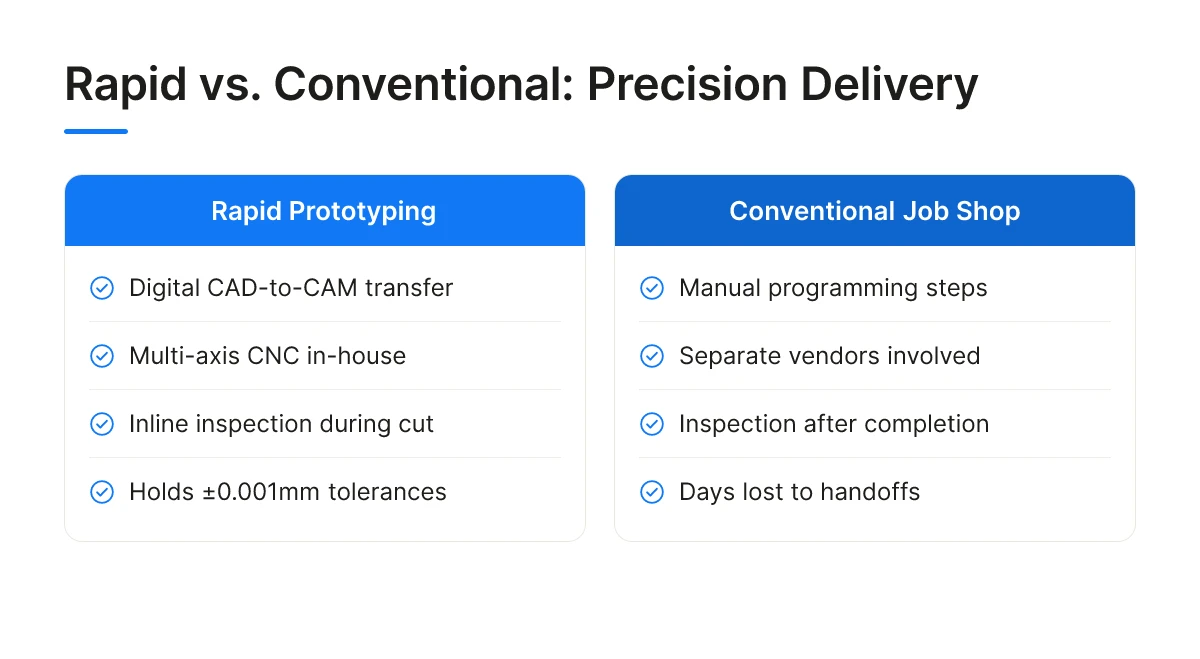
A rapid prototyping manufacturer holds ±0.001mm tolerances on compressed schedules by removing handoffs, digital CAD-to-CAM transfer, in-house multi-axis machining, dedicated capacity, and inline inspection replace the separate vendors and manual steps that eat days in a conventional job shop.
What Technologies and Processes Enable One-Week Delivery Without Sacrificing Precision?
Four mechanics do the heavy lifting: direct CAD-to-CAM programming, multi-axis CNC kept entirely in-house, scheduling that separates prototype jobs from production runs, and measurement that happens during the cut rather than after it. Each one removes a point where a part would otherwise sit waiting, for a file conversion, a subcontractor, an open machine slot, or a final inspection queue.
Stratasys frames the comparison directly: traditional prototyping methods like hand-building or outsourced tooling can stretch into weeks, while digitally-driven processes compress that into days by cutting out the manual rework loop between design and first part. The gap isn’t about machine speed, it’s about how many times a design has to change hands before metal gets cut.
How Does Digital Manufacturing Integration Speed Up the Prototyping Cycle?
CAD files move straight into CAM software without a manual re-drafting step, which is where a surprising amount of lead time usually disappears in shops that still require engineers to redraw geometry for their specific programming environment. GC INDUS runs CAD files directly into CAM programming, so a customer’s STEP or IGES file becomes a machining program the same day it arrives rather than after a round of translation and sign-off.
Multi-axis CNC, including 5-axis and Swiss lathe setups, lets one machine complete features that would otherwise require shuttling a part between a mill, a lathe, and an outside wire-EDM vendor. Every outsourced step is a shipping delay and a new tolerance risk; keeping milling, turning, wire cutting, EDM, and grinding under one roof removes both. Dedicated prototyping capacity, scheduled apart from large production batches, means a one-piece order doesn’t queue behind a 10,000-unit run waiting for a machine to free up.
Inline measurement, CMM checks and in-process inspection during the run, not only at the end, catches a dimensional drift on part three instead of discovering it across all fifty after the batch finishes. Readers who want the full breakdown of how these pieces combine to cut overall lead time can see our detailed process guide on reducing manufacturing lead times.
Which Rapid Prototyping Methods Fit Your Industry and Materials?
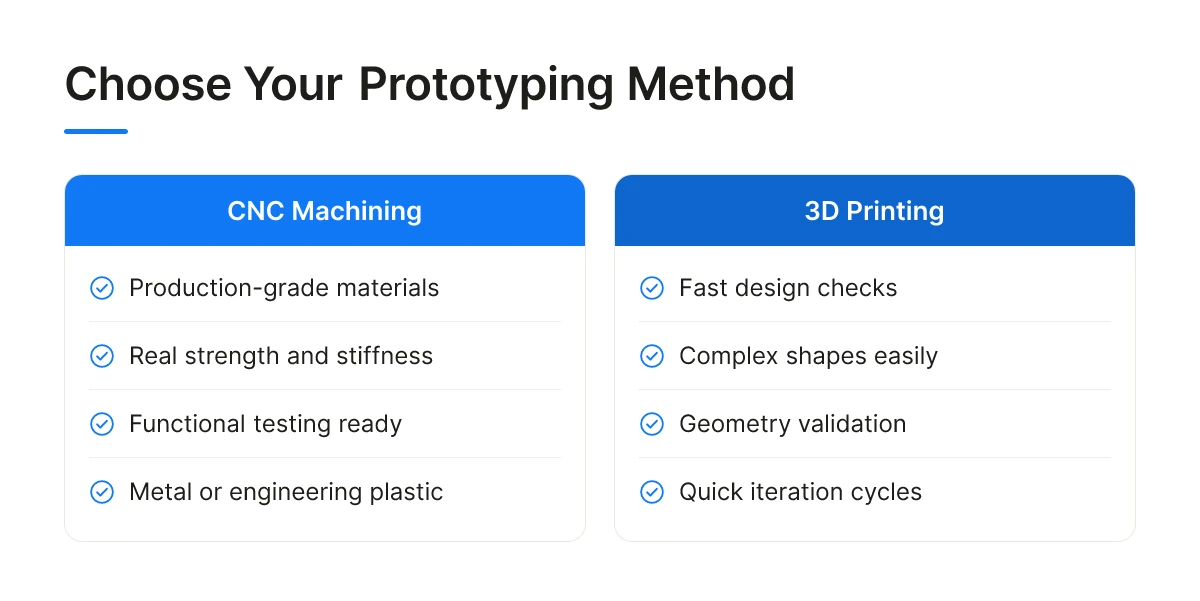
The right method depends on what the prototype needs to prove: CNC machining suits parts that must behave like final production metal or plastic, while 3D printing suits fast design checks on complex shapes. A rapid prototyping manufacturer that offers both lets you match the process to the question you’re actually trying to answer, instead of forcing every part through the same machine.
CNC machining cuts prototypes from the same aluminum, steel, or engineering plastic stock used in production, so the part carries real strength, stiffness, and surface finish. That matters for functional testing, a bracket that has to survive vibration, or a housing that needs a threaded insert under real torque. 3D printing builds parts layer by layer from resin or thermoplastic powder, which makes it faster for early-stage iteration and far better suited to internal lattices, organic curves, or undercuts that a cutting tool can’t reach.
What Material Compatibility Should Aerospace, Medical, and Automotive Manufacturers Consider?
Each industry’s regulatory and performance demands point toward different prototyping processes and materials. Aerospace parts typically need traceable material certifications and tolerances tighter than general industrial work, which favors CNC machining over printed plastics that can’t document lot-level material properties. Medical device prototypes often need biocompatible materials and documentation aligned with ISO 13485, since a prototype that will inform a regulatory submission has to be traceable back to a controlled process, not a one-off print run. Automotive programs frequently need processes that scale toward production volume, sheet metal fabrication and die casting prototypes let engineers validate a design using the same forming method that will eventually run thousands of units, rather than switching processes between prototype and production and re-validating everything.
Material compatibility is the practical constraint behind all of this. Some engineering plastics and most metals can’t be printed with the density or grain structure needed for load-bearing tests, so CNC remains the only way to get production-representative data. Printed prototypes are sufficient when the goal is form and fit only, checking that a housing closes correctly or that a connector aligns, not when the part needs to survive the stresses of its final application.
How Do You Choose Between CNC, 3D Printing, and Other Rapid Prototyping Techniques?
A simple rule: use CNC machining when the prototype must perform like the production part, and use 3D printing when geometry complexity or turnaround speed outweighs the need for production-grade material behavior. Sheet metal and die casting prototypes sit in between, useful when the end goal is validating a manufacturing process itself, not just a shape. Readers working on flight hardware or high-cycle automotive components can go deeper in our dedicated guides on aerospace parts manufacturing and additive manufacturing.
How Does Rapid Prototyping Reduce Time-to-Market and Manufacturing Costs?
Rapid prototyping lowers total cost by catching design flaws before they reach tooling, which is where mistakes get expensive. A cracked wall section, a bad draft angle, or a tolerance stack-up that doesn’t close is cheap to fix on a single machined piece and expensive to fix on a production mold.
Why Catching Flaws Early Changes the Cost Equation
Tooling for die casting or injection molding is a fixed, sunk cost once cut. If a design flaw surfaces after that point, the fix means re-cutting steel, not editing a CAD file, a jump in cost and schedule that a one-week prototype cycle is built to prevent. Each prototype round tests fit, function, and manufacturability before the business commits to hard tooling, so the flaw gets caught when it still costs a part, not a production run.
This is also why iteration speed matters more than any single part price. A design that needs four revisions to pass functional testing reaches market faster at one week per cycle than at four to six weeks per cycle through a traditional job shop. In categories where a competitor’s product launch window is measured in months, that compressed path from concept to market-ready design is often the deciding factor, not the per-unit cost of the prototype itself.
What Metrics Should You Track When Switching to Rapid Prototyping?
Vendor-quoted ROI percentages are hard to verify and rarely map to your product. Track your own numbers instead:
- Iteration count, how many design revisions it takes to reach a production-ready part.
- Days per revision, the actual turnaround between submitting a revised file and receiving a testable part.
- Defect rate caught pre-production, how many issues surface during prototyping versus after tooling is cut.
These three numbers, tracked across a few projects, tell you more about real savings than any marketed percentage.
What Results Have Manufacturers Achieved by Adopting Rapid Prototyping?
Outcomes vary by part complexity and industry, but the pattern holds across reports from manufacturers and prototyping providers: faster feedback loops reduce redesign cycles and shrink the gap between concept and shippable product. The consistent theme is fewer late-stage surprises, not a single universal percentage saved.
A flexible minimum order quantity reinforces this. Committing to full production tooling before a design is proven is a budget risk; ordering a single prototyped piece from a rapid prototyping manufacturer that accepts MOQs starting at one unit keeps early-stage spend in a lower, more controllable tier. GC INDUS applies this model directly, prototype orders from 1 piece move through the same CNC machining, die casting, and finishing processes used in production, so the part validated during prototyping reflects what production will actually deliver.
Outsourcing this work also frees in-house capacity. Running prototype iterations on your own CNC machines ties up equipment and staff that production work needs, a cost that doesn’t show up on a per-part quote but shows up in missed production schedules. Sending prototype rounds to an external partner avoids that trade-off entirely.

Frequently Asked Questions
Can a rapid prototyping manufacturer deliver production-grade parts, not just visual samples?
Yes, when the manufacturer runs the same processes used for production—CNC machining, die casting, or injection molding—rather than pattern-only additive methods. GC INDUS machines prototypes to the same tolerances it holds in production runs, as tight as ±0.001mm, using materials identical to the final part, so test results carry over to the production design instead of requiring rework.
What file formats and information does a rapid prototyping manufacturer need to quote a one-week job?
A STEP or IGES CAD file, material preference, required tolerances, and target quantity are the minimum needed. Drawings with critical dimensions and surface finish callouts speed up the quote further, since the shop can confirm feasibility against its own machines without back-and-forth emails.
Does rapid prototyping work for low-volume production runs, or only one-off parts?
It works for both, provided the manufacturer accepts flexible minimum order quantities. GC INDUS takes orders starting from 1 piece, which means the same job that produces a single functional prototype can scale to a low-volume batch of 50 or 500 units without switching vendors or re-qualifying a process.
How do you document a prototype’s manufacturing process for later production handoff?
Capture the exact machine parameters, fixturing, tooling, and inspection data used on the prototype, not just the final CAD file. A shop operating under ISO 9001 quality management typically logs this as part of its standard process control, so the documentation already exists when the project moves from prototype to production order rather than being recreated from scratch.
Conclusion
A one-week prototype only earns its speed if the parts hold up under production tolerances, documented inspection, and a clear path to scale. Prioritize manufacturers who machine prototypes on production-grade equipment, quote fast from a complete CAD package, and accept low quantities without forcing a vendor switch later. GC INDUS builds this into one operation—CNC, casting, molding, and finishing under ISO 9001 and ISO 13485 compliance, with orders starting from 1 piece. Before your next design iteration, pull together your STEP file, tolerance callouts, and target quantity, and request a quote to see how fast a compliant shop can turn it around.
Recommended Articles
Explore more from our content library:


