
Book Appointment Now

GC INDUS / MANUFACTURING KNOWLEDGE
What an Electronic Components Manufacturer Needs from You

An electronic components manufacturer needs a clear, verifiable brief from you before it can deliver consistent quality: documented tolerances, applicable certifications (ISO 9001, IATF 16949, RoHS, IPC-A-610), expected volumes, and inspection criteria. In return, you should require proof of process control, traceability records, and committed lead times in writing. The relationship works both ways—vague specs on your side produce inconsistent parts on theirs, so treating sourcing as a two-way requirements exchange, not a one-time purchase order, is what separates reliable partnerships from recurring quality disputes.
What Capabilities and Quality Standards Should You Require From an Electronic Components Manufacturer?
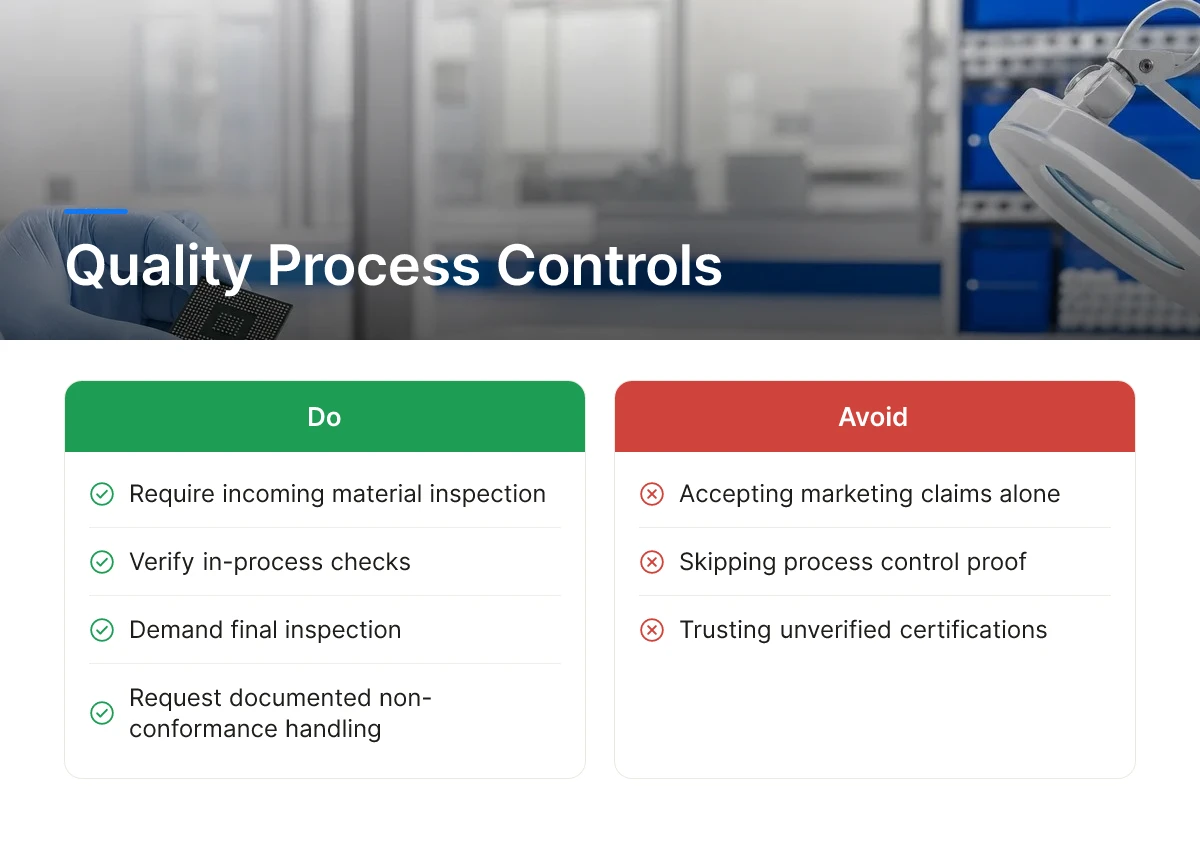
Require proof of four process controls before any purchase order: incoming material inspection, in-process checks, final inspection, and documented non-conformance handling. Any qualified electronic components manufacturer should walk you through these without hesitation, because they form the backbone of a quality system rather than a marketing claim.
What Precision Tolerances and Quality Assurance Processes Are Standard in the Industry?
A capable manufacturing partner separates part quality into stages, checking raw material certifications on arrival, verifying dimensions mid-run, and inspecting finished parts against the original drawing before shipment. Federal Electronics notes that choosing the right contract manufacturer directly affects product quality, supply chain stability, and long-term operational outcomes, the process controls a shop uses are the mechanism, not an afterthought. When something goes wrong, the manufacturer needs a documented non-conformance procedure: what got flagged, why, and what corrective action followed. If a supplier can’t produce that paperwork on request, treat it as a warning sign, not a formality.
How Do Manufacturers Handle Tight Tolerance Requirements (±0.001mm and Tighter)?
Tolerances that tight are held through calibrated equipment, controlled environmental conditions, and statistical process control, not through operator skill alone. Machines need regular calibration against traceable standards, temperature and humidity in the shop need to stay within a defined band, and measurements taken across a production run need to be tracked statistically to catch drift before it produces out-of-spec parts. GC INDUS holds tolerances as tight as ±0.001mm across CNC milling, turning, 5-axis, and Swiss lathe work by combining calibrated machinery with full inspection protocols at each stage, rather than relying on a single end-of-line check.
Before signing with any electronic components manufacturer, ask for the documentation that proves this control is real: first article inspection reports, control plans, and process capability studies (often expressed as Cpk values). These documents show how a part performed the first time it ran and how consistently the process repeats across volume. A manufacturer that shares this data upfront, without being pressed, is signaling confidence in its own process, a stronger indicator of quality than any certification logo on a website.
Flexible minimum order quantities are a quality signal in their own way. A manufacturer whose system only performs well at high volume is often cutting corners on small runs, skipping first article inspection or reducing in-process checks to save time. A partner that applies the same control plan whether the order is one prototype or ten thousand units, as GC INDUS does across MOQs starting from a single piece, demonstrates that its quality system scales without shortcuts.
How Do Certifications and Compliance Standards Differ Across Electronic Components Manufacturers?
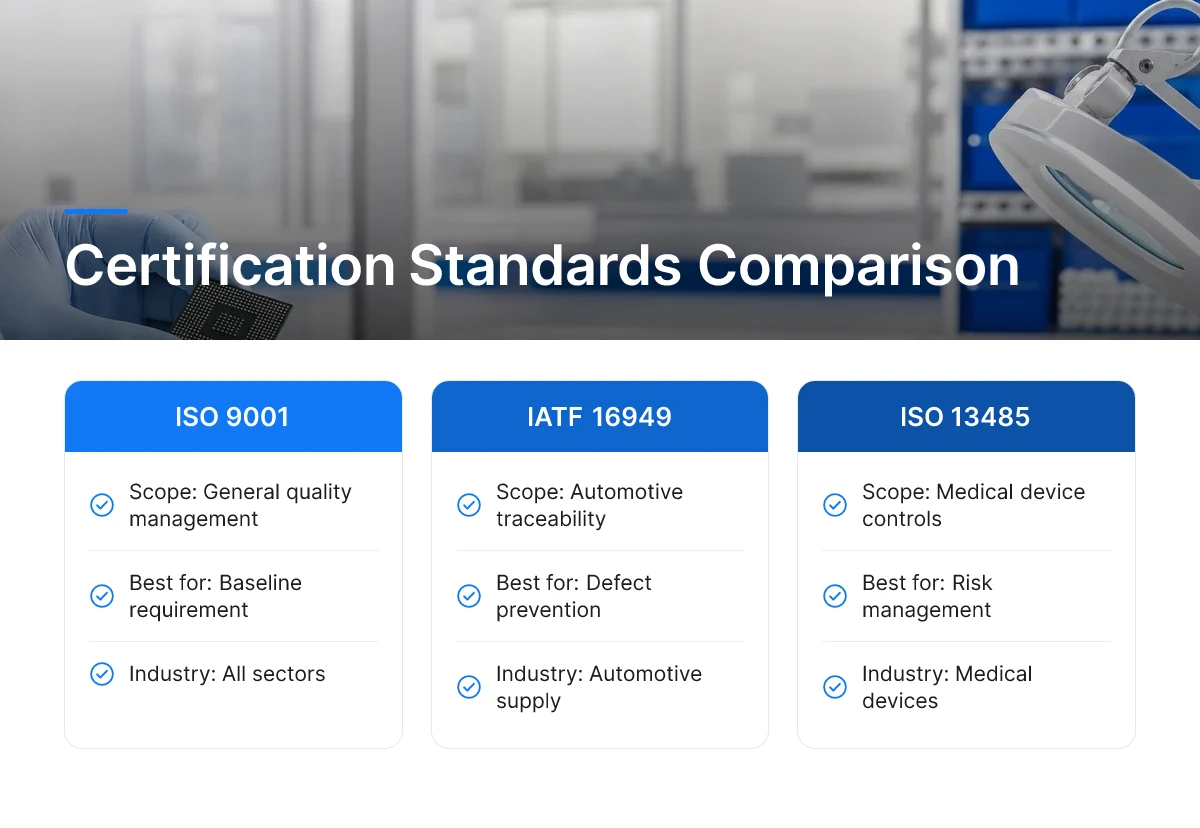
Certifications signal different things: ISO 9001 covers general quality management, IATF 16949 adds automotive-specific traceability and defect-prevention rules, and ISO 13485 governs medical device production risk controls.
A logo on a homepage tells you almost nothing on its own. What matters is which standard applies to your end-use industry, whether the certificate is current, and whether the manufacturer can produce the paperwork behind it on request.
Which Certifications Matter Most: ISO, RoHS, IPC Standards, and Others?
ISO 9001 is the baseline: a general quality management system standard covering process control, corrective action, and document traceability. It’s a reasonable floor for any electronic components manufacturer, but it doesn’t guarantee automotive-grade defect rates or medical-grade risk documentation.
IATF 16949 builds on ISO 9001 with requirements specific to automotive supply chains, production part approval processes, statistical process control, and stricter supplier traceability. ISO 13485 does the equivalent for medical devices, requiring formal risk management files and design controls tied to patient safety. If your part goes into a car or a diagnostic device, the generic ISO 9001 certificate isn’t the one that matters, the industry-specific standard is. GC INDUS holds both ISO 9001 and ISO 13485 certification, which covers general precision work and medical device production under one roof.
RoHS and REACH compliance aren’t sustainability checkboxes, they restrict specific hazardous substances (lead, cadmium, certain phthalates) and control chemical registration in ways that directly determine whether your product can legally be sold in the EU and other regulated markets. A non-compliant component can block a shipment at customs or trigger a product recall, not just an environmental complaint.
IPC-A-610 and J-STD-001 are workmanship standards covering acceptability of electronic assemblies and soldering, respectively. Asking a manufacturer which IPC class they build to, Class 1 (general consumer), Class 2 (dedicated service), or Class 3 (high-reliability), is a fast way to gauge how rigorously they inspect solder joints, component placement, and mechanical assembly.
What Compliance Requirements Should You Verify Before Partnering With a Manufacturer?
Ask for the certificate number, confirm the issuing body is accredited, and request the date of the last audit rather than accepting a certification claim at face value. Certificates lapse, get suspended, or apply to a different facility than the one quoting your job, details a five-minute verification call can catch.
Before onboarding, request certificates of conformance, material declarations (including RoHS/REACH statements), and test reports tied to your specific part family. These documents, not marketing pages, are what hold up during a customer audit or a field failure investigation.
What Role Does Manufacturing Specialization Play in Choosing the Right Components Supplier?
Specialization determines depth of process control on one part family; full-service scope determines how many vendors sit in your supply chain. Neither is universally better, the right choice depends on part complexity and how many component types your bill of materials actually spans.
How Do Manufacturers Differ in Their Focus: Semiconductors vs. Connectors vs. Passive Components?
Semiconductor fabrication, connector tooling, and passive component production each demand distinct equipment, cleanroom standards, and process controls that a single specialist tends to master over years of narrow focus. A connector house lives in stamping dies, plating lines, and contact-force testing. A passives producer lives in materials science and high-volume automated placement. These specialists often deliver tighter repeatability within their one domain because every process variable has been tuned to that component family alone.
Full-service and outsourced manufacturing partners take a different approach: they run mixed BOMs across CNC machining, casting, molding, and assembly under one operation. GC INDUS is structured this way, combining CNC milling, turning, 5-axis and Swiss lathe work with die casting and injection molding, so a buyer sourcing housings, brackets, and fasteners alongside electronic components doesn’t need three separate vendor relationships.
Should You Source Different Component Types From Specialized vs. Full-Service Manufacturers?
Use a simple filter: safety-critical or high-complexity parts favor a specialist with deep process history in that exact component; standard or mixed-volume assemblies favor consolidating with one electronic components manufacturer or contract partner. A pacemaker connector or a high-reliability semiconductor package justifies the narrower, deeper expertise. A bracket, housing, or standard fastener rarely does.
Fragmentation carries a hidden tax. Every additional niche supplier adds its own onboarding, quality audit, and communication cycle, overhead that often erases the unit-cost savings a specialist quoted. A qualified electronics manufacturing partner should reduce that fragmentation, not just quote low per-piece.
Dual-sourcing splits the difference: route the critical, tolerance-sensitive component to a specialist, and let a full-service partner, one holding ISO 9001 and ISO 13485 certifications, like GC INDUS, handle secondary components, fixtures, and finishing under a single quality system.
How Do Lead Times, Supply Chain Reliability, and Geographic Sourcing Affect Component Procurement?
Lead times and supply chain reliability determine whether a design change or urgent reorder ships on schedule or stalls for weeks waiting on a single overseas supplier. The mechanism is simple: every added link in a supply chain, a customs checkpoint, a sole-source material, a single production region, is a point where a delay can start and cascade downstream.
What Supply Chain Reliability and Lead Time Data Should You Compare Across Manufacturers?
Ask for numbers, not assurances. A capable electronic components manufacturer should be able to share its historical on-time delivery rate, average lead time broken down by component category, and its process for notifying customers when a delay is likely.
A vague answer to any of these three questions is itself informative. If a supplier cannot produce delivery-performance history or explain how it flags at-risk orders, that gap in transparency tends to show up later as a missed date. Federal Electronics notes that the wrong manufacturing partner introduces production delays and supply chain risk that ripple into quality and cost, which is exactly why these questions belong in the qualification stage, not after the first missed shipment.
How Do Geographic Location and Regional Manufacturing Capacity Impact Your Sourcing Strategy?
Concentrating sourcing in a single region ties your production schedule to that region’s customs backlogs, weather events, labor disruptions, and raw material availability all at once. Geographic diversification, or nearshoring part of the supply base, spreads that exposure so a single disruption cannot halt an entire product line.
Regional manufacturing capacity also affects how fast a partner can respond to an urgent reorder or a last-minute design change. A manufacturer embedded in a local supplier ecosystem for raw materials, tooling, and finishing can turn around a revised order faster than one dependent on a long, single-path import chain. Reliable supply chain management and transparent communication are recurring criteria buyers are advised to weigh when comparing electronics manufacturing partners, alongside scalable capacity that can flex with demand.
Inventory buffering plays a similar role. A manufacturer that holds safety stock on common materials and fasteners can absorb a demand spike without pushing the delay onto your schedule, while one running lean on raw materials passes that risk straight to you.
Ask directly for supply chain transparency: visibility into sub-tier suppliers, and whether critical materials are dual-sourced. GC INDUS supports this kind of visibility by supplying spare parts, fasteners, and electronic components alongside its core CNC, casting, and molding work, giving OEMs one accountable source instead of a chain of unverified sub-suppliers.
What Cost and Service Trade-Offs Should You Evaluate When Selecting a Components Manufacturer?
The cheapest quote rarely reflects the true cost of a program, weigh total cost of ownership and service reliability instead of comparing unit prices line by line.
How Do Pricing Models and Cost Structures Vary Between Different Manufacturers?
An electronic components manufacturer typically prices work one of three ways: per-piece volume pricing that drops as order size grows, a tooling-plus-unit-cost model where you pay upfront for molds or fixtures and a lower price per part afterward, or tiered service contracts that bundle inspection, packaging, and logistics into a flat program rate. Each model suits a different stage of a product’s life. Volume pricing rewards stable, high-run production; tooling-plus-unit-cost fits parts that need dedicated fixtures for die casting or injection molding; tiered contracts suit buyers who want predictable costs across a multi-year program rather than renegotiating every order.
The lowest quoted unit price can hide costs that surface later. A supplier who shaves margin on the front end may cut corners on inspection, leading to rework or field failures. Others compensate for thin margins by slowing communication or deprioritizing rush orders, which forces expedited freight charges when a deadline slips. A quote that looks lean on paper can turn expensive once rework, air freight, and delayed launches enter the calculation.
What Service Commitments and On-Time Delivery Guarantees Should Be Non-Negotiable?
Certain commitments belong in the contract, not just the sales conversation. Write in on-time delivery guarantees, a defined escalation path for quality issues, full inspection protocols at each production stage, and a responsiveness SLA that specifies how fast the manufacturer answers a quality hold or engineering change. These commitments turn vague assurances into terms you can enforce.
Flexible order quantities let you test a manufacturer’s consistency before betting a full production run on them. Placing a small prototype or pilot order first, before committing to premium-tier volume pricing, shows whether tolerances, finish quality, and delivery timing hold steady at scale. GC INDUS accepts orders starting from a single piece, which lets buyers validate quality on a prototype before scaling into a production contract, rather than committing to volume pricing on faith.

Frequently Asked Questions
What should be included in a request for quote (RFQ) sent to an electronic components manufacturer?
A complete RFQ includes CAD files (STEP or IGES), material specs, tolerance requirements, finish and assembly needs, target volume, and delivery timeline. Also state applicable certifications required, such as ISO 13485 for medical parts, and whether you need prototype runs before committing to production quantities. Vague RFQs produce vague quotes, and quotes that later change once real specs surface.
How often should you audit an electronic components manufacturer once onboarded?
Most OEMs run a formal audit annually, with lighter quality reviews every quarter for critical suppliers. Medical device and automotive programs often require more frequent checks tied to regulatory cycles. Match audit frequency to part criticality and any history of quality escapes.
Can a single manufacturer handle both prototyping and full production volumes?
Yes, if the manufacturer supports flexible minimum order quantities and holds the same tolerance and inspection standards across volumes. GC INDUS accepts orders starting from 1 piece and scales into production runs without switching vendors or re-qualifying tooling, which avoids the handoff risk that comes with using separate prototype and production suppliers.
What red flags suggest a components manufacturer will miss quality or delivery commitments?
Watch for vague answers about certifications, reluctance to share inspection reports, and quotes with no clear tolerance commitments in writing. Long, unexplained lead times, high supplier turnover on your account, and an inability to name the actual CNC or casting processes used are also warning signs. A qualified partner answers technical questions directly, without hedging.
Conclusion
Choosing an electronic components manufacturer comes down to three checks: verified certifications (ISO 9001, ISO 13485 for medical work), documented tolerance and inspection capability, and flexibility to move from prototype to production without changing vendors. Suppliers who dodge specifics on any of these three tend to be the ones who miss deadlines or ship out-of-tolerance parts later.
GC INDUS builds all three into one operation, CNC machining, die casting, injection molding, and assembly under one roof, with tolerances held to ±0.001mm and MOQs starting at 1 piece. Before your next production run, send an RFQ with full specs and certification requirements, and compare the response against the red flags above.
Recommended Articles
Explore more from our content library:


