
Book Appointment Now

GC INDUS / MANUFACTURING KNOWLEDGE
What Contract Manufacturing Services Really Cover for OEMs

Contract manufacturing services for OEMs cover far more than production capacity, they define the specific tolerances, quality systems, technical processes, and scope of support an outside manufacturer will take on for your parts. Evaluating them properly means checking measurable precision capability, certification depth (ISO 9001, industry-specific standards), equipment and process range, and how quality is verified at each stage. OEMs who treat this as a checklist of capabilities and standards, not just a quote, avoid costly mismatches between what they need and what a partner can actually deliver.
What Manufacturing Capabilities and Quality Standards Should Contract Manufacturing Services Include?
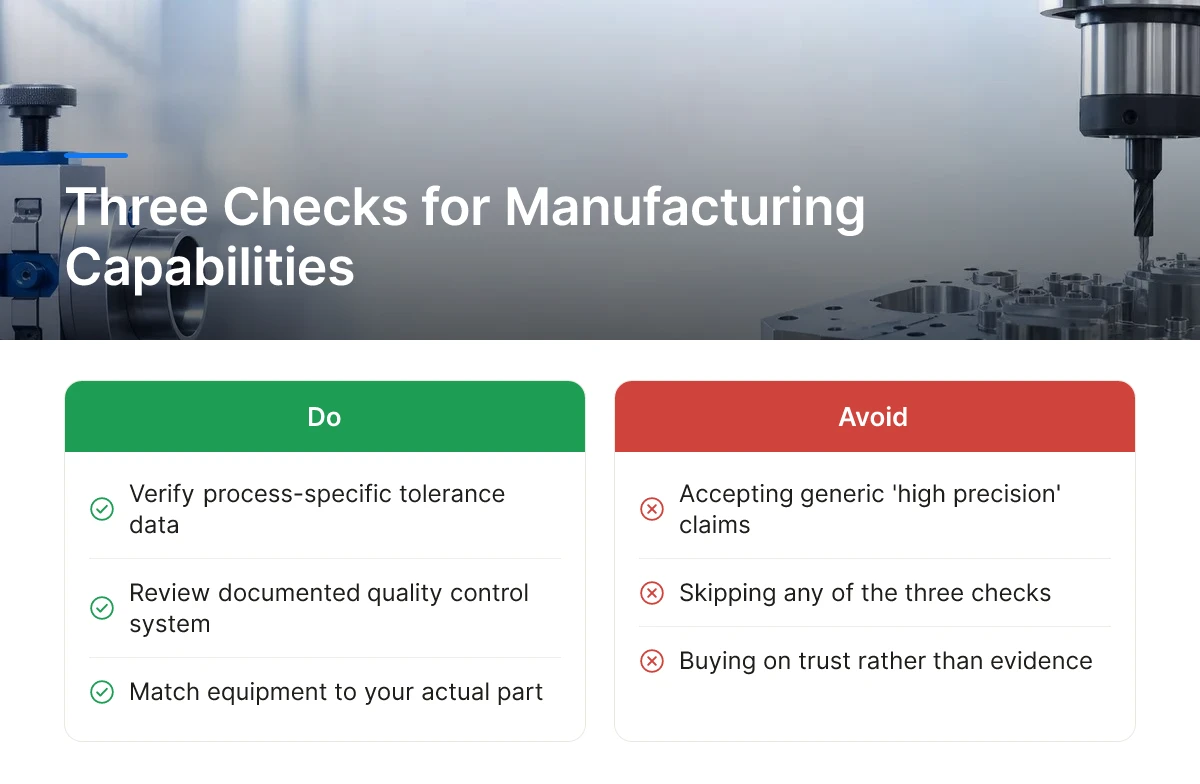
The right contract manufacturing services rest on three concrete checks: process-specific tolerance data, a documented quality control system, and equipment matched to the actual part. Skip any of the three and you’re buying on trust rather than evidence.
What Tolerance Levels and Precision Standards Can Different Contract Manufacturers Reliably Achieve?
Tolerance capability depends on the process, so a manufacturer’s general “high precision” claim tells you nothing until you see numbers tied to a specific method. This is particularly relevant for contract manufacturing services.
CNC machining, die casting, and injection molding each carry different achievable tolerances, and even within CNC, a 5-axis mill and a Swiss lathe hold different ranges depending on part geometry and material. GC INDUS, for example, publishes tolerances as tight as ±0.001mm across its CNC processes, but the honest way to evaluate any supplier is to ask what tolerance they hold for a part like yours, in the material you specify, not what their best-case machine can theoretically do. Request a capability chart broken down by process (milling, turning, wire cutting, EDM, grinding) rather than a single headline figure. If a quote arrives without process-specific tolerance data, that’s a gap worth flagging before you commit a production run.
How Should You Verify a Manufacturer’s Quality Control Systems and Regulatory Compliance Certifications?
Verify quality control by checking three stages, incoming material inspection, in-process checks, and final inspection, plus the paper trail behind each one.
A manufacturer that inspects raw material on arrival, checks dimensions mid-run, and performs a documented final inspection is running a repeatable system, not relying on luck. Ask for sample inspection reports and process travelers that show which operator, machine, and check performed at what step, this is the traceability record you’ll need if a part fails downstream. Certifications like ISO 9001 signal that this documentation discipline is audited and maintained, not a one-time setup. Industry-specific standards go further: ISO 13485 confirms a system built for medical device requirements, and AS9100 does the same for aerospace. GC INDUS holds both ISO 9001 and ISO 13485, which matters less as a badge and more as proof that its inspection and documentation processes have already passed external audit against those requirements.
Certifications also don’t substitute for capability matching. A shop with broad equipment lists but no experience in your specific material or tolerance range is a worse fit than a smaller operation whose process range lines up exactly with what your part needs, breadth on paper matters less than fit in practice. When considering contract manufacturing services, this point stands out.
How Do You Assess a Contract Manufacturer’s Technical Expertise and Production Capacity?
Confirm capacity with direct evidence: ask pointed questions about scheduling, audit the equipment against your actual part, and request a sample run before committing volume.
A capabilities page tells you what a shop owns. It doesn’t tell you whether that equipment is available when you need it, staffed by people who can run your tolerances, or scheduled around jobs that already have priority. OEMs evaluating contract manufacturing services need to verify capacity the same way they’d verify a part print, with specifics, not marketing copy.
What Questions Should You Ask About Lead Times, Minimum Order Quantities, and Production Timelines?
Ask how lead time changes between a first article and a repeat order, since the two numbers are rarely the same. A shop quoting six weeks for a new part should be able to explain what happens on reorder, tooling reuse, program storage, material on hand.
Push further on minimum order quantities. Some contract manufacturers only make sense above a few thousand units; others, including GC INDUS, accept orders starting from a single piece, which matters for OEMs validating a design before committing to a production batch. Ask directly: “What’s your MOQ for this part geometry and material?” and “How does your production schedule change between a 50-unit pilot and a 5,000-unit reorder?” A vague answer to either question is a warning sign.
How Do You Evaluate Whether a Manufacturer Can Scale Production to Meet Your Growth Demands?
Scalability comes down to three things: available machine hours, shift structure, and a documented history of ramping comparable volumes. A shop running one shift on shared 3-axis mills has a different ceiling than one running 5-axis and Swiss lathe cells across two or three shifts. For those exploring contract manufacturing services, this matters.
Read the equipment list against your part, not against the total machine count. A supplier listing twenty CNC machines isn’t useful if none of them hold ±0.001mm on a small, thin-walled aluminum housing, capability at that tolerance depends on machine class, tooling, and operator experience with similar geometries, not raw inventory. Ask what percentage of their floor is running comparable materials and tolerance bands today.
Sample parts and pilot runs reveal more than any brochure. A pilot batch shows real cycle times, real scrap rates, and whether the inspection report matches the print, details a sales conversation can’t surface. Flexible MOQ policies, paired with willingness to run a small pilot before scaling to full production, signal a manufacturer built for varied OEM needs rather than one optimized only for long, uninterrupted production runs.

What Are the Key Differences Between Contract Manufacturers, and How Do You Choose the Right Partner?
Contract manufacturers differ most by process depth, facility scale, and industry focus, matching those variables to your part’s requirements matters more than comparing brochures.
The first split is specialization. A shop built around precision CNC machining runs different equipment, staff training, and inspection routines than one built for sheet metal fabrication or injection molding. Some contract manufacturing services list all four capabilities on a website but only run one or two at meaningful volume. A supplier with deep experience in 5-axis milling and Swiss lathe turning will hold tighter tolerances on a complex machined housing than a generalist shop that added CNC as a side offering. Depth in the process your part actually needs beats a long menu of services performed at moderate skill.
Facility scale and industry focus narrow the field further. A partner built for high-volume automotive stamping may not have the cleanroom discipline or documentation trail a medical device program requires under ISO 13485. Geography matters too, a domestic or regional partner cuts shipping time and simplifies engineering change communication, while an overseas facility might offer lower unit costs on large runs. GC INDUS addresses this by running CNC machining, die casting, injection molding, and sheet metal fabrication under one roof with ISO 9001 and ISO 13485 certification, so OEMs with mixed part types are not forced to split sourcing across multiple specialized vendors. This directly impacts contract manufacturing services outcomes.
What Red Flags or Warning Signs Indicate a Contract Manufacturer May Not Be Reliable?
Reliability problems usually show up before the first order ships, in how a supplier handles questions rather than in the parts themselves.
- Reluctance to share inspection data or first-article reports when asked directly.
- Vague or evasive answers about which certifications actually cover the facility producing your parts, versus a parent company’s certificate.
- Unclear ownership of tooling and fixtures, which creates disputes if you need to move production later.
- Quotes that shift materially between the initial RFQ and the purchase order without a documented reason.
How Should Cultural Fit and Communication Style Factor Into Your Partnership Decision?
Communication cadence during quoting predicts how the relationship runs once production starts, so treat the RFQ process as a trial run. Note response times, whether engineers answer technical questions directly, and whether time zone and language differences slow down urgent issues. Shared expectations on quality reporting and escalation reduce day-to-day friction more than a slightly lower unit price, a partner who calls out a deviation immediately is worth more than one who stays silent until the shipment arrives.
What Hidden Costs and Risk Factors Should You Account for Beyond the Quoted Price?
The line-item quote rarely captures tooling amortization, changeover time, and rework costs from unclear specifications, all of which shift the real cost per part. OEMs who compare quotes on unit price alone often discover the gap only after production starts.
Tooling, Engineering Changes, and Requalification Fees
Custom tooling, fixtures, and molds usually carry a separate charge that may or may not be amortized into the per-unit price, ask directly which model applies before signing. Engineering changes after tooling is cut typically trigger a requalification fee and a new first-article inspection, and manufacturers rarely volunteer this detail unless asked. Build a standard question into every RFQ: “What happens to cost and lead time if we revise the drawing after tooling starts?” The answer tells you how the relationship handles change, not just how it handles the first order. This is particularly relevant for contract manufacturing services.
Minimum Order Quantities and Changeover Time
A quoted rate that looks attractive at 10,000 units can look very different at 50. Changeover time between jobs, setup, tool changes, first-article checks, gets spread across the batch, so low-volume orders absorb a disproportionate share of fixed cost per part. This is where flexible minimum order quantities matter: a partner willing to run a single piece without inflating the per-unit price economically supports prototyping and low-volume production without forcing early overstock.
What Supply Chain Risks and Business Continuity Measures Should You Discuss With a Contract Manufacturer?
Ask how the manufacturer sources critical raw materials and whether production is concentrated in one facility or region before you sign anything. Single-source material dependency and geographic concentration are the two risk factors most likely to disrupt delivery, and neither shows up in a quote. Ask about backup suppliers for key alloys, plans if a facility loses power or capacity, and whether the manufacturer operates more than one production site. A partner serving a global client base across multiple industries typically has more built-in redundancy than a single-site regional shop.
How Do You Build Contingency Planning Into a Contract Manufacturing Relationship?
Put dual-sourcing, safety stock, and escalation timelines in writing before you need them, not after a delay has already started. Dual-sourcing critical components protects against a single supplier failure; safety stock agreements, even modest buffer inventory held by the manufacturer or a third-party warehouse, absorb short-term demand spikes. Define escalation paths explicitly: who gets notified at 24 hours late versus 5 days late, and what remedy applies. Finally, tight documentation, clear drawings, GD&T callouts, inspection criteria, prevents the inspection and rework costs that come from ambiguous specs, a cost category most side-by-side comparisons of contract manufacturing services miss entirely because it never appears until parts fail incoming inspection.
How Do You Establish a Successful Long-Term Partnership With a Contract Manufacturer?
A durable partnership runs on tracked metrics, scheduled communication, and a contract that spells out remedies before anything goes wrong, not after.
What Logistics, Communication Protocols, and Performance Metrics Define a Strong Ongoing Relationship?
Once production starts, three metrics tell you whether the relationship is working: on-time delivery rate, defect or scrap rate, and how fast the supplier responds to engineering change requests. On-time delivery below expectation signals capacity or scheduling problems worth escalating early. A creeping defect rate often points to tooling wear or process drift rather than a one-off mistake, so tracking it over consecutive lots matters more than any single inspection report. When considering contract manufacturing services, this point stands out.
Responsiveness to change requests is easy to overlook but reveals a lot. A manufacturer that takes weeks to quote a minor dimension change or material swap will slow down every future product revision. Build this into your vendor scorecard alongside quality and delivery data.
Structured communication prevents small issues from turning into missed shipments. A named point of contact on both sides, a recurring production review, weekly during ramp-up, monthly once stable, and a documented escalation path for quality holds keep problems visible before they compound. Ad hoc email threads are where accountability disappears.
How Should You Structure Contracts and SLAs to Protect Both Parties and Ensure Accountability?
A service-level agreement for contract manufacturing services should specify four things in writing: quality thresholds (acceptable defect rate, inspection sampling method), delivery windows with defined tolerance, capacity commitments for scaling volume up or down, and remedies, credits, rework at the supplier’s cost, or termination rights, when targets are missed. Vague language like “commercially reasonable effort” leaves both sides guessing when a dispute arises. Coastline International’s evaluation framework for OEMs stresses reviewing quality control systems and regulatory compliance as a standing practice, not a one-time check before signing.
Joint continuous-improvement reviews turn a transactional vendor into a long-term partner. Sit down quarterly with inspection and yield data from both sides, identify the recurring failure modes, and agree on corrective actions with owners and deadlines. GC INDUS runs this kind of review with clients under ISO 9001 and ISO 13485 quality systems, using inspection data to catch drift before it produces scrap.
Finally, schedule periodic on-site or virtual audits, annually at minimum, to confirm the manufacturer’s equipment, staffing, and quality practices still match what you evaluated at onboarding. Facilities change; your oversight should track that.

Frequently Asked Questions
How is contract manufacturing different from working with a distributor or reseller?
A contract manufacturer produces parts to your specifications, while a distributor or reseller resells goods someone else already made. When you outsource to a contract manufacturer like GC INDUS, you own the design and the tooling relationship; a distributor just moves inventory. That distinction matters for IP control, custom tolerances, and the ability to modify a part without renegotiating an entire supply agreement. For those exploring contract manufacturing services, this matters.
What documents should a contract manufacturer provide to prove regulatory compliance?
Ask for current ISO 9001 and, for medical parts, ISO 13485 certificates, plus material certifications and inspection reports tied to your specific order. Certificates alone aren’t enough, request sample first-article inspection reports and a description of the quality management system behind them so you can verify the paperwork matches actual practice.
How much lead time should you build in when qualifying a new contract manufacturer?
Plan on several weeks to a few months for a full qualification cycle, covering sample parts, first-article inspection, and a trial production run. Rushing qualification to hit a launch date is a common cause of quality escapes later, so build in time for at least one round of corrective sampling before committing to volume.
Can a contract manufacturer handle both prototyping and full production runs?
Yes, if the shop supports flexible minimum order quantities and keeps the same process controls across both stages. GC INDUS accepts orders starting from a single piece and carries the same CNC machining, casting, or molding setup into production, so parts don’t need re-qualification with a new vendor when volume increases, a common gap with shops built only for high-volume runs.
Conclusion
Choosing a contract manufacturer comes down to three checks: verified quality systems (ISO 9001, ISO 13485 where relevant), documented tolerance capability rather than marketing claims, and a process that scales from prototype to production without a vendor change. Skipping any of these tends to surface later as rework, missed deadlines, or a failed audit.
Before sending your next RFQ, pull together your tightest tolerance requirement, your expected volume range, and any regulatory certifications your industry demands, then send that exact package to two or three candidate manufacturers and compare their first-article inspection process side by side.
Recommended Articles
Explore more from our content library:


