
Book Appointment Now

GC INDUS / MANUFACTURING KNOWLEDGE
How Additive Manufacturing Complements Precision Machining

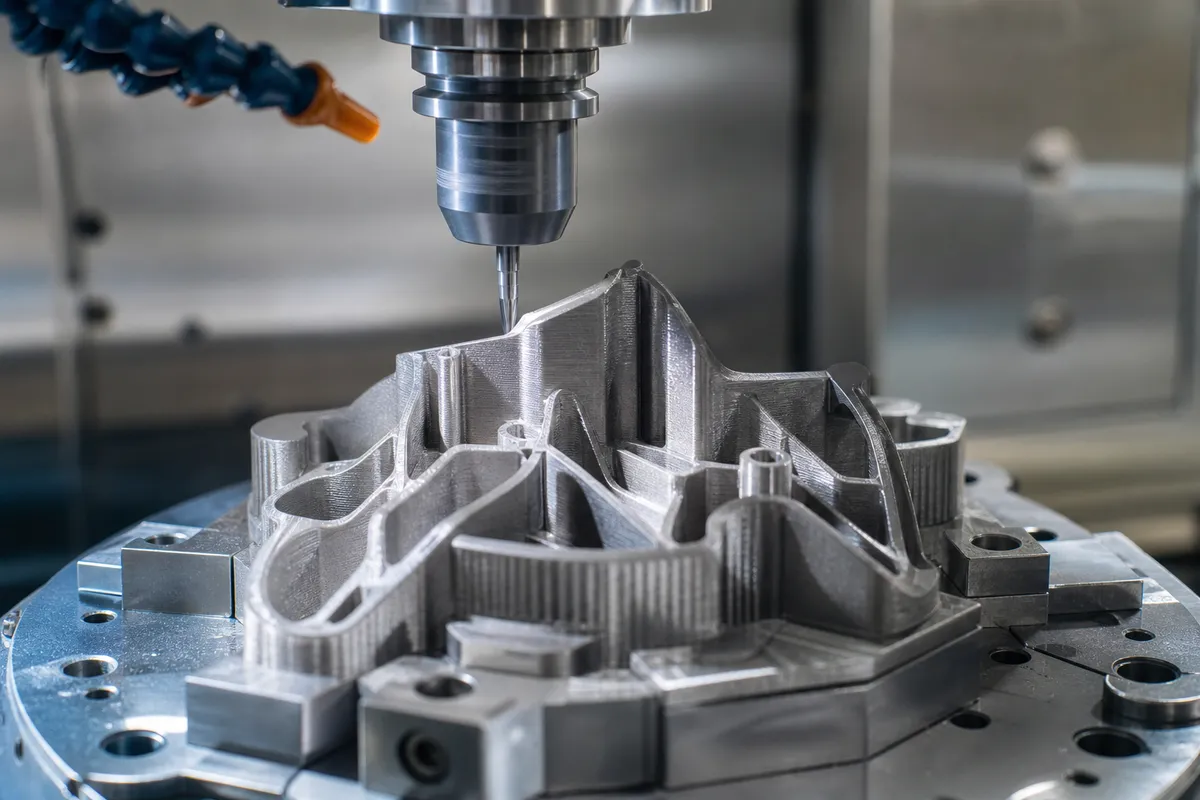
Understanding additive manufacturing precision machining is essential. Additive manufacturing complements precision CNC machining rather than replacing it: 3D printing builds complex geometries and low-volume prototypes quickly with minimal tooling, while CNC machining delivers the tight tolerances and surface finishes that finished, load-bearing parts require. In practice, the two are often combined, a part is printed near net shape, then machined on critical surfaces to hit precision specs. The right choice, or right combination, depends on part geometry, tolerance requirements, material, and production volume.
When Should You Choose Additive Manufacturing Instead of Precision CNC Machining?
Choose additive manufacturing when a part’s geometry, low volume, or need for consolidation outweighs the tolerance and finish advantages of machining. Choose CNC when the part must bear load, hold tight dimensions, or ship in quantity.
Is CNC Machining Additive or Subtractive, and How Does That Affect Part Design?
CNC machining is subtractive, a cutting tool removes material from a solid block of aluminum, steel, or another stock material until the finished part emerges. Additive manufacturing works in the opposite direction, building a part layer by layer from powder, resin, or filament. That single difference drives most decisions in additive manufacturing precision machining workflows. For a closer look at where each approach has the advantage, this comparison of CNC and additive manufacturing scenarios breaks down the tradeoffs in more detail.
Subtractive processes are constrained by tool access: a cutter has to physically reach every surface it machines, which rules out certain internal features. Additive processes have no such constraint, because each layer is deposited only where the design calls for material. Designers working in additive gain freedom to place mass and voids almost anywhere in a part, a freedom CNC programming simply cannot match.
What Complex Geometries Can Additive Manufacturing Handle That Traditional Machining Cannot?
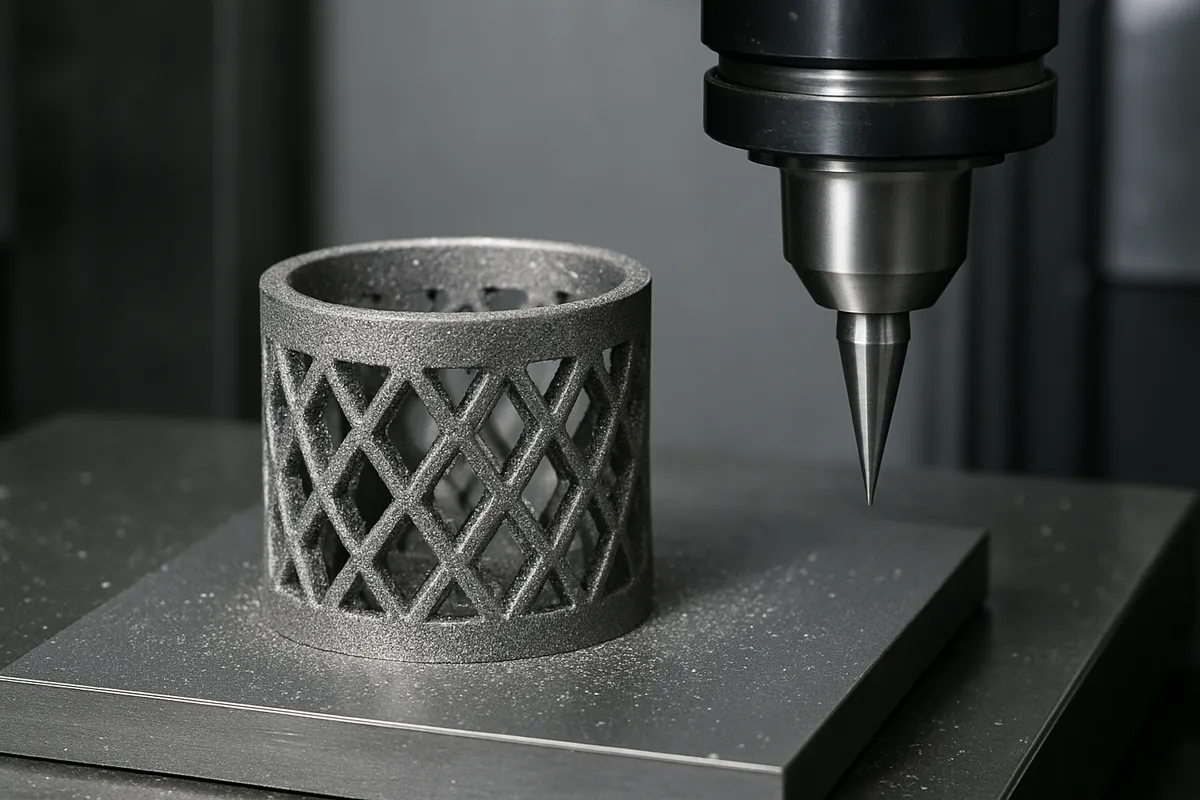
Additive manufacturing produces internal lattice structures that reduce weight while maintaining strength, organic cooling channels that follow curved paths through a part, and single-piece assemblies that consolidate what used to be five or ten separately machined and fastened components. None of these are reachable with a rotating cutting tool.
Machining still wins in several areas:
- Tolerances tighter than what most printers can hold
- Load-bearing metal parts that need certified mechanical properties
- Smooth as-machined surface finish without secondary polishing
- High-volume repeatability where per-part cost drops as quantity rises
Practical cues: use additive for early prototypes and low-volume geometries with consolidation potential; use CNC for production parts and any geometry that still allows post-machining access to critical surfaces. GC INDUS applies this logic on customer projects, machining critical features to ±0.001mm after near-net-shape production to meet finished-part specs.
How Do Additive Manufacturing and Precision Machining Work Together in One Workflow?
A printed part becomes a rough blank, and machining turns that blank into a finished component with tight, verifiable tolerances. That handoff, print, then cut, is the core of additive manufacturing precision machining: the two processes split the work by what each one does best.
What Do Real-World Hybrid Manufacturing Workflows Look Like in Production?
A hybrid job starts at the design stage, not the print bed. Engineers design for hybrid manufacturing from the outset, marking which surfaces will stay as-printed and which need machined datums, so the printed geometry leaves enough stock in the right places.
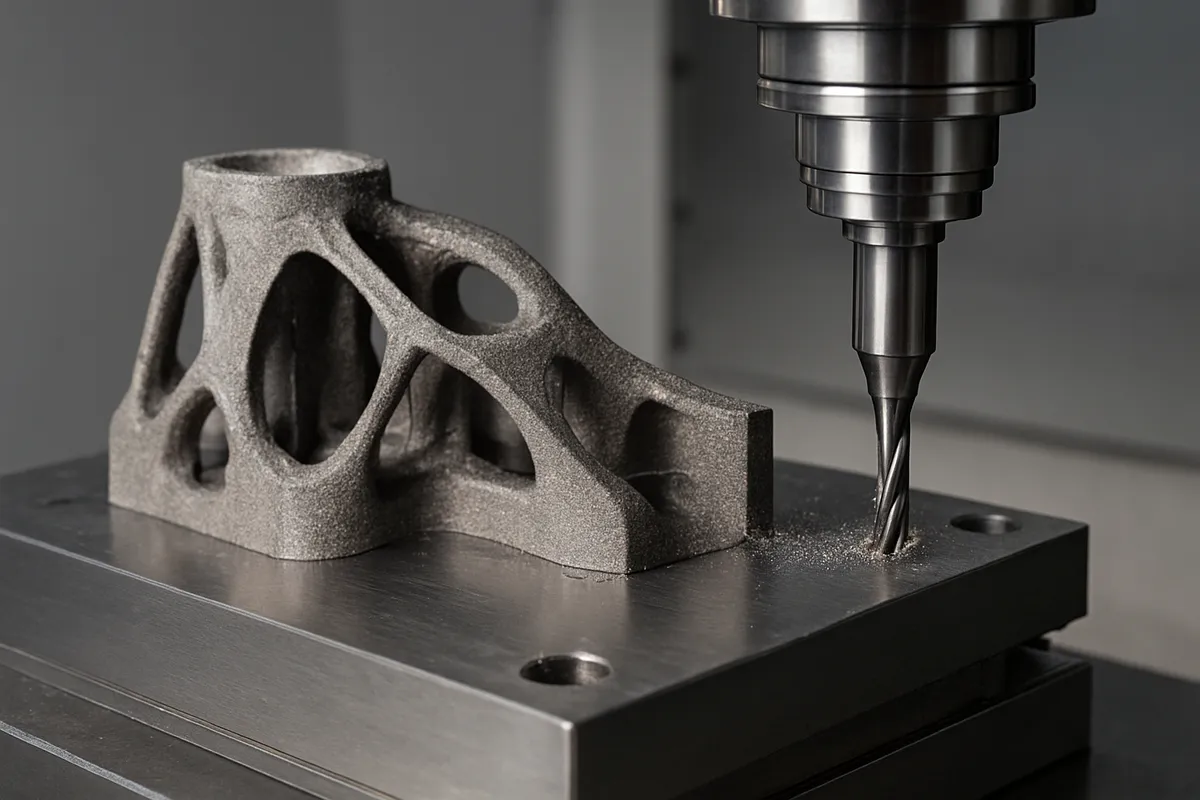
The printer then builds a near-net-shape blank, close to final geometry but oversized on critical faces. Once printed, the part gets fixtured on a CNC machine using the datums planned at the design stage. From there, the machinist cuts the features that actually carry function: mounting holes, register diameters, and any surface that has to meet another part precisely.
Printed surfaces, even from a well-calibrated machine, don’t hold the tolerances that mating surfaces, threaded holes, bearing bores, and sealing faces demand. Layer lines and thermal distortion leave dimensional variation that no printer fully eliminates. Machining removes a controlled layer of material to bring those specific features into spec, while the rest of the part keeps its printed geometry, including internal lattices or channels that would be impossible to cut from solid stock.
What Post-Processing and Finishing Steps Are Required After Additive Manufacturing to Meet Tolerances?
Before a printed blank ever touches a mill, it typically goes through the following steps, in order:
- Support removal
- Stress relief or heat treatment to stabilize the material
- Surface finishing to clean up the build
- Precision machining passes on the datum features
Skipping heat treatment before machining is a common mistake, residual stress in a printed part can shift dimensions after cutting, undoing the precision the machining step was meant to lock in.
This sequence shortens lead time on complex custom parts. Printing the rough shape cuts the tooling and setup time a shop would otherwise spend roughing out the same geometry from solid stock, leaving machining time for the tolerances that matter. Shops like Precision ADM illustrate how dedicated additive manufacturing operations structure this kind of workflow around finishing and quality control.
What Are the Cost and Lead-Time Tradeoffs Between Additive Manufacturing and CNC Machining?
Additive manufacturing wins on low volumes because it skips tooling entirely; CNC machining wins at scale because setup costs spread across more parts. The right mix depends on quantity, geometry, and how much finishing work each part needs.
Additive manufacturing builds parts layer by layer from a digital file, so there is no fixture, mold, or cutting program to design before the first part comes off the machine. That eliminates one of the largest fixed costs in traditional production. For a one-off prototype or a batch of five replacement brackets, this is the difference between a same-week turnaround and a multi-week tooling lead time.
CNC machining carries upfront costs, fixture design, work-holding setup, and program verification, that don’t scale with part count. Once those costs are paid, each additional unit costs less to produce because the machine is already dialed in. A large-volume order absorbs setup costs far better than a small order, which is why machining shops can offer more favorable per-part pricing as batch size grows.
At What Production Volume Does Additive Manufacturing Become More Economical Than CNC Machining?
There’s no fixed unit count where the crossover happens, it shifts with part geometry, material, and tolerance requirements. As order quantities grow, machining typically becomes the more economical choice once setup and programming costs are spread across enough units to outweigh the raw material and cycle-time advantages additive offers per part. Simple geometries in common metals tend to cross over sooner; complex internal features push that point higher.
How Do Total Cost of Ownership and Lead Times Compare Across Industries and Part Types?
Unit price alone misses most of the real cost. Machining often wastes material as it cuts away stock, while additive processes use material closer to net shape, but additive parts frequently need more secondary finishing, support removal, and dimensional inspection to hit tight tolerances. Rework risk also differs: a bad CNC program run can be caught early, while additive builds may not reveal defects until the print finishes.
Industry and complexity change the calculation further. Medical device components with intricate lattice structures or patient-specific geometry can favor additive manufacturing even at moderate quantities, since machining those shapes may be impossible or prohibitively slow. For most standard OEM components, GC INDUS still recommends CNC machining, casting, or molding, chosen per part based on tolerance, volume, and material rather than a single default process.
What Quality Standards and Tolerances Can Additive Manufacturing Achieve for Precision-Critical Parts?
As-printed features typically hold tolerances in the range of several hundredths of a millimeter at best, well short of the ±0.001mm a CNC-machined feature can achieve—which is why precision-critical surfaces get machined after printing, not left as-printed.
That gap is not a flaw to work around; it defines how additive manufacturing precision machining actually works in practice. A shop prints the bulk geometry—internal lattices, organic contours, consolidated assemblies that would be difficult or wasteful to machine from solid stock—then routes the part through CNC finishing for the bores, mating faces, and datum surfaces that carry a tight tolerance callout. The print gets you shape and material efficiency. The machining pass gets you the fit.
What ISO, FDA, and AS9100 Certification Requirements Apply to Additive Manufacturing Parts?
Hybrid parts have to satisfy whichever quality framework governs the end application, and each one treats the additive step differently. ISO 9001 requires documented process control and traceability across every production step, which for a hybrid part means recording print parameters (layer height, build orientation, material lot) alongside machining records. AS9100, the aerospace extension of ISO 9001, adds requirements around configuration management and risk analysis that make build-file version control and post-print inspection non-negotiable. FDA requirements for medical devices go further still, demanding design history files and process validation that cover the printer, the post-processing steps, and the final machined geometry as one continuous chain of evidence. A supplier holding ISO 13485, the medical device quality standard, has already built that documentation discipline into its operations—GC INDUS applies the same ISO 9001 and ISO 13485 quality system across its CNC, casting, and finishing lines, which matters once a hybrid additive-plus-machining workflow enters a regulated supply chain.
How Do Tolerance Specifications and Quality Control Differ Between Additive and Machined Parts?
Inspection has to match the process that made each feature. Bulk printed geometry is usually checked for dimensional conformance and internal defects through visual and basic dimensional review, while machined features—bores, threads, sealing faces—go through CMM measurement and first-article inspection against the drawing’s tightest callouts. Treating both halves of a hybrid part with the same inspection protocol either wastes time on low-tolerance surfaces or misses defects on the ones that matter.
Which Materials Work Best for Additive Manufacturing Precision Machining Applications?
Metal powders, stainless steel, titanium, and aluminum alloys, machine cleanly after printing, while most polymers and composites resist clean secondary cutting. Material choice determines whether additive manufacturing precision machining delivers a usable finished part or a scrapped print.
What Are the Material Compatibility Limitations for Additive Manufacturing in Precision Applications?
Printed polymers and fiber composites often fail during post-machining because their layer bonds are weaker than the base material itself. A cutting tool can pull layers apart rather than shear through them cleanly, leaving torn edges instead of a smooth finish.
Heat sensitivity compounds the problem. Many thermoplastics soften or deform under the friction of drilling or milling, especially at the tight tolerances precision applications demand. Brittle photopolymer resins crack under clamping pressure before a cutter ever touches them. These limitations don’t rule polymers out of hybrid production, but they narrow the window of usable processes to gentler operations like light trimming or hole finishing rather than aggressive material removal.
Which Additive Manufacturing Materials Can Withstand the Stresses of Secondary Machining?
Metal powders remain the most reliable choice for hybrid workflows. Stainless steel, titanium, and aluminum alloys respond to CNC cutting the same way their wrought counterparts do, once internal stresses from the printing process are addressed.
Printed metal parts carry porosity and layer lines from the build process that can trap stress or create weak points under a cutting tool. That’s why stress relief heat treatment, and in some cases hot isostatic pressing, typically happens before parts reach the machine. Skipping this step risks warping or fracture mid-cut.
Matching material to the machining step matters as much as matching material to the final application. A part that will face heavy clamping force, high-speed cutting loads, or thermal buildup during finishing needs a printed alloy dense and ductile enough to absorb that stress, GC INDUS applies this same alloy-matching logic across its CNC milling, turning, and grinding lines to confirm mechanical soundness before finishing work begins.
Frequently Asked Questions
Can additive manufacturing fully replace precision CNC machining for custom parts?
No, additive manufacturing can’t match CNC’s tolerance control, surface finish, or material density for most functional parts. Printed parts often carry internal porosity and layer-line surfaces that need machining to hit tight fits. The two processes work best paired: print complex geometry, machine the critical surfaces.
Do 3D-printed parts need machining before they can be used in production?
Most metal 3D-printed parts need at least some machining before they’re production-ready. Mating surfaces, bore diameters, and threaded holes typically fall outside as-printed tolerance ranges, so CNC finishing on critical features is standard practice, not an exception, for load-bearing or assembly-critical components.
What industries benefit most from combining additive manufacturing and precision machining?
Medical devices, aerospace, and industrial equipment gain the most from combining the two processes. Medical device makers use printing for patient-specific geometry and machining for implant interfaces that need certified tolerances. Aerospace uses the pairing to cut weight through part consolidation while still machining critical mating surfaces. Electronics and automotive benefit similarly wherever complex internal channels meet tight-tolerance mounting points.
How do you decide which features of a hybrid part to print versus machine?
Print the geometry that CNC tools can’t reach, internal lattices, conformal channels, organic contours, and machine every surface that mates, seals, or bears load. A practical rule: if a feature needs a tolerance tighter than roughly ±0.1mm or a specific surface finish, plan for it to be machined after printing, not left as-built.
What should you check before sending a hybrid part design out for quoting?
Before quoting, confirm the CAD model clearly marks which surfaces are functional-critical, note any tolerance callouts tighter than standard as-printed capability, and flag the intended material. Also verify that printed datums leave enough stock for machining. Sorting this out upfront prevents costly redesigns once the part is already printed.
Conclusion
Additive manufacturing and precision machining aren’t competing choices, they’re sequential steps in the same production plan. Print for geometric freedom and part consolidation, then machine the surfaces that need certified tolerances, threads, or finish. The decision that matters most is drawn at the design stage: flag which features are functional-critical before the first layer prints, not after.
If you’re evaluating a hybrid part for the first time, send GC INDUS the CAD file and call out your critical tolerances directly, a fast quote will show you which features we’d machine and why.
Recommended Articles
Explore more from our content library:


