
Book Appointment Now

GC INDUS / MANUFACTURING KNOWLEDGE
How Centerless Grinding Improves Cylindrical Part Precision

Understanding centerless grinding precision manufacturing is essential. Centerless grinding is a machining process that removes material from a cylindrical part’s outer surface without holding it between centers—the workpiece rests on a support blade between a grinding wheel and a regulating wheel, which controls rotation and feed rate. This setup eliminates deflection from center-mounting, letting shops hold tolerances as tight as ±0.001mm with excellent roundness and surface finish. It’s especially suited to high-volume runs of pins, shafts, rollers, and bushings where consistent diameter control matters more than complex geometry.
What Is Centerless Grinding and How Does It Work in Precision Manufacturing?
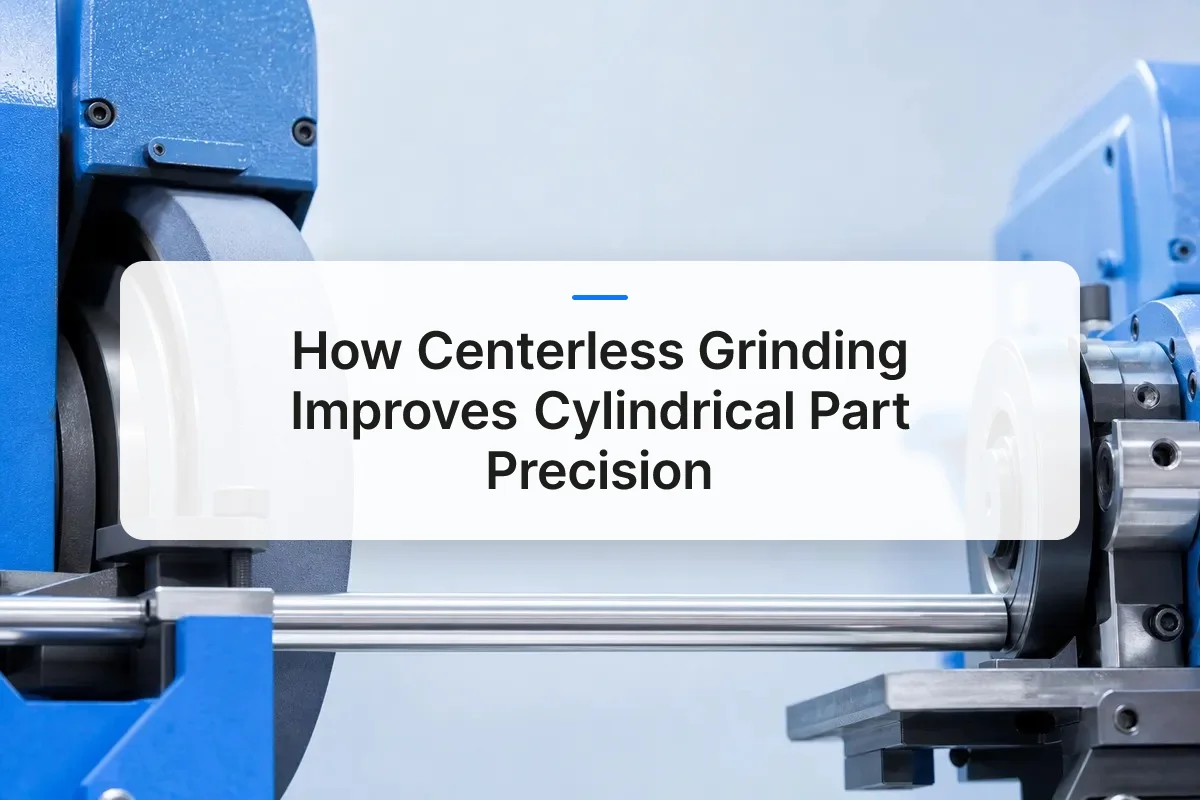
Three components do the work: a grinding wheel that removes material, a regulating wheel that controls rotation speed and axial feed, and a support blade that holds the part at center height between them. There’s no chuck, no collet, no center-drilled hole, the workpiece simply sits on the blade, squeezed between two spinning wheels moving at very different speeds. The grinding wheel, running fast, does the cutting. The regulating wheel, running much slower and often tilted slightly, controls how fast the part turns and how quickly it moves through the machine. This is the mechanical core of centerless grinding precision manufacturing, and it’s why the process behaves so differently from anything that clamps a part down.
Traditional cylindrical grinding takes the opposite approach: it mounts the part between two centers, like a lathe, and grinds while the part rotates on that fixed axis. That works fine for short, rigid parts. But clamp a long, slender shaft between centers and grinding pressure will flex it, especially at the midpoint, the same way a thin dowel bows if you press on it while it’s supported only at the ends. That deflection shows up as taper, out-of-roundness, or inconsistent diameter along the part’s length. Centerless grinding avoids the problem because the support blade backs the part along its full contact length instead of pinning it at two end points.
Thrufeed vs. Plunge-Feed Grinding: When to Use Each
Thrufeed grinding pushes parts continuously between the wheels, good for long stock of uniform diameter, like pins, dowels, or rod stock cut to length after grinding. The regulating wheel’s slight tilt is what drives the part forward while it spins, so material feeds through in a steady stream with minimal operator intervention. Plunge-feed (also called infeed) grinding holds the part axially stationary while the grinding wheel moves in radially, which suits parts with shoulders, flanges, or stepped diameters that can’t pass straight through the wheel gap. Shops pick between the two based on part geometry, not preference, a shouldered shaft simply won’t work in a thrufeed setup.
Why Manufacturers Choose Centerless Grinding Over Traditional Methods
Skipping the center-drilling step alone saves a full operation per part, which matters when volumes run into the thousands. Loading is faster too, an operator or feeder just places the part on the blade rather than aligning it between centers. Combined with reduced deflection on thin or long parts and the ability to feed parts continuously rather than one at a time, centerless grinding fits high-volume production of shafts, rollers, and bushings better than center-type grinding ever could.
What Tolerances and Surface Finishes Can Centerless Grinding Achieve?
Centerless grinding holds diameter tolerances to ±0.001mm and produces roundness figures that chuck-mounted or between-centers grinding rarely match on the same part geometry. That level of control comes from how the workpiece is supported, not from a more powerful wheel.
In a chuck or between-centers setup, the part flexes around a fixed axis and any runout in the holding device transfers directly into the finished dimension. Centerless grinding removes that variable. The workpiece rests on a support blade, sandwiched between a grinding wheel and a regulating wheel, and never touches a fixture that could introduce its own error. The regulating wheel controls rotational speed and feed rate independently of the grinding wheel, which lets the part find its own rotational center as material comes off. This self-centering behavior is why centerless grinding precision manufacturing consistently delivers tighter roundness and diameter consistency across long production runs than fixture-dependent methods.
How Accurate Is Centerless Grinding for Tight-Tolerance Applications?
Tolerances down to ±0.001mm are achievable, but three factors determine whether a shop actually holds that number in production. Wheel dressing accuracy sets the geometric baseline, a poorly dressed wheel transfers its own irregularities straight onto the part. Machine rigidity matters just as much: any deflection in the wheel spindle, regulating wheel head, or blade support shows up as size drift over a production run. Some centerless platforms use compensation adjustments as fine as 0.001mm to correct for wheel wear in real time, which keeps parts within spec across long batches without manual intervention. Part material stability is the third variable, parts that move or distort under grinding heat, particularly thin-walled or heat-sensitive components, will not hold tolerance no matter how rigid the machine is.
What Surface Finish Can You Expect on Different Materials?
Harder alloys generally finish smoother because they resist the smearing and micro-tearing that softer metals are prone to under the wheel. Pairing a hardened steel or hardened alloy with a finer-grit wheel produces a consistently smooth finish suited to sealing surfaces and bearing journals. Softer metals, aluminum, brass, and some stainless grades, need slower feed rates and closer heat control, since aggressive feeds on soft material can cause surface burn or smearing that no amount of downstream polishing fully corrects.
Feed method also affects finish consistency along a part’s length. Thrufeed grinding, where parts pass continuously between the wheels, tends to produce uniform finish over long cylindrical sections, making it well suited to bar stock and shaft-type parts. Plunge-feed grinding, used for parts with shoulders or profiled sections, concentrates wheel contact at a fixed axial position, which demands tighter dressing control to avoid finish variation across the ground length.
Which Materials and Cylindrical Components Suit Centerless Grinding Best?
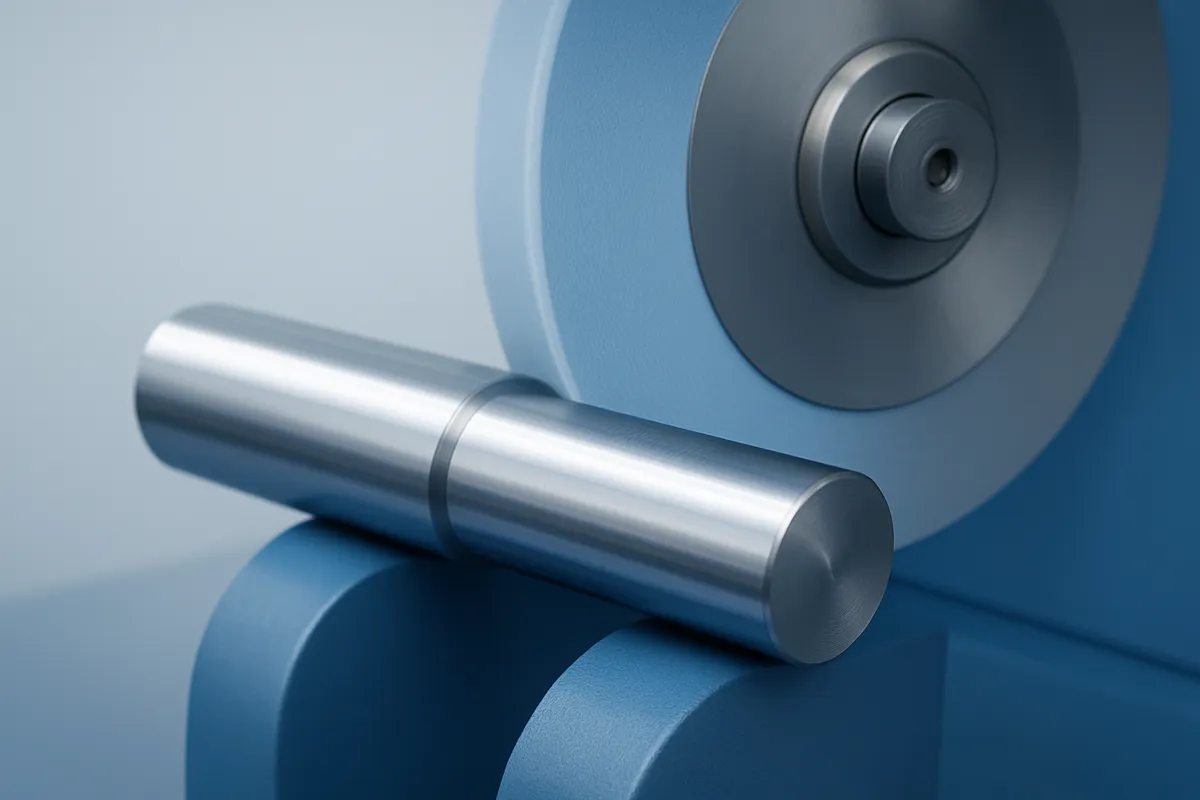
Centerless grinding precision manufacturing works best on round metal parts, hardened and stainless steels, aluminum, brass, and select nickel alloys, where the geometry is simple and the volume is high.
Which Metals and Alloys Work Best with Centerless Grinding?
Hardened and stainless steels are the most common candidates, since the process was built to hold tight tolerances on tough materials that resist deformation under grinding pressure. Aluminum and brass grind well too, but their softness demands a different approach: lighter infeed rates and open-structure wheels to avoid loading the abrasive with smeared metal.
Nickel alloys show up in aerospace and medical applications where corrosion resistance matters more than machining ease. These alloys tend to work-harden quickly, so wheel selection and dressing frequency have to be tuned to the specific grade rather than treated as a one-size-fits-all setting. Softer materials generally allow faster feed rates, while hardened steels need slower passes and more frequent wheel dressing to hold size consistently across a production run.
What Types of Cylindrical Parts Are Typically Ground This Way?
Pins, shafts, rollers, bushings, and dowels are the classic fits, because centerless grinding depends on a continuous round cross-section riding against the support blade throughout the cut. That continuous contact is what lets the part self-center without a chuck or fixture, remove the round profile and the part loses its reference surface mid-grind.
Parts with keyways, flats, cross-holes, or other heavy interruptions in the round profile are harder to grind on a centerless machine. The support blade needs a stable surface to ride on, and a flat or slot breaks that contact, causing chatter or size variation. Shops typically grind these features in with a secondary operation or handle the part on a different process entirely rather than force it through centerless equipment.
This is where the method earns its keep in custom manufacturing: high-volume runs of similar cylindrical parts, a batch of identical shafts or bushings, get the most value, because the blade and wheel dressing are optimized for one profile and held there for the length of the run. A shop switching profiles every few pieces spends more time re-dressing than grinding, which is why centerless lines are usually scheduled around families of similar parts rather than mixed one-off geometries. At GC INDUS, grinding is one of several finishing processes offered alongside CNC milling, turning, and 5-axis machining, so parts that don’t suit centerless grinding can move to a better-fit process without changing vendors.
What Are the Cost and Efficiency Benefits of Centerless Grinding Precision Manufacturing?
Centerless grinding precision manufacturing cuts cost per part mainly by removing setup steps, not by running the wheel faster than other grinding methods.
How Does Centerless Grinding Improve Throughput and Cost per Part?
The throughput advantage comes from continuous thrufeed loading. A part enters between the grinding wheel and regulating wheel, gets ground to size, and exits while the next piece is already feeding in behind it, no stopping to re-chuck, re-align, or re-zero between cycles. On a chucking or cylindrical grinder, each part requires its own load-locate-clamp sequence, which adds fixed time regardless of batch size. Strip that step out and cycle time per piece keeps shrinking as volume climbs, since the fixed overhead per part approaches zero.
The cost mechanism runs deeper than machine speed. Centerless grinding needs no center-drilled holes and no dedicated workholding fixture for each part geometry, which lowers upfront tooling cost and operator handling time. Because the workpiece rests on a work-rest blade rather than being clamped or driven on centers, it self-centers as it rotates, this reduces deflection-related sizing errors that show up as scrap or rework on parts held rigidly off-center.
What Drives ROI When Investing in Centerless Grinding for High-Volume Work?
Payback depends on part volume, tolerance-driven rework avoided, and fixturing costs eliminated, not a fixed timeline that applies to every shop.
For low-volume or highly varied geometries, CNC turning or standard cylindrical grinding stays the budget-friendly setup: less tooling investment, faster changeover between one-off jobs, no need to configure regulating-wheel angles for a specific diameter. As volume rises and part geometry stays consistent, centerless grinding becomes the more efficient option at scale, the setup cost amortizes across thousands of identical pieces instead of a handful.
The return shows up in three places: fewer scrapped parts from center-hole runout, less operator time per piece since loading is continuous, and lower fixturing spend since the work-rest blade replaces part-specific chucks. Shops evaluating centerless grinding precision manufacturing for a new production line should model these three variables against their own part mix rather than assume a universal payback window.
What Common Defects Occur in Centerless Grinding and How Do You Prevent Them?
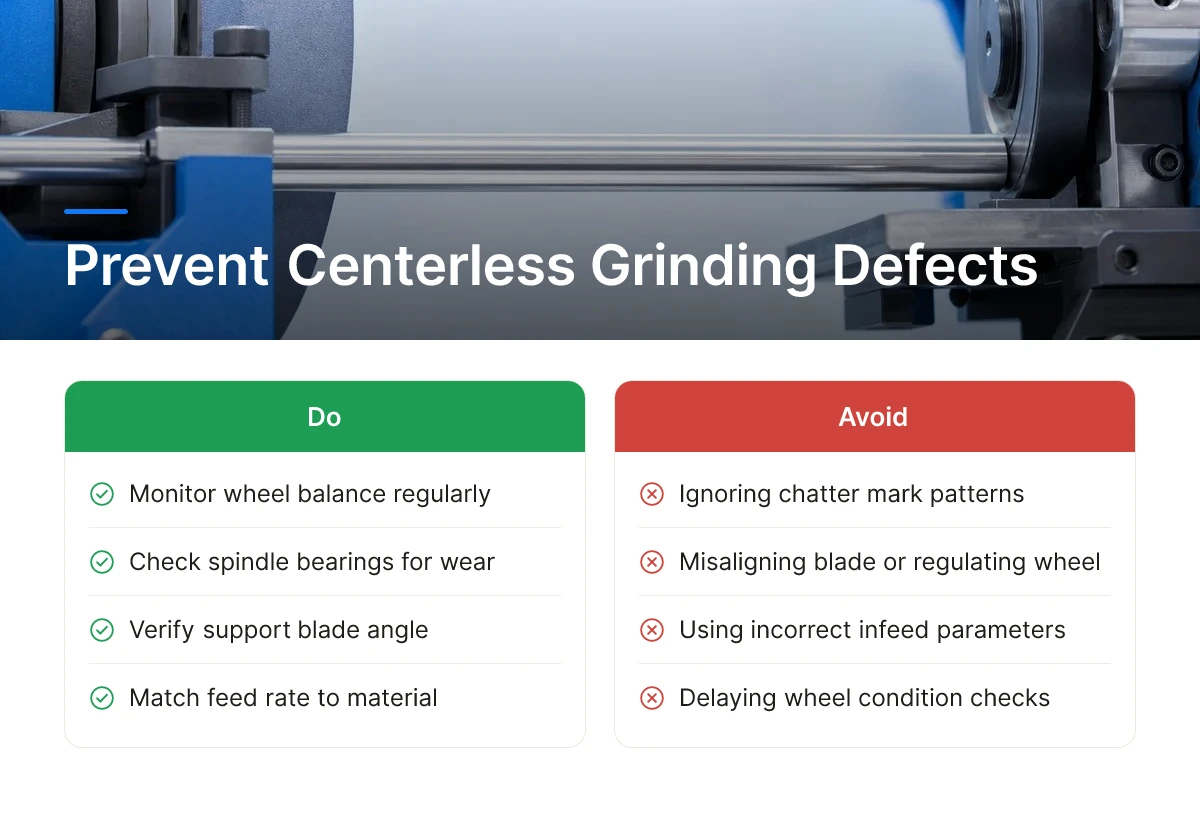
Most centerless grinding defects trace back to three root causes: wheel condition, blade or regulating wheel misalignment, and mismatched feed-to-material parameters. Catching the pattern early prevents scrapped parts and repeat rework, which is the whole point of disciplined centerless grinding precision manufacturing.
How Do You Troubleshoot Chatter Marks, Taper, and Finish Problems?
Chatter marks show up as regular, repeating bands on the part surface, and they almost always come from wheel imbalance, worn spindle bearings, or an incorrect support blade angle that lets the workpiece bounce instead of ride smoothly. The fix starts with a wheel dressing schedule tight enough to keep the abrasive surface true, paired with periodic blade angle checks against the machine’s specified geometry. If chatter persists after dressing, the bearings are the next suspect, not the wheel.
Taper, where one end of the part measures larger or smaller than the other, usually comes from a misaligned regulating wheel angle or uneven wear on the support blade. Because the regulating wheel controls both rotation speed and axial feed in through-feed grinding, even a small angular drift compounds over the length of the part. Correcting it means realigning the wheel centerlines to spec and verifying the blade makes even contact along its full length, not just at the entry point.
What Are the Most Common Centerless Grinding Problems and Solutions?
Surface finish defects, burn marks, waviness, or a dull, discolored band, generally point to a feed rate that doesn’t match the material’s hardness, or coolant flow that isn’t reaching the grinding zone. Harder alloys need slower feed and higher coolant volume to carry away heat; skipping that adjustment burns the surface even when dimensions stay in tolerance. Waviness specifically often signals coolant starvation combined with a wheel that needs redressing.
A short preventive-maintenance routine catches most of these before they produce scrap:
- Dress grinding and regulating wheels on a fixed interval, not just when defects appear
- Inspect support blades for wear and correct contact angle each shift
- Filter coolant continuously and check flow rate at the grinding zone
- Calibrate machine geometry, wheel centerlines, blade height, regulating wheel angle, on a set schedule
GC INDUS builds these checks into its grinding operations alongside CNC milling, turning, and EDM processes, backing them with full inspection protocols under ISO 9001 so tolerance and finish issues get caught before parts ship, not after.
Frequently Asked Questions
Can centerless grinding be used on non-round or interrupted profiles?
Yes, but with limits, plunge-feed centerless grinding handles shaped, tapered, and formed profiles, while through-feed methods require a continuous round section. Interrupted surfaces like keyways or flats can cause chatter, so we evaluate part geometry before recommending centerless grinding over CNC turning or milling.
How does centerless grinding affect part straightness on long shafts?
Centerless grinding improves straightness on long shafts because the workpiece is supported along its length rather than held at two end centers. This reduces deflection and bowing during grinding, which is one reason it’s favored for slender shafts, pins, and rods that distort under traditional center-driven grinding.
Does centerless grinding require secondary finishing steps like polishing or honing?
Not always, centerless grinding often produces the final surface finish and tolerance in one pass, especially for bearing races, pins, and shafts. Some applications still call for honing or polishing afterward, typically when a part needs a mirror finish or extremely tight roundness beyond what grinding alone delivers. We determine this during process planning, based on the part’s function and spec sheet.
How do you choose between centerless grinding and CNC turning for a new part?
The choice depends on volume, tolerance, and geometry, centerless grinding suits high-volume cylindrical parts needing tight diameter control and fine surface finish, while CNC turning handles complex features, threads, and lower-volume runs more economically. Many parts pass through both: turning to rough shape, then centerless grinding for final tolerance. We assess drawings and quantities before recommending a path.
Conclusion
Centerless grinding earns its place in precision manufacturing when parts demand tight diameter control, fine surface finish, and straightness that center-driven methods struggle to hold on long or slender geometries. The process works best paired with upstream steps like turning or milling, not as a standalone answer for every cylindrical part. Before specifying it, confirm your part’s geometry supports through-feed or plunge-feed grinding and that volume justifies the setup.
If you’re evaluating a current part for tolerance or finish problems, send GC INDUS the drawing and quantity, we’ll tell you whether centerless grinding, CNC turning, or a combined process gets you to ±0.001mm reliably.
Recommended Articles
Explore more from our content library:


