
Book Appointment Now

GC INDUS / MANUFACTURING KNOWLEDGE
How Gear Hobbing Shapes Teeth in Precision Manufacturing

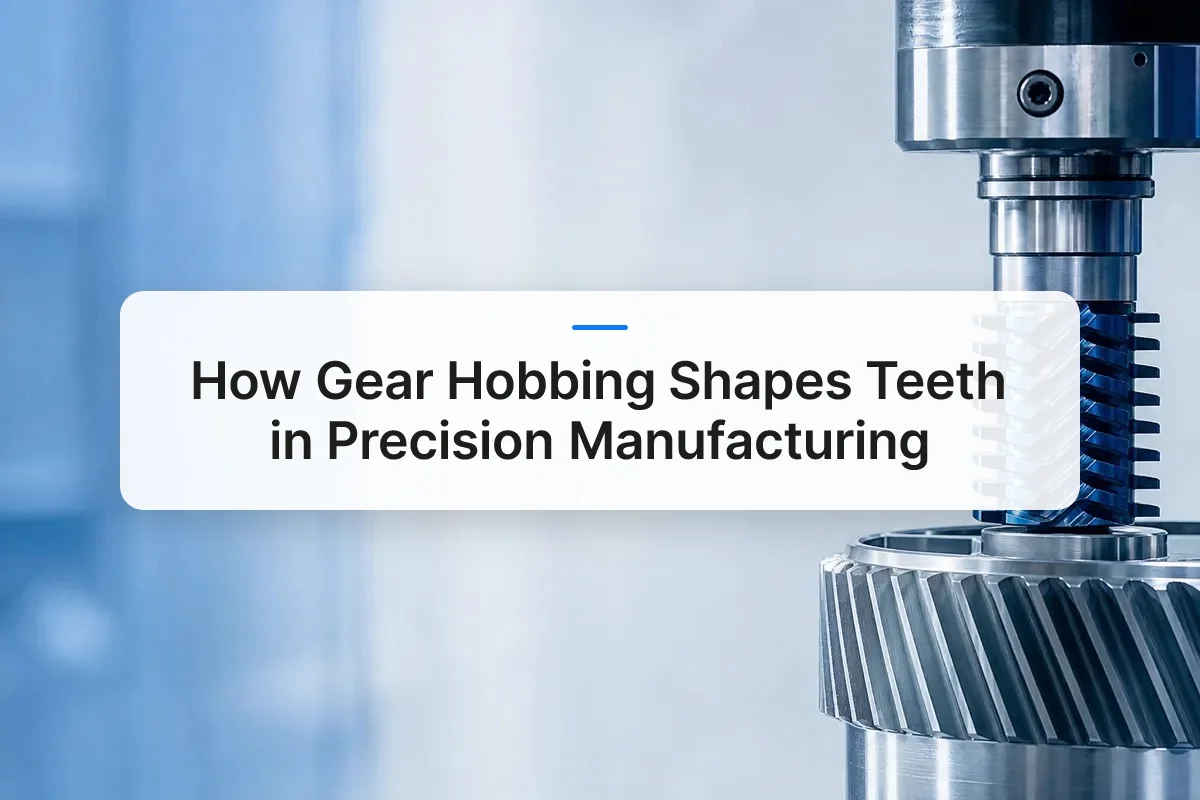
Understanding gear hobbing precision manufacturing is essential. Gear hobbing is a machining process that cuts gear teeth by rolling a rotating, helical cutting tool (a hob) against a rotating workpiece blank, generating the tooth profile through a continuous, synchronized motion rather than cutting one tooth at a time. It’s the dominant method for producing external gears in high volumes because it’s fast, repeatable, and holds tight tolerances suited to AGMA quality classes used in automotive, industrial, and aerospace gearboxes. Compared to broaching or shaping, hobbing generates complex tooth geometries efficiently while keeping cost per part low for OEM production runs.
What Is Gear Hobbing and How Does It Work in Precision Manufacturing?
Gear hobbing generates tooth profiles through a rolling, synchronized cut between a rotating hob and a rotating gear blank, rather than removing all material in a single pass. This is particularly relevant for gear hobbing precision manufacturing.
The hob and the workpiece turn together at a fixed ratio tied to the number of teeth being cut and the number of thread starts on the hob. As they rotate in lockstep, the hob’s cutting edges pass through the blank repeatedly, each pass removing a thin slice of material until the full tooth depth and profile form. This is the generating principle that separates hobbing from single-point cutting methods: no individual tooth space is finished in one motion. Instead, the shape emerges progressively across the rotation, which is part of why gear hobbing precision manufacturing achieves such consistent results across a full batch of parts.
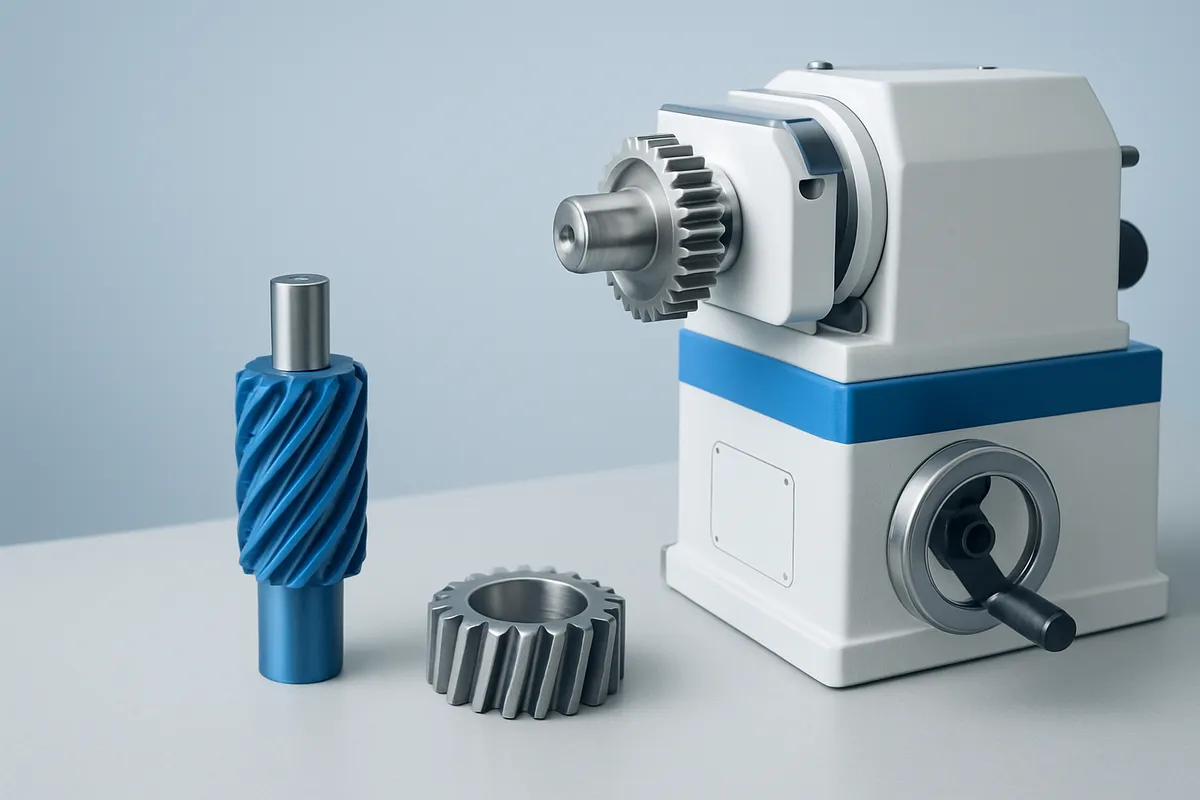
The hob itself is a cylindrical tool with helical flutes machined around its body, each flute ground to match the involute form of the target tooth. As the hob feeds axially or radially into the blank, that feed rate, combined with the helix angle of the flutes, controls tooth depth, profile accuracy, and lead. Get the feed and rotational timing wrong, and the tooth form drifts out of tolerance even if the raw dimensions look correct on a caliper.
What Tools and Equipment Are Used in the Gear Hobbing Process?
A hobbing setup needs four core elements working in coordination: the hobbing machine, the hob cutter, workholding, and a control system that keeps everything synchronized.
- Hobbing machine: provides the rotational axes for both hob and blank, plus the feed mechanism.
- Hob cutter: made from high-speed steel (HSS) for general-purpose runs or carbide for higher cutting speeds and longer tool life in volume production.
- Workholding/arbor: fixtures the blank securely so it holds concentricity through every pass, critical since any wobble transfers directly into tooth error.
- CNC controls: synchronize hob rotation, blank rotation, and feed axes electronically, which lets one machine cut spur gears, helical gears, and worm gears just by changing the hob and the axis programming.
What Are the Main Advantages of Gear Hobbing Over Manual Gear Cutting Methods?
Hobbing’s continuous cutting motion removes material faster than tooth-by-tooth methods like shaping or broaching, while still holding the profile accuracy OEM gearbox specs demand.
Because the hob is always engaged and rotating rather than indexing between individual tooth spaces, cycle times drop and tool wear distributes evenly across the cutting edges. That combination, speed plus repeatability, is why hobbing remains the default choice for spur, helical, and worm gear production wherever precision manufacturing shops need to scale from prototype quantities to full production runs without changing the fundamental process.
How Does Gear Hobbing Compare to Other Gear Manufacturing Methods?
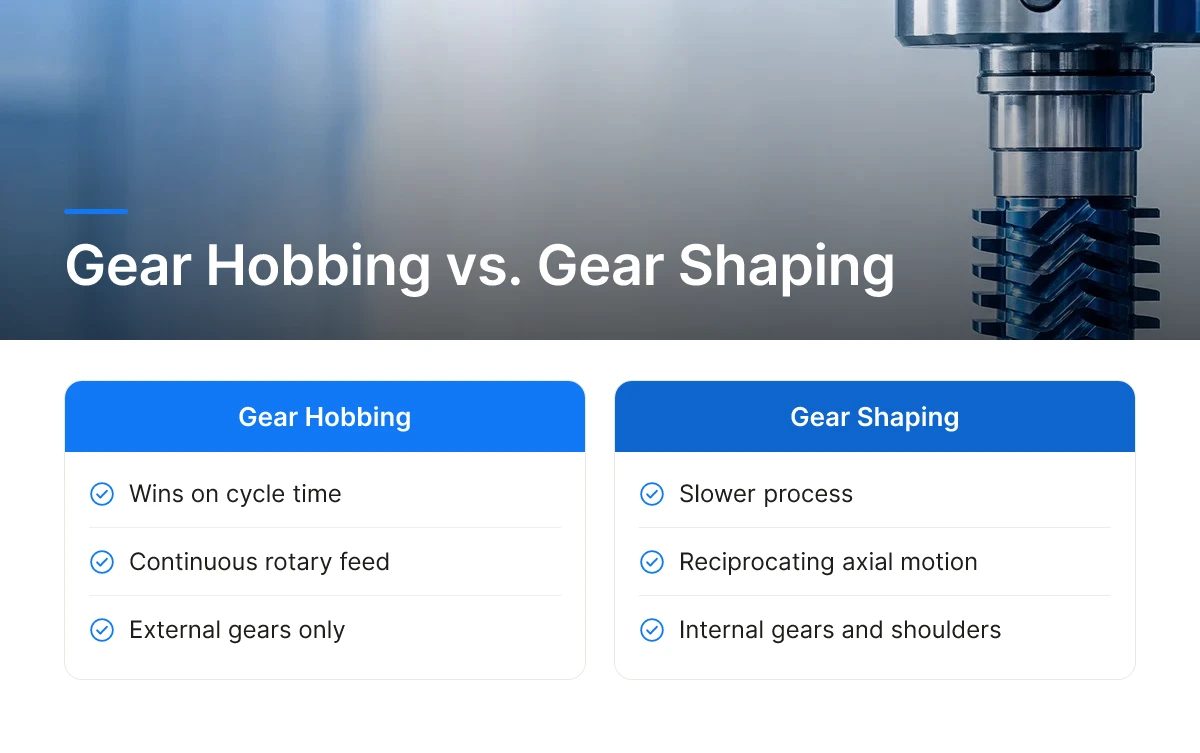
Hobbing wins on cycle time and setup flexibility for external gears, while shaping, grinding, and broaching each solve problems hobbing cannot touch. Choosing among them comes down to gear geometry, volume, and how tight the final tolerance needs to be.
When Should You Choose Gear Hobbing Versus Gear Shaping, Gear Grinding, or Broaching?
Gear shaping earns its place where hobbing physically can’t reach. A shaper cutter reciprocates axially and can cut internal gears, gears with shoulders, and interrupted or blind profiles, geometries a hob’s continuous rotary feed cannot access. The tradeoff is speed: for a straightforward external spur or helical gear, shaping generally runs slower than hobbing because the cutting action is intermittent rather than continuous. If the part is an external gear with clearance to run a hob past the face, hobbing is almost always the faster choice. When considering gear hobbing precision manufacturing, this point stands out.
Gear grinding sits downstream of hobbing, not in competition with it. Grinding removes material with an abrasive wheel after heat treatment, correcting the distortion that hardening introduces and pushing surface finish and tooth accuracy to higher AGMA classes than hobbing alone can hold. That precision comes at a cost, grinding is a second setup, a second cycle, and added machine time. Most shops reserve it for hardened, high-load gears in automotive transmissions or aerospace drives where the extra AGMA grade justifies the extra operation.
Broaching beats hobbing on raw throughput for one narrow case: very high volumes of simple internal splines or profiles cut in a single linear pass. But broach tooling is dedicated to one exact profile, cutting a different tooth form means buying a new broach, an expensive, long-lead investment that only pays off at high production volumes. Hobbing tooling, by contrast, adapts to different gear specs with change gears and cutter swaps, which is why gear hobbing precision manufacturing remains the default for OEM programs that run multiple part numbers through the same equipment.
Taken together, hobbing offers the best balance of setup flexibility, cycle time, and achievable tolerance for mid-to-high volume production, which is why it’s the workhorse process most shops reach for before considering shaping, grinding, or broaching as a follow-on step.
What Are the Common Challenges and Limitations of Gear Hobbing?
Hobbing has real limits. It cannot cut internal gears, that geometry requires shaping or broaching instead. Certain tooth modifications, such as crowning, tip relief, or very fine surface finishes for hardened gears, fall outside what a hob alone can deliver and require secondary grinding or honing. Recognizing these boundaries early, during part design, avoids costly rework later in production.
What Tolerance Levels and AGMA Standards Can Gear Hobbing Achieve?
As-hobbed gears typically land in AGMA quality classes 6 through 8, and grinding or honing after hobbing can push that to class 12 or higher for aerospace and high-speed applications. That range covers most of what industrial buyers need, but knowing where your part falls on that scale determines whether hobbing alone gets you there or whether a secondary process has to finish the job.
AGMA quality numbers describe how closely a gear’s tooth profile, spacing, and runout match a theoretical ideal. Mid-range classes, the as-hobbed output most shops deliver without extra steps, hold tight enough tolerances for automotive transmissions, industrial gearboxes, and general power transmission equipment. Aerospace gearing, high-speed turbine drives, and precision servo systems usually demand the tighter classes, which means a grinding pass after hobbing to remove the last few microns of profile error and improve surface finish on the tooth flank.
How Do Deburring and Finishing Processes Affect the Final Precision of Hobbed Gears?
The hobbing cut leaves burrs at the tooth edges where the hob exits the material, and removing them changes more than appearance. Left in place, burrs concentrate stress at the tooth root and raise the risk of fatigue cracking under repeated load, a failure mode that shows up as noise or vibration long before a tooth breaks. Deburring and edge-honing smooth these transitions, which improves root fatigue life and reduces mesh noise, especially in gearboxes running at higher RPM where tooth contact frequency amplifies any surface irregularity. For those exploring gear hobbing precision manufacturing, this matters.
What Specific Tolerance Capabilities Does Gear Hobbing Offer for Tight Precision Requirements?
Positional and profile accuracy in hobbing come down to four variables: hob accuracy, machine rigidity, thermal stability, and workholding runout control. A worn or imprecisely ground hob transfers its own errors directly into every tooth it cuts. Machine flex under cutting load, thermal drift during long production runs, and any play in the workholding fixture all show up as profile deviation or lead error in the finished gear.
For tolerance requirements in the ±0.001mm class, hobbing alone rarely gets there, that level of gear hobbing precision manufacturing typically comes from hobbing to rough the tooth form followed by grinding or honing to hold final dimensions. GC INDUS pairs CNC hobbing with grinding and full inspection protocols to hit tolerances in that range, which matters for medical device gearing and precision motion components where tooth-to-tooth consistency affects the whole assembly’s performance.
Which Materials and Alloys Are Best Suited for Gear Hobbing?
Case-hardening steels and free-machining grades hob most predictably, while hardened alloys, stainless steel, and high-silicon aluminum grades each demand adjusted tooling and cutting parameters.
Material selection drives tool life, cycle time, and dimensional stability more than almost any other variable in gear hobbing precision manufacturing. Choosing the wrong alloy for a given tooth profile and load case leads to chatter, premature hob wear, or parts that shift out of tolerance during heat treatment. Getting this decision right upfront saves rework downstream.
How Do Different Steel Grades and Alloys Perform in the Gear Hobbing Process?
Carburizing grades like 8620, 4320, and 1018 are the workhorses of gear hobbing because they cut with predictable, well-formed chips and respond consistently to post-hobbing case hardening. We machine these grades routinely at GC INDUS because their metallurgy stays stable through the cutting operation, and the case-hardening response afterward is uniform across the tooth profile, critical for gears that need a hard wear surface with a tough core.
Brass and aluminum alloys hob easily and generate low cutting forces, making them attractive for lighter-duty gears in instruments, consumer electronics, and low-torque drive assemblies. They’re not suited to high-load or high-cycle applications where steel’s fatigue strength and surface hardness matter more.
Hardened or high-alloy steels present the opposite problem. Cutting a gear blank that’s already at or near final hardness accelerates tool wear dramatically, forcing a shift from high-speed steel hobs to carbide tooling and noticeably slower feed rates to protect the cutting edges. This is why hobbing sequencing matters: the operation typically happens before hardening, not after, so the blank machines easily and any heat-treatment distortion gets addressed with a secondary finishing pass rather than baked into the original cut.
Stainless steel introduces its own headaches. It work-hardens quickly under cutting pressure and tends to produce gummy, stringy chips instead of clean breaks, which requires slower speeds, sharper hob geometry, and closer coolant control to avoid built-up edge and surface tearing on the tooth flank. This directly impacts gear hobbing precision manufacturing outcomes.
What Equipment, Tooling, and ROI Factors Matter When Investing in Gear Hobbing?
Equipment and tooling decisions in gear hobbing precision manufacturing hinge on matching spindle rigidity, axis configuration, and tooling economics to the part mix and volume a manufacturer actually runs. Buy more machine than the application needs and capital sits idle; buy too little and tolerance drift or changeover delays eat the margin on every batch.
What Are the Real-World Applications of Gear Hobbing in Automotive, Aerospace, and Industrial Sectors?
Automotive transmissions, industrial gearboxes, and aerospace gear trains each pull hobbing equipment in different directions, and no single machine configuration serves all three well.
Automotive transmission gears run in high volumes with moderate tolerance bands, favoring dedicated hobbing cells optimized for cycle time and repeatability over flexibility. Industrial gearboxes, used in conveyors, pumps, and drive systems, cover a wider range of module sizes and often need worm gears or sprockets alongside standard spur gears, which hobbing handles well since the process suits spur gears, worm gears, sprockets, and pinions alike. Aerospace components sit at the opposite end: lower volumes, tighter tolerances, and frequent part-number changes, which reward machines built for fast setup and consistent accuracy over raw throughput.
How Do Hobbing Machine Selection and Tooling Costs Impact Return on Investment?
Machine selection starts with spindle rigidity, a stiffer spindle holds tighter profile tolerances across longer production runs without deflection-driven tooth errors. CNC axis count matters next: a 5-axis or 6-axis hobbing center synchronizes hob rotation, workpiece rotation, and feed motion in ways that reduce setup time when switching between gear specs, a real advantage for OEM clients whose orders vary in module, pressure angle, and helix angle from one run to the next. Workpiece size range, the maximum hob diameter and workpiece diameter the machine can handle, needs to match the largest and smallest parts in the expected product mix, not just the current job.
Tooling cost is the second lever. High-speed steel (HSS) hobs sit at the budget-friendly end and tolerate multiple regrinding cycles, making them a reasonable choice for shorter runs or softer materials. Carbide hobs cost more upfront but hold an edge longer at higher cutting speeds, lowering cost-per-part over high-volume production despite the premium tier price. Regrinding cadence, how many cycles a hob survives before it needs replacement, directly shapes the real cost-per-part over the tool’s working life, not just its sticker price.
Batch size and changeover time tie these choices together into an ROI picture. A shop running long, single-spec batches recoups a rigid, dedicated machine quickly. A shop serving OEM clients with varied gear specs and smaller lot sizes needs flexible tooling and fast changeover to avoid overhead piling up between orders. For manufacturers who don’t run gear volumes high enough to justify the capital outlay, partnering with an established precision manufacturer, GC INDUS works across CNC milling, turning, and grinding processes with tolerances as tight as ±0.001mm and flexible minimum order quantities starting from one piece, avoids the upfront machine and tooling investment while still meeting tight tolerance and delivery requirements.
Frequently Asked Questions
Can gear hobbing produce internal gears?
No, gear hobbing cannot cut internal gears because the hob needs clearance to rotate around the outside of the workpiece. Internal gears require gear shaping instead, which uses a reciprocating pinion cutter that can work inside a bore. This is particularly relevant for gear hobbing precision manufacturing.
Does gear hobbing require secondary finishing operations?
Most hobbed gears need deburring, and many precision applications add grinding or shaving afterward. Hobbing leaves burrs at the tooth edges that must be removed, and gears requiring tight tolerances or smoother tooth surfaces often go through additional finishing to hit final specifications.
How does hob wear affect gear tooth accuracy over a production run?
Hob wear gradually changes tooth profile and thickness, so parts cut late in a run can drift out of tolerance compared to the first pieces off the machine. Shops manage this with scheduled hob inspection, tool changes at set cycle counts, and in-process gauging that catches drift before it produces scrap.
Is gear hobbing suitable for low-volume or prototype gear production?
Yes, gear hobbing works for both prototype runs and high-volume production once tooling is set up. GC INDUS accepts orders starting from a single piece, letting engineering teams validate a gear design before committing to full production quantities.
What causes burrs to form during gear hobbing, and why do they need removal?
Burrs form when the hob exits the workpiece and displaces metal at the tooth edges rather than cleanly cutting it. Left in place, burrs interfere with gear meshing, accelerate wear, and can cause noise or premature failure in the finished assembly.
Conclusion
Gear hobbing earns its place in precision manufacturing because it pairs high-volume efficiency with the tolerance control that OEM, medical, and automotive parts demand. The process still requires attention to hob wear, deburring, and secondary finishing to hold tight specifications across a full production run. Before committing to a supplier, ask for their in-process gauging data and hob replacement schedule, those two details reveal more about consistency than a quoted tolerance ever will. GC INDUS runs gear hobbing under ISO 9001 and ISO 13485 quality protocols, with MOQs starting at one piece for teams that need to validate a design before scaling up.
Recommended Articles
Explore more from our content library:


