
Book Appointment Now

GC INDUS / MANUFACTURING KNOWLEDGE
When to Use Vertical CNC Machining vs. Horizontal Systems

Vertical CNC machining uses a spindle oriented vertically above the worktable, cutting into stationary or table-fed stock from above, making it the standard choice for flat, prismatic parts, single-setup milling, and shops that need lower upfront investment and simpler programming. It suits precision manufacturing operations focused on smaller batches, frequent design changes, or 3-axis work, while horizontal systems better handle high-volume production and complex multi-sided parts. The right choice depends on your part geometry, batch size, and tolerance requirements rather than one system being universally superior.
What Is Vertical CNC Machining and How Does It Work?
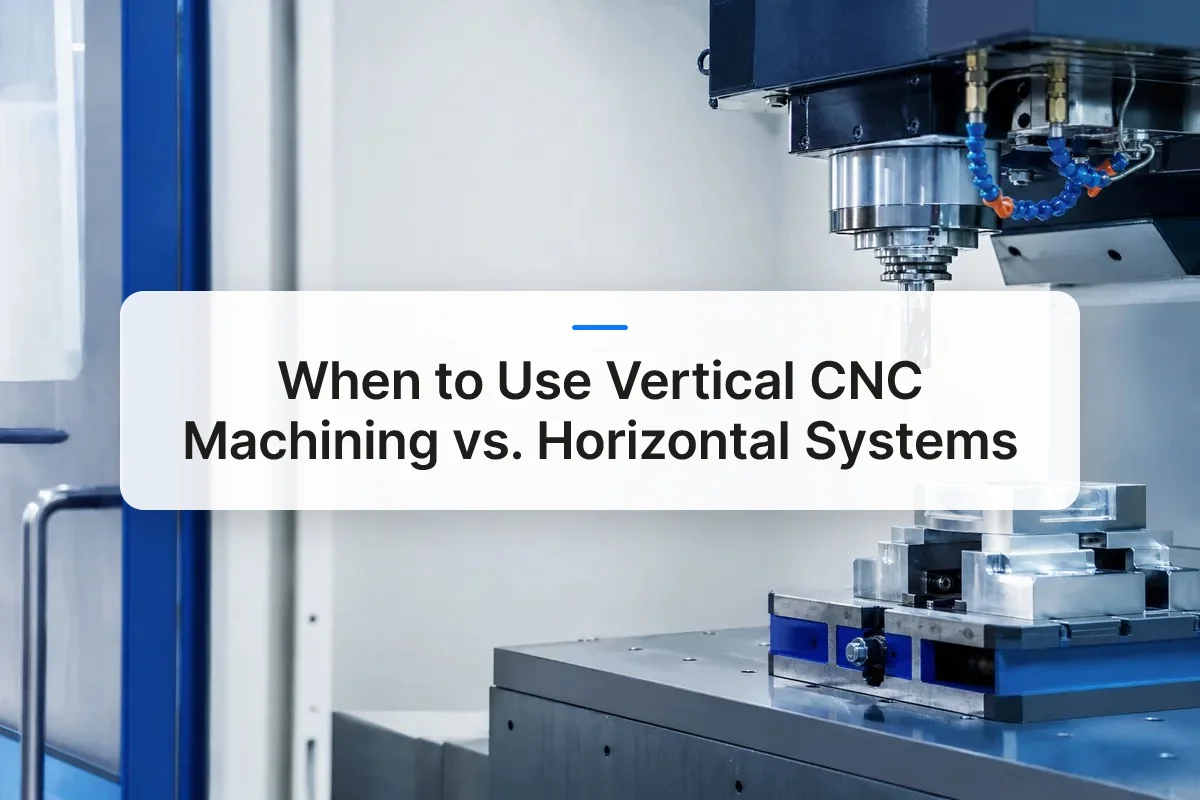
Vertical CNC machining orients the spindle straight up and down, so the cutting tool plunges downward into stock that sits flat on a table beneath it. That geometry, tool above, workpiece below, is the defining trait of the category, and it drives most of the tradeoffs the rest of this guide covers.
Core Components of a Vertical Machining Center
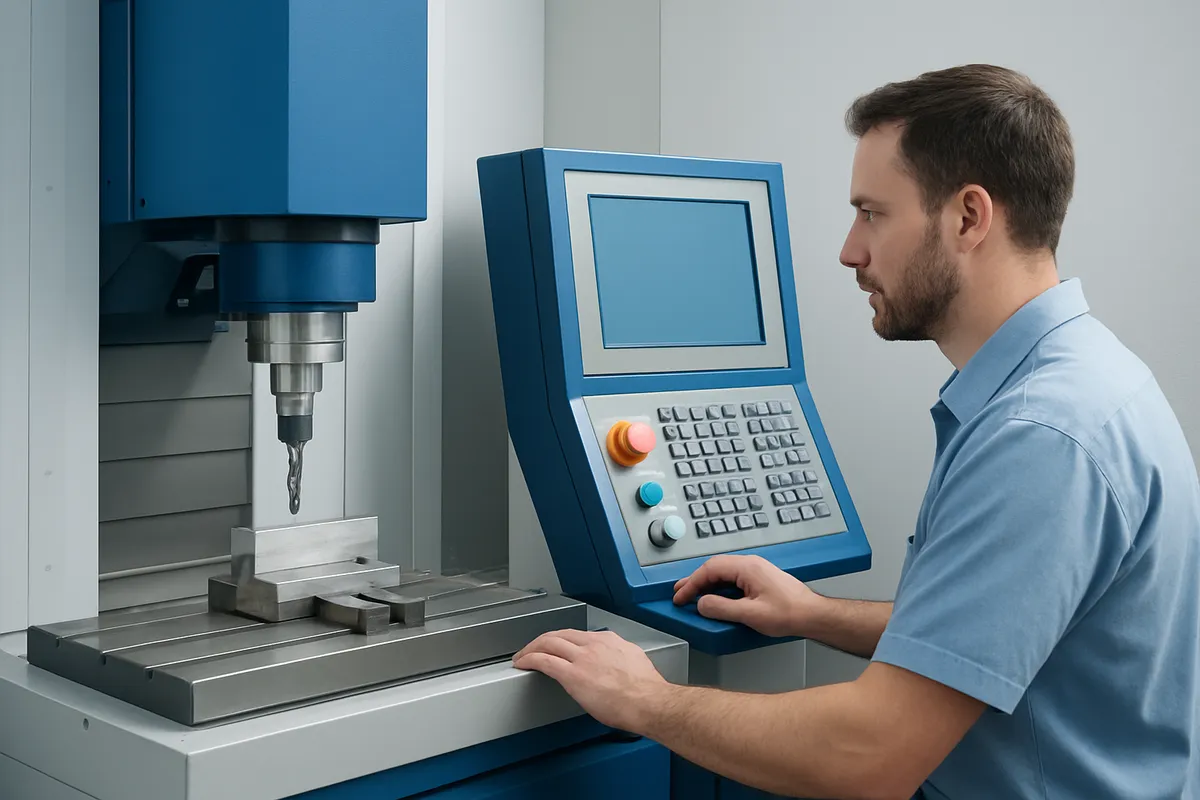
A standard vertical machining center (VMC) is built around four parts working together. The column is the rigid vertical backbone that holds everything in alignment. The spindle head rides up and down that column, carrying the cutting tool and driving its rotation. The table holds the workpiece and moves it along the X and Y axes so the tool can reach different points on the part. A tool changer, usually mounted to the side or on a carousel, swaps bits automatically between operations, drilling one hole, then milling a pocket, then tapping threads, all in one cycle without a machinist manually reloading tools.
Because the workpiece stays fixed under a single overhead tool path, programming is comparatively straightforward. This is one reason vertical machining centers are the default entry point for shops offering CNC milling and Swiss lathe turning alongside broader fabrication work, the setup logic is intuitive even for complex prismatic geometry.
What Are the Downsides and Limitations of Vertical Milling Machines?
The main limitations of vertical CNC machining are poor chip clearing in deep cavities, extra setups for multi-sided parts, and a table footprint that caps workpiece size. Because gravity is the primary chip-evacuation mechanism, cuttings can pack into deep pockets or narrow slots instead of falling clear the way they do on a horizontally oriented spindle. Parts that need features cut on more than one face typically require unclamping and re-fixturing the stock, which adds cycle time and introduces alignment risk with each repositioning. Table dimensions and travel range also set a hard ceiling on how large a single workpiece can be.
How Do Vertical CNC Capabilities Differ Across Price Tiers and Manufacturers?
Entry-level vertical CNC machines typically run basic 3-axis control with modest spindle speeds and looser positioning tolerances, adequate for simple flat-face work. Mid-range and premium VMCs add live tooling, a fourth or fifth axis, faster spindle RPMs, and tighter repeatability, the difference between roughing out a bracket and holding tolerances suitable for medical or aerospace components. GC INDUS runs vertical and multi-axis CNC equipment capable of ±0.001mm tolerances, which puts it well above the basic 3-axis tier most job shops rely on.
Despite the setup and chip-evacuation tradeoffs, vertical machines excel at flat parts, die and mold cavities, drilling operations, and any job that finishes complete in one 3-axis setup, which covers a large share of production work.
How Do Vertical and Horizontal CNC Machines Compare for Precision Manufacturing?
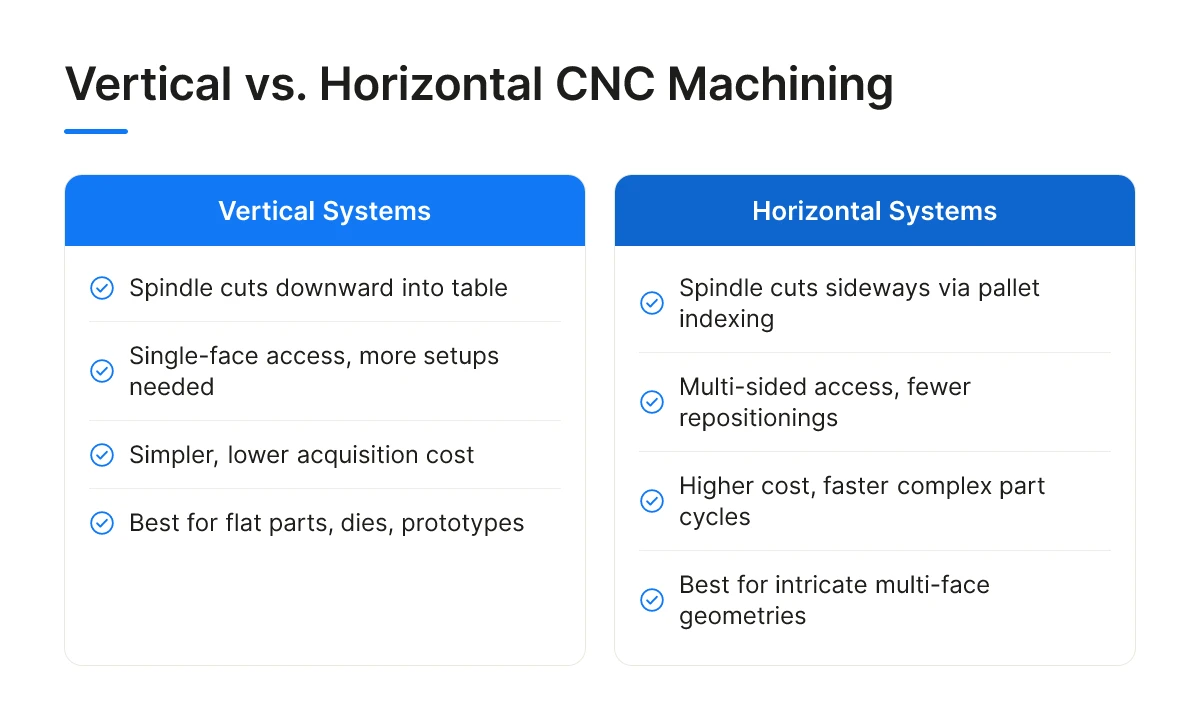
Horizontal machines cut faster on complex, multi-face parts because pallet indexing avoids repositioning; vertical CNC machining wins on simple, flat parts and lower upfront cost.
The core difference is spindle orientation. A horizontal machining center holds the cutting tool on a horizontal axis, which lets chips fall away from the workpiece by gravity instead of packing into pockets and features . That matters most on deep cuts and heavy roughing, where chip re-cutting damages surface finish and shortens tool life. Horizontal setups also use pallet indexing to rotate the part and machine multiple faces without removing it from the fixture, useful for prismatic housings, blocks, and manifolds that need features on four or more sides.
Vertical machining centers, by contrast, give the operator direct, single-face access with the spindle pointed straight down at the part . That layout is simpler to program, easier to load, and generally cheaper to buy and tool. For flat parts, plates, and components where most of the geometry sits on one or two faces, a vertical CNC machining setup gets the job done with less capital tied up in the machine.
How Do I Choose Between Horizontal and Vertical Machining for My Production Needs?
Match the machine to three variables: part geometry, batch size, and available floor space. Flat or prismatic parts with features concentrated on one or two faces suit vertical machining, lower tooling cost, faster setup, smaller footprint. Complex multi-face parts running in production volumes justify a horizontal machine’s higher acquisition and tooling cost, because pallet indexing cuts the labor and error that come from manually re-fixturing a part between operations.
Shop floor layout matters too. Horizontal machines need more floor space and often pair with pallet pools or automation cells, which raises the total footprint and investment. A job shop running mixed low-volume work, prototypes, short runs, varied geometries, usually gets more flexibility per square foot from vertical CNC machining.
What Are the Trade-Offs in Precision, Speed, and Part Complexity Between Vertical and Horizontal Systems?
Both machine types can hold tight tolerances when properly maintained and programmed. The difference shows up on multi-face parts: every time an operator removes a part from a vertical machine’s fixture to reach a new face, that re-fixturing step introduces a small alignment error. Horizontal machines avoid most of that error because pallet indexing keeps the part fixed while the machine rotates it, which reduces cumulative deviation across faces.
On cycle time, horizontal systems reduce non-cutting time for complex parts by eliminating manual repositioning, but that speed advantage costs more upfront and in tooling. At GC INDUS, we run both vertical and horizontal CNC platforms alongside 5-axis and Swiss lathe equipment, matching the process to the part’s geometry and tolerance requirement, holding tolerances as tight as ±0.001mm regardless of which spindle orientation the job calls for. This decision sits inside a larger machine-selection process that also weighs tooling inventory, operator training, and automation compatibility, which we cover separately.
What Are the Real Costs and ROI of Investing in Vertical CNC Machining?
Total cost depends on machine tier, axis count, tooling, control software, and facility prep, while payback depends on utilization, scrap reduction, and labor hours saved per part.
What Is the Price Range for CNC Vertical Machining Centers and What Factors Drive Cost?
Vertical CNC machining centers span budget, mid-range, and premium tiers, and the gap between them comes down to rigidity, spindle speed, axis count, and control sophistication rather than any single feature. A basic 3-axis vertical machining center (VMC) suits shops running simple, repeatable geometry. A 5-axis machine capable of the ±0.001mm tolerances that medical and aerospace parts often demand costs substantially more, both in the machine itself and in the programming expertise needed to run it.
Beyond the machine, five cost drivers determine the real investment:
- Machine tier, budget machines trade rigidity and thermal stability for lower upfront cost; premium machines hold tolerance longer under continuous production.
- Number of axes, each added axis (4th, 5th) increases cost but reduces the number of setups needed per part, which cuts labor and setup error.
- Tooling, cutting tools, tool holders, and probing systems are recurring costs, not one-time purchases.
- Control software, CAM licensing, post-processors, and simulation software add ongoing cost but reduce scrap from programming errors.
- Installation and facility prep, foundation work, power supply upgrades, coolant systems, and rigging can rival the machine’s own cost on older facilities.
Tooling and fixture costs scale directly with part variety. A shop running one part family repeatedly needs one fixture design and a narrow tool library. A shop handling frequent changeovers between dissimilar parts needs multiple fixtures, more tool inventory, and more programming time per job, all of which raise the effective cost per part even though the machine itself is identical.
How Can I Calculate the Return on Investment and Payback Period for Vertical CNC Equipment?
Payback period is a function of three internal numbers: machine cost, expected monthly output, and what you currently pay per part through outsourcing or manual labor. Build the calculation with your own figures rather than industry benchmarks, since utilization rates and part mix vary too widely for external averages to apply reliably.
A simple version: divide total machine investment (equipment, tooling, installation) by your current cost-per-part multiplied by expected monthly volume. That gives a rough month-to-breakeven figure. Refine it by factoring in reduced scrap, repeatable CNC setups cut the rework common with manual machining, and labor hours reclaimed per part versus your current process.
ROI improves faster in shops running multiple similar parts across production runs than in shops doing highly variable one-off work, since fixture and programming costs amortize over more units. Companies that outsource this analysis entirely, working with a partner like GC INDUS that already runs 5-axis and Swiss lathe equipment across varied materials, can compare an in-house investment case against per-part outsourcing costs before committing capital.
Which Industries and Applications Benefit Most from Vertical CNC Machining?
Mold and die work, prototyping, medical device components, electronics enclosures, and aerospace brackets with flat-face features rely on vertical CNC machining because the process favors accuracy and setup flexibility over raw throughput.
These parts share a common trait: they need precise flat-plane features, pocketing, or drilled patterns more than they need to remove large volumes of material fast. A mold cavity, a surgical instrument housing, or a bracket with mounting holes on one face all machine cleanly on a vertical center because the tool approaches the workpiece from directly above, giving the operator a clear view of the cut and simple, repeatable part alignment.
How Does Vertical CNC Machining Support Tight Tolerance Requirements?
Tight tolerances come from three things working together: a rigid spindle that resists deflection under cutting load, thermal stability that keeps the machine geometry consistent as it heats up during a shift, and precise ball-screw or linear-guide positioning that controls exactly where the tool sits on each axis.
None of these factors work in isolation. A rigid spindle means nothing if thermal drift shifts the Z-axis reference point an hour into a run. Precise positioning hardware means nothing if the frame flexes under load. Shops that hold tolerances on medical and aerospace parts control all three variables at once, and vertical machines simplify that control because the single-spindle, single-axis-orientation design reduces the number of moving elements that can introduce error.
GC INDUS applies this logic to tolerance-critical work directly. Holding tolerances as tight as ±0.001mm on parts destined for medical devices or electronics assemblies means treating spindle rigidity, thermal management, and axis positioning as a single system rather than three separate specs on a machine tool data sheet.
Why Low-to-Mid Volume, High-Mix Production Favors Vertical Machines
Shops running frequent job changes, a batch of ten brackets, then a prototype run, then a short order of enclosures, benefit from the faster setup changes vertical machines allow. Fixturing is simpler because the workpiece sits flat on the table and the operator loads it from above, cutting the time spent between jobs compared to more complex multi-face setups.
That matters most for OEMs and medical device makers ordering low-to-mid volumes with frequent design revisions, since machine time spent on changeovers doesn’t cut metal or advance the order.
How to Measure Whether the Switch Paid Off
Track three numbers before and after any equipment or process change: cycle time per part, first-pass yield, and scrap rate. Cycle time shows whether setup and cutting time actually dropped. First-pass yield shows whether parts pass inspection without rework. Scrap rate shows whether tolerance control held up across a full production run, not just a single sample part.
What Software, Maintenance, and Operational Requirements Come with Vertical CNC Systems?
Running vertical CNC machining well requires trained operators, a defined CAM workflow, and a maintenance schedule that catches wear before it becomes downtime.
What CAM Programming and Software Skills Are Needed to Operate Vertical CNC Machines Effectively?
Vertical 3-axis work starts with CAM software that converts a CAD model into toolpaths, defining stepover, feed rate, and cutting order for each operation before anything touches the machine. That toolpath then runs through a post-processor tuned to the specific controller on the shop floor, whether that’s Fanuc, Siemens, or Haas, a generic G-code file will not run correctly without this translation step.
This creates a real staffing consideration. Operators need working G-code literacy to spot errors before a crash, and programmers need CAM software familiarity to avoid tool collisions or inefficient cuts. Shops that underestimate this training curve often see it show up as scrapped parts or damaged tooling during the first few production runs on new equipment.
At GC INDUS, CAM programming and post-processing are handled by staff who work across milling, turning, and 5-axis setups daily, which keeps toolpath quality consistent whether a job is a single prototype or a production batch.
What Are the Maintenance Schedules, Troubleshooting Strategies, and Downtime Prevention Best Practices?
A dependable maintenance routine runs on three timeframes. Daily checks cover lubrication levels and chip removal, since built-up chips affect coolant flow and can contaminate the way surfaces. Weekly checks inspect the spindle and slideways for unusual play or wear patterns. Beyond that, machines need scheduled calibration at set intervals to keep positioning accuracy within the tolerance band the job requires.
Preventing downtime means tracking wear before it causes a failure, not reacting after one. Shops that log spindle hours, watch for vibration signatures, and monitor tool wear can schedule replacements or adjustments during planned stops rather than mid-run. That shift, from reactive fixing to preventive scheduling, is usually what separates shops with predictable throughput from ones with recurring surprises.
Toolpath optimization ties directly into this. A well-optimized path reduces unnecessary tool engagement, which shortens cycle time and extends tool life simultaneously, fewer replacements, less spindle strain, and steadier output. It’s a detail that rarely gets attention outside the shop floor, but it compounds across thousands of parts.
Frequently Asked Questions
Can vertical CNC machines handle multi-sided parts without refixturing?
Only with added hardware, a standard 3-axis VMC needs manual refixturing for each new face, but a trunnion table or 5-axis head lets it reach multiple sides in one setup. Without that hardware, multi-sided parts are better suited to a horizontal machining center or a 5-axis vertical configuration. At GC INDUS, we route multi-face parts to 5-axis equipment specifically to avoid the tolerance drift that repeated refixturing introduces.
Is vertical CNC machining suitable for high-volume production runs?
Vertical CNC machining works for high volume, but horizontal centers generally outperform it on very large production runs. Horizontal machines handle pallet changers and multi-part fixturing more efficiently, cutting cycle time per part as batch size grows.
What is the difference between a VMC and a CNC mill?
A VMC is a specific type of CNC mill, one where the spindle sits vertically over the workpiece. “CNC mill” is the broader category that includes both vertical machining centers and horizontal machining centers, distinguished by spindle orientation and how the table or bed moves.
Do vertical CNC machines require more operator supervision than horizontal machines?
Generally yes, for long unattended runs, because chip evacuation is less automatic on a vertical setup. Horizontal machines let chips fall away from the cutting zone by design, reducing the risk of chip recutting or tool damage during extended cycles. Vertical setups often need more frequent operator checks or added coolant/evacuation systems to run unattended safely.
Conclusion
Vertical CNC machining earns its place on the shop floor for prototypes, low-to-mid volume runs, and parts that don’t need multi-face access in a single setup, but it’s not the default answer for every job. Match the machine to the part: horizontal centers for high-volume, multi-sided production; vertical centers for faster changeovers, simpler programming, and lower upfront investment. Before committing capital either way, map your part mix against setup frequency and volume, since that ratio decides which architecture pays off faster. If you’re weighing that decision now, send GC INDUS your part drawings for a fast quote, our team will tell you which process fits, whether that’s vertical milling, 5-axis, or Swiss lathe turning, based on your actual tolerances and volumes.
Recommended Articles
Explore more from our content library:


