
Book Appointment Now

GC INDUS / MANUFACTURING KNOWLEDGE
Which Manufacturing Quality Standards Your Parts Must Meet
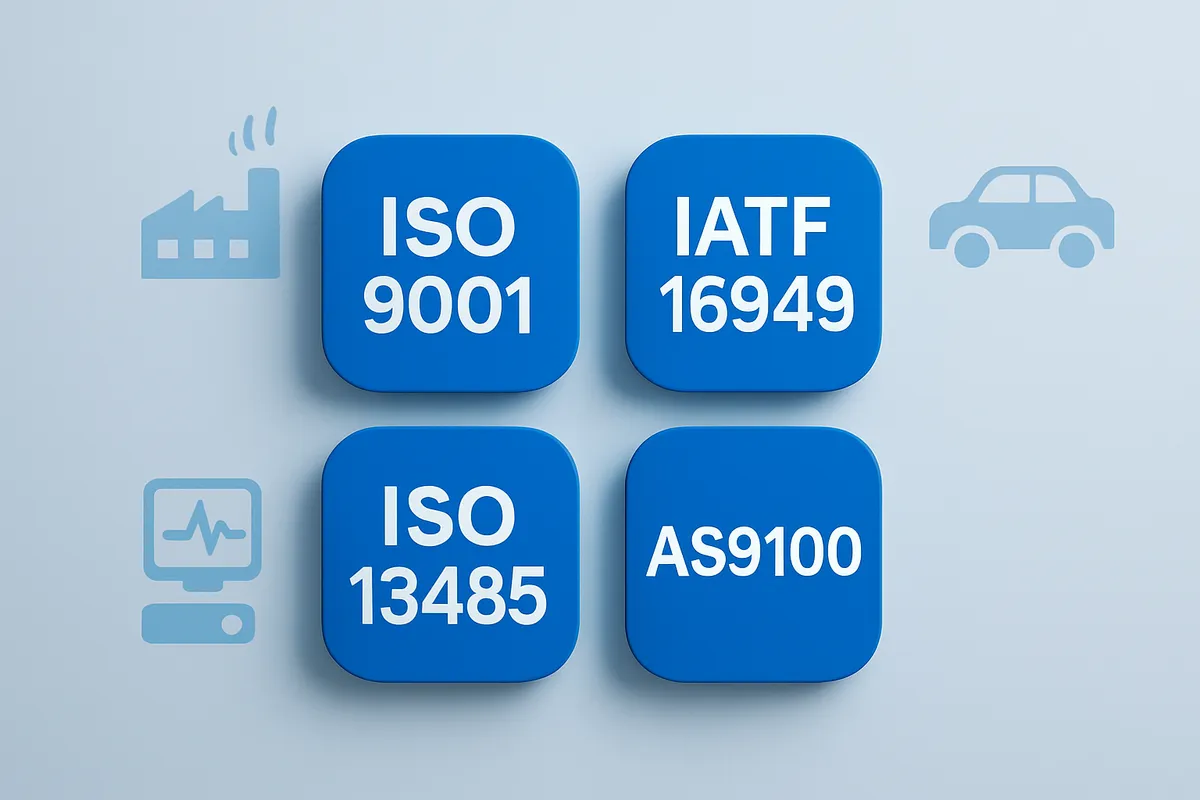
Understanding manufacturing quality standards is essential. Precision-manufactured parts typically must meet ISO 9001 as a baseline quality management standard, plus industry-specific certifications such as IATF 16949 for automotive, ISO 13485 for medical devices, or AS9100 for aerospace. Which standards apply depends on your industry, customer contracts, and the regulatory bodies governing your end market. These standards define how a manufacturer documents processes, controls materials, inspects parts, and traces defects back to their source, giving customers confidence that every part meets specification before it ships.
What Are Manufacturing Quality Standards and Why Do They Matter for Precision Engineering?
Manufacturing quality standards are the written, auditable requirements that define how a part must be made, measured, and documented, not the activities that enforce them. They set the specification; separate systems and inspections confirm the work meets it.
For precision engineering, this distinction carries more weight than it does in general fabrication. A bracket with a ±0.5mm tolerance that drifts slightly out of spec might still function. A surgical implant component or an automotive fuel injector held to ±0.001mm cannot drift at all without risking failure in the field. Tighter tolerances leave less room for ambiguity, which is why regulated sectors, medical devices, automotive, aerospace, build entire compliance structures around documentation that general machine shops rarely need.
How Do Quality Standards Differ From Quality Assurance and Quality Control in Practice?
Quality standards, quality assurance, and quality control sit in sequence, and conflating them causes real confusion in supplier contracts. A quality standard, ISO 9001, for example, specifies that a manufacturer must maintain calibrated measurement equipment. Quality assurance is the preventive system built to satisfy that requirement: a calibration schedule, a maintenance log, a training record showing operators know how to use the equipment correctly. Quality control is the inspection activity that happens on the shop floor, a technician measuring a machined bore with a calibrated gauge before the batch ships. The standard sets the rule, assurance builds the system around it, and control checks the output against it.
Buyers who ask a supplier “are you ISO 9001 certified?” are asking whether all three layers exist and connect to each other.
What’s the Relationship Between Quality Standards and Regulatory Compliance for Global Customers?
A recognized quality standard functions as shared proof of process control that regulators and customers in different countries can both recognize, without each one auditing the factory from scratch. A medical device company selling into the EU and the US doesn’t need to invent separate proof of manufacturing discipline for each regulator, ISO 13485 certification signals the same documented process control to both. This is the practical mechanism behind certification value: it doesn’t guarantee a zero-defect part, but it shifts the audit burden. A customer’s quality team can review a certificate and an audit history instead of inspecting every incoming lot or sending engineers to walk the production floor.
At GC INDUS, ISO 9001 and ISO 13485 certifications cover this baseline for OEM and medical device clients, so traceability documentation, material certs, inspection records, process logs, travels with each part rather than living in a filing cabinet only one customer can access.
Which Manufacturing Quality Standards and Certifications Does Your Precision Manufacturer Need?
The certification your parts require depends on your industry and your customer’s contract, not on what your manufacturer happens to hold already. ISO 9001 is the baseline nearly every buyer expects, while automotive, medical, and aerospace sectors layer additional, legally binding requirements on top of it.
What Are the Key Differences Between Automotive, Medical Device, and General Manufacturing Quality Standards?
ISO 9001 establishes the general-purpose quality management system that applies regardless of industry, documented processes, traceability, corrective action, and continuous improvement. Most OEMs treat it as a minimum qualifying credential before they will even review a supplier’s quote, independent of what the part is or where it ends up.
IATF 16949 builds on ISO 9001 for automotive suppliers, adding requirements such as production part approval process (PPAP) documentation, defect-prevention planning, and tighter control over process variation across high-volume runs. Automotive buyers use these added layers to catch deviations before parts reach an assembly line, since even a small tolerance drift can trigger a recall or warranty claim across thousands of units.
ISO 13485 does the equivalent job for medical devices, requiring risk management documentation, design-history records, and traceability tied to each device’s regulatory file. AS9100 covers aerospace, adding configuration management and first-article inspection on top of the ISO 9001 core. Each standard keeps the same foundation but adds controls specific to what happens if the part fails in the field, a recall, a patient injury, or a grounded aircraft.
Which Certifications Do Customers Typically Require, and What’s the Trade-Off in Pursuing Each One?
Customer contracts and end-market regulation decide which certification is mandatory, not manufacturer preference. A medical device company selling implantable products has no choice but to require ISO 13485 from every supplier in its chain, because regulators hold the device maker accountable for the full supply chain. A Tier 1 automotive supplier will require IATF 16949 as a contract term because its own customers mandate it upstream.
Pursuing any of these certifications means trading implementation effort and ongoing audit cost against access to regulated-sector contracts. Building the documentation, training staff, and passing periodic third-party audits takes sustained investment. But without the certification, a manufacturer is simply excluded from bidding, the standard functions as a gate, not a differentiator. GC INDUS holds both ISO 9001 and ISO 13485, which lets clients source general industrial parts and medical device components from the same production line without qualifying a second supplier for the regulated work.
How Do You Choose Between ISO 9001, Six Sigma, Lean, and Other Quality Frameworks?
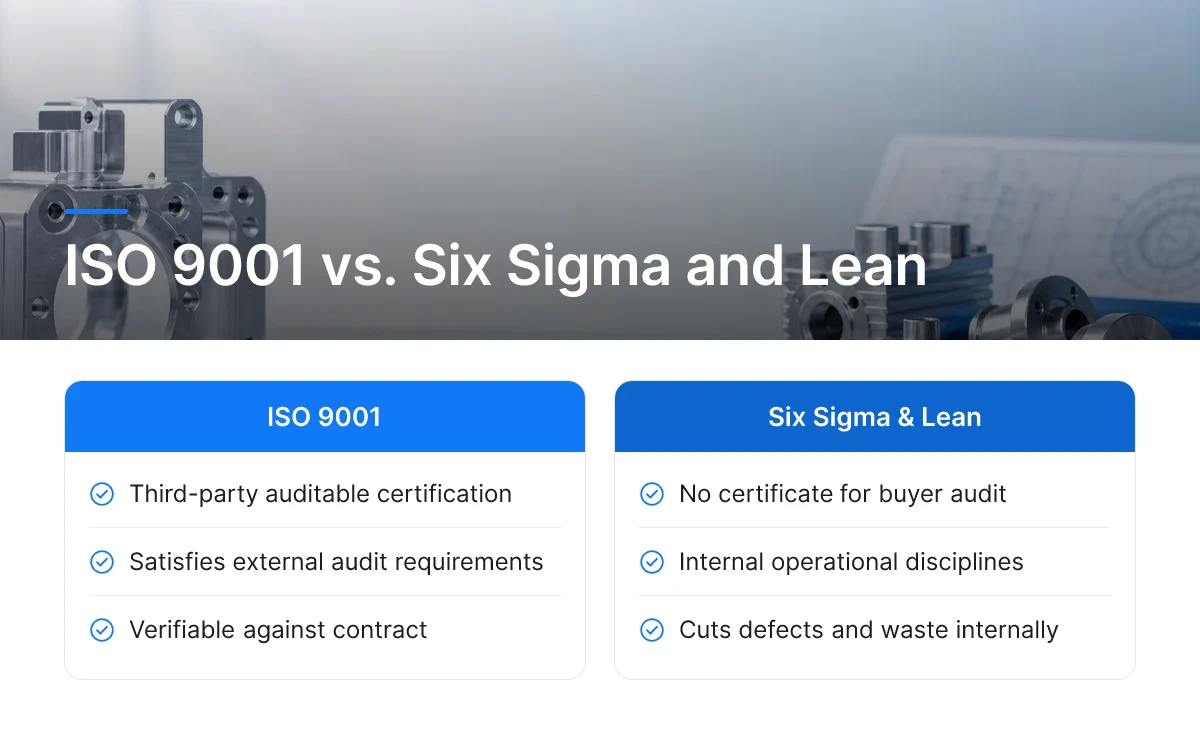
You don’t choose one, ISO certifications satisfy external audit and contractual requirements, while Six Sigma and Lean are internal methods for cutting defects and waste inside that certified system.
This distinction trips up a lot of procurement teams evaluating suppliers. ISO 9001 is a quality management system standard verified by a third-party auditor; a customer or regulator can check whether a supplier holds it. Six Sigma and Lean carry no certificate that a buyer can audit against a contract. They’re disciplines a manufacturer adopts to run its own operation better, Lean by stripping out steps that don’t add value for the customer, Six Sigma by narrowing process variation through statistical measurement. A shop can run both inside an ISO 9001-certified system: ISO sets the documented procedures and audit trail, Lean and Six Sigma tighten what happens inside those procedures.
How Does Implementation Timeline Differ Across Quality Standards Based on Business Size and Industry?
Smaller shops typically get ISO 9001 compliance in place first, then layer improvement methodologies on once volume justifies the investment.
A ten-person job shop serving a handful of industrial clients may need nothing beyond ISO 9001 to win contracts and pass audits. A high-volume operation running thousands of identical parts per month gets more return from Six Sigma’s variation-reduction tools, because small defect rates compound fast at scale. Industry adds another layer: automotive buyers generally expect IATF 16949 built on top of ISO 9001, and medical device programs require ISO 13485. GC INDUS holds both ISO 9001 and ISO 13485, which lets clients skip the sequencing question for medical work and go straight to a compliant partner.
How Do These Frameworks Complement Each Other Versus Compete for Resources?
They compete for the same engineers and training hours, not for the same purpose, so sequencing matters more than picking one framework permanently.
Running a Six Sigma project and an ISO internal audit in the same quarter pulls from the same pool of process engineers and the same training budget. A plant manager has to decide which problem to solve first: documentation gaps that threaten certification, or a defect rate that’s driving scrap cost. Most manufacturers sequence rather than run everything at once, stabilize the quality management system, then apply Lean to cut waste, then bring in Six Sigma once variation becomes the main constraint. Treating manufacturing quality standards and improvement methodologies as a staged roadmap, rather than a single permanent choice, avoids spreading limited engineering time too thin across competing initiatives.
What’s the Step-by-Step Process to Implement Manufacturing Quality Standards in Your Facility?
Implementing manufacturing quality standards follows six sequential stages: gap analysis, documentation, training, internal audit, corrective action, and external certification audit.
Each stage builds on the one before it, and skipping ahead usually shows up as a finding during the certification audit. A facility that writes procedures before it understands its gaps often documents the wrong things. One that trains staff before procedures exist has nothing consistent to train against.
What Tools, Documentation, and Training Do You Need to Deploy Quality Standards Effectively?
Start with a gap analysis that compares current practices against the target standard, ISO 9001, ISO 13485, or an automotive-specific requirement like IATF 16949. This identifies which processes already meet the standard and which need new controls, equipment, or oversight.
Documentation comes next, and it forms a backbone with four core elements: a quality manual describing the overall management system, work instructions detailing how each operation is performed, inspection records showing what was measured and when, and non-conformance logs tracking defects and their resolution. Auditors check for consistency across these documents, if a work instruction specifies a torque spec that doesn’t match the inspection record, that gap becomes a finding regardless of whether the part actually passed.
Training follows the documentation, but it is not one-size-fits-all. Operators need hands-on instruction tied to the specific work instructions they’ll follow on the floor, how to measure, what tolerance band is acceptable, when to flag a part. Quality staff need a different skill set entirely: internal auditing technique and root-cause analysis methods like 5 Whys or fishbone diagrams, since their job is to find gaps before an external auditor does.
After training, run an internal audit against the same checklist an external auditor would use. Findings get logged, corrective actions get assigned and verified, and only then does the facility schedule the external certification audit.
How Does BOM Management and Technology Integration Support Quality Standard Compliance?
A digital bill of materials (BOM) ties part revisions, supplier certifications, and inspection results to a single traceable record, which is what auditors look for when they ask “show me” rather than “tell me”.
Without this link, a facility might prove it has a quality manual and prove it inspected parts, but struggle to show which supplier’s certified material went into which revision of which part on a given production run. BOM and quality management software close that gap by connecting engineering change orders, supplier documentation, and inspection data in one place.
At GC INDUS, this kind of traceability underpins ISO 9001 and ISO 13485 compliance across CNC machining, die casting, and injection molding work, inspection records and material certifications stay linked to the specific part revision a client ordered, which matters when a medical device customer needs to trace a component back through its full production history.
What Are the Common Pitfalls When Deploying Manufacturing Quality Standards, and How Do You Avoid Them?
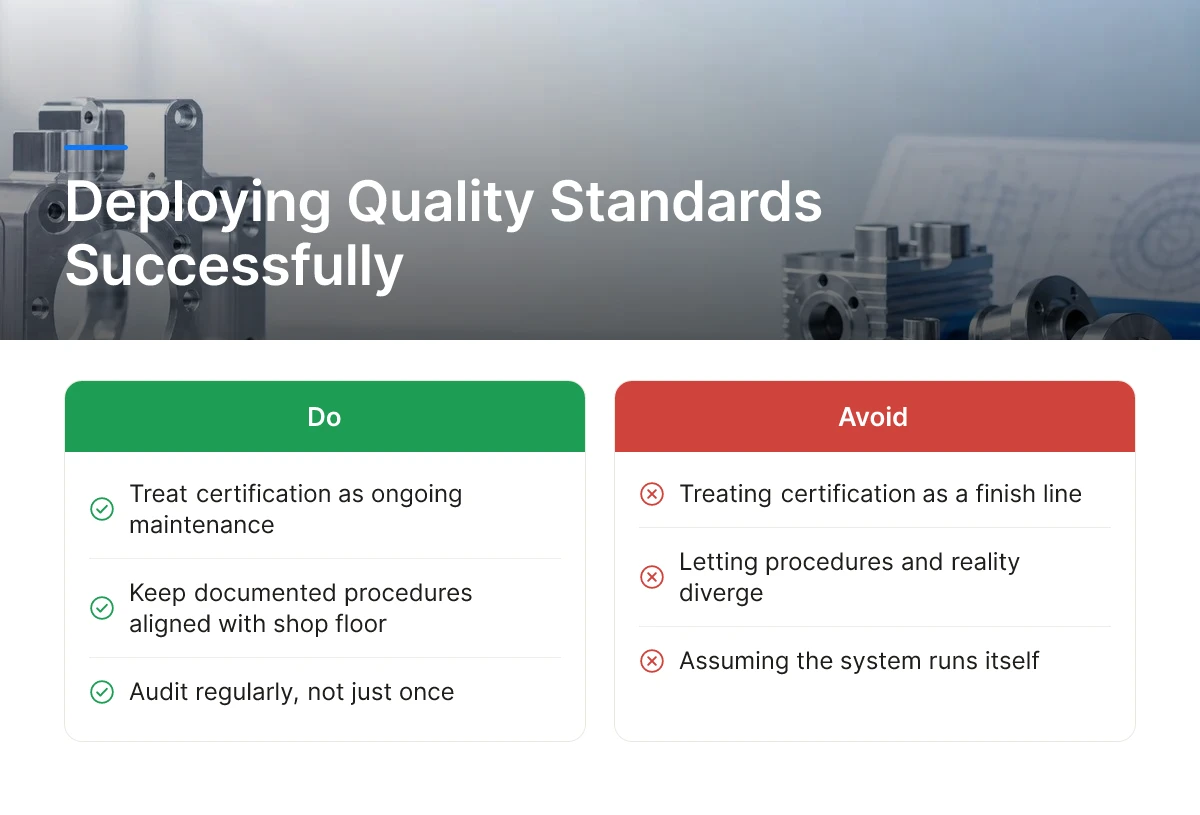
Most failures trace back to treating certification as a finish line instead of a maintenance obligation, which lets documented procedure and shop-floor reality quietly diverge.
What Implementation Failures Do Precision Manufacturers Encounter, and How Can You Prevent Them?
The most common mistake is auditing once and assuming the system runs itself afterward. A plant passes its ISO 9001 surveillance audit, the binder goes back on the shelf, and six months later operators are running a modified sequence that was never written into the work instructions. Nothing breaks immediately, parts still ship, customers still get their orders, but the gap between what’s documented and what’s actually happening on the floor widens with every shift change. The fix is procedural, not disciplinary: schedule internal reviews between external audits specifically to compare recorded procedure against observed practice, and update one or the other before the gap becomes a non-conformance.
Inadequate operator training causes a related but distinct problem. Documentation can be correct and detailed, yet execution still varies if the person running the machine was never trained on that specific revision of the work instruction. A new hire trained informally by a departing operator inherits whatever shortcuts that operator used, not the approved process. Role-specific training tied directly to current work instructions, repeated on a fixed schedule rather than once at onboarding, closes this gap. Retraining should trigger automatically whenever a work instruction changes, not wait for an annual refresher.
Under-resourced internal audits compound both problems. When internal audits happen infrequently, once a year instead of quarterly, or skipped when production schedules get tight, minor non-conformances accumulate unnoticed until the external auditor finds them in a formal report. By then, correcting them costs more and risks certification status. Precision manufacturers serving medical device or automotive customers under ISO 13485 or IATF 16949 generally cannot absorb that risk; the fix is staffing internal audits as a fixed calendar commitment, not a discretionary task.
How Do You Measure and Maintain Quality Standards Once They’re in Place?
Waiting for the next audit cycle to learn whether manufacturing quality standards are holding is reactive by design. Track non-conformance rates monthly, measure corrective action closure time rather than just whether a CAPA was opened, and monitor supplier quality scores as a leading indicator of incoming material risk. At GC INDUS, inspection protocols and ISO 9001 / ISO 13485 compliance checks run continuously across production rather than as a pre-audit scramble, which keeps non-conformance trends visible before they become audit findings.
Frequently Asked Questions
Do small manufacturers need the same quality certifications as large suppliers?
Smaller manufacturers need the same certifications if they serve the same regulated markets—certification requirements track the industry, not company size. A small machine shop supplying medical device components still needs ISO 13485, just as a large one does. Buyers qualify suppliers against the standard required for the part, regardless of headcount or revenue.
How long does it take to get ISO 9001 certified?
Most manufacturers take six to twelve months to reach ISO 9001 certification, depending on how mature their existing quality processes already are. The timeline covers gap analysis, documentation, internal audits, and corrective actions before the external certification audit. Companies with an informal quality system in place often move faster than those starting from scratch.
Can a manufacturer hold multiple certifications like ISO 9001 and IATF 16949 at the same time?
Yes, manufacturers routinely hold both, since IATF 16949 builds directly on the ISO 9001 framework rather than replacing it. A facility serving automotive and general industrial clients typically maintains ISO 9001 as its base system, then layers IATF 16949 or ISO 13485 on top for sector-specific requirements.
What happens if a manufacturer fails a quality standards audit?
A failed audit triggers a corrective action period, and certification can be suspended or revoked if gaps aren’t fixed within the auditor’s deadline. Minor nonconformities usually allow 30 to 90 days for correction with evidence submitted to the certifying body. Major nonconformities—like missing calibration records or untracked nonconforming parts—can halt shipments to customers who require that certification as a contractual condition.
Is Six Sigma a certification or a quality standard?
Six Sigma is a methodology and training credential, not a formal quality standard like ISO 9001. It gives individuals belt-level certifications (Green Belt, Black Belt) in statistical process improvement, but no regulatory body or customer contract requires “Six Sigma certification” the way they require ISO or IATF compliance.
Conclusion
Quality certification isn’t a formality—it’s the credential that determines which contracts you can bid on. ISO 9001 sets the baseline, IATF 16949 and ISO 13485 add sector-specific teeth, and full inspection protocols turn paper compliance into parts that actually hold tolerance. The manufacturers that win repeat OEM business pair the right certification with documented, auditable process control, not one without the other.
If you’re vetting a supplier for a new part, start by asking for their current ISO certificate number and audit date, then verify it directly with the issuing body before sending the RFQ.
Recommended Articles
Explore more from our content library:


