
Book Appointment Now

GC INDUS / MANUFACTURING KNOWLEDGE
Choosing the Best Steel Grades for Steel Machined Parts
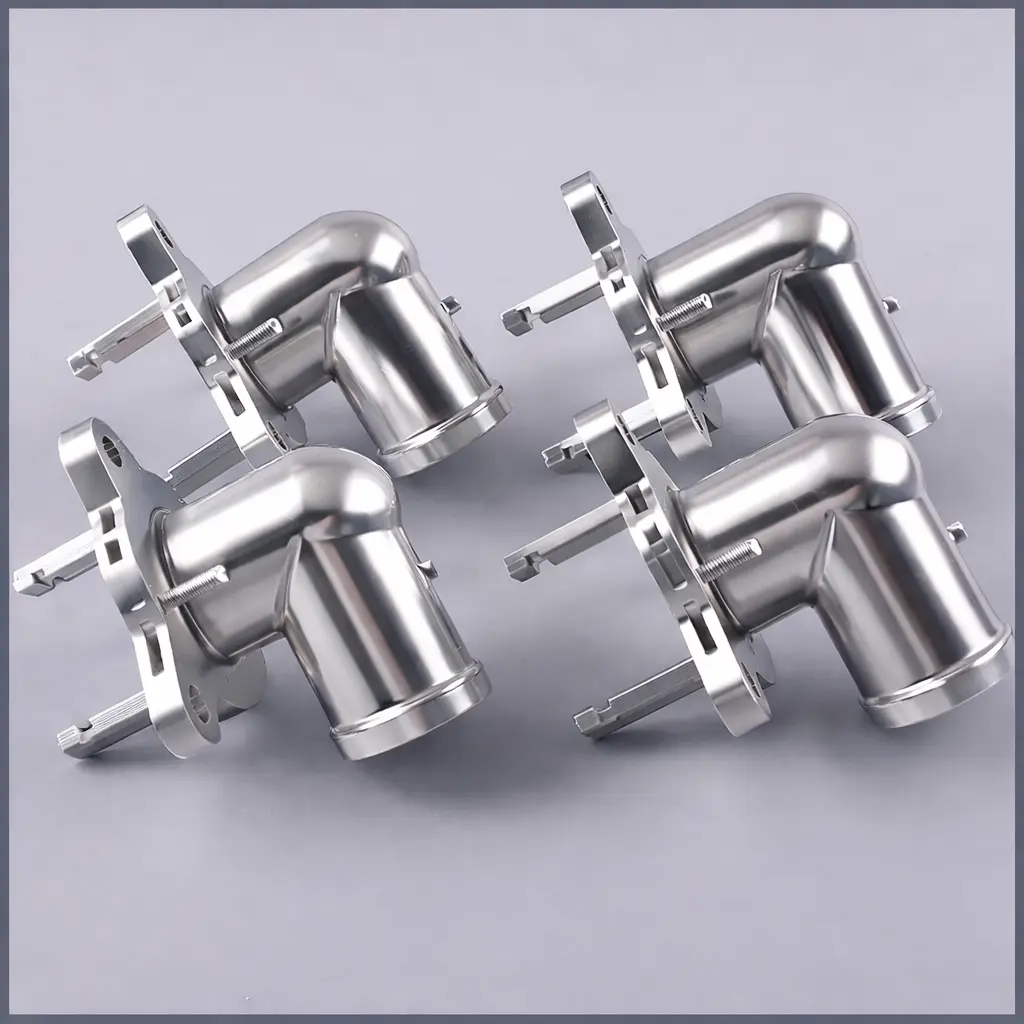
Understanding steel machined parts is essential. The best steel grades for precision machined parts balance cutting speed, tool wear, and tolerance stability, free-machining carbon steels like 1215 and 12L14 cut fastest and hold tight tolerances cheaply, while 303 stainless outperforms 304 and 316 for machinability thanks to added sulfur, at a small trade-off in corrosion resistance. Alloy steels such as 4140 sit in between, offering higher strength for load-bearing parts at a moderate machining cost. The right choice depends on whether your part needs maximum precision at low cost, corrosion resistance, or mechanical strength under stress.

Which Steel Grades Machine Best for Precision Parts?: steel machined parts
Free-machining grades like 1215 and 12L14 top the list for steel machined parts because added sulfur breaks chips cleanly and cuts tool wear, while stainless and alloy grades trade some of that ease for strength or corrosion resistance.
Steel is an iron-carbon alloy, often blended with manganese, chromium, or vanadium to adjust hardness and corrosion resistance. That composition is exactly what determines how a grade behaves under a cutting tool, and why two steels with similar strength ratings can produce wildly different results on a CNC lathe. For a closer look at how different alloys respond to cutting operations, see this overview of steel CNC parts machining.
Resulfurized carbon steels such as 1215 and 12L14 contain sulfur (and in 12L14’s case, a small lead addition) specifically to make machining faster and cheaper. The sulfur forms manganese sulfide inclusions that act as internal chip-breakers, so the material shears away in short, manageable pieces instead of long stringy ribbons that tangle in tooling. Shops running high-volume turning operations favor these grades when a part doesn’t need weld integrity or high fatigue strength, because cycle times drop and tool life stretches considerably. Lead-free alternatives using bismuth or higher sulfur content are increasingly common where environmental or recycling regulations limit lead content, offering similar chip control without the compliance exposure.
Is 304 or 316 Stainless Steel More Machinable, and When Would You Choose Each?
Neither 304 nor 316 machines as easily as 303 stainless, which adds sulfur specifically to improve cutting performance at a modest cost to corrosion resistance.
303 is the benchmark free-machining stainless: its sulfur content produces the same short-chip behavior seen in 1215 and 12L14, letting shops run higher speeds with less tool wear. 304 and 316, by contrast, lack that sulfur addition and tend to gum up cutting edges, generate built-up edge on inserts, and demand slower feeds and more frequent tool changes. 316 adds molybdenum for better corrosion resistance in marine or chemical environments, but that same alloying makes it tougher and stickier to cut than 304. Choose 303 when the part is a dry, low-corrosion application where machinability matters most; choose 304 or 316 when the end-use environment, medical fluids, saltwater, chemical exposure, demands the corrosion performance and the slower cycle time is an acceptable trade. Buyers comparing fabrication options for steel machined parts can also review steel parts fabrication and CNC steel cutting services for a sense of how different shops handle these grades.
What Makes Certain Steel Grades Easier or Harder to Machine to Tight Tolerances?
Gummy chip formation, work hardening, and heat buildup at the cutting edge are the three factors that push a grade toward the “difficult” end of the machinability scale.
Austenitic stainless grades like 304 and 316 work-harden quickly under cutting pressure, meaning each pass can leave the surface harder than the last, which complicates holding tight tolerances across repeated operations. Heat buildup at the tool tip accelerates wear and can distort small, precision-ground features before they’re finished. Alloy steels such as 4140 sit in a middle tier: higher strength and fatigue resistance than free-machining carbon steel, with machinability that’s manageable but requires tighter speed and feed control, making it a common choice for shafts, gears, and other load-bearing components.
In short, the factors that most often separate an easy-cutting grade from a difficult one include:
- Sulfur or lead content that promotes clean chip breaking
- Work-hardening tendency under repeated cutting passes
- Thermal conductivity and heat buildup at the tool edge
- Alloying elements like chromium, molybdenum, or vanadium that add strength but resist shearing
- Base hardness before any machining begins
How Do Material Properties Affect Machining Cost and Tolerance Capability?
Hardness and carbon content set the pace of every cut, and that pace determines how much a steel machined part costs before it ever reaches final inspection. Higher carbon content raises hardness, and harder material resists the tool rather than shearing away cleanly. That resistance forces slower cutting speeds, generates more heat at the tool edge, and wears cutting inserts faster, all of which get priced directly into the part.
What’s the Hardest Steel to Machine and Why Does It Matter for Your Project Budget?
Hardened tool steels and high-carbon alloys sit at the difficult end of the machining spectrum, and they cost more to cut, period. Steel’s mechanical profile comes from iron combined with carbon plus elements like manganese, chromium, vanadium, and tungsten, and each addition changes how the material responds to a cutting edge. Alloy steels in particular are selected for strength and wear resistance, but that same toughness is what slows down a spindle. A shop running a high-carbon or heavily alloyed grade burns through inserts faster, which means more tool changes, more setup time, and a higher per-part labor cost than a free-machining low-carbon equivalent. Shops that specialize in machined parts and solutions across a range of hardness levels are often better positioned to manage these cost trade-offs.
How Do Carbon Content and Hardness Influence Both Machining Speed and Final Precision?
Harder grades force slower feed rates and more frequent tool swaps, which stretches cycle time and pushes out lead time on every order. Steel machining is typically chosen specifically when a part must survive high-load, high-wear, or safety-critical conditions, which means the hardness that makes the part durable in service is the same property that slows the machine down on the shop floor. CNC turning and milling on these materials require tighter tooling control and more active process management just to hold dimensions steady.
Tight tolerances compound the problem. A hard-to-machine steel held to a tolerance near ±0.001mm typically needs roughing passes, a separate finishing pass, and in-process inspection between stages rather than a single cutting operation, because heat buildup and tool deflection on hard material cause dimensional drift that one pass can’t catch. CNC processes offer the repeatability to hold these tolerances, but repeatability on hard steel takes more passes, not fewer.
The practical fix is matching hardness to the actual tolerance the part needs, not the tolerance that sounds safest. A bracket with ±0.05mm tolerance doesn’t need a tool-steel grade chosen for a precision shaft, over-specifying hardness adds tool wear and cycle time with no functional benefit. At GC INDUS, engineers review tolerance callouts against grade selection during quoting, so customers machining steel parts pay for the precision their application requires and not for unnecessary hardness.

What’s the Difference Between Stainless, Alloy, and Carbon Steel for Machined Parts?
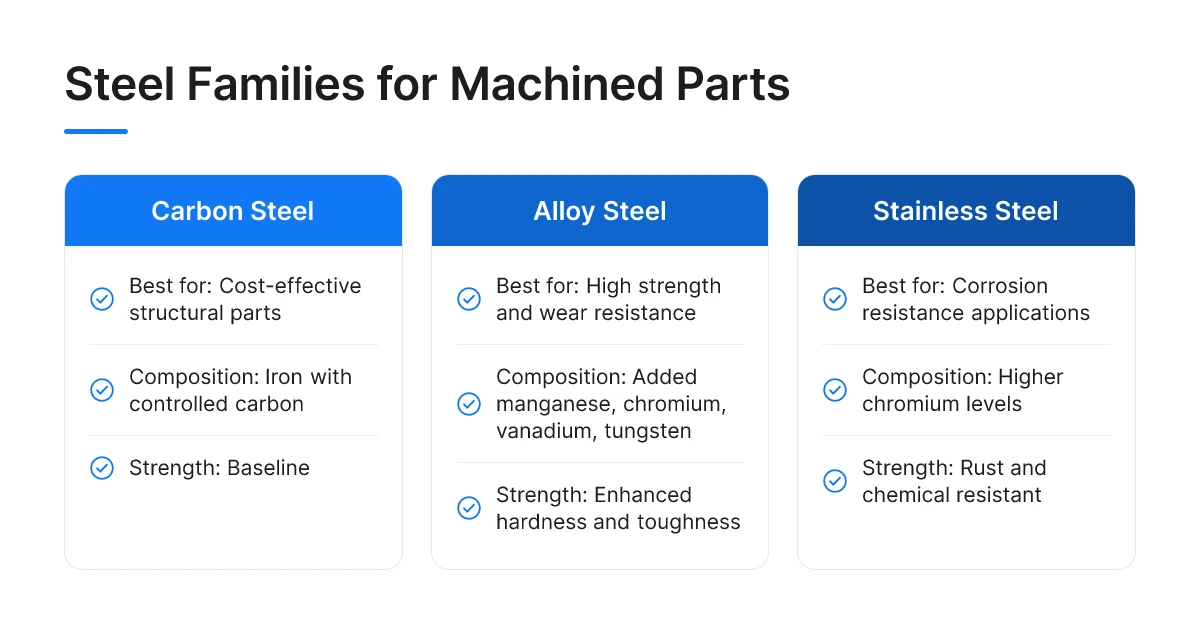
Carbon steel wins on cost for structural parts, alloy steel wins on strength and wear resistance, and stainless steel wins on corrosion resistance, no single grade wins all three.
Each family serves a different job on the shop floor. Carbon steel is mostly iron with controlled carbon content and little else, which keeps it affordable and easy to cut. Alloy steel adds elements such as manganese, chromium, vanadium, or tungsten to boost hardness, toughness, or fatigue resistance beyond what plain carbon steel offers. Stainless steel adds chromium at higher levels specifically to resist rust and chemical attack, which matters most in medical, food-contact, and outdoor applications. Picking the right family starts with asking what the part needs to survive, load, friction, moisture, or just a tight budget. Buyers researching steel machining options will find similar guidance on matching material family to application demands.
What Metals Can Be Machined, and Which Ones Work Best for Custom Precision Applications?
Steel shares the machining floor with aluminum, brass, titanium, and several other metals, each suited to different weight, conductivity, or cost requirements. Aluminum cuts faster and weighs about a third as much as steel, making it the default choice for aerospace brackets and housings where weight matters more than raw strength. Brass machines cleanly and resists corrosion in low-load applications like fittings and electrical components, often at a lower tooling cost than stainless. Titanium outperforms steel on strength-to-weight ratio and biocompatibility, which is why it shows up in implants and high-performance aerospace parts despite being harder and slower to machine. GC INDUS works across this full material range, steel and stainless alongside aluminum, magnesium, and iron, so the material choice gets made on part requirements, not on what one supplier happens to stock.
How Do Performance Trade-Offs Between Steel Grades Affect Your Part’s Real-World Durability?
Corrosion resistance, strength, and machinability pull against each other, so improving one property usually means giving up some of another. Stainless steel’s chromium content that stops rust also makes it gummier to cut, which raises tool wear and cycle time compared to free-machining carbon steel. Alloy steel’s hardness improves wear resistance in high-friction applications like gears and shafts, but that same hardness can demand slower feed rates and more frequent tool changes. Carbon steel cuts fast and cheap but offers no real defense against moisture or chemical exposure, which rules it out for anything that touches water, food, or bodily fluids.
These trade-offs shape how engineers pair steel machined parts with specific use cases. Brackets, fasteners, and low-stress structural components typically specify carbon steel because cost matters more than corrosion resistance. Shafts, gears, and load-bearing components lean toward alloy steel, where fatigue strength and wear resistance justify the added machining difficulty. Medical devices and food-processing equipment call for stainless steel almost by default, since corrosion resistance and cleanability outweigh the higher per-part cost. Matching the grade to the application, not defaulting to the strongest or cheapest option, is what keeps a part performing for its full service life.
How Do You Balance Material Cost, Lead Time, and Precision Tolerances?
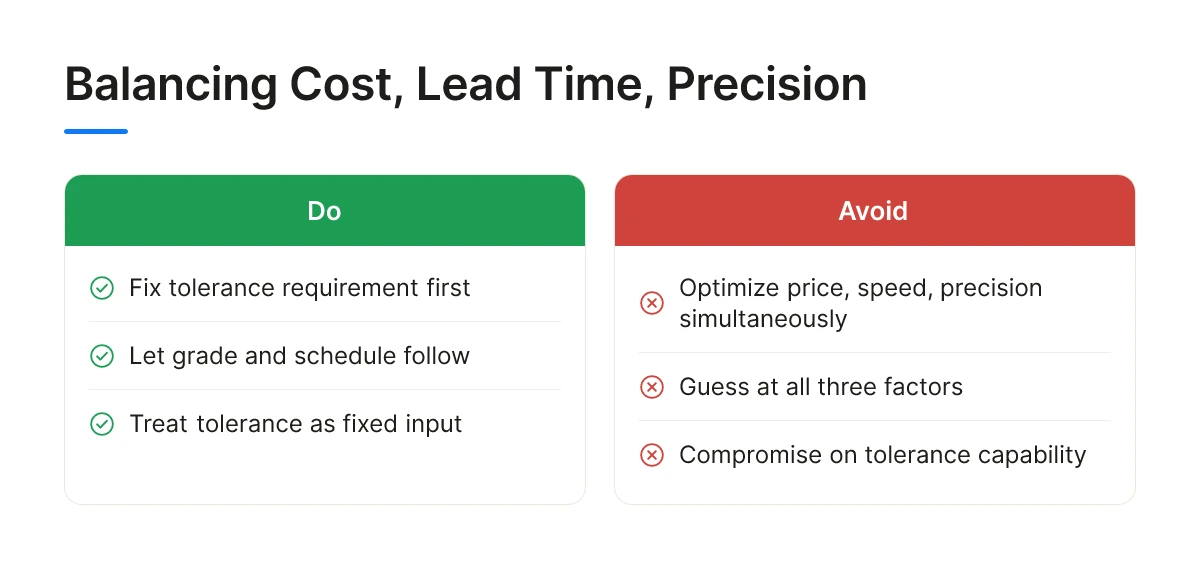
Balancing cost, lead time, and tolerance on steel machined parts means fixing your tolerance requirement first, then letting grade and schedule follow from that decision rather than guessing at all three at once.
Buyers who try to optimize price, speed, and precision simultaneously usually end up compromising on the one factor they can least afford, tolerance. A more reliable approach treats tolerance as the fixed input and treats cost and lead time as variables you adjust around it.
What Lead Times and Rush Order Capabilities Should You Expect From a Precision Steel Machining Partner?
Expect lead time to hinge on stock availability and machinability of the chosen grade before a single cut is made.
Common grades like 1018 or 4140 are typically stocked in standard bar and plate sizes, so a shop can start cutting immediately. Specialty or certified aerospace-grade steels often require mill orders or certified material pulls, which can add days to a schedule regardless of how fast the CNC program runs. A shop quoting a rush order on an uncommon alloy is quoting a material sourcing delay, not a machining delay, worth asking about directly before assuming the bottleneck is on the shop floor.
How Do Material Choice and Production Method Impact Delivery Schedules for Tight-Tolerance Parts?
Harder steels slow cycle times on every production method, so the method you pick has to match the grade’s machinability or your schedule slips.
CNC milling handles prismatic, multi-feature steel machined parts but runs slower as hardness climbs, since tool wear and reduced feed rates stretch cycle time on hardened or high-carbon grades. Swiss turning suits small-diameter, high-volume turned parts and holds tight tolerances efficiently on free-machining grades, but loses that speed advantage on tougher alloys requiring lower spindle speeds. Multi-axis machining adds setup time for complex geometries, and that setup cost compounds when the material itself cuts slowly. Matching method to material hardness up front avoids discovering the mismatch mid-production. Suppliers offering custom machined components across multiple production methods can help buyers find the right match for a given grade and tolerance.
Flexible minimum order quantities change this calculation. GC INDUS accepts orders starting at a single piece, which lets buyers prototype in an easier-to-machine grade, mild steel instead of hardened tool steel, for instance, before committing to the production-grade alloy and larger run. That sequence catches design issues while machining is still fast and inexpensive.
- Step 1: Define the tolerance the part actually needs, not the tightest tolerance available.
- Step 2: Match that tolerance to a steel grade with adequate machinability and strength.
- Step 3: Evaluate whether a rush order is realistic given that grade’s cutting speed and stock availability.
What Quality Certifications Should You Require From a Steel Machining Partner?
Require ISO 9001 at minimum for any supplier producing steel machined parts, and add AS9100 or ISO 13485 documentation if your application is aerospace or medical.
Certifications are not decoration on a supplier’s website. They are proof that a quality system exists, is audited, and is followed on the shop floor, not just described in a sales deck. For a transactional buyer who cannot inspect a shop in person before placing an order, certification and documentation are the closest substitute for firsthand trust.
Which Certifications (ISO, AS9100, etc.) Matter Most for Your Industry and Application?
ISO 9001 verifies that a manufacturer has a documented, repeatable quality management system covering process control, corrective action, and traceability, it confirms the system exists, not that every part meets a specific tolerance. AS9100 builds on ISO 9001 with added requirements for configuration management, risk assessment, and first-article inspection, reflecting the zero-defect expectations of aerospace programs.
Which certification you should demand depends on where the part ends up. Medical device components need full material and process traceability back to raw stock, which is why ISO 13485 compliance matters for any supplier making implantable or surgical hardware. Aerospace work generally requires AS9100. General industrial parts, brackets, housings, fixtures, tooling components, are usually well served by ISO 9001 alone, provided the supplier backs it with real inspection data.
How Can You Verify That a Machining Partner Can Consistently Deliver Documented Tight Tolerances?
Ask for the paperwork before you ask for the quote. A supplier serious about precision will readily produce CMM (coordinate measuring machine) inspection reports, first-article inspection records, and material certifications tied to a specific job, not generic marketing claims about tolerance capability.
These documents matter because they show a tolerance was measured and achieved, not just targeted on a drawing. A CMM report ties dimensional data to the actual part in hand. A first-article inspection confirms the first unit off a production run matches spec before the rest of the batch proceeds. Material certs confirm the steel grade delivered is the grade ordered, with mill traceability.
Beyond documents, ask directly how a supplier tracks and corrects deviations. A credible answer names a process: statistical process control, root-cause analysis, corrective action reports tied to specific nonconformances. GC INDUS backs its ±0.001mm tolerance claims on steel machined parts with full inspection protocols under ISO 9001 and ISO 13485 certification, giving buyers documentation they can check rather than assurances they have to take on faith.
If a supplier cannot produce a sample inspection report on request, treat that as a disqualifying signal, regardless of how the quote reads.

Frequently Asked Questions
Is 303 or 304 stainless steel easier to machine for precision parts?
303 stainless machines far easier than 304 because of its added sulfur content, which breaks chips cleanly and reduces tool wear. 304 offers better corrosion resistance and weldability, so it’s the right choice when parts face harsh environments, but 303 is the default pick whenever corrosion demands allow it.
Why do harder steel grades cost more to machine?
Harder steels wear down cutting tools faster and require slower speeds and feeds, which adds machine time and tooling cost per part. Grades that need heat treatment before or after machining add process steps, and tighter tolerances on hard materials often mean more frequent in-process inspection.
Can carbon steel parts be machined to the same tolerances as stainless steel?
Yes, carbon steel can hold tolerances as tight as stainless steel, including ±0.001mm on capable CNC equipment. Low-carbon grades actually machine more easily than many stainless alloys, so tolerance isn’t the limiting factor, material selection should instead depend on strength, cost, and corrosion requirements.
What steel grade is best for parts that need both strength and corrosion resistance?
316 stainless steel is the common choice because it combines solid mechanical strength with corrosion resistance better than 304 or carbon alloys, thanks to added molybdenum. For higher-strength applications where some corrosion exposure is acceptable, alloy steels like 4140 with a protective coating are a cost-effective alternative worth evaluating against project specs.
How do you choose between different suppliers for steel machined parts?
Compare suppliers on certifications, minimum order quantities, documented tolerance capability, and material range rather than price alone. A supplier able to produce CMM inspection reports and material certifications on request, and willing to recommend a grade suited to your tolerance rather than the most expensive option, is generally a safer long-term partner for steel machined parts.
Conclusion
Steel grade selection comes down to three tradeoffs: machinability versus strength, corrosion resistance versus cost, and tolerance requirements versus cycle time. 303 stainless, low-carbon grades, and 4140 alloy steel each solve a different combination of these constraints, so the right choice depends on your part’s operating environment, not a general preference for “the best steel.”
GC INDUS machines steel, stainless, and alloy grades to tolerances as tight as ±0.001mm, with ISO 9001 and ISO 13485 quality protocols and MOQs starting at one piece. Send us your drawing and target tolerance, and we’ll recommend a grade suited to your application before you commit to a production run.
Recommended Articles
Explore more from our content library:


