
Book Appointment Now

GC INDUS / MANUFACTURING KNOWLEDGE
Why Stamped Metal Parts Win for High-Volume Production

Stamped metal parts win for high-volume production because the process turns coils or sheets into finished components in a single die stroke, so tooling cost is paid once while per-part cost drops sharply as volume rises. Once a die is built and proven, cycle times are measured in seconds, tolerances stay repeatable across hundreds of thousands of cycles, and material waste stays low compared with machining from solid stock. That combination of speed, repeatability, and low marginal cost is why OEMs choose stamping over machining or casting for brackets, housings, terminals, and structural parts ordered in volume.

What Is Metal Stamping and How Does the Stamping Process Work?
Metal stamping converts flat sheet or coil into a shaped part by pressing it between a punch and die, cutting and forming it in one controlled stroke.
The cycle is mechanical and repeatable. A coil or pre-cut blank feeds into the press, the die set closes and performs its cutting or forming action, the finished piece ejects, and the press resets for the next stroke. Stamping covers several distinct forming techniques—blanking, punching, bending, and piercing among them—run in sequence or combination depending on part geometry. Producers who need thousands or millions of identical stamped metal parts rely on this repeatability to hold tolerance from the first part to the last.
Tooling choice depends on volume and part complexity. A single-station die performs one operation per stroke and suits low-volume or simple parts, where the strip or blank is manually or mechanically repositioned between hits. A progressive die strings multiple stations along one continuous strip, so each stroke advances the material and completes a different operation—piercing at station one, bending at station two, final blanking at station three—until a finished part drops out at the end of the line. High-volume automotive brackets, electrical terminals, and appliance hardware almost always run on progressive tooling because it eliminates repositioning and keeps cycle times short.
What Is the Difference Between Stamped Metal and Stamped Steel?
“Stamped steel” describes a substrate, not the process—steel is just one of several metals that can be stamped.
Stamping works on aluminum, copper, brass, and various steel and stainless grades, with material choice driven by strength, conductivity, corrosion resistance, or cost. Calling a part “stamped steel” only tells you what it’s made from; “stamped metal parts” is the correct umbrella term covering any substrate run through a stamping press.
What Are the Main Types of Stamping Operations and When Is Each Used?
Each stamping operation solves a different shaping problem, and most parts combine several in one die or press line.
- Blanking: cuts a flat shape from the sheet or coil—the first step for most parts, producing the outline before any forming happens.
- Piercing: punches holes or slots into the blank, used for mounting points, fastener clearance, or ventilation.
- Bending: folds the flat blank along a line to create brackets, flanges, or enclosure walls.
- Deep drawing: pulls flat metal into a die cavity to form cups, housings, or shells with depth, common in fuel tanks and battery enclosures.
- Coining: applies high pressure to imprint fine detail or hold precise flatness, used for identification marks or tight-tolerance features.
Lubricant and press tonnage govern how consistently these operations run. Lubricant reduces friction between metal and die, limiting galling and extending die life; tonnage must match material thickness and part geometry, since under-tonnage causes incomplete forms and over-tonnage accelerates die wear. Getting both right is what keeps stamped metal parts dimensionally consistent across long production runs.
What Types of Stamped Metal Parts Can Be Manufactured, and Which Materials Work Best?
Stamping produces brackets, enclosures, terminals and connectors, springs, EMI shielding, and structural chassis components, with material choice driven by strength, conductivity, corrosion resistance, and weight targets. The category spans from a simple bent mounting bracket to a deep-drawn enclosure with dozens of features per part.
Automotive brackets and mounting hardware, clips, retainers, and fasteners cover the structural side of the business, while ECU enclosures, EMI shields, and spring finger contacts serve electronics applications where signal integrity and grounding matter as much as shape. Appliance work adds electrical components, ground clips, panel hardware, and torsion, compression, and extension springs, parts that need consistent spring rate across tens of thousands of cycles. HVAC applications bring baffles, bypass valves, and tube support brackets into the mix, each with its own dimensional tolerance driven by airflow or fit-up requirements.
What Metals and Materials Are Suitable for Stamping, and How Do Material Choices Affect Part Performance?
Material selection trades off cost, strength, conductivity, and corrosion resistance, and the right choice depends on what the part has to survive in service.
- Low-carbon steel, the default for cost-driven structural brackets and chassis parts where strength matters more than appearance.
- Stainless steel, chosen when the part faces moisture, chemicals, or repeated washdown, common in medical and appliance applications.
- Aluminum, used where weight reduction matters, particularly in automotive and portable electronics housings.
- Copper and brass, reserved for terminals, connectors, and springs that need electrical conductivity or specific spring temper.
Ductility and sheet thickness determine which forming operations a material can survive. A highly ductile, thin-gauge low-carbon steel tolerates deep drawing into an enclosure shape, while a thicker or less ductile stainless grade may crack under the same draw ratio and instead suits simple bending or blanking. Springback, the tendency of formed metal to partially return to its original shape, also varies by alloy and hardness, and toolmakers compensate for it in die design rather than fighting it during production.
Material choice also sets the finishing path. Steel parts often need plating or a protective coating to resist rust, stainless parts may only need passivation, and aluminum parts commonly get anodized for wear resistance, decisions that connect directly to a shop’s surface finishing capabilities alongside the stamping operation itself.
Which Industries Rely on Stamped Metal Parts, and What Are Their Specific Application Requirements?
Automotive, electronics, appliances, and industrial equipment account for most demand, each placing a different constraint on tolerance or finish. Automotive buyers push for repeatable dimensions across high-volume runs since brackets and clips feed automated assembly lines. Electronics manufacturers need tight flatness and conductivity on connectors and EMI shields to avoid signal loss. Appliance makers prioritize consistent spring force and corrosion resistance for components exposed to moisture. GC INDUS supports these requirements through sheet metal fabrication paired with in-house surface treatment, giving OEM and medical device clients a single source for formed parts and the finishing their application demands.
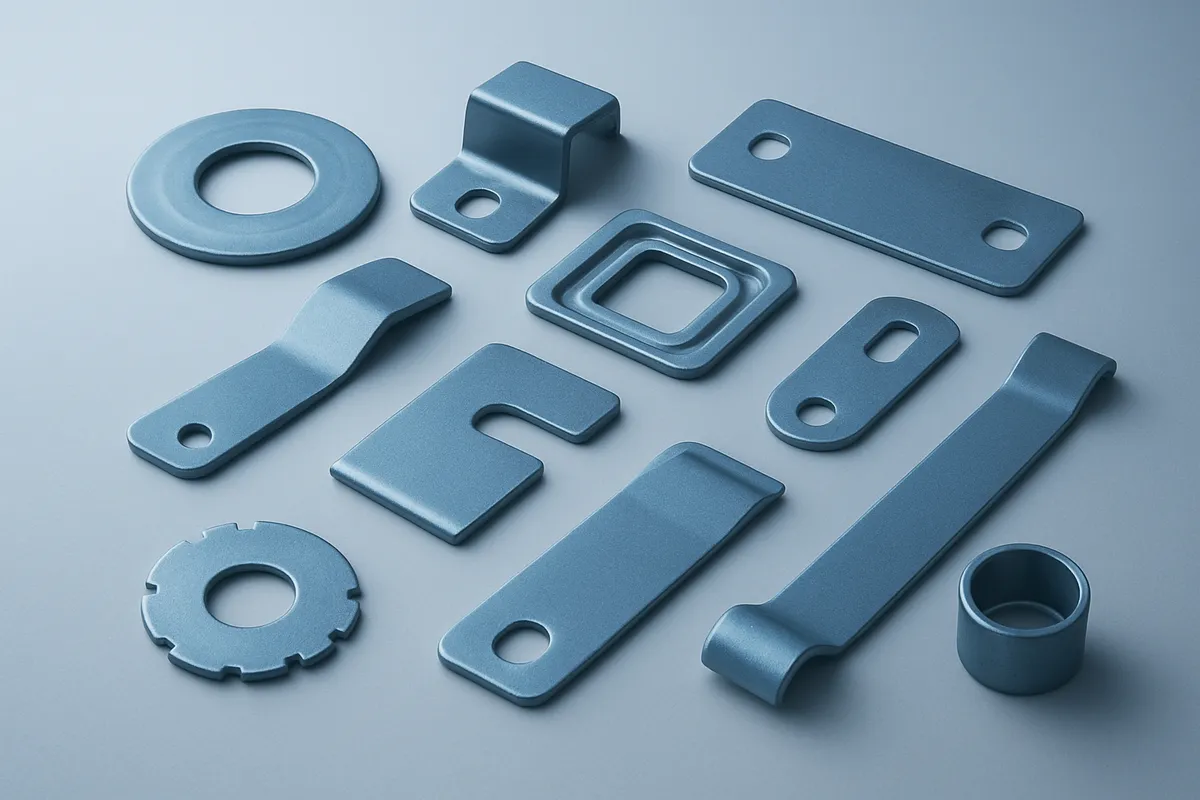
How Do You Achieve Tight Tolerances and High-Volume Production with Stamped Metal Parts?
Tight tolerances at high volume come from removing human variability at every step: hardened tooling, guided press strokes, and die designs that force the metal into the same shape thousands of times in a row.
A manual or single-point process depends on an operator’s hand, eye, and fatigue level from part to part. Stamping replaces that with a die set built to a fixed geometry and a press that guides the ram along the same path stroke after stroke. Hardened tool steel resists wear over long runs, so the 500th part comes out the same size as the 5,000th. This is why stamped metal parts hold repeatable dimensions in ways that hand-forming or single-point cutting cannot match.
Progressive dies push this further. Each station in the die performs one fixed operation, piercing, bending, forming, on the strip as it advances, and every part passes through the identical sequence of stations. There’s no operator decision at any step, which is the mechanism that keeps part 1 and part 100,000 within the same tolerance band. Fourslide tooling and transfer dies extend this same logic to more complex geometries, feeding stock from multiple directions without adding manual handling.
What Quality Standards, Certifications, and Inspection Procedures Ensure Stamped Parts Meet Tight Tolerance Requirements?
Documented inspection protocols under ISO 9001 catch dimensional drift before it turns into scrap, through first-article inspection, in-die sensors, and statistical sampling plans.
First-article inspection confirms the die produces a conforming part before a full run starts. From there, sampling plans pull parts at set intervals to check for tool wear, and some die sets carry in-die sensors that flag misfeeds or broken punches mid-stroke. GC INDUS runs these checks under ISO 9001 quality management, with tolerances held as tight as ±0.001mm on precision work and inspection records kept for every batch. For medical-grade tolerance requirements, our ISO 9001 precision manufacturing protocols add the traceability that regulated buyers need to sign off a supplier.
How Does Stamped Metal Manufacturing Compare to Other Production Methods in Terms of Cost, Speed, and Precision?
Stamping wins on per-part cost and cycle time once volume climbs; CNC machining wins on complex geometry or very low quantities.
A progressive die can produce a finished part in a single press stroke, so cycle times measure in seconds rather than the minutes a CNC program needs to cut the same shape from solid stock. That advantage compounds across production runs in the thousands or millions. Casting can match stamping on shape complexity but usually needs secondary machining to hit tight tolerances, adding steps back into the process. Machining still wins where geometry is too intricate for a die, or where order quantities are too small to justify tooling cost, a tradeoff worth weighing before committing to stamped metal parts as the production route.
What Cost, Lead Time, and Quality Factors Should You Weigh When Choosing Stamped Metal Manufacturing?
Four variables drive cost and schedule for stamped metal parts: tooling investment, part complexity, material choice, and the tooling class you select for your expected volume.
Understanding how these interact lets you read a quote critically instead of comparing bottom-line numbers across suppliers with different assumptions baked in.
How Do Production Volume, Part Complexity, and Material Choice Affect Stamped Metal Part Pricing?
Tooling is the dominant upfront cost in metal stamping, and it amortizes across your order, the more parts you run against that die, the lower the tooling cost contributes to each piece. A die built for a bracket might represent most of the cost on a run of 500 units but becomes a minor line item once that same die produces 50,000. This is why stamping quotes almost always ask for annual volume before pricing per-piece cost: volume is the lever that moves a job from premium to budget-friendly on a per-part basis.
Part complexity moves the needle independently of volume. A single-station blank-and-punch part costs less to tool and run than one requiring multiple progressive die stations, tight tolerance zones, or secondary operations like tapping, welding, or plating. Each additional station adds engineering time, die maintenance, and inspection points, all of which shift a job from budget-friendly toward mid-range or premium pricing, regardless of volume.
Material selection affects both piece cost and die wear. Softer metals like aluminum stamp with less tonnage and extend die life, while harder alloys and stainless steel increase cutting force and accelerate tool wear, which suppliers factor into their quoted maintenance and replacement costs over the life of the tooling.
What Lead Times and Production Timelines Should You Expect for Short-Run Versus High-Volume Stamped Metal Orders?
Short-run and prototype orders typically use simpler or soft tooling, dies designed for a limited number of cycles, which keeps upfront tooling cost lower but raises the per-part cost and doesn’t hold up under sustained high-volume production. Production tooling, by contrast, is hardened and engineered for hundreds of thousands of cycles, with a longer build lead time upfront but a much lower steady-state per-part cost and shorter cycle times once running.
That’s the practical case for MOQ flexibility: producing prototype or pilot quantities on soft tooling lets you validate fit, function, and tolerances before committing capital to hardened production dies. GC INDUS supports this path directly, accepting orders from a single piece so engineering teams can confirm a design before scaling into full production runs, avoiding the expense of retooling after a design error surfaces downstream.
How Should You Design Parts for Stamping to Optimize Cost and Manufacturability?
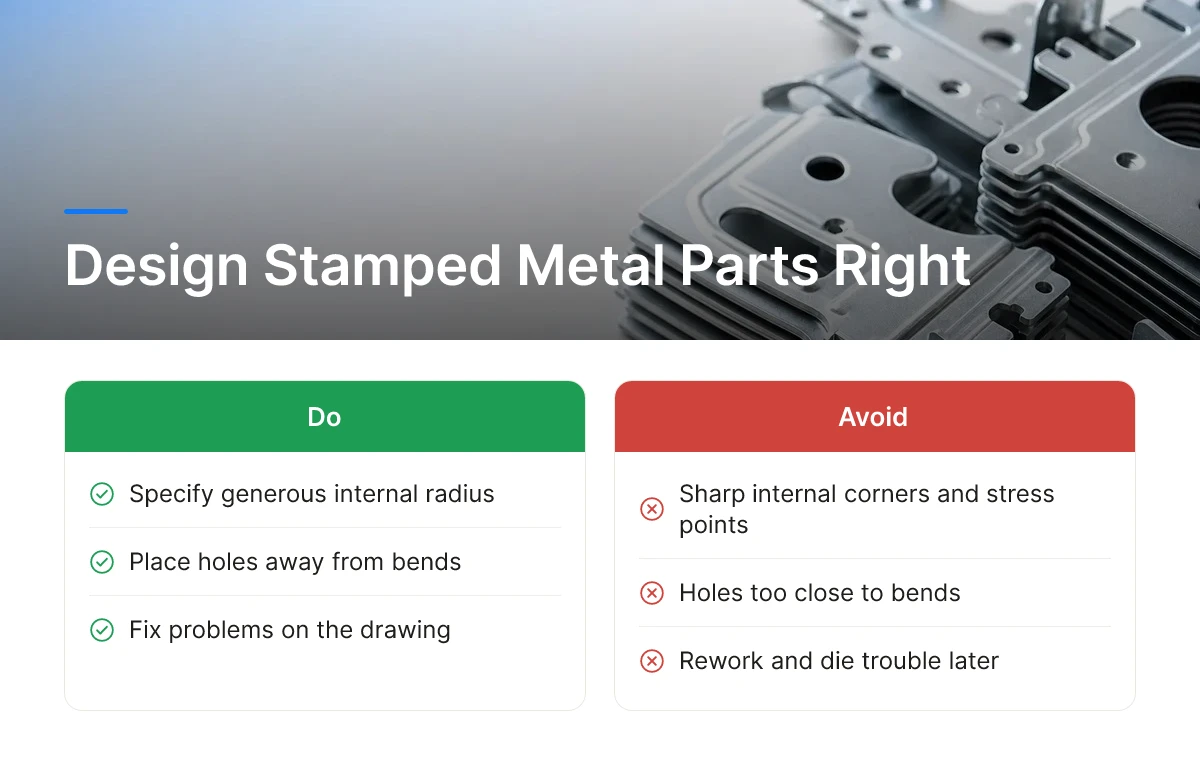
Design choices made before a die is cut determine most of the cost, scrap rate, and rework risk in stamped metal parts, fixing a problem on the drawing is far cheaper than fixing it in steel.
What Are Common Design Mistakes That Increase Stamping Costs, and How Can They Be Avoided?
Three mistakes show up repeatedly on drawings that later cause die trouble. Sharp internal corners concentrate stress and become crack initiation points under repeated cycles, so designers should specify a generous internal radius rather than a true 90-degree corner. Holes placed too close to a bend distort during forming because the material around the hole hasn’t stabilized yet, which is why hole-to-bend and hole-to-edge distances need to scale with material thickness. Inconsistent wall thickness across a part causes uneven material flow through the die, leading to thinning in some zones and excess buildup in others.
Minimum bend radius rules exist because bending metal below a certain radius stretches the outer fiber past its elongation limit, producing cracks or tears at the bend line. Hole-to-edge distance rules serve a similar purpose: punching too close to an edge or a bend weakens the die section and can shear the material unevenly, damaging both the part and the tooling over repeated strokes. Both rules are simple to apply at the drawing stage and expensive to ignore once tooling exists.
How Can Design Optimization and Simulation Improve Stamped Part Performance and Reduce Production Waste?
Forming simulation software models how a blank will flow through a die before any steel is cut, predicting springback, thinning, and wrinkle risk so engineers can adjust geometry or material grade in advance. This matters because stamping is inherently a forming process, bending and piercing sheet stock in a press, and small deviations in springback compound across a production run if not caught early.
Consolidating operations into a progressive die, combining bending, piercing, and forming stations into one continuous strip, cuts the number of secondary operations and manual handling steps a part needs after the press cycle. Fewer handoffs mean fewer chances for dimensional drift and lower per-part labor cost, which is the core economic argument for high-volume stamping programs.
The most reliable way to catch these issues is a design-for-manufacturability (DFM) review with the manufacturer’s engineering team before tooling starts. GC INDUS engineers review CAD files during quoting to flag bend radii, hole placement, and wall-thickness issues on sheet metal fabrication jobs, catching problems while the drawing is still cheap to change.
Frequently Asked Questions
What is the difference between stamped metal and stamped steel?
“Stamped steel” refers to one material category, while “stamped metal” covers any sheet metal formed by a stamping press, including aluminum, brass, copper, and stainless steel. Steel is the most common choice for structural brackets and automotive parts because of its strength and low cost, but stamping shops routinely work with other alloys depending on corrosion resistance, weight, or conductivity requirements.
Can stamped metal parts be produced in small prototype batches before committing to full tooling?
Yes, many shops offer soft tooling or low-volume processes to validate a design before cutting a full production die. Options include laser-cut blanks, short-run dies, or bridge tooling that produces functional prototypes in the actual material. GC INDUS accepts orders from 1 piece across its manufacturing processes, which lets engineering teams test fit and function before committing to hard tooling costs.
How do you know if a part is better suited to stamping than CNC machining?
Stamping wins on flat or formed sheet metal parts needed in high volumes; CNC machining wins on complex geometry, thick sections, or tight tolerances at lower volumes. If a part is a bracket, clip, or enclosure under roughly 6mm thick and you need thousands of units, stamping usually costs less per piece. If it needs internal features, deep pockets, or holds tolerances near ±0.001mm, machining is the better fit.
What certifications should a stamped metal parts supplier hold?
Look for ISO 9001 as a baseline quality management standard, and ISO 13485 if the part goes into a medical device. Automotive programs often expect IATF 16949, though ISO 9001 combined with documented inspection protocols covers most industrial and electronics applications. GC INDUS holds both ISO 9001 and ISO 13485, covering general industrial and medical device compliance under one operation.
How long does it typically take to build tooling for a new stamped part?
Progressive die tooling generally takes several weeks to a few months, depending on part complexity and the number of stations required. Simple single-station dies build faster; multi-stage progressive dies with tight tolerances and in-die sensors take longer. Shops with in-house tool and die capability, rather than outsourced tooling, tend to compress this timeline.
Conclusion
Stamped metal parts deliver low per-piece cost at volume, but the real risk sits upstream, in tooling decisions, material selection, and supplier quality systems made before the first die strike ever happens. Validate designs with soft tooling before committing to progressive dies, match the process to the part instead of forcing high volumes through the wrong method, and confirm your supplier’s certifications match your industry, whether that’s ISO 9001 or ISO 13485 for medical work. If you’re weighing stamping against CNC machining or casting for an upcoming part, request a manufacturability review with quoted tolerances and lead times before finalizing your drawing.
Recommended Articles
Explore more from our content library:


