
Book Appointment Now

GC INDUS / MANUFACTURING KNOWLEDGE
Why Titanium Machined Parts Cost More and When It Pays Off

Understanding titanium machined parts is essential. Titanium is worth the higher cost when a part needs a high strength-to-weight ratio, corrosion resistance, or biocompatibility that aluminum and steel can’t match, think aerospace brackets, medical implants, or marine fasteners. The premium comes from slow cutting speeds, rapid tool wear, and specialized fixturing, not just raw material price. If the application doesn’t demand those specific properties, a lower-cost metal usually delivers comparable performance for less money and shorter lead time.

When Should You Choose Titanium Machined Parts Over Other Materials?
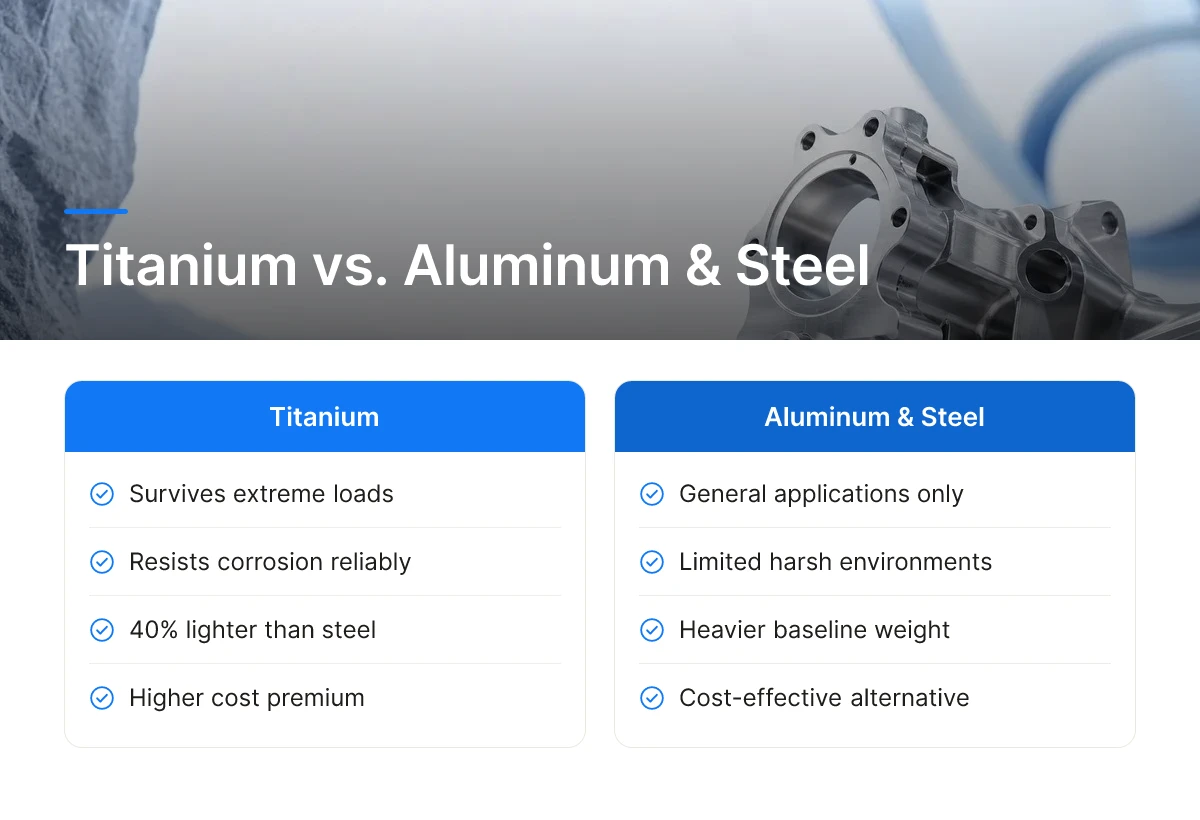
Choose titanium machined parts when a component must survive extreme loads, corrosive environments, or implantation in the human body without failing or triggering rework. For every other application, the cost premium is hard to justify against aluminum or stainless steel.
What Are the Key Advantages of Titanium That Justify the Higher Cost?
Titanium’s strength-to-weight ratio is the main reason engineers specify it in the first place. It delivers strength comparable to steel at roughly 40% less weight, which matters in any design where mass directly affects performance, like aircraft structures or rotating assemblies.
Beyond weight, titanium resists corrosion in environments that destroy other metals, including seawater, chlorides, and many industrial acids. It also holds up under cyclic loading better than most alloys, which is why it shows up in compressor blades, hydraulic system components, and other parts subject to repeated stress.
Titanium is biocompatible, meaning the body tolerates it without rejection, a property that makes it the default choice for orthopedic implants, spine hardware, cranial screws, and dental implants. It also keeps its mechanical properties at high temperatures where aluminum would soften, which explains its use in engine components and aerospace frames.
What Is the Downside of Titanium, and When Should You Consider Alternatives?
The same properties that make titanium valuable also make it expensive to cut. Low thermal conductivity concentrates heat at the cutting edge, slow cutting speeds stretch cycle times, and rapid tool wear adds consumable cost, together these drive titanium parts to cost several times more than equivalent aluminum or stainless steel components. Machining time, not raw material price, is usually the larger cost driver. Lead times stretch too, since specialized tooling, lower feed rates, and more careful fixturing all slow production.
If a part doesn’t face extreme weight limits, corrosive exposure, or biocompatibility requirements, aluminum or stainless steel will often match the needed performance for less money and a shorter schedule.
Concrete triggers for choosing titanium: a weight-critical aerospace bracket where every gram affects fuel burn, an implantable device that must sit in tissue for years, or a fastener exposed to saltwater or chemical processing. Outside those scenarios, a housing, a bracket in a dry indoor environment, a low-stress fixture, specifying titanium usually just adds cost without adding function. GC INDUS machines titanium alongside aluminum, stainless steel, and other alloys, which lets engineering teams compare material options before committing to the premium.
Why Is Titanium So Difficult and Expensive to Machine?
Titanium resists cutting because its low thermal conductivity, work-hardening tendency, and low stiffness combine to slow every stage of the machining process.
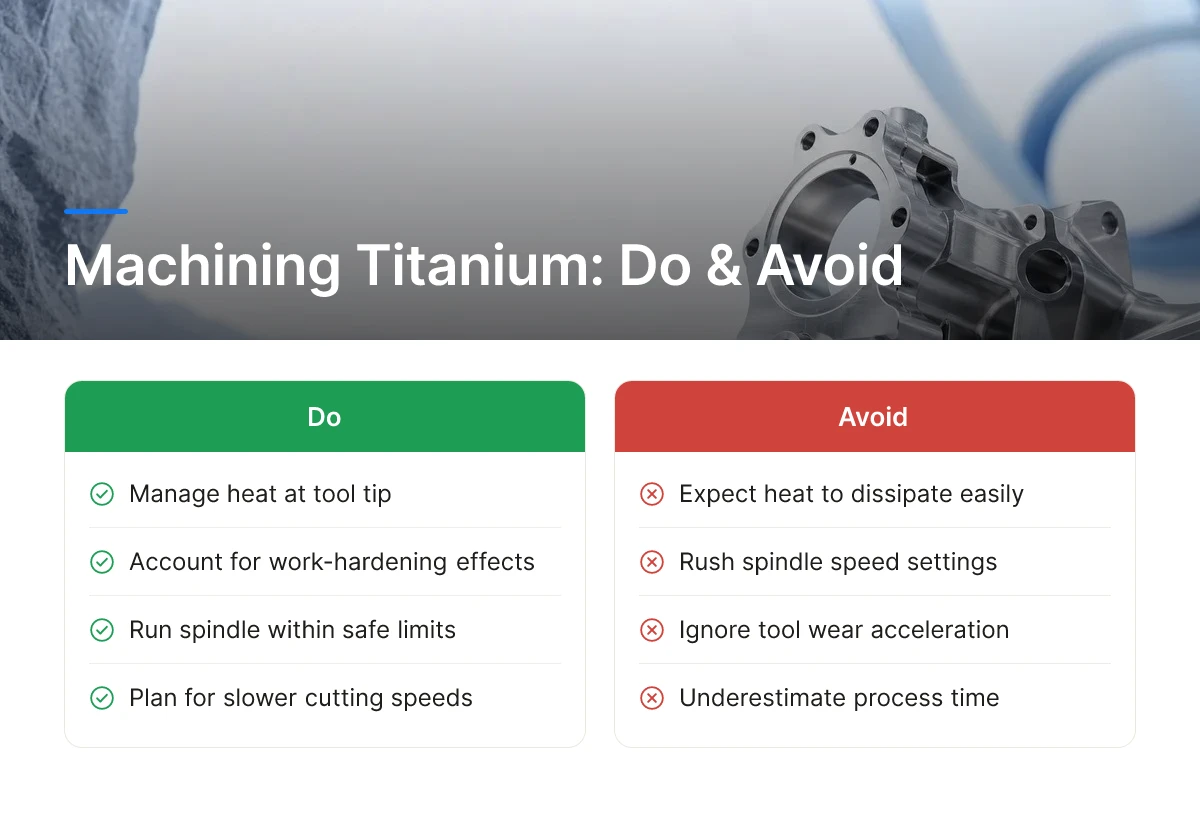
Steel and aluminum carry heat away from the cutting edge and into the chip as it forms. Titanium does not. Its thermal conductivity is roughly a seventh that of steel, so heat stays concentrated right at the tool tip instead of dissipating . That concentrated heat softens the tool’s cutting edge, accelerates wear, and limits how fast a shop can safely run the spindle without burning through inserts.
Titanium also work-hardens as it is cut. Each pass leaves the surface layer harder than before, so the next pass meets tougher material and generates even more friction and heat. This forces machinists to use lower feed rates, specialized carbide or diamond-coated tooling, and frequent tool changes to avoid chipping or premature failure . Combined with titanium’s low elastic modulus, about half that of steel, the part itself tends to flex and vibrate under cutting pressure, producing chatter marks and dimensional drift unless the setup uses rigid fixturing and conservative speeds .
Is Titanium Easily Machinable, and How Does Machinability Affect Your Project Timeline?
Titanium is not easily machinable, and that directly extends lead times beyond what a comparable aluminum or steel part would require.
Marver Med notes that titanium’s combination of strength, low thermal conductivity, and work-hardening behavior makes it one of the more demanding materials to cut on conventional CNC equipment . In practice, this means longer cycle times per part, more frequent tool changes mid-run, and tighter process controls to hold tolerance. For a buyer planning a production schedule, that translates into a longer quoted lead time for titanium machined parts than for a functionally similar aluminum component, a scheduling factor worth building into project timelines from the start, not discovering after the purchase order is placed.
How Does the Cost of Machining Titanium Compare to Steel or Aluminum?
Titanium parts routinely cost several times more than equivalent aluminum or stainless steel components, and machining time, not raw material price, is usually the larger driver .
Slower cutting speeds, shorter tool life, and the need for coolant systems capable of managing concentrated heat all add machine-hours per part . Aluminum, by contrast, cuts fast and dissipates heat readily; steel sits in between, machinable at moderate speeds with standard tooling. Titanium demands both slower feeds and premium tooling simultaneously, which is why the cost premium compounds rather than adds linearly.
How Do You Select the Right Titanium Grade for Your Application?
Grade selection comes down to matching alloy composition to the load, corrosion exposure, and regulatory environment the part will face in service. Pick the wrong grade and you either overpay for strength you don’t need or under-spec a part destined to fail an audit or a fatigue test.
What Are the Differences Between Grades Like Gr2, Gr5, and Gr23, and Which Should You Specify?
Grade 2 is commercially pure titanium, no major alloying elements, which makes it more machinable than the alloyed grades and gives it strong corrosion resistance in harsh chemical and marine environments. It’s a common starting point for tanks, piping, and fasteners that need corrosion resistance more than peak strength.
Grade 5 (Ti-6Al-4V) is the aluminum-vanadium alloy that dominates aerospace and defense work. Adding aluminum and vanadium increases strength substantially over Grade 2, at the cost of slower cutting speeds and faster tool wear during machining. It’s the benchmark alloy engineers mean when they say “aerospace-grade titanium.”
Grade 23 is the extra-low-interstitial (ELI) version of the same 6Al-4V chemistry, with tighter control over oxygen, iron, and other interstitial elements. That lower interstitial content improves fracture toughness and ductility, which is why Grade 23 is the standard choice for implantable medical devices. The tradeoff is a tighter, more expensive supply chain, mills certify ELI bar stock to stricter chemistry and testing requirements than standard Grade 5.
How Do Material Properties and Alloy Composition Impact Part Performance in Aerospace, Medical, or Defense Applications?
Alloy composition governs the tradeoff between strength, ductility, and fatigue life, the properties that decide whether a part survives millions of load cycles or cracks early. Commercially pure Grade 2 flexes more and resists cracking from corrosion, which suits static or low-stress hardware like marine fittings and chemical processing components. Alloyed Grade 5 trades some ductility for higher strength and stiffness, matching the structural demands of aircraft brackets, fasteners, and engine components. Grade 23’s reduced interstitial content lowers the risk of brittle fracture inside the body, where a failed implant isn’t a warranty claim, it’s a second surgery.
Industries sort themselves along these lines fairly predictably: Grade 2 for chemical processing and marine hardware, Grade 5 for aerospace structural parts, Grade 23 for implantable medical devices. None of these grades are interchangeable once you factor in certification requirements and service environment.
Confirm grade availability and machinability with your manufacturing partner before the design is locked. GC INDUS works with engineering teams early in the process to verify which titanium grade fits both the application and the production timeline, so the material spec on the drawing matches what’s actually buildable as titanium machined parts at the tolerances the project needs.
What Quality Standards and Certifications Matter for Machined Titanium Parts?
The certification a titanium part needs depends on where it ends up: aerospace calls for AS9100, medical devices call for ISO 13485 and FDA pathways, and everything else runs on ISO 9001 as the baseline. Because titanium shows up almost exclusively in applications where failure carries real consequences, the paperwork behind titanium machined parts tends to be more demanding than for a general-purpose aluminum bracket.
What Compliance Certifications Do You Need for Your Industry?
ISO 9001 is the floor, it establishes a documented quality management system and should be a non-negotiable from any supplier, regardless of material. Aerospace buyers add AS9100, which layers in requirements around risk management, configuration control, and first-article inspection that matter when a compressor blade or airframe fitting is titanium for a reason, not a preference.
Medical device programs follow a different path: ISO 13485 governs the quality system, while FDA clearance or approval governs the device itself. Titanium’s biocompatibility makes it a default choice for implantable devices, so suppliers working in orthopedic, spine, and dental implants need a quality system built around traceability and risk files, not just tight tolerances. GC INDUS holds both ISO 9001 and ISO 13485, which lets the same production floor handle an industrial titanium bracket and a surgical instrument component without switching vendors mid-program.
How Do Quality Assurance Processes Differ When Machining Titanium Versus Other Materials?
Titanium adds inspection burdens that aluminum and steel jobs rarely require. Material traceability starts at the mill: certified mill certs confirm chemical composition and mechanical properties for the specific grade and lot, which matters because titanium alloys like Ti-6Al-4V and its medical-grade variant behave differently depending on processing history.
Microstructure consistency is also worth checking on critical parts, since heat treatment and prior machining can alter grain structure in ways that affect fatigue life. Dimensional verification deserves extra attention too, titanium’s low stiffness relative to its strength means thin-walled or long, slender features can deflect under cutting force, and a part can measure out of tolerance even when the program ran correctly. Full inspection protocols, including first-article and in-process checks, catch this before parts ship.
Finally, a certificate of conformance ties the finished part back to its material certification, confirming the grade actually supplied matches the print. For safety-critical titanium machined parts, that paper trail is often as important to the customer as the part itself.
What Should You Expect for Titanium Machined Parts Cost, Lead Time, and Minimum Orders?
Expect titanium machined parts to cost more than aluminum or steel equivalents, with slower lead times driven by cutting speed and tool wear, not just order volume.
Budgeting for titanium starts with the material itself and compounds from there. Cutting speed, tool selection, and inspection all add time and cost that a quote should spell out clearly before a job starts.
How Does the Cost of Raw Titanium Affect Your Part Pricing?
Raw titanium costs considerably more per pound than aluminum or steel, and that gap shows up directly in the price of a finished part. This isn’t a markup GC INDUS or any shop applies arbitrarily, it reflects the cost of extracting and refining the metal itself.
The premium doesn’t stop at the material invoice. Titanium’s poor thermal conductivity and tendency to work-harden during cutting mean machining time often outweighs raw material cost as the bigger driver of final price. A part that looks simple on a drawing can still take considerably longer to cut in titanium than the same geometry in steel, and that time gets billed.
Engineers choosing titanium for strength-to-weight ratio or corrosion resistance should plan the budget around both line items, material and cycle time, rather than assuming the sticker price for titanium is just a flat multiple of other metals.
What Are Typical Tooling Costs and Minimum Order Quantities for Custom Titanium Machining?
Tooling costs run higher with titanium because the metal demands specialized carbide or coated cutting tools that wear out faster than tools used on softer materials. Shops either absorb that wear into their rates or pass it through as a line item, and tool changes also add non-cutting time to every job.
Flexible minimum order quantities help offset this risk during prototyping. GC INDUS accepts orders starting from a single piece, which lets engineering teams validate a titanium design before committing to a full production run and the tooling investment that comes with it.
Lead time depends on more than batch size. Slower cutting speeds, planned tool changes, and the inspection protocols needed to confirm tight tolerances all add days that a rush order can’t simply buy away.
Before requesting a quote, finalize drawings and specify the titanium grade, Grade 5 (Ti-6Al-4V) behaves differently on a machine than commercially pure titanium, and geometry or tolerance complexity can move cost as much as the material choice itself.
Frequently Asked Questions
Can titanium parts be machined to tight tolerances like aluminum or steel parts?
Yes, titanium holds tolerances comparable to aluminum and steel, including down to ±0.001mm with the right equipment and process control. The difference is cycle time: titanium’s low thermal conductivity and work-hardening tendency mean slower feeds, more tool changes, and tighter in-process inspection to hold those tolerances consistently across a production run.
What surface finishing options work best for titanium machined parts?
Anodizing, passivation, and bead blasting are the most common finishes for machined titanium parts. Anodizing builds a protective oxide layer and can add color coding for part identification, while passivation improves corrosion resistance for medical and aerospace applications. Finish choice depends on whether the part needs biocompatibility, wear resistance, or cosmetic uniformity.
Do titanium parts require special coatings or post-processing for corrosion resistance?
No, titanium forms a natural oxide layer that resists corrosion without coatings in most environments. Some applications still specify passivation or anodizing to reinforce that layer, particularly for implants or parts exposed to aggressive chemicals, but it’s a performance enhancement rather than a requirement.
How do you verify a supplier can actually machine titanium reliably?
Ask for material certifications, inspection reports, and evidence of ISO 9001 or ISO 13485 compliance on past titanium jobs. Request a sample part or first-article inspection before committing to full volume. GC INDUS, for example, backs titanium work with full inspection protocols and medical-grade ISO 13485 certification, so clients can verify quality before scaling orders.
Is titanium a good choice for low-volume prototype runs?
Yes, especially when the prototype needs to match production material properties exactly. The main tradeoff is cost per part, since titanium’s machining time and tool wear don’t improve much at low volumes, flexible MOQs from 1 piece help absorb that without inflating minimum order costs.
Conclusion
Titanium earns its cost premium when strength-to-weight ratio, corrosion resistance, or biocompatibility directly affect how a part performs, not as a default upgrade from aluminum or steel. Before specifying it, confirm the application actually demands those properties, and get a supplier to quote both titanium and a lower-cost alternative side by side so the tradeoff is visible in real numbers. GC INDUS runs that comparison routinely, holding ±0.001mm tolerances across materials with ISO 9001 and ISO 13485 certification. The next step: send your drawing in for a quote on both material options before finalizing the spec.
Recommended Articles
Explore more from our content library:


